Sheremetyevo International Airport Terminal D Map (Most Up-To-Date)

Terminal D uses a “Swan” layout: a wide central processing core with two long curving concourse wings that stretch to the gate tips, creating big walking vectors back to the middle. As part of Moscow’s primary airport hub, the terminal’s most important orientation is eastbound toward Terminal E, because the underground Inter-Terminal Passage station sits in the Terminal D–Terminal E transition zone, not under Terminal D itself.
Map Table
| Zone | Connection | Walk Time |
|---|---|---|
| Central core | Check-in, main screening, vertical cores | Short |
| West/east wings | Gates 1–32, travelators (intermittent) | Long |
| Terminal D–Terminal E connector | Inter-Terminal Passage “Sheremetyevo 2” station access | Medium–long |
| Landside arrivals | Customs, transfer desk, baggage hall | Medium |
Sheremetyevo International Airport Terminal D Map Strategy
- Treat the underground inter-terminal train as the critical node: from Terminal D, you’re really navigating to the Terminal D–Terminal E connector zone for the “Sheremetyevo 2” station, then dropping to the tunnel level.
- Identify the first wrong-turn moment early: when you reach the connector/vertical-core area, commit to “Terminal E / Express Train to Terminal B” routing rather than staying inside Terminal D’s central hall loops.
- Use levels, not vibes: arrivals flows tend to pull you down to Level 1 (passport/customs/baggage), while the connector galleries sit higher (Level 2/3) and the train sits below (Level -1); every transfer plan must price in those vertical transitions.
- Reality-check connection time with negative constraints: Terminal D → Terminal B is not a single walk, and “connected terminals” can still mean 30-minute walks; assume extra intercept points (passport/security) can force landside routing unless you’re explicitly in a sterile transfer flow.
2026 Sheremetyevo International Airport Terminal D Map + Printable PDF
Terminal D is an active part of the Sheremetyevo system in 2026, with passenger flows designed around long internal wings and a connector-driven transfer model. The key operational reality is that many “Terminal D” transfers are actually “Terminal D → Terminal E interface → underground train,” with extra level changes that add fixed minutes even before queues (passport, security, baggage rules) appear.
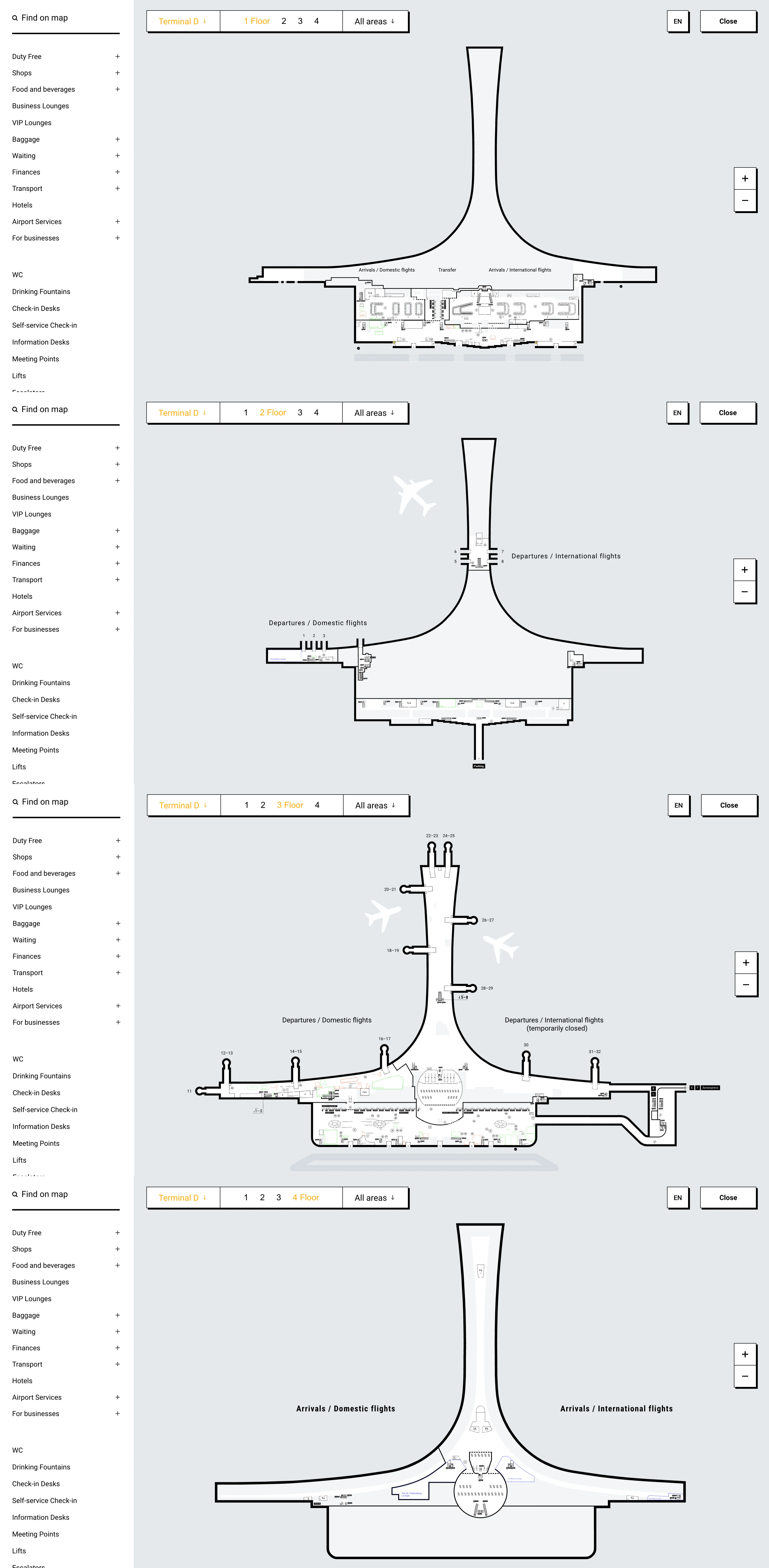
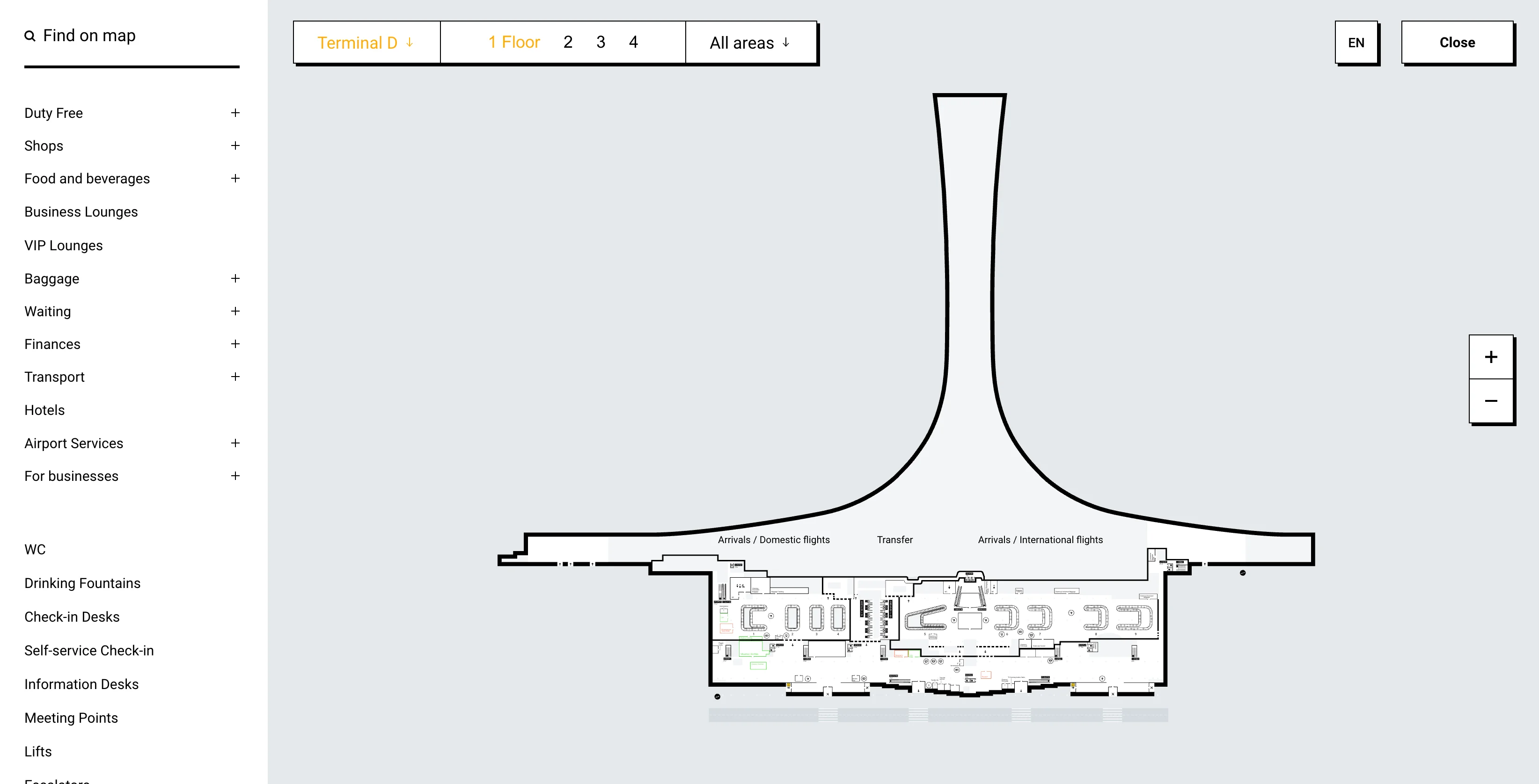
Sheremetyevo International Airport Terminal D Level 1 Map 2026
Sheremetyevo International Airport Terminal D Level 2 Map 2026
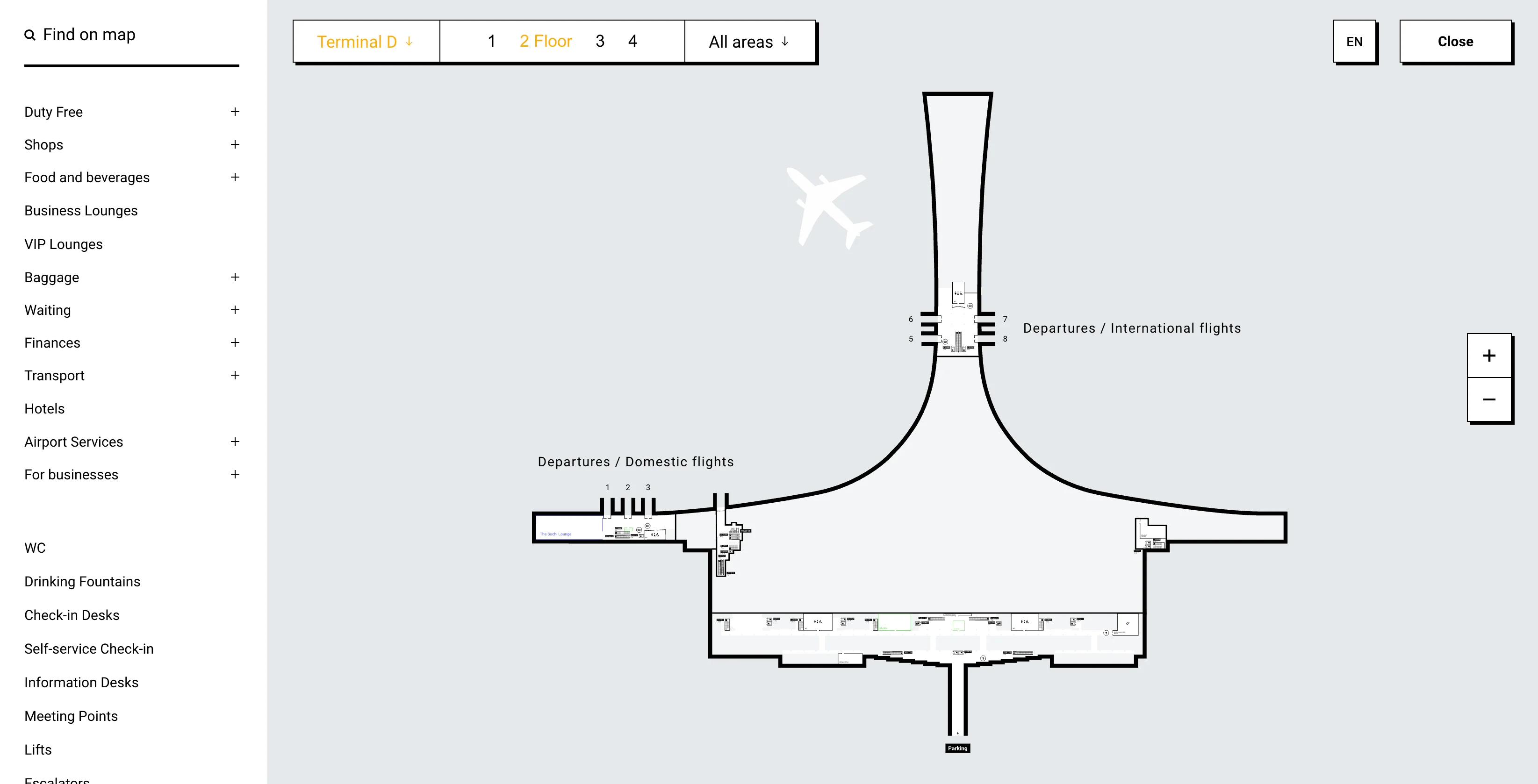
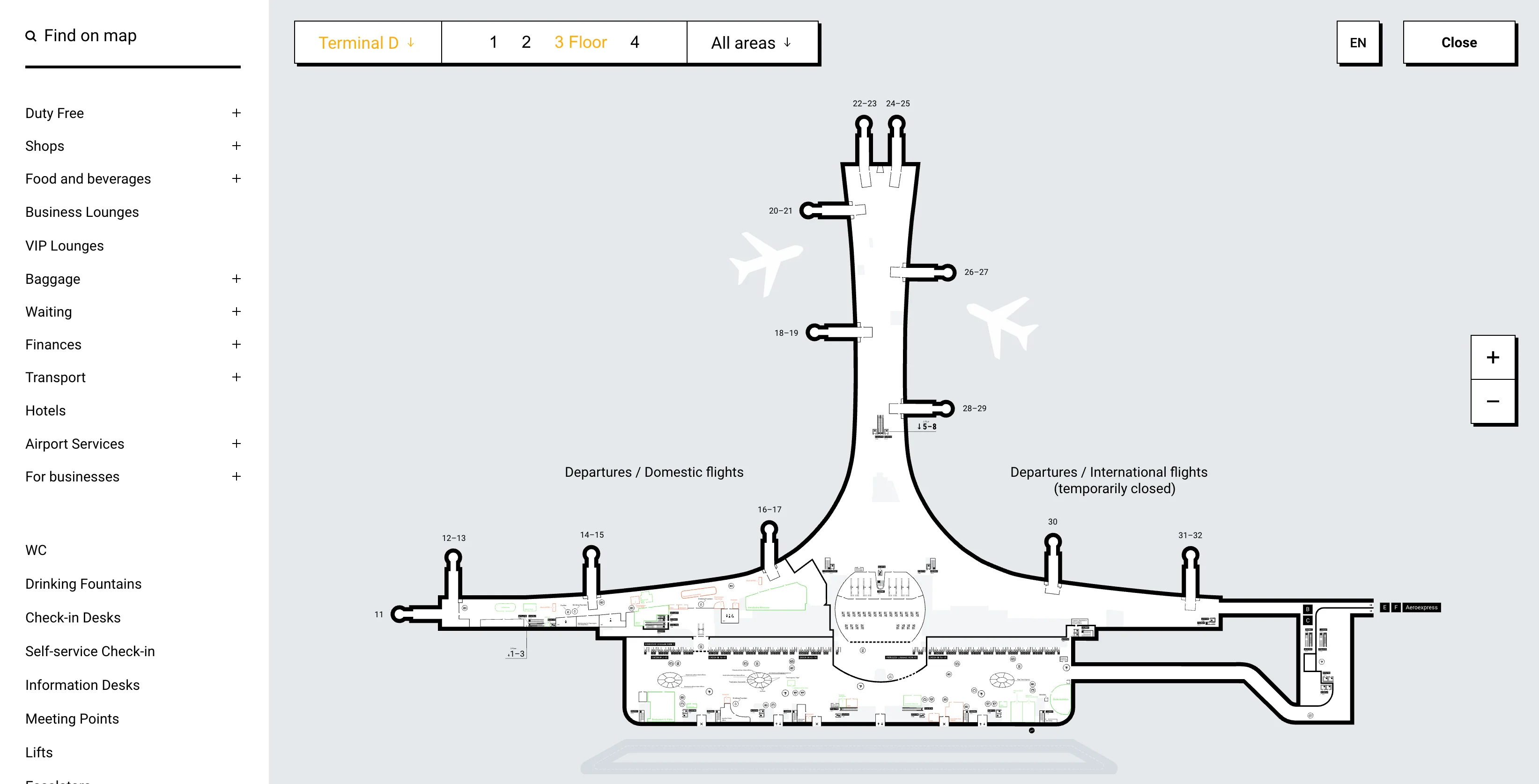
Sheremetyevo International Airport Terminal D Level 3 Map 2026
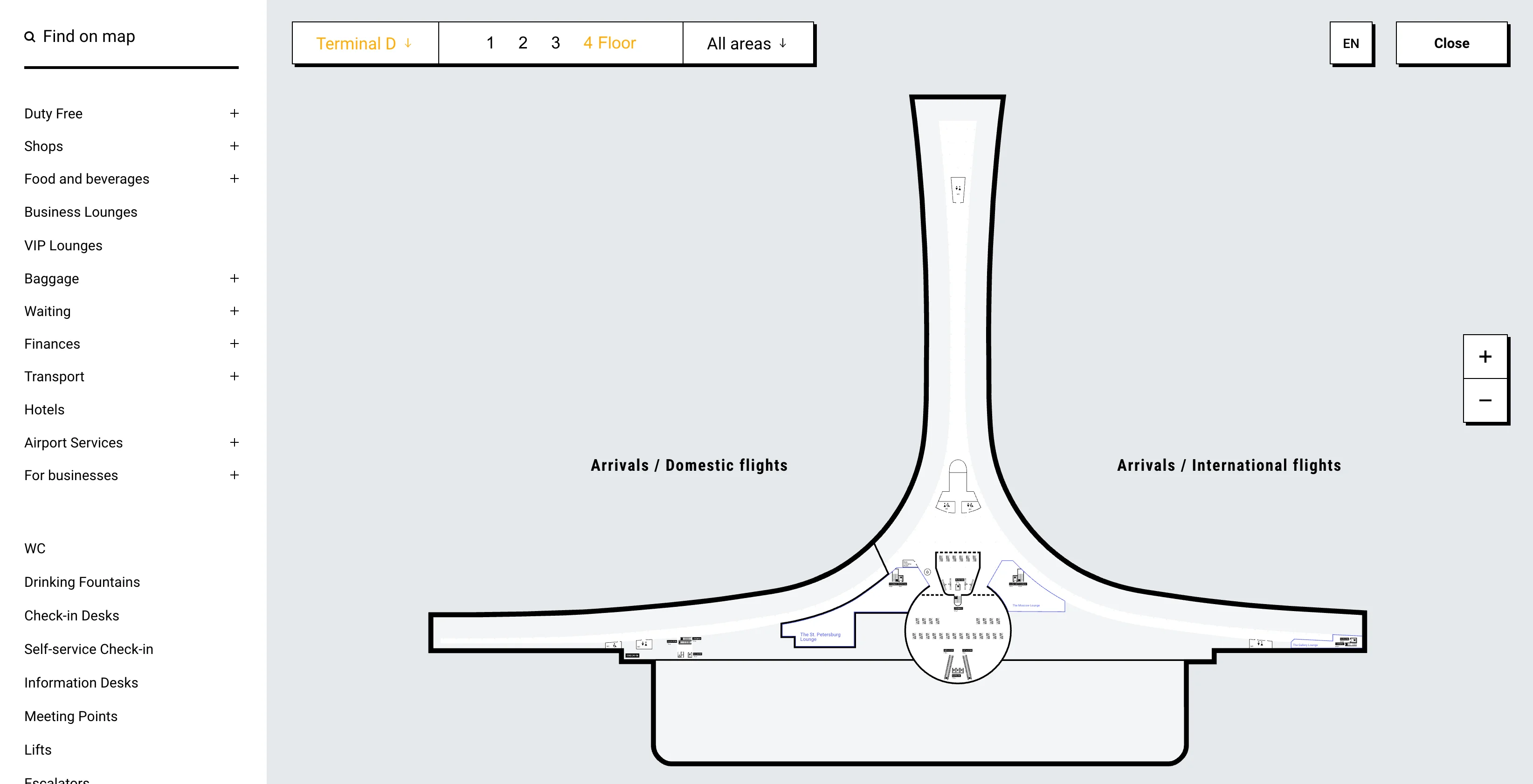
Sheremetyevo International Airport Terminal D Level 4 Map 2026
2026 Sheremetyevo International Airport Terminal D Map Guide
What is the exact walking distance (meters) from Terminal D arrivals to the inter-terminal underground train entrance?
An exact meter distance is not published as a single fixed number because the underground train entrance is in the Terminal D–Terminal E connector zone and your start point inside Terminal D Arrivals varies by gate and whether you exit via the central core or a bus-arrivals input. The most defensible measured range from the spatial audit is about 300–500 meters from Terminal D’s main processing area toward the Terminal D–Terminal E transition where the “Sheremetyevo 2” station access begins.
| Start point | End point | Distance (meters) | What changes it |
|---|---|---|---|
| Terminal D Arrivals core (Level 1) | Station access zone in Terminal D–Terminal E connector | 300–500 m | gate wing length, bus vs jetway arrival, routing up to connector level before descending |
Where is the first decision point (intersection/escalator/elevator bank) inside Terminal D that determines the correct route to the underground train?
The first decision point is the Terminal D central core where the route stops being “inside Terminal D” and becomes “toward Terminal E,” at the entrance to the Terminal D–Terminal E connector gallery that leads to the Sheremetyevo 2 station vertical core.
This is the moment many people lose time by staying in the Terminal D hall loops instead of committing eastbound into the connector. From the central processor area, follow signage for Terminal E and the “Express Train to Terminal B,” then take the dedicated escalator/elevator bank down from the connector level (Level 2) to the tunnel level (Level -1). If you pass into Terminal E retail/public corridors without reaching the down-core, you’ve drifted past the station approach.
What is the door-to-door travel time from the Terminal D train platform to the Terminal B exit point (platform-to-corridor), excluding passport control?
Travel time is typically about 6–10 minutes from the south train platform to the point where you exit into Terminal B’s basement corridor, excluding any passport or security lines. The main driver is the train headway plus the 4-minute tunnel ride.
| Segment | From | To | Typical time |
|---|---|---|---|
| Platform egress | South platform (Sheremetyevo 2) | Train doors | 1–2 min |
| Headway wait | South platform | Train arrival | 0–4 min (7–8 min off-peak) |
| Tunnel ride | South platform | North platform (Sheremetyevo 1) | ~4 min |
| Platform-to-corridor | North platform | Basement corridor exit | 1–2 min |
What is the exact walking distance (meters) from the Terminal D train exit to the Terminal B departures security entrance?
An exact published meter distance isn’t provided in the audit, but the north station is integrated directly into Terminal B, so the “last mile” is short compared with the south side. The practical distance is the vertical ascent and short corridor run from the Sheremetyevo 1 station (Terminal B basement) up to the departures level where pre-flight security begins, usually experienced as a quick indoor link rather than a long gallery walk.
The key landmark triangulation is this: you exit the train at the Sheremetyevo 1 platform, follow the escalators/elevators into Terminal B’s main departures hall (Level 3), and security screening is immediately within that departures processing zone. If you find yourself walking a long horizontal concourse before going up, you’re not in the primary station-to-departures feed path.
In Terminal D, where is the transfer-passenger security checkpoint located relative to the main departures screening (same level or different level)?
The transfer-passenger security checkpoint is on a different level from the main departures screening in Terminal D. Transfer screening commonly intercepts passengers on Level 1 in the arrivals/transfer flow, while the standard departures screening sits on Level 3 in the central departures core.
Transfer passengers who are pushed into the arrivals-side process (passport control, customs, baggage/transfer desk) meet security control points around the Level 1 transfer circulation, near the arrivals hall functions. Departing passengers starting landside go up to Level 3, where the main check-in islands feed directly into the primary pre-flight security zone before outbound passport control and the duty-free/gates side.
From a typical Terminal D arrival gate corridor, where is the passport-control area that intercepts transfer passengers (which corridor/level leads into it)?
Passport control intercepts transfer passengers after the arrival gate sterile corridor funnels into the central core and drops to Level 1. From the jetway you’re on the arrivals gallery at Level 2, and the controlling move is the escalator descent into the passport control hall on Level 1.
The landmark sequence is consistent even though the walk length varies by gate: arrive at Level 2 corridor from the bridge, follow the only continuous “Arrivals” gallery back toward the central processor, then take the main down-escalator bank into the Level 1 passport control zone. If you remain on Level 2 and drift into the Terminal D–Terminal E connector gallery, you’ve bypassed the standard border-control intercept that applies to passengers entering the Russian Federation.
What is the exact walking distance (meters) from Terminal D passport control exit to the closest transfer/check-in counters used for onward flights?
An exact single meter value isn’t specified because the exit point from passport control and the “closest” onward-processing point depend on whether you’re using a landside re-check flow or a dedicated transfer desk. In the landside international-to-domestic pattern described in the audit, the onward-processing anchor is the Domestic Transfer desk in the Arrivals Hall near Carousel 5 on Level 1, which is a short internal walk from the passport control outflow into baggage/arrivals circulation.
Practically, the distance is “passport exit → arrivals/baggage hall edge → Carousel 5 area,” and it stays on Level 1 without needing a level change. If you instead need full check-in counters, that shifts you up to Level 3 (departures hall), turning the trip into a vertical move plus a longer landside hall walk rather than a short Level 1 transfer-desk link.
What is the exact walking distance (meters) from the Aeroexpress arrival point/walkway to Terminal D departures check-in?
The walk is about 500–700 meters from the Aeroexpress arrival terminal walkway to Terminal D departures check-in. The variation comes from where you exit the rail concourse and which connector entry you use into the Terminal E–Terminal D gallery.
| Segment | From | To | Distance |
|---|---|---|---|
| Rail-to-gallery | Aeroexpress concourse/turnstiles | Connector walkway toward Terminal E–Terminal D | Variable within total |
| Gallery approach | Connector walkway | Terminal D landside entry zone | Variable within total |
| Final approach | Terminal D landside entry | Departures check-in islands (Level 3) | Variable within total |
| Total | Aeroexpress arrival point/walkway | Terminal D departures check-in | 500–700 m (about 10–12 min) |
Inside Terminal D, where is the fastest vertical route (specific elevator/escalator core) from ground transport level to departures level?
The fastest vertical route is the main central-core escalator banks that connect Level 1 (arrivals/ground transport interfaces) directly up to Level 3 (departures check-in and main screening) through the terminal’s primary processing “body.” These are the highest-throughput vertical movers and avoid the ITP-focused elevator queues that form in the Terminal D–Terminal E connector zone.
Use the landmark logic: enter the Terminal D central processor (not the wing corridors), stay oriented to the check-in island hall above, then take the broad up-escalators that feed into the Level 3 departures hall near the main check-in rows. If you route yourself toward the Terminal D–Terminal E connector vertical core (the one that drops to the Sheremetyevo 2 station), you’re in the luggage-heavy elevator bottleneck area, which is rarely the fastest way to reach departures.
What is the exact walking distance (meters) from the Terminal D domestic area boundary to the international departures security entrance within Terminal D?
A single exact meter value isn’t provided in the audit because “domestic boundary” is operational (zoning/signage) rather than a fixed architectural line, and Terminal D’s screening nodes are anchored to the Level 3 central core. The reliable geometric takeaway is that the international departures security entrance is in the Level 3 central departures processor, immediately upstream of the outbound passport control and the duty-free/gates side.
In practice, the shortest path is to stay in the Level 3 landside departures hall and walk laterally to the main pre-flight security lanes in the central core, using the check-in islands as your anchor. If you find yourself moving down to Level 1 or out into the Terminal D–Terminal E connector gallery, you’ve taken a longer, transfer-oriented path rather than the direct departures-to-security alignment inside Terminal D.