Sheremetyevo International Airport Map (Most Up-To-Date)

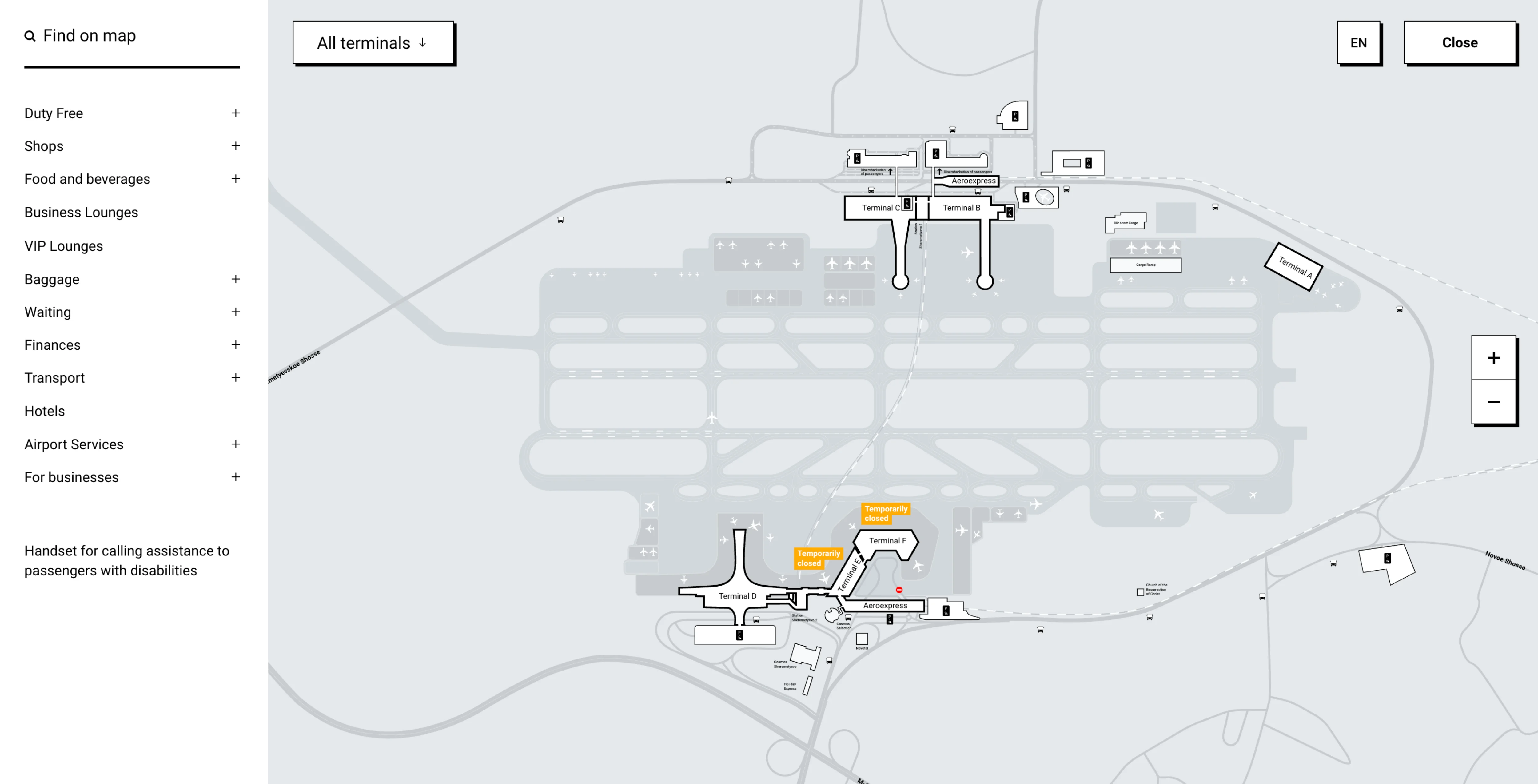
Sheremetyevo International Airport (SVO) functions like two airports separated by runways: the South Complex (Terminals D/E/F) and the North Complex (Terminals B/C). The footprint is wide and linear, with the key orientation being South ↔ North via the underground inter-terminal train. Most navigation success at the main Moscow air hub comes from treating the train stations (Sheremetyevo 2 in the south, Sheremetyevo 1 in the north) as your true “center points,” not the terminal curb.
Map Table
| Terminal | Key Airlines | Primary Function | Transfer Mode |
|---|---|---|---|
| Terminal B | Aeroflot | Domestic hub | Underground train, internal B/C link |
| Terminal C | Aeroflot | International hub | Internal B/C link, underground train |
| Terminal D | Pobeda, Smartavia | Low-cost, long piers | Underground train via D/E saddle |
| Terminal E | Mixed, rail interface | Connector, Aeroexpress access | Gallery to D, rail concourse |
| Terminal F | — | Closed, refurbishment | No passenger operations |
Sheremetyevo International Airport Map Strategy
- Treat North (B/C) and South (D/E) as separate campuses: confirm the terminal letter before you move, because fixing a wrong-terminal drop-off costs a full transfer.
- Go to the underground train by targeting the station name first (Sheremetyevo 2 for D/E, Sheremetyevo 1 for B/C), then the terminal—this prevents “endless gallery walking” errors.
- Protect sterile status: if you accidentally exit to landside while hunting the train, you trigger extra security and lose the time buffer you thought you had.
- Budget for hidden distance: long piers in Terminal D and vertical climbs in Terminal B are the connection killers, especially when re-screening queues spike.
2026 Sheremetyevo International Airport Map + Printable PDF
Terminal D remains active for key flows, Terminal F stays closed for refurbishment, and SVO’s north/south split is still bridged by the underground inter-terminal train with segregated landside vs airside cars. The operational “gotchas” are unchanged: deep station access, vertical climbs inside Terminal B, and re-screening choke points near the south station that can turn a normal walk into a sudden time spike.
2026 Sheremetyevo International Airport Guide
What is the exact walking distance (meters) from Terminal D arrivals to the inter-terminal underground train entrance in the south complex?
Walking distance is ~550–700 meters from Terminal D Arrivals (Level 1) to the Sheremetyevo 2 inter-terminal train entrance near the D/E border. The spread comes from where you start in Arrivals and which internal path you take to reach the Level 3 gallery and the station descent.
Use the “D–E connecting gallery” as your anchor: from the Arrivals hall exit, go to the lifts/escalators up to Level 3, then follow the enclosed gallery east toward Terminal E until the Sheremetyevo 2 station entrance and escalators/elevators down to the platform zone. If you’re coming off a far D-gate pier, add the long pier walk before you even reach Arrivals.
What is the exact walking distance (meters) from the inter-terminal train exit in Terminal B to the Terminal B international departures security entrance?
Walking distance is ~350–450 meters from the Sheremetyevo 1 train station exit (Terminal B basement/Level 1) to the Terminal B departures security entrance (Level 3). The time cost is disproportionately high because the route is dominated by vertical ascent and escalator-bank choke points.
| Segment | Landmark anchor | Distance |
|---|---|---|
| Station concourse → main escalator bank | Sheremetyevo 1 hall → central atrium escalators | ~100 m |
| Level 1 → Level 3 ascent | escalator/elevator banks in the atrium | vertical (2 levels) |
| Level 3 landing → security entrance | departures hall corridor to pre-flight screening | ~200 m |
| Typical total | train exit → departures security | ~350–450 m |
Where is the first decision point (exact corridor/turn) where passengers choose between walking vs the inter-terminal train when moving D/E/F ↔ B?
The first decision point is the Arrivals Hall exit corridor at Terminal D’s customs/exit channels, where signage splits you toward the city exit versus the vertical access up to the inter-terminal transfer gallery. That fork is where people mistakenly stay on the straight “Exit” line and drift away from the transfer path.
From the red/green channel exit into the public Arrivals zone (Level 1), look for the sign cluster that includes “Terminal B/C Transfer” alongside “Aeroexpress” and “Terminal E.” The train-bound move is the turn toward the elevators/escalators up to Level 3; the wrong move is continuing straight on the “Exit to City” corridor, which pulls you away from the D–E saddle where the Sheremetyevo 2 station entrance sits.
What is the shortest physical route from Terminal E to Terminal D (exact corridor sequence), assuming both are accessible airside?
The shortest route is the Level 3 connecting gallery that runs directly between Terminal E and Terminal D. This is the straight, climate-controlled connector that functions as the main crosswalk between the two south terminals.
From Terminal E, go to Level 3 and enter the signed pedestrian gallery toward Terminal D (the same corridor used by rail passengers leaving the Aeroexpress concourse). Stay in the main gallery—do not drop to Arrivals—until you reach the Terminal D side, then continue into the central Terminal D processing zone (check-in/security core) before branching into the D gate piers. Travelators often line this connector; if they’re offline, the same route remains shortest, just slower.
Where exactly is the transfer security re-screening checkpoint located for international-to-international connections inside the south terminal complex?
The transfer re-screening checkpoint is at the Sheremetyevo 2 station airside entrance near the Terminal D/Terminal E border. This is the controlled gateway into the sterile airside inter-terminal train cars (the airside-designated section), so it sits immediately before the descent/escalators into the station’s airside platform access.
Use the D–E “saddle” as your anchor point: you reach it via the Level 3 connecting gallery between Terminals D and E, then follow signs for inter-terminal transfer that funnel into a constrained queue area. If you find yourself in the public Arrivals hall or street-facing entrance screening, you are no longer on the airside path and will be routed into the landside train flow instead.
What is the exact distance from the transfer re-screening checkpoint to the furthest D-gates (end-of-pier) that commonly cause “long run” complaints?
Walking distance is ~800–900 meters from the Sheremetyevo 2 transfer re-screening checkpoint (near the D/E border) to the furthest end-of-pier gates in Terminal D (commonly cited around the far D-gate tips). This is the segment that creates the “I cleared security and still had a kilometer to go” effect.
The route is essentially one long push: exit re-screening into Terminal D’s interior circulation, continue toward the central rotunda/core, then follow the curved boarding pier all the way to the end gate cluster. The distance balloons because the pier geometry is long and arcing; even when the corridor is straightforward, crowding and duty-free pinch points can turn the same 800–900 meters into a 15+ minute walk with luggage.
What is the shortest route from the Aeroexpress rail platform/terminus to Terminal D check-in rows (distance + which level)?
Walking distance is ~700 meters from the Aeroexpress terminus in Terminal E to the Terminal D check-in hall, primarily via Level 3. This is the fastest indoor path because it uses the straight connecting gallery rather than dropping to Arrivals and re-climbing.
From the Aeroexpress concourse in Terminal E, go up to Level 3 (gallery level) and follow the signed connector toward Terminal D through the enclosed pedestrian gallery. Stay on the gallery until you enter Terminal D’s central processing zone, then descend/align into the main check-in row area in the Terminal D hall. If travelators are out of service, the same Level 3 corridor remains the shortest route, but the walk feels significantly longer with bags.
Where is the closest curbside drop-off point to Terminal B departures, and what is the indoor walking distance from that door to the check-in hall?
The closest curbside drop-off is the Terminal B Departures curb on Level 3, with an indoor walk of ~50 meters from the nearest departures doors to the check-in hall. This is the shortest “car to counters” path because it drops you onto the same level as the main departures processing zone.
Use the Level 3 departures entrance doors as your anchor: get out at the departures curb, enter immediately through the nearest doors into the departures hall, and the check-in rows begin essentially straight ahead within a short, open interior span. If you’re dropped at an arrivals-level curb instead, you’ll pay the vertical drag—escalators/elevators up to Level 3—before you even start that ~50-meter indoor segment.
Where exactly are the airport bus stops that serve each terminal (B vs D/E/F), and what is the walking distance from each stop to the nearest terminal entrance?
The main bus stops are curbside at the terminal roadways, with typical walks of ~150 meters from stop to entrance depending on which curb you land on. Terminal B/C is served directly by the north-side stop area; Terminal D is served at the south-side curb, and Terminal E is reached by walking through the D–E landside connectors (Terminal F is closed and not a practical bus target).
- Bus 1195: Khovrino Metro → Terminal B/C curbside stop area; ~150 m to the nearest Terminal B entrance.
- Bus 1195D: Khovrino Metro → Terminal D departures curb (Level 3); short curb-to-door walk (typically under ~150 m).
- Public routes 851/817: stop at terminal roadway zones used for Terminal B and Terminal D arrivals-side access (Level 1); ~150 m to the nearest entrance, plus vertical movement if you need departures/check-in.
What is the shortest landside path from Terminal D arrivals to the Terminal B check-in hall using the inter-terminal train (exact sequence of levels/entrances)?
A landside D→B transfer requires leaving Terminal D Arrivals, climbing to the Level 3 gallery to reach Sheremetyevo 2 station access, riding the landside train cars, then climbing inside Terminal B to the Level 3 check-in hall. This sequence is the most reliable “do exactly these moves” path because it aligns with how the stations are actually embedded under the terminals.
| Step | Exact sequence | Landmark anchor |
|---|---|---|
| 1 | Terminal D Arrivals hall (Level 1) → follow transfer signs to elevators/escalators | Arrivals exit zone |
| 2 | Up to Level 3 → enter D–E connecting gallery eastbound | Level 3 gallery |
| 3 | Continue to Sheremetyevo 2 station entrance near D/E border → descend to platform | station descent |
| 4 | Board landside-designated train cars → ride to Sheremetyevo 1 (North) | train platform |
| 5 | Exit at Terminal B basement/Level 1 → walk to main escalator bank | station concourse |
| 6 | Ascend to Level 3 Departures → walk into check-in hall | departures hall entry |
Where is the baggage services / transfer-baggage help point located in Terminal D for passengers whose checked bag didn’t make a tight connection?
The baggage services help point is in Terminal D’s Arrivals hall on Level 1, at the Lost & Found desk adjacent to the baggage claim area. This is the first and most direct place to report a missing bag for a tight-connection misconnect because it sits where claim issues are processed.
After you enter the Arrivals zone, stay in the baggage reclaim side rather than walking into the landside gallery toward Terminal E. Look for the Lost & Found/irregular baggage desk positioned near the claim belts and the flow of passengers exiting baggage claim. If you’ve already left the reclaim area, you typically have to backtrack to Level 1 Arrivals to access the desk and file the report.
If Terminal D is the only south terminal operational for certain flows, what is the exact indoor route from the arrivals hall to the domestic side/gate piers inside Terminal D?
The indoor route is Arrivals (Level 1) to Departures (Level 3), then through the main security checkpoint into the Terminal D gate piers. This is the standard “back to sterile” movement inside D when you’re starting from the public arrivals side and need to reach domestic gate corridors.
From the Terminal D Arrivals hall on Level 1, locate the central elevator/escalator cores that feed the main departures processing level. Go up to Level 3 and enter the departures hall aligned with the check-in and central rotunda zone, then follow signs to the security entrance that controls access to the sterile departures area. After clearing security, continue forward into the concourse and follow the curved pier corridor to your domestic gate section; the piers extend far, so the walk after security can still be substantial.