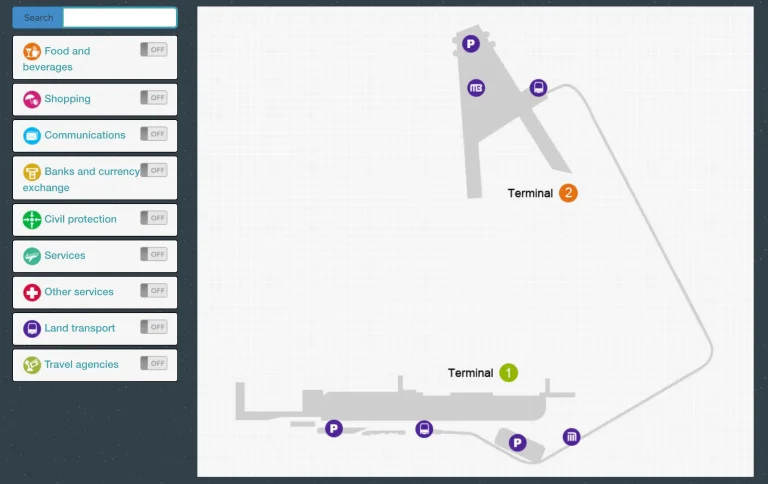
Ninoy Aquino International Airport Terminal 2 Map (Most Up-To-Date)

Ninoy Aquino International Airport Terminal 2 is a compact, V-shaped (“arrowhead”) terminal built around a central rotunda that splits into two long wings (North and South). Arrivals runs along one linear curb with numbered bays, while Departures sits above with a central security node that fans out to the gate wings. Within Manila’s main airport hub, most time-loss comes from choosing the wrong curb direction or committing to the wrong wing and having to backtrack.
Map Table
| Level | Core Layout | Key Zones | Transfer Mode |
|---|---|---|---|
| Ground (Arrivals) | linear curb, numbered bays | baggage claim, exit doors, Bay 1–28 | curbside walk, external ramps |
| Level 2 (Departures) | central security splitter, two wings | rotunda, Gates 1–15, Gates 16–20 | long corridor walk, limited moving walkways |
| Wings | dead-end tips | Gate 1 area, Gate 20 area | distance-heavy walks |
Ninoy Aquino International Airport Terminal 2 Map Strategy
- Treat Arrivals as a bay-number navigation problem: decide your transport first, then walk directly to the correct bay to avoid a 100–180 m backtrack through congestion.
- Use the map to “pin” decision nodes (Arrivals exit doors, Bay 11/14 taxi lines, Bay 19 shuttle zone, Bay 1 Grab pickup) so you don’t get pulled into the wrong queue by crowd flow.
- After security, stop at the central rotunda/FIDS node, confirm gate and wing, then commit—wing-switching later forces a return to the same splitter.
- Assume chokepoints at gates and boarding areas: use the map to identify shortest paths to wing tips and avoid wandering when gate calls change late.
2026 Ninoy Aquino International Airport Terminal 2 Map + Printable PDF
Terminal 2’s current domestic-heavy flow keeps pressure on two places: the Arrivals curb bay system (Bay 1 vs Bay 19 decisions) and the post-security “splitter” where you commit to the North or South wing. The printable 2026 map should be used to lock in bay numbers, door positions, and the shortest no-backtrack routes before you step out of baggage claim or clear security.
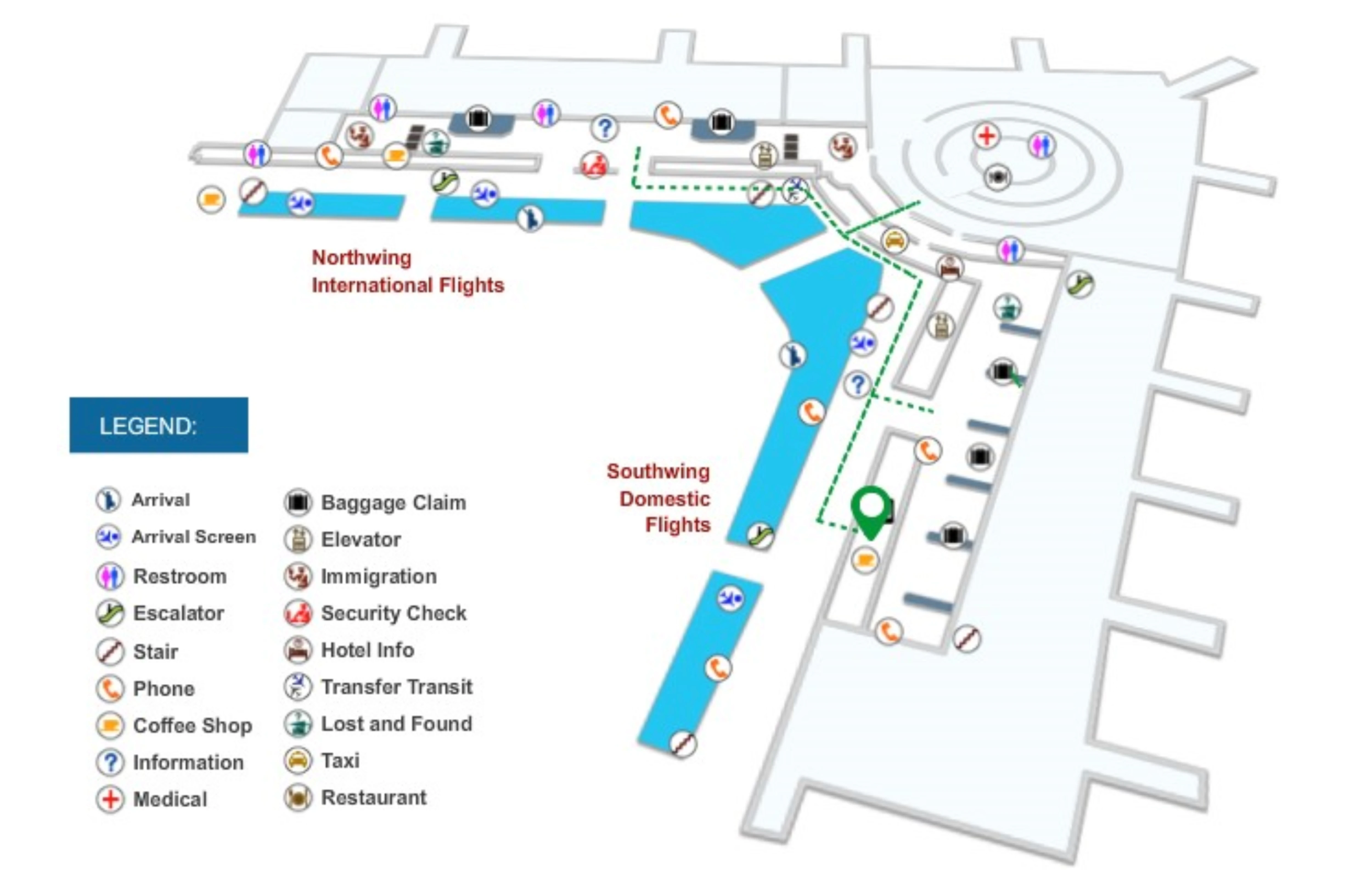
2026 Ninoy Aquino International Airport Terminal 2 Map Guide
What is the exact location (door/bay/level) of the Terminal 2 → Terminal 3 shuttle pickup point?
The Terminal 2 → Terminal 3 inter-terminal shuttle pickup is at Arrivals curbside on the ground level at Bay 19. Bay 19 sits on the South Wing side of the arrivals roadway, reached by turning right after exiting the central Arrivals doors that typically land you around Bays 10–14.
| Step | Landmark anchor | End point |
|---|---|---|
| Exit Arrivals | central exit doors near Bay 10–14 | curbside bay line |
| Go right (South Wing direction) | pass the Yellow Taxi zone around Bay 14 | Bay 19 “Inter-Terminal Shuttle” stop |
| Confirm stop | look for white shuttle buses, “Inter-Terminal Shuttle” signage | queue/loading at Bay 19 |
What is the exact walking distance (meters) from Terminal 2 Arrivals baggage claim exit to the Terminal 2 inter-terminal shuttle stop?
Walking from the central Arrivals exit doors (the typical baggage-claim exit near Bay 12) to the inter-terminal shuttle stop at Bay 19 takes about 85–100 meters. The walk runs along the covered Arrivals curb line on the South Wing side, with the most reliable mid-route anchor being the Yellow Taxi area around Bay 14 before continuing to Bay 19.
| Route segment | Landmark anchor | Distance |
|---|---|---|
| Arrivals exit doors (near Bay 12) → Bay 14 | Yellow Taxi zone | ~20 m |
| Bay 14 → Bay 19 | curbside bays continuing South Wing | ~65–80 m |
| Total | Arrivals exit → Shuttle stop (Bay 19) | ~85–100 m |
What is the exact location of the official Grab pickup point in Terminal 2 (Bay 1) relative to the Arrivals exit (which curb/bay line)?
The official Grab pickup point is on the Arrivals curbside ground level at the North Wing end, centered on Bay 1. Relative to the central Arrivals exit doors (typically near Bay 10–14, roughly Bay 12), it sits on the far-left curb/bay line when you face the roadway, requiring a long walk along the covered curb toward the lowest bay numbers.
| Reference point | Direction along curb | End point |
|---|---|---|
| Arrivals exit doors (near Bay 12) | left toward lower bay numbers (North Wing) | Grab pickup loading at Bay 1 |
| Grab booking booths (if needed) | left but closer than pickup | booths around Bay 9 / Bay 6–9 axis |
| Grab pickup vs booths | continue past booths | Bay 1 vehicle loading zone |
Where is the official metered/coupon taxi queue located at Terminal 2 Arrivals (exact bay/door), distinct from informal solicitors?
The official Coupon Taxi queue is at Arrivals curbside ground level at Bay 11, directly in front of the primary Arrivals exit doors. The official Yellow Metered Taxi queue is immediately to the right of the same central exit, centered on Bay 14, and it often forms a visible line that can partially block sightlines farther down the curb toward Bay 19.
| Official taxi type | Exact bay | Landmark anchor |
|---|---|---|
| Coupon Taxi (fixed-rate) | Bay 11 | directly in front of the main Arrivals exit doors |
| Yellow Metered Taxi (airport-accredited) | Bay 14 | right of the main Arrivals exit, along the central curb line |
What is the exact walking distance (meters) from Terminal 2 security screening exit to the furthest domestic gates in the departure hall?
Walking from the main security exit to the furthest domestic gates is about 300–350 meters to Gate 1 (North Wing tip) and about 350–400 meters to Gate 20 (South Wing tip). The distance risk spikes because the first decision point is immediately after security at the central rotunda splitter—commit left for Gates 1–15 or right for Gates 16–20.
| Furthest gate | Wing direction from security | Distance |
|---|---|---|
| Gate 1 | left into North Wing | ~300–350 m |
| Gate 20 | right into South Wing | ~350–400 m |
Where is the first reliable flight/gate information display located after clearing Terminal 2 security (exact position relative to exits/escalators)?
The first reliable flight/gate information display is the main FIDS bank directly ahead of you immediately after the final security X-ray exit, centered at the rotunda “splitter” before the corridor divides into the North and South wings. The screens face passengers as they step out of the X-ray lanes, acting as the decision node where you choose left for Gates 1–15 or right for Gates 16–20.
The most dependable way to use it is to stop as soon as you clear the security exit and read the screens before you drift into either wing. Once you walk past this rotunda splitter, switching wings requires returning to the same node, adding a full backtrack through the densest foot traffic.
What is the exact walking distance (meters) from the first baggage carousel to the domestic arrivals exit curb in Terminal 2?
Walking from the first baggage carousel to the domestic Arrivals exit curb is about 25–40 meters. The path is short because the baggage belts sit close to the landside doors, with the main added distance coming from the narrow greeter lobby (“tube”) between the glass exit doors and the curb.
The typical sequence is: step off a central carousel, walk roughly 15–20 meters to the customs/exit glass doors, then continue through the short lobby for about 10 more meters to reach the curb edge. Even though the curb is close, the bigger time-risk starts after you exit—choosing the correct bay direction (toward Bay 1 Grab or toward Bay 19 shuttle) determines whether you add an extra 80–180 meters outside.
What is the exact walking distance (meters) from Terminal 2 baggage claim to the PAL domestic check-in counters (re-check point)?
Walking from Terminal 2 baggage claim to the PAL domestic check-in counters is about 150–200 meters. The route is distance-heavy because the practical connection from Arrivals (ground) to Departures (Level 2) typically requires exiting to the curb and using an external ramp or stairwell, then re-entering upstairs near the departure entry/security area before continuing to the PAL counter row.
The most direct pattern is: baggage carousel area to Arrivals exit (about 20–30 m), curbside walk to the nearest usable ramp access (about 20–50 m from the central exit area), up the external ramp to Level 2 (about 50 m of ramp length), then back inside to the departures entry and onward to the PAL counters (about 50–70 m depending on counter position). This movement is the key friction point when re-checking with luggage.
Where is the random/ETD secondary screening area positioned inside Terminal 2 security (exact side/zone from the X-ray lanes)?
The ETD/random secondary screening is set up at the boarding gate entrance, not in a fixed zone beside the main X-ray lanes. Screening tables are typically placed at the entry to the gate’s cordoned holding “pen,” with glass partitions controlling access so passengers queue at the gate before reaching the podium.
This matters because the time-risk shifts from the central security checkpoint to the gate itself: the “boarding time” on your pass effectively becomes the start of the ETD/hand-search queue. The best anchor is your assigned gate zone—expect the screening point right at the gate pen entrance, where staff can funnel passengers into a single-file line before the boarding door.
Where are the nearest escalators/elevators that connect Terminal 2 Arrivals → Departures without leaving the building?
No public internal escalator or elevator reliably connects Terminal 2 Arrivals (ground) to Departures (Level 2) without exiting the building. The standard passenger path is to “flush” out to the Arrivals curb and use the external side ramps or stairwells near the ends of the terminal to reach Level 2, then re-enter the departures hall.
Elevators do exist near the mid-block areas associated with VIP/admin functions, but access is often restricted or discouraged for general passenger flow, so they cannot be treated as a dependable internal transfer option. For re-checking or tight timelines, plan your route around the curbside ramps as the default vertical connection.
Where is the largest public seating cluster in Terminal 2 Departures after security (exact gate-zone), based on terminal layout?
The largest public seating cluster after security is in the central rotunda zone immediately past the main duty-free area. This rotunda seating works as the terminal’s primary overflow and waiting hub because it sits between the post-security splitter and the two wing corridors.
Secondary “big blocks” of seating appear at the wing tips, especially the South Wing cul-de-sac serving Gates 16–20 and the North Wing end serving Gates 1–4. These end zones are useful as quieter fallback anchors once you’ve confirmed your gate at the rotunda FIDS node, since switching wings later forces a full return to the central splitter.
Where are the closest public charging outlets to the main departure concourse in Terminal 2 (exact gate-zone)?
The closest reliable public charging outlets to the main departure concourse are at the central rotunda high-table area near the central café zone immediately after security. This is the highest-probability power location in the terminal because outlets are integrated into the high tables rather than relying on wall or floor sockets.
A dedicated charging station is also positioned near Gate 6 in the North Wing, with additional charging points reported near Gate 14 and near Gate 20 in the South Wing. For trip-planning, charge at the rotunda before committing to a wing walk, since outlet availability becomes less predictable deeper into the concourses.