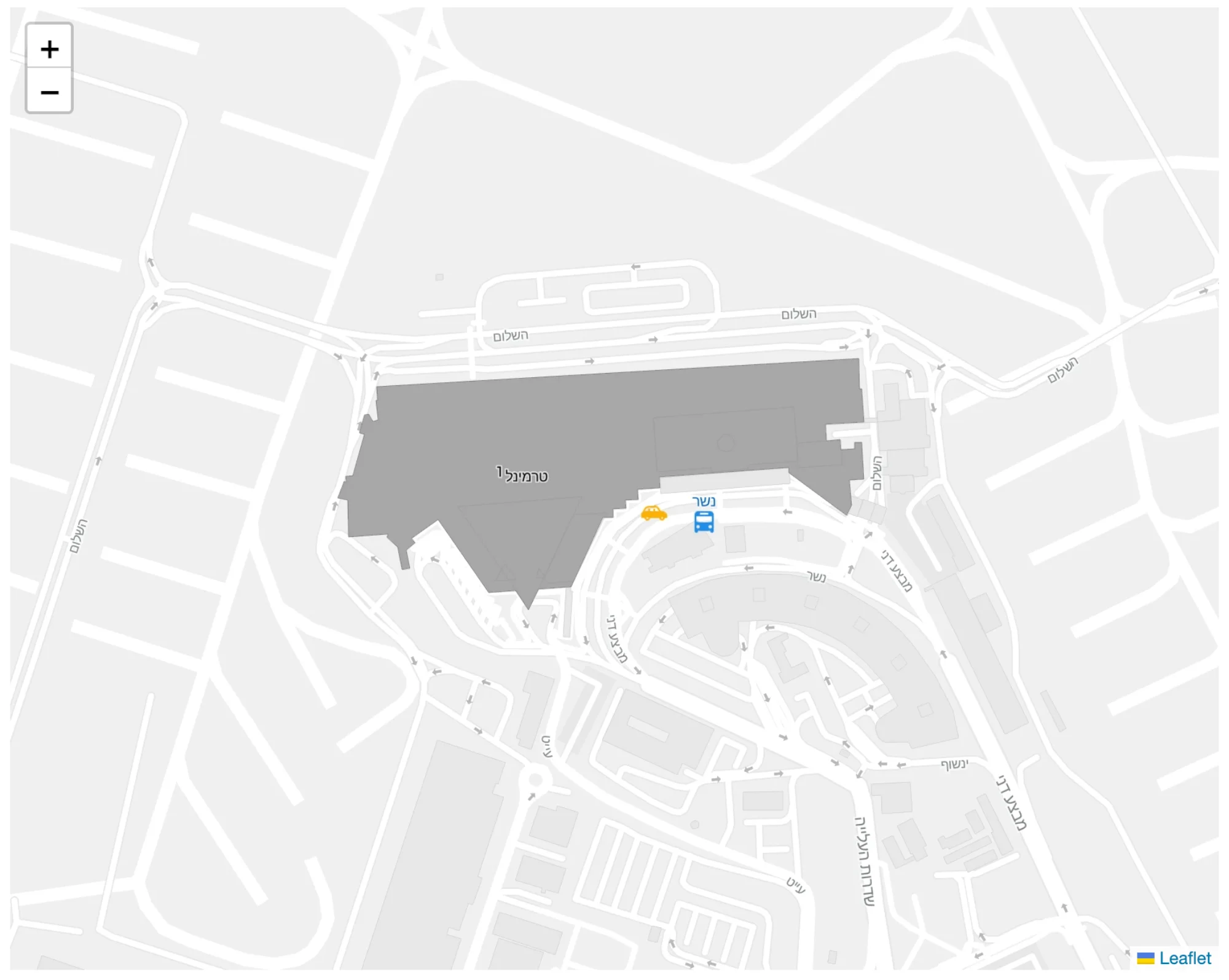
Ben Gurion International Airport Terminal 3 Map (Most Up-To-Date)

Terminal 3 is a vertically stacked hub with a wide, curved Departures Hall on Level 3 feeding a controlled airside “connector” down to the Duty-Free Rotunda and three long concourses (B/C/D). Landside flows split hard by level: Arrivals and shuttles sit on Level G, public buses above on Level 2, and rental desks up on Level 1. Within Israel’s primary Tel Aviv gateway, the layout is built around security-first routing, not straight-line walking.
Map Table
| Zone | Connection | Walk Time |
|---|---|---|
| Level 3 Departures | Security interview → Check-in A–D / Area W | Variable, queue-driven |
| Post-screening Connector | Sterile transition → Duty-Free Rotunda | 5–8 min |
| Rotunda | Concourses B / C / D spokes | 0–2 min to pier heads |
| Level G Arrivals | Gate 01 shuttle / Gate 03 taxis / rail down to Level S | 2–8 min, exit-dependent |
Ben Gurion International Airport Terminal 3 Map Strategy
- Treat the first security interview as the real start line: plan curb-to-gate around interrogation variance, not the distance to counters.
- Use Area W only when you are eligible; if your airline requires a document check, you cannot “force” the shortcut with carry-on only.
- Lock the transport levels before you move: T1 shuttle and parking shuttles are Level G Gate 01; municipal buses are Level 2 Gate 23—standing at the wrong gate will not self-correct.
- For rentals after arrival, go up to Level 1 (Eastern Gallery) for desks, then back down to Level G for pickup; do not exit the building from Arrivals expecting counters curbside.
2026 Ben Gurion International Airport Terminal 3 Map + Printable PDF
Terminal 3 remains security-led and timing-volatile, with the pre-check-in interview acting as the true pace-setter for departures. Area W continues to be the main shortcut for carry-on-only travelers who already have valid boarding credentials, while the post-security connector remains a one-way commitment into the Duty-Free Rotunda. Level separation still drives most “wrong turn” errors: shuttle vs. public bus vs. rental car desks.
2026 Ben Gurion International Airport Terminal 3 Map Guide
What is the exact walking distance (meters) from the Terminal 3 departures entrance to the first screening checkpoint (where document/security questions begin)?
Security questioning starts almost immediately inside the Departures Hall, so the walking distance is short but not fixed because selectors intercept travelers in open floor space rather than at a single marked checkpoint. Most travelers encounter the first document/questions zone within roughly 20–60 meters of the doors, depending on which departures gate you enter and where the “floating” selector line has formed.
The critical detail is that this is not a corridor-to-checkpoint walk; it’s a hall entry into a moving interception area. Entering near Gate 32 typically puts you closer to the VIP/Fast Track meeting node and can reduce lateral walking before first contact, while entering through central doors can add sideways drift as you hunt for the active selector queue. During peak periods, the “meander factor” can exceed the straight-line distance because the line geometry sprawls across the hall.
Where are the separate security zones/entrances (e.g., A–D) located in the departures hall, and which one is closest to the main check-in island for most airlines?
Separate departures processing zones are organized around the A–D check-in areas on Level 3, with security interview flow feeding those lettered counter blocks rather than a single fixed “security entrance.” The closest zone to your airline is therefore the check-in letter block your carrier is assigned to, not a universally “best” entrance.
| Departures hall zone | Where it sits | Closest to |
|---|---|---|
| A | Level 3 check-in hall, one end of the A–D counter line | Airlines ticketed to A counters |
| B | Level 3 check-in hall, adjacent block to A | Airlines ticketed to B counters |
| C | Level 3 check-in hall, adjacent block to B | Airlines ticketed to C counters; Gate 32 curb vector nearby |
| D | Level 3 check-in hall, far end of the A–D counter line | Airlines ticketed to D counters |
The practical way to “pick the right one” is to use the overhead A–D counter signage as your anchor immediately after the interview sticker is applied, then walk directly to that letter block without drifting toward the Buy & Bye mixed-traffic area near the security entrance. If you enter curbside near Gate 32, you’re typically positioned nearer the C-side of the departures ecosystem, which can reduce cross-hall walking for carriers clustered there.
What is the exact walking distance from the busiest check-in counter rows to the next security control point (post check-in), including the correct corridor/turns?
The post check-in security sequence is reached by moving to the rear of the Level 3 Departures Hall and into the passport control and hand-luggage screening complex, but the audit material does not provide a measured meter distance from the check-in rows to that control point. The shortest-path walk is primarily a “back of hall” traverse rather than a multi-corridor maze, and the time penalty is usually queue-driven at passport control and X-ray rather than the walk itself.
From the densest A–D counter rows, the correct alignment is to face away from the landside glass wall and move toward the rear boundary of the departures hall where the biometric passport-control bank begins. Staying on the main central aisle avoids being pulled into the Buy & Bye landside mall edge traffic. Once you commit into passport control and hand-luggage screening, the connector becomes one-way toward the Duty-Free Rotunda, so do not enter that channel until check-in and documents are fully resolved.
Where is the secondary screening area typically routed from the main security flow (the spot where travelers are pulled aside), and what is the shortest path back to the main line afterward?
Secondary screening is typically initiated at the pre-check-in security interview layer in the Level 3 Departures Hall, where officers divert higher-risk profiles out of the open “selector” line into a separate questioning/screening area rather than letting them proceed to check-in. The diversion point is therefore not a post-X-ray side room; it is the interview zone itself, before you can access airline counters without the barcode sticker.
The practical “shortest path back” is procedural, not spatial: you rejoin the main flow only after you are cleared and a barcode sticker is applied to your passport and (if applicable) luggage. Once released, you return to the closest A–D counter block for your airline using the same departures hall floor, aiming directly for the overhead letter signage rather than drifting toward the landside mall edge. If you have carry-on only and are eligible, you can then redirect to Area W; otherwise you must proceed to standard check-in before the later passport control and hand-luggage screening sequence.
Where is the Terminal 1 ↔ Terminal 3 shuttle/bus pickup located relative to Terminal 3 departures, and what is the exact walking distance to reach it from the central check-in area?
The Terminal 1 ↔ Terminal 3 shuttle pickup is on Level G at Gate 01, outside the Arrivals/Greeters Hall—not on the Level 3 departures curb. Walking from the central Level 3 check-in islands to Gate 01 is a multi-level descent plus an outdoor curb walk, and the practical path is defined by the correct elevator/escalator bank to Level G.
| Route segment | Landmark anchor | Distance |
|---|---|---|
| Check-in islands → vertical core | A–D counter spine → central escalators/elevators | 150–250 m |
| Level 3 → Level G | same vertical bank to Arrivals/Greeters Hall | 0 m walking |
| Greeters Hall exit → Gate 01 | Arrivals doors → curbside “Shuttles” bay | 200–350 m |
| Total | Central check-in → Gate 01 | 350–600 m |
If you arrive at Terminal 3 with carry-on only, what is the exact route (with decision points) to avoid walking into the wrong terminal/check-in flow intended for Terminal 1 bus transfers?
Avoiding the wrong flow means staying on Level 3 Departures for Terminal 3 processing and not descending toward Level G Gate 01 unless you are intentionally taking the Terminal 1 shuttle. Carry-on only does not equal “skip security interview” at TLV; you still need the interview clearance before any airside move.
From the Level 3 curb, enter the Departures Hall and immediately commit to the security interview (“selector”) flow in the open hall. After you receive the barcode sticker, make a fork decision: if you are eligible for Area W (hand luggage + valid web/mobile boarding pass accepted by your airline), follow signage for Area W and do not join the A–D counter queues. If you are not eligible, go straight to your assigned A–D counter block using overhead letter signage. The wrong-turn trap is taking escalators/elevators down for “Transportation” and ending up at Level G where Gate 01 shuttle operations run; that path is for inter-terminal transfers and parking shuttles, not for a Terminal 3 departure.
What is the exact route from Arrivals Hall (ground/G) to the rental car desks on Level 1 without getting trapped by the wrong elevator bank, and how many vertical transitions does it require?
The rental car desks are on Level 1 in the Eastern Gallery, so the correct route requires going up from Level G before you exit the building. This path uses 1 upward vertical transition to reach Level 1, and (if you’re continuing to the cars afterward) it later forces a second transition back down to Level G.
From Customs, enter the Greeters Hall on Level G and stop before the exterior doors to the taxi curb (Gate 03 area). Look left of the main exit flow for the elevator bank signed for “Gallery” / “Level 1” / “Car Rental,” then take that elevator up one level to Level 1. On Level 1, follow the gallery frontage to the rental counters (Avis/Hertz/Budget/Eldan/Sixt cluster). The “trap” is exiting to the curb first and searching outside—once you’re on the taxi/shuttle curbside, you’ve already bypassed the internal elevator access points and will have to re-enter and backtrack.
Where is the rental car shuttle pickup point at Terminal 3 (gate number/door), and what is the exact walking distance from Arrivals exit to that pickup?
Rental car pickup is not a “shuttle bay” in the same sense as an inter-terminal bus; the standard flow is to complete paperwork at the Level 1 Eastern Gallery counters, then return to Level G and walk outside to the Pardes Parking Lot to collect the vehicle. The audit material does not specify a numbered gate/door for a dedicated rental-car shuttle pickup at Terminal 3.
The reliable anchor is the Arrivals curbside: exit to Level G and cross the roadway toward Pardes Parking for car collection. If you are instead using a specific off-airport rental operator that runs a shuttle, their pickup door/gate and distance can vary by company and isn’t defined in the provided topology. The “don’t waste time” rule is to treat on-airport rentals as a walk-to-lot pickup after the Level 1 desk step, not as a shuttle-first process.
From the main post-security exit point, what is the exact walking distance to the farthest common international gate cluster (worst-case walk) using the shortest legal route?
The farthest common international gates are at the ends of the long concourse piers (for example, the tail end of Concourse D such as the D8/D9 area), and the walk is long but linear from the Duty-Free Rotunda hub. The audit describes the Rotunda-to-end-of-pier distance as roughly 300–400 meters, which is the best available “worst-case” range from the post-security airside hub using the shortest route.
After hand-luggage screening, you take the one-way connector down to the Duty-Free Rotunda, then pick the correct spoke (B, C, or D) and stay on the main pier centerline, using moving walkways where available. The last stretch to the gate is typically a “last mile” segment beyond the walkway endpoints, so the practical worst-case is Rotunda → end-of-pier, not Rotunda → mid-pier clusters. If you start timing from the security exit before the connector, add the connector walk (about 5–8 minutes) before you even reach the Rotunda decision node.
Where is the nearest restroom immediately after you clear the main security chokepoint, and what is the exact walking distance from that chokepoint?
The nearest predictable restroom after the main screening sequence is in the airside retail core around the Duty-Free Rotunda, reached after you finish hand-luggage screening and walk the one-way connector into the Duty-Free Hall. The audit does not provide a measured meter distance from the chokepoint to the closest restroom.
Operationally, the “right after security” reality at TLV is that you are funneled into the connector and then into the Duty-Free complex, so the restroom you can reliably target is the first set available once you enter the Rotunda/Duty-Free area rather than expecting one immediately at the exit of the X-ray lanes. If you need facilities before committing, use restrooms in the concourse arrival walk or landside areas earlier, because once you enter the connector you cannot reverse back without escort.
Where is the priority/business-class security lane entrance located within the main security area, and what landmark confirms you’re in the correct lane before committing?
Priority/business-class screening typically branches inside the main hand-luggage screening complex after passport control, but the audit material does not specify a fixed, labeled “priority lane” entrance point or a unique landmark for confirming the lane at the moment of commitment. At TLV, lane availability can also shift with staffing and demand, so the best “confirmation landmark” is the official overhead signage and staff direction at the lane split.
The practical way to reduce mis-commitment is to anchor yourself at the passport-control exit and scan for dedicated markings (business/fast track) before you enter any stanchioned queue, because once you are inside the X-ray lane maze it’s difficult to change lines without losing your place. If you are using a paid VIP/Fast Track service, the most reliable pre-lane landmark in the overall flow is the Gate 32 curb/VIP meeting node landside; missing that entry point often forces you back into standard processing regardless of ticket class.