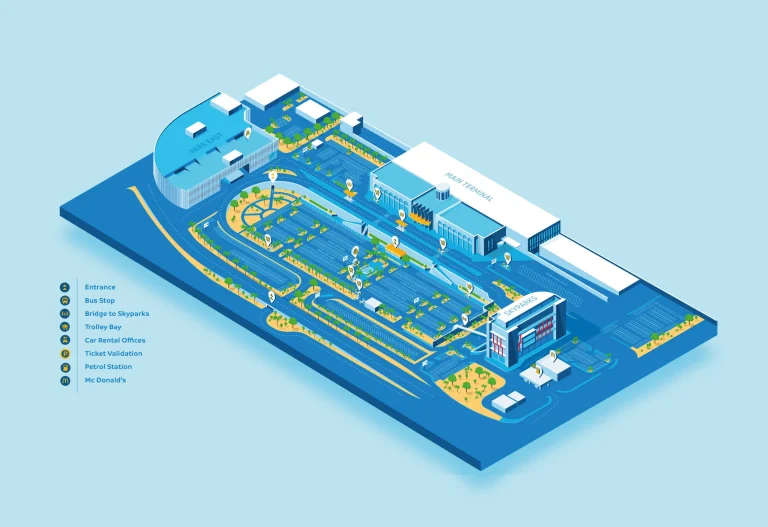
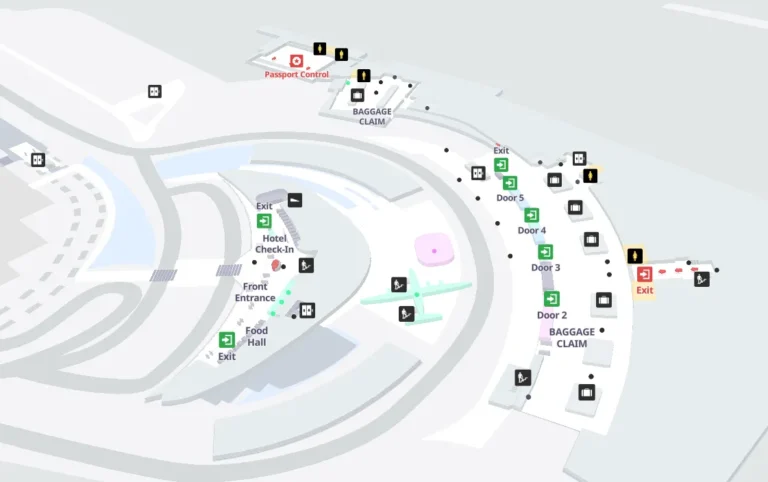
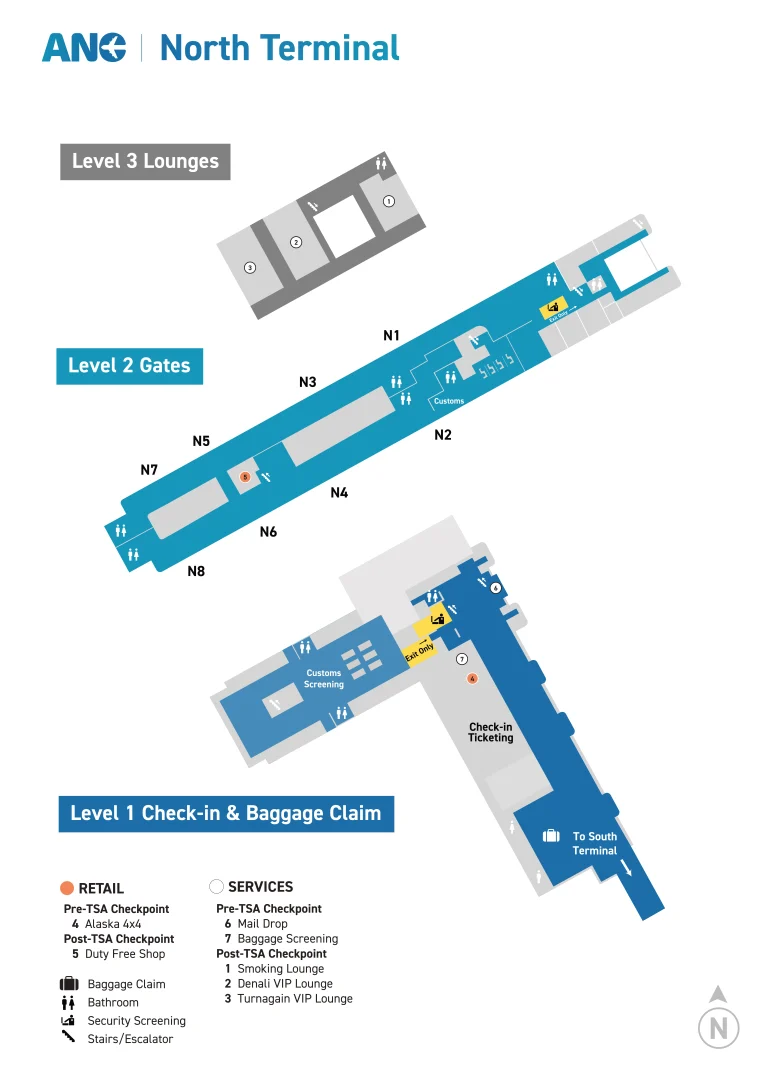
Beijing Capital International Airport Map (Most Up-To-Date)

Beijing Capital International Airport is a three-terminal campus with Terminal 3 stretched in a long south–north “spine” that connects the main processing hall (Terminal 3C) to the isolated international concourse (Terminal 3E). The footprint is huge, so transfers are defined less by “walking faster” and more by choosing the correct mode (APM train vs. landside shuttle) and the right level. Most missed-connection stress comes from Terminal 3’s forced checkpoints and level changes across Beijing’s main airport grounds.
Map Table
| Terminal | Key Airlines | Primary Function | Transfer Mode |
|---|---|---|---|
| Terminal 2 | SkyTeam carriers | Mixed domestic + international | Landside shuttle bus from Terminal 3 Gate 5 |
| Terminal 3C | Air China + partners | Landside processing, domestic check-in, ground transport | APM link to Terminal 3E, vertical cores Level 2↔Level 4 |
| Terminal 3E | International carriers | International arrivals/departures concourse | APM only to/from Terminal 3C; no walk option |
Beijing Capital International Airport Map Strategy
- Treat Terminal 3 as two buildings you cannot “power-walk” between: Terminal 3E ↔ Terminal 3C requires the APM, so budget fixed train + platform time before you even start your next walk.
- Lock in the two decision points that cause most wrong turns: the Terminal 3E Level 3 core split (international transfer desk vs. down to immigration/APM) and the Terminal 3C Level 2 split (baggage claim exit vs. sterile transfer lanes).
- For Terminal 2 ↔ Terminal 3, go straight to Level 1 Gate 5 for the free inter-terminal shuttle; don’t follow “train/city” signage to the Airport Express on Level B2 when you’re trying to reach another terminal.
- Assume at least one chokepoint will add minutes: transit security re-screening, elevator queues with luggage carts, and international-to-domestic baggage reclaim + re-check (Level 2 → Level 4 → Level 3) are the connection-killer sequences.
2026 Beijing Capital International Airport Map + Printable PDF
Terminal 3 remains the defining layout for 2026 navigation: Terminal 3E (international) is physically separated from Terminal 3C (processing/ground transport), making the APM train a non-optional connector. Inter-terminal transfers to Terminal 2 are still primarily landside via the free shuttle at Terminal 3 Gate 5 (Level 1), and tight connections are most often lost to repeat checkpoints (immigration, transit security, baggage reclaim/re-check).
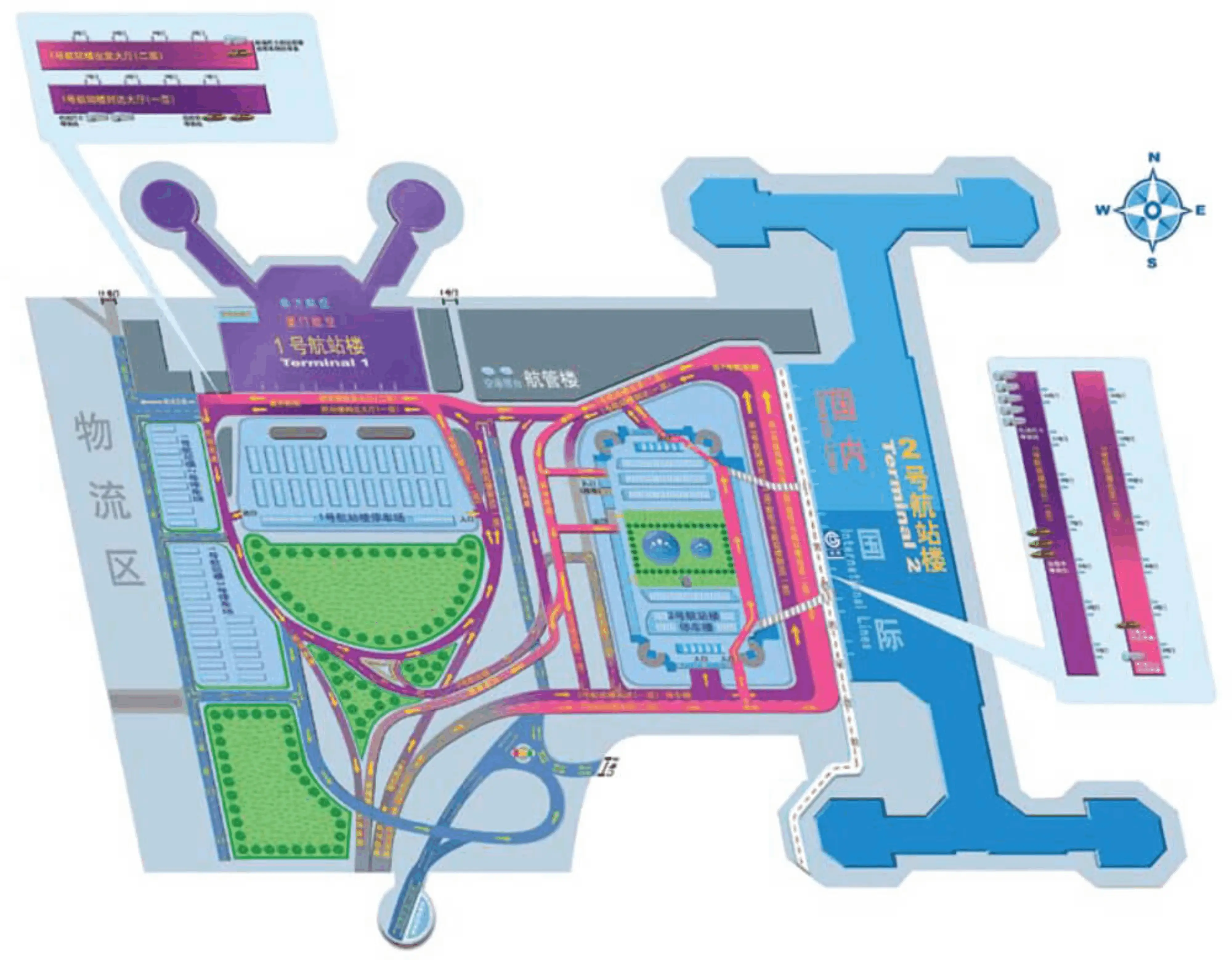
2026 Beijing Capital International Airport Map Guide
What is the exact walking distance (meters) from Terminal 3 International Arrivals to the inter-terminal shuttle bus stop for Terminal 2 (including floor/exit door number)?
Walking takes approximately 180–220 meters from the Terminal 3C customs exit to the free inter-terminal shuttle stop for Terminal 2, using Gate 5 on Level 1 as the curbside exit.
The practical start point is Customs Exit B on Level 2 in the Terminal 3C International Arrivals Hall. Walk about 60–80 meters to the central elevator and moving-walkway bank, go down to Level 1, then walk another 40–50 meters through the transit lobby to the exterior glass doors labeled Gate 5. The shuttle stop is immediately curbside outside Gate 5, marked for the free inter-terminal shuttle to Terminal 2 and Terminal 1.
Where is the Terminal 3 → Terminal 2 shuttle bus stop located by Gate number and level (the precise door/zone travelers miss)?
The Terminal 3 → Terminal 2 free inter-terminal shuttle boards at Gate 5 on Level 1 of Terminal 3C.
Gate 5 is on the ground transportation curb outside the Level 1 transit lobby, directly below the International Arrivals Hall on Level 2. From customs exits (Exit A or Exit B) on Level 2, the shortest path is to the central elevator/escalator core down to Level 1, then straight to the glass doors marked Gate 5; the shuttle stop is immediately outside on the curb and labeled for the free inter-terminal shuttle to Terminal 2 (and Terminal 1).
Inside Terminal 3, what is the exact route (and level changes) from a gate in Terminal 3E to the train/people-mover platform that takes you toward Terminal 3C processing areas?
The route runs along Terminal 3E Level 3 to the central core, then drops one level to the Automated People Mover platform on Level 2 immediately after immigration.
From any Terminal 3E arrival gate on Level 3, follow the fixed one-way corridor flow toward the concourse spine until all streams merge at the central core where Inspection & Quarantine and Immigration (Border Control) sit. After you clear immigration, stay on Level 3 only long enough to reach the large escalator and elevator bank directly beyond the immigration hall.
Go down from Level 3 to Level 2 at that bank; the Automated People Mover station entrance and platform are on Level 2 at the base of the descent. Walking to Terminal 3C is not an option from Terminal 3E—this train is the required connector.
What is the end-to-end walking distance from the Terminal 3E train drop-off to the domestic check-in hall in Terminal 3C (the long post-train segment)?
Walking runs about 400–550 meters from the Terminal 3C Automated People Mover arrival on Level 2 to the domestic check-in hall on Level 4, depending on baggage carousel and how far your check-in aisle is.
After the train drops you at the Terminal 3C station on Level 2, the sterile corridor to the baggage claim hall is about 50 meters. Crossing the baggage claim hall to your carousel is typically another 50–150 meters, then you pass the customs channels and exit into the public arrivals hall. From there, it’s roughly 100 meters to the central vertical core, then up from Level 2 to Level 4 by elevator. From the elevator exit to the domestic check-in islands (Zones F, H, J, K), expect about 150–250 meters, with the farthest counters at the ends of the hall.
Where is the transit security checkpoint for international-to-international connections in Terminal 3 located (exact zone/gate cluster), and what is the shortest on-map path to reach it from arrivals?
The transit security checkpoint sits in the central core of Terminal 3E on Level 3, on the west side of the main arrival atrium beside the international transfer counters.
| Segment | On-map path | Landmark anchor |
|---|---|---|
| Gate corridor → core | Walk on Level 3 toward the central core | converging arrival corridors into the main atrium |
| Core decision point | Stay on Level 3 and follow “International Transfer” to the west side | before the down escalators that feed immigration/APM |
| Transfer counters | Verify boarding pass at the transfer service counter | transfer counter bank on the west side of the atrium |
| Transit security | Enter the adjacent security screening channel | immediately next to the transfer counters |
| After security | Use the dedicated escalators/elevators down to Level 2 departures | departure hall access directly below the checkpoint |
From the transit security exit in Terminal 3, what is the walking time to the farthest E-gates (identify the farthest typical gate cluster and distance)?
Walking takes about 12–15 minutes from the transit security exit area to the farthest typical E-gates, which are usually the E50–E62 cluster at the tips of the Terminal 3E “Y” wings, roughly 750–900 meters away.
The transit security process returns you into the Terminal 3E departures circulation where the central core functions like the “Y” junction. From that core, the longest straight-line trek is out one of the wings to the highest-numbered gates (commonly E50–E62), with moving walkways reducing effort but not eliminating distance. The opposite long walk is toward the low-numbered gates near the other end of the spine (often E01–E10), typically 10–12 minutes at a steady airside pace.
For intl → domestic when bags are not checked through, what is the step-by-step physical path from international arrivals to baggage claim, then to domestic re-check counters (with exact concourse/level transitions)?
The process forces an entry-exit-entry loop: Terminal 3E Level 3 arrivals → Terminal 3C Level 2 baggage/customs → Terminal 3C Level 4 domestic check-in for re-check, then down to Level 3 for domestic security.
After arriving at a Terminal 3E gate on Level 3, walk to the central core and clear Inspection & Quarantine and Immigration on Level 3. Immediately after immigration, go down to Level 2 to board the Automated People Mover and ride to the Terminal 3C station (arriving on Level 2). Exit into the sterile corridor to the baggage claim hall on Level 2, collect bags, then pass through customs (red/green channels) to enter the public arrivals hall on Level 2.
From the arrivals hall, go to the central elevators and ride up to Level 4 (domestic departures check-in). Re-check bags at the domestic check-in counters (Zones F, H, J, K), then go down to Level 3 for the domestic security checkpoint and continue to the C-gates boarding area on Level 3.
Where are the oversize baggage and re-check counters located in Terminal 3C, and what is the shortest route from customs exit to those counters?
Oversize baggage and re-check happen in Terminal 3C on Level 4, with re-check at the standard domestic check-in islands (Zones F, H, J, K) and oversize drop-offs positioned on the perimeter ends of those rows near the central elevators.
| Step | Shortest on-map path | Landmark anchor |
|---|---|---|
| 1 | Exit customs into the public arrivals hall on Level 2 | Customs exit doors near Exit A / Exit B |
| 2 | Walk straight to the main central elevator bank | midpoint between Exit A and Exit B |
| 3 | Take the elevator from Level 2 to Level 4 | central vertical core |
| 4 | Walk to domestic check-in Zones F, H, J, K for bag re-check | main check-in islands on Level 4 |
| 5 | Use the oversize drop-off at the end-cap/perimeter side of the check-in rows | ends of the check-in aisles closest to the elevators |
What are the highest-failure wayfinding junctions for transfers at Beijing Capital International Airport (exact corridors/escalators where travelers commonly pick the wrong direction), and what labels should the map highlight there?
The highest-failure junctions are the Terminal 3E Level 3 central core split and the Terminal 3C Level 2 post-train split, because each puts “one wrong level change” between you and the correct transfer path.
- Terminal 3E, Level 3, central core where gate corridors converge before the down escalators: “STOP HERE: International Transfer stays on Level 3 (west side). Down escalators = Immigration + train to Terminal 3C.”
- Terminal 3C, Level 2, immediately after exiting the Automated People Mover before the baggage hall: “Baggage Claim + Customs (re-check) straight ahead. Airside Transfer (no bags) use the marked transfer channel.”
- Terminal 3C, Level 2 arrivals hall approaches to the central elevator bank between Customs Exit A and Exit B: “Terminal 2 Shuttle = Level 1 Gate 5. Airport Express (city train) = Level B2.”
- Terminal 3C, Level 4 domestic check-in to Level 3 domestic security transition: “Domestic Security is Level 3 (go down one level after check-in).”
Where are the English-capable information desks located in Terminal 3 (hall name + level), specifically the nearest one from international arrivals?
The nearest English-capable information desk from international arrivals is in Terminal 3E on Level 3 at the central core, positioned just north of the customs/immigration processing area as you approach the quarantine and border-control queues.
Additional information desks sit in Terminal 3C’s public halls, but they are farther once you commit to the train and exit into the main terminal. In Terminal 3C, a staffed desk is in the public arrivals hall on Level 2 near the east side by Exit A, and another is in the public departures hall on Level 4 in the central check-in area around the Counter C, E, and F zone. These are the best fallback anchors if you miss the Terminal 3E core desk.
Where is the passport-scan / information desk travelers use to obtain WiFi login credentials in Terminal 3, and what is the shortest mapped route from arrivals?
The WiFi credential kiosks are clustered in Terminal 3E on Level 3 near the main information desk in the central core, close to the immigration and quarantine queue area used by arriving passengers.
From a Terminal 3E arrival gate on Level 3, follow the one-way arrival corridors toward the central core until you reach the large processing atrium where Inspection & Quarantine and Immigration are located. Before you commit to the down escalators toward the train platform, angle toward the staffed information desk in the core; the passport-scan kiosks for “AIRPORT-FREE-WIFI-NEW” are typically positioned adjacent to that desk and nearby service counters (often in the same cluster as visa-free/assistance desks). If you’ve already left the core and descended a level, backtracking to this cluster can be difficult without staff help.
In Terminal 3, which gate range / seating zones are the most sleep-tolerable (armrest-free benches / quieter areas), and where are they on the map relative to the E-gates spine?
The most sleep-tolerable areas are usually around Gates E14–E19 and Gates E19–E27 in Terminal 3E, because they sit near the central “Y-junction” while being slightly off the loudest through-corridor.
These zones are on the E-gates side of Terminal 3E, close to the point where the main concourse spine meets the split into the two angled wings. Relative to the E-gates spine, the better seating clusters tend to be just beyond the central processing core—far enough from the busiest atrium traffic to reduce noise, but not so far out the wings that you’re exposed to colder, emptier stretches. If you see the GoSleep pod area near Gate E19 (and another near Gate E27), you’re in the right band for the most consistently reported armrest-free or padded bench options.