Westchester County Airport Map (Most Up-To-Date)

Westchester County Airport is a single, compact, three-level terminal where curbside and ticketing sit on the ground floor, TSA and the departure lounge stack above, and limited upstairs space tops it off—everything arranged in a tight, linear footprint that can feel “blocked” during peak banks. Within the White Plains airport hub, most key walks are short in distance but high in friction when parking fills, shuttles bunch, and security queues spill into the lobby.
Map Table
| Terminal | Key Airlines | Primary Function | Transfer Mode |
|---|---|---|---|
| Single terminal | JetBlue, Delta, United, American | Regional commercial departures/arrivals | Garage crosswalk, long-term shuttle, off-site shuttle, curbside |
Westchester County Airport Map Strategy
- Treat parking as the first decision point: plan a primary option and a bailout option so a full garage doesn’t trigger a last-second diversion loop.
- If you’re using Long Term or an off-site lot, budget for shuttle headway plus a “missed bus” scenario, especially for early departures and late-night returns.
- Assume TSA can overflow into the lobby during peak banks; arrive with enough buffer that a line spilling toward the escalators doesn’t become a missed-flight event.
- Pre-visualize your critical micro-routes (parking → terminal doors, counter → escalator/TSA, shuttle curb → entrance) so short distances don’t get erased by crowding.
2026 Westchester County Airport Map + Printable PDF
2026 operations at Westchester County Airport still behave like a “small space, big surge” airport: the main garage can hit capacity fast, shuttle lots introduce timing risk, and TSA queuing can spill into public circulation when departure banks stack up. Print or screenshot a map view that includes the main garage, Long Term Lot (Loop Road), and the terminal curb so you can pivot quickly if parking or security compresses.
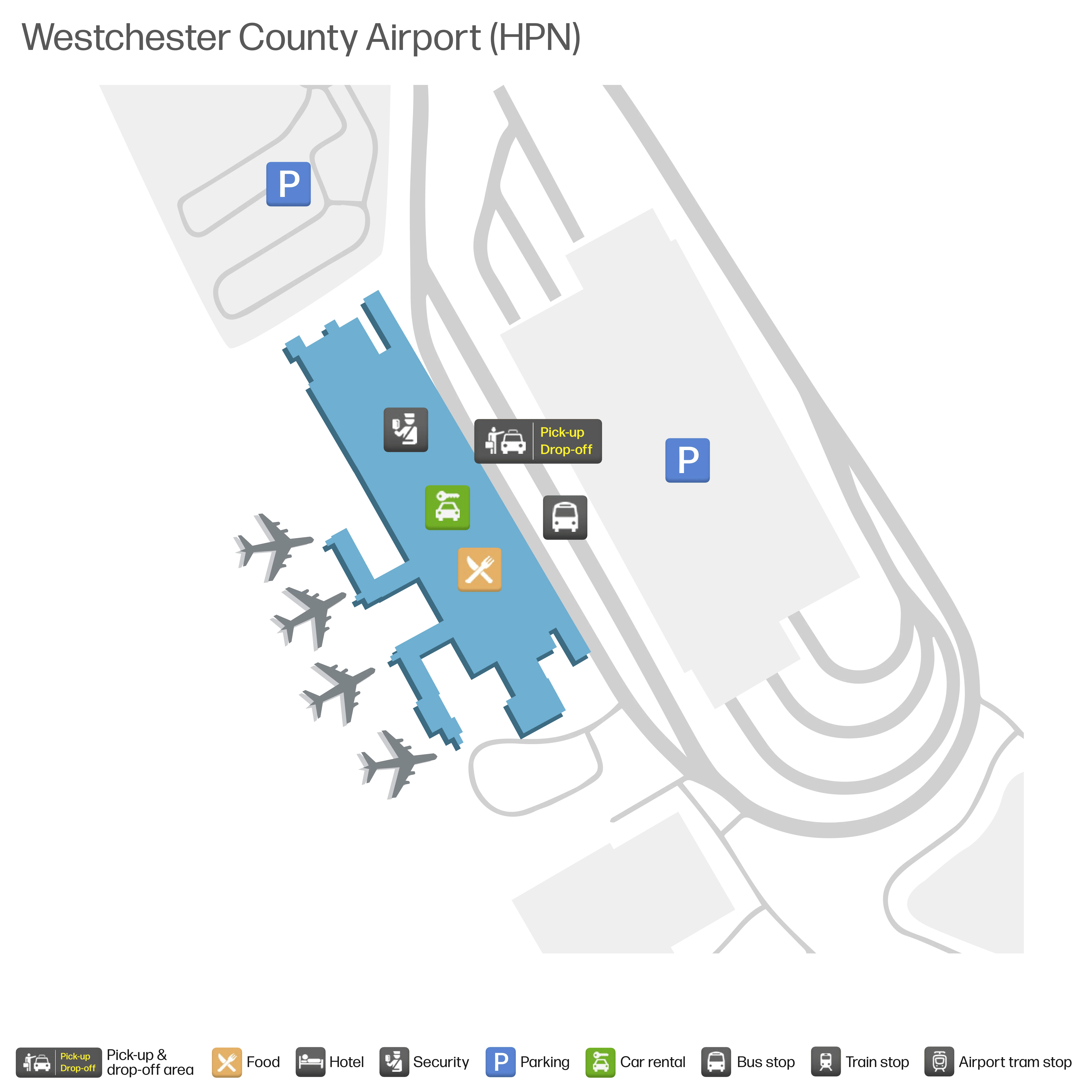
2026 Westchester County Airport Map Guide
What is the exact walking route and distance from the main parking garage to the terminal entrance doors at HPN?
There is no enclosed skybridge from the main parking garage to the terminal, so the route is a ground-level crosswalk walk of about 150–300 feet (45–90 meters). Exit the garage via the pedestrian/elevator core to the terminal-facing side, follow the marked zebra crosswalk over the access/drop-off roadway, then enter through the main sliding glass entrance doors on the ground level.
Route time is typically about 2 minutes on foot, but it varies by where you park inside the garage. The key landmark is the garage exit facing the terminal curb frontage; once outside, aim directly at the terminal’s main glass doors across the pickup lane.
Where is the physical entrance/footpath from the long-term lot to the shuttle pickup point, and what is the walking distance?
There is no walkable footpath from the long-term lot to the terminal, so the only “footpath” is inside the lot to the shuttle shelter, up to about 800 feet. Enter the Long Term Lot at Loop Road and follow the internal driving aisles/painted pedestrian areas toward the designated shuttle pickup shelter (typically positioned near the lot’s entrance/booth or a central island).
The longest walk is from deep overflow rows: expect roughly 3–4 minutes with luggage from the far end of the surface lot to the shelter. The landmark to look for is the covered waiting area/signage for airport parking shuttles; once you’re there, the next leg is strictly shuttle-only because the access road to the terminal is not a safe pedestrian route.
Where is the parking “walking bridge” referenced for HPN parking, and what lot/structure does it connect to the terminal?
There is no dedicated pedestrian “walking bridge” at Westchester County Airport connecting a parking structure to the terminal. The connection from the main parking garage to the terminal is a short at-grade walk that uses the ground-level crosswalk across the pickup/access roadway.
Most “bridge” references map to the covered canopy elements near the garage exit or the terminal-side entrance area rather than an elevated skybridge. Use the garage-to-terminal crosswalk as your anchor: exit the terminal-facing side of the garage, follow the zebra crosswalk, and enter the main sliding doors on the ground level.
What is the walking distance from the ticket counters to the TSA checkpoint entrance at HPN (front-of-house to security)?
The walk from the ticket counters to the TSA checkpoint entrance is under 200 feet (about 60 meters) plus a short escalator/elevator ride up to the screening level. From the counter line on the ground-floor lobby back wall, walk toward the central escalator/elevator bank, go up to the upper level, then follow the stanchions/signage to the TSA entry.
On a clear path, the walk portion is roughly 90 seconds, and the full “counter to TSA” transition is typically under 3 minutes including the vertical move. The key landmark is the central escalator bank—when crowds spike, the TSA line often backs up toward (or down) this escalator area, which can slow the approach even though the distance is short.
Where do security lines physically queue/overflow in the terminal (i.e., the exact corridor/area used when crowded)?
The TSA queue overflows back toward the central escalators and can spill down into the ground-floor check-in lobby when departure banks surge. The primary line forms in the stanchion maze immediately in front of the TSA document-check podiums on the screening level; when that container fills, the line backs up along the approach corridor to the escalator/elevator landing.
In heavier spikes, the overflow continues down the escalators and snakes through the ground-level lobby circulation between the entrance doors and the ticket counter wall. A reliable landmark cue is the escalator base: if you see a standing line near baggage-claim-adjacent open space or people blocking the direct path from the entrance doors toward the escalators, you’re looking at TSA overflow rather than an airline check-in line.
Where are the largest seating clusters located post-security, and what is the walking distance from TSA to those seats?
The largest post-security seating clusters sit in the central departure lounge immediately beyond the TSA exit, about 50–100 feet away. After you clear the metal detector/body scanner and exit screening, walk straight into the main concourse area where the densest rows of connected gate seating line the center of the lounge.
Those seats are effectively “right outside TSA,” which makes them the first to fill during peak banks. Use the TSA exit as your landmark: if you can’t find open seats within that first 100-foot zone, the next best fallback is to drift toward the concourse ends near the far gate corners, where through-traffic is lower than the central core.
Where are the largest seating clusters located post-security, and what is the walking distance from TSA to those seats?
The largest post-security seating clusters sit in the central departure lounge immediately beyond the TSA exit, about 50–100 feet away. After you clear the metal detector/body scanner and exit screening, walk straight into the main concourse area where the densest rows of connected gate seating line the center of the lounge.
Those seats are effectively “right outside TSA,” which makes them the first to fill during peak banks. Use the TSA exit as your landmark: if you can’t find open seats within that first 100-foot zone, the next best fallback is to drift toward the concourse ends near the far gate corners, where through-traffic is lower than the central core.
Which specific gate areas or corners function as the best “standing room” overflow zones when the terminal is packed?
The best standing-room overflow zones are the perimeter edges near the restaurant/concession area and the dead-end corners at the far ends of the concourse, such as the area by Gate F or the far corner by Gate A. These spots work because they sit outside the main centerline where people cluster around boarding lanes and the seating core.
Use the central seating block as your reference point: when the middle of the lounge turns into a slow-moving crowd, step to the outer wall line near concessions (often with airfield-facing views) or continue walking to the concourse ends where there’s less cross-traffic. Avoid standing in the central walkway between the busiest mid-concourse gates, since that’s where boarding lines and pass-through pedestrians collide.
Where is the exact curb location of the Purchase/SUNY-style shuttle drop-off at the HPN terminal, and what is the walk distance from drop-off to TSA?
The Purchase/SUNY-style shuttle typically drops passengers at the commercial/shuttle curb area in the outer lane of the terminal frontage rather than the tightest inner private-car curb. From the bus door, the route is: cross at the nearest marked crosswalk to the terminal entrance doors, enter the ground-floor lobby, walk to the central escalator/elevator, go up to the screening level, then follow TSA signage to the checkpoint entry.
Total walking distance from drop-off to TSA is about 200–250 feet, broken into short segments: roughly 50 feet curb-to-doors, about 100 feet doors-to-escalator, then about 50 feet from the upper landing to the TSA entrance. The key landmark is the terminal’s main glass entrance; once you’re inside, aim straight for the central escalators.
Where is the exact shuttle pickup location for the off-site lot at SUNY Purchase (W2 / security booth area), and how far is it from the lot rows to pickup?
The off-site shuttle pickup at SUNY Purchase is at the designated Park 2 Fly intake area within the West 2 (W2) parking lot, signed near the lot’s control point/security-booth-style entrance area. After parking, walk along the internal lot lanes toward the marked pickup/shelter or attendant check-in spot where shuttles stage and load.
The walk from your parking row to pickup is typically about 200–600 feet, depending on whether you’re in near rows or pushed deeper into W2. Use the lot’s entrance/control point as your landmark: signage and attendants funnel you toward the same pickup node, and first-time users reduce failure risk by navigating to “W2” specifically rather than “SUNY Purchase” generally.
Where is the cell phone lot entrance, and what is the driving route distance/time from the cell phone lot to the passenger pickup curb?
The cell phone lot entrance is off Airport Road roughly a half mile before the terminal, and the drive to the pickup curb is about 0.5 miles and usually 2–4 minutes. Exit the cell phone lot, merge back onto Airport Road in the terminal direction, then follow the one-way terminal approach/loop to the curb frontage.
The practical “dealbreaker” is curb enforcement: if the driver leaves the lot too early, they may be forced to keep circling, adding a 5–10 minute loop penalty. Use a simple trigger: the passenger should call only after they’ve exited the baggage-claim doors and are physically at the curb, then the driver departs the cell phone lot for a single clean approach.
Where is the pickup curb zone relative to baggage claim exit doors, and what is the walking distance from baggage claim to curb?
The pickup curb runs directly outside the baggage claim exit doors, so the walk is about 20–50 feet from carousel to curb. Grab your bag, walk to the automatic glass doors, and you’re immediately on the sidewalk at the curb frontage.
Because there’s almost no buffer space between baggage claim and the curb, timing matters more than distance. Use the exit doors as the landmark: coordinate your pickup by door location, and don’t signal the driver to leave the cell phone lot until you are standing outside those doors—otherwise the driver can get pushed into a forced loop while you’re still waiting on bags.