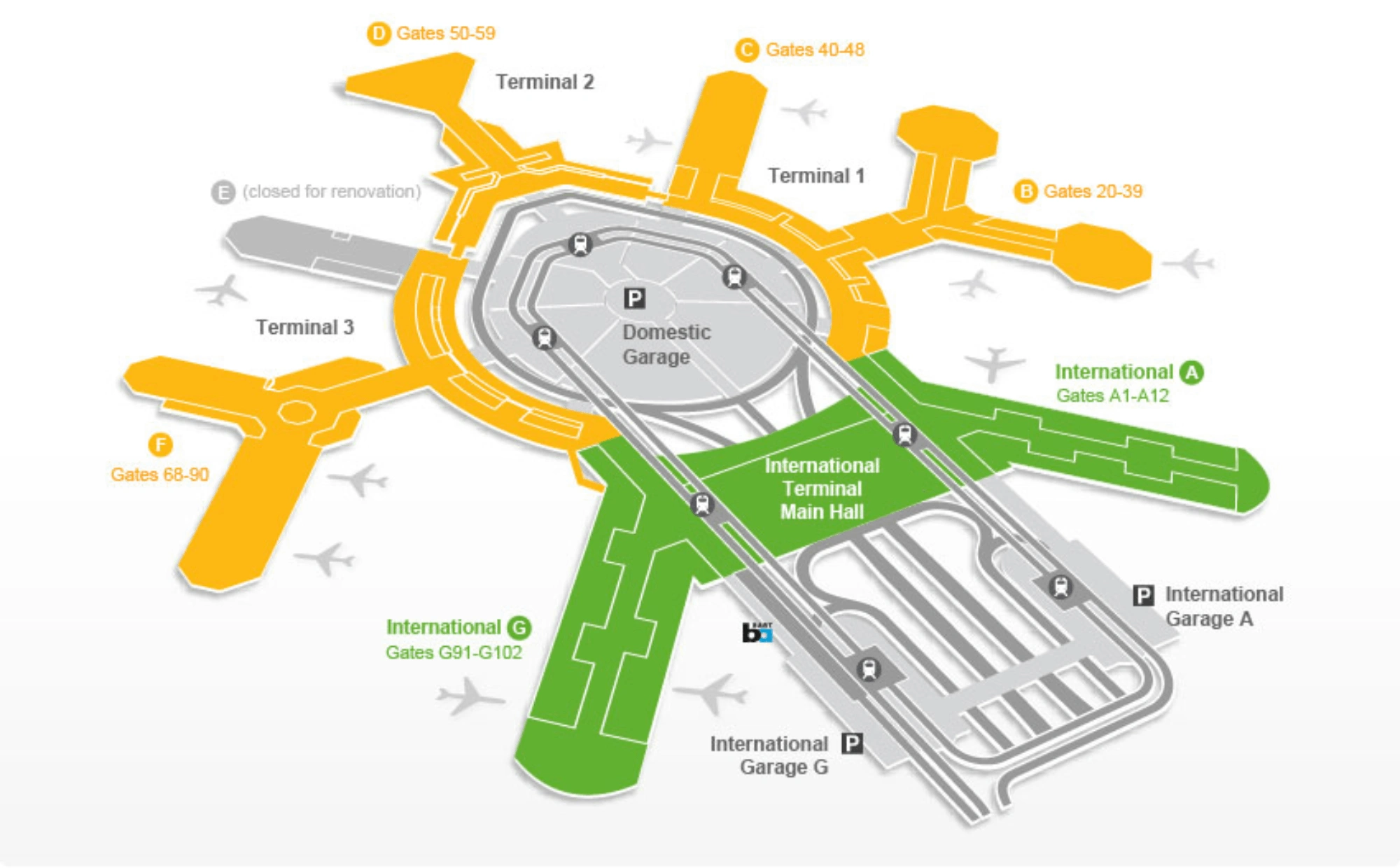
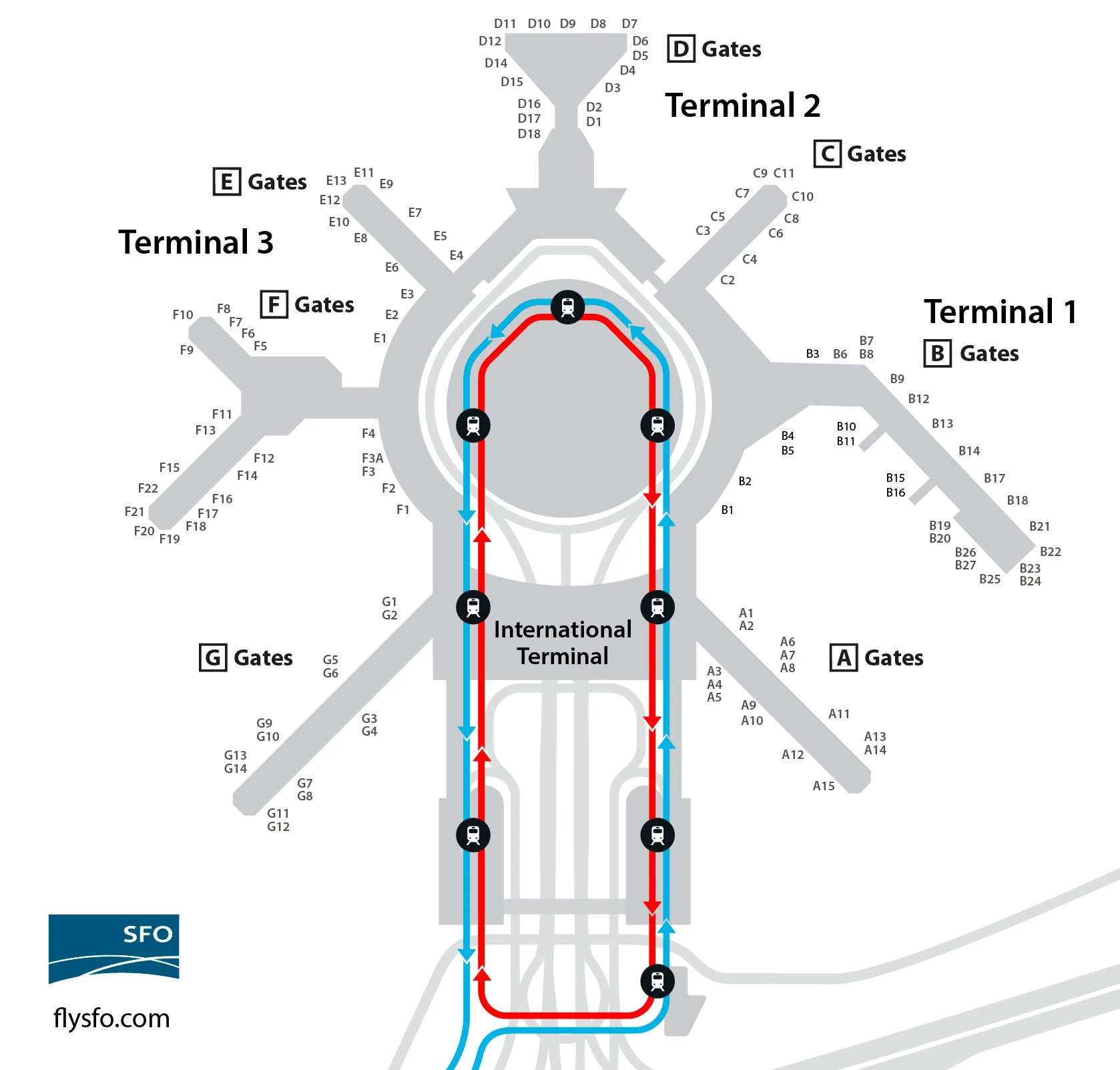
San Francisco International Airport Map (Most Up-To-Date)

San Francisco International Airport’s United Airlines hub side is a long east–west terminal spine (Terminal 2 → Terminal 3 E/F) that links post-security to the International Terminal G concourse, wrapped by a curbside loop and the AirTrain. The current layout is defined by detours: the Terminal 3 AirTrain station is closed, much of the Terminal 3 departures curb is blocked, and the correct “front door” depends on whether you’re headed to D/E or F. This sits within the Bay Area’s main airport hub complex.
Map Key
| Zone | Primary Gates | Landside Entry | Transfer Mode |
|---|---|---|---|
| Terminal 2 West | D, E (United check-in) | T2 Doors 1–2 | Checkpoint D → airside connector |
| Terminal 3 E-side | E | T3 Doors 1–5 area | landside corridor from T2/T3 station |
| Terminal 3 F-side | F | Arrivals Doors 10–12 | Checkpoints F1 / F3 |
| International G | G | Main Hall G-side | G security → airside to F/E/D |
San Francisco International Airport Map Strategy
- Treat “Terminals 2 & 3 AirTrain Station” as a Terminal 2 landing point: enter via the Terminal 2 skybridge/Core E and commit to an indoor eastbound landside walk for Terminal 3 security; garage flanking via Core F or the F-walkway dead-ends.
- Choose check-in by gate letter, not airline: D/E routes start at United Airlines’ Terminal 2 West counters (Terminal 2 Door 1/2 zone), while F routes require Terminal 3 East access; mixing these creates the highest-risk backtrack.
- Use Arrivals-level positioning to bypass the closed departures curb: Terminal 3 Departures Doors 6–13 are not usable, so the fastest Terminal 3 F-side access is the lower level near Arrivals Doors 10–12 with a one-level vertical move up to departures and security.
- Pick checkpoints to prevent double walking: Security Checkpoint D is the shortest entry for D/E with an airside connector to E/F, while International Terminal G security is the cleanest re-entry for international-to-United Airlines connections; the International Terminal A to International Terminal G airside break is a hard boundary that forces an exit and re-screen.
2026 San Francisco International Airport Map + Printable PDF
The 2026 operating map for San Francisco International Airport must reflect active Terminal 3 West Modernization conditions: the Terminal 3 AirTrain station remains closed (service consolidated at “Terminals 2 & 3”), Terminal 3 Departures Doors 6–13 stay blocked, and United Airlines check-in is split (Terminal 2 for D/E, Terminal 3 for F). Route success now depends on choosing the correct station, curb door, and security checkpoint before you start walking.
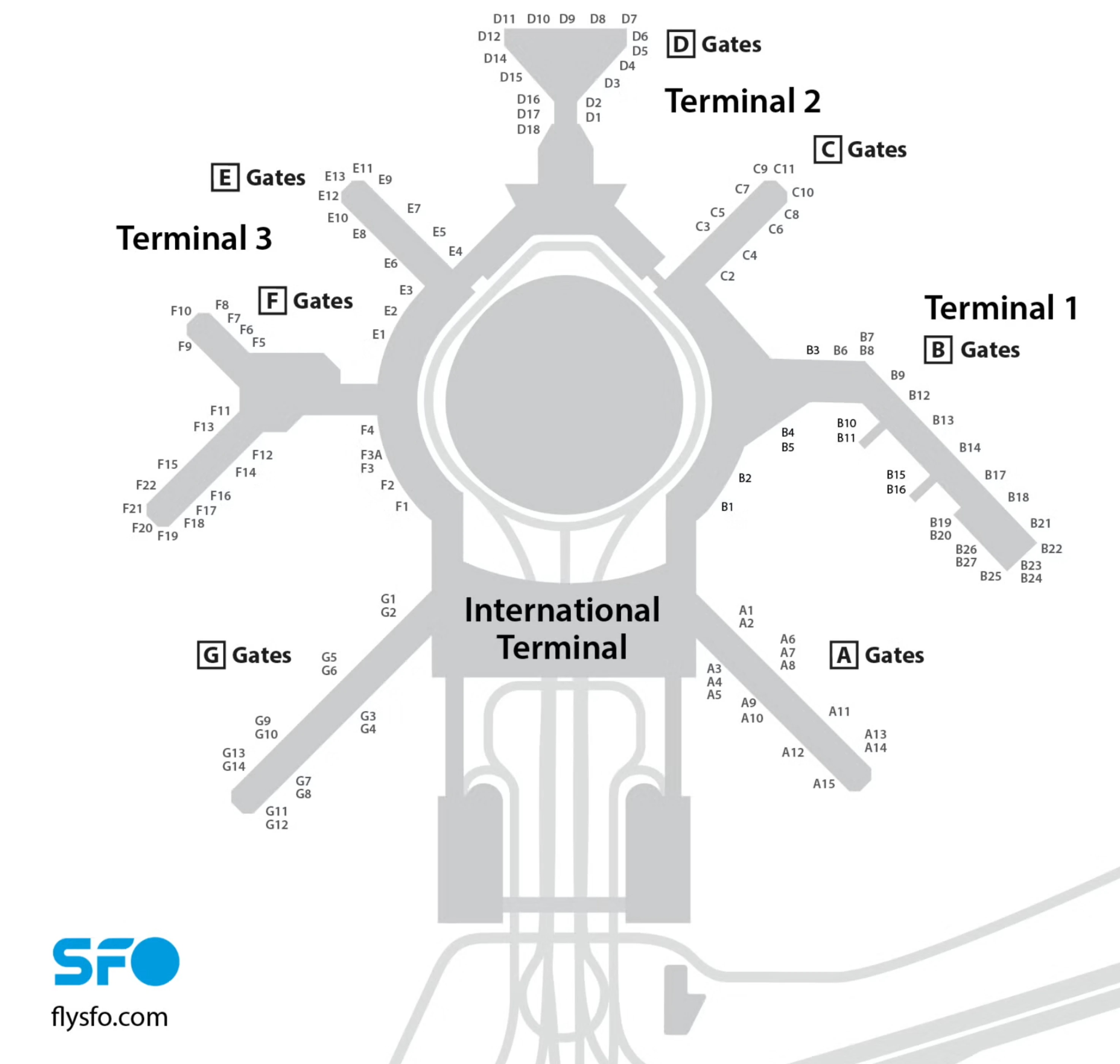
2026 San Francisco International Airport Map Guide
What is the exact walking route right now from “Terminals 2 & 3 AirTrain Station” to Terminal 3 security for E/F gates, including detour corridors, and how many minutes does it take?
Walking takes about 8–12 minutes from the “Terminals 2 & 3 AirTrain Station” to Terminal 3’s F-side security (Security Checkpoints F1/F3) because the closed Terminal 3 station forces an indoor Terminal 2-to-Terminal 3 detour.
| Segment | Exact route cues | Typical time |
|---|---|---|
| AirTrain platform → terminal entry | Exit at “Terminals 2 & 3” → take the pedestrian skybridge into the terminal complex (Core E / E-walkway entry) | 2–3 min |
| Mezzanine → Departures Level | Use the escalator/elevator bank down to Departures (you will land in the Terminal 2 lobby area) | 1–2 min |
| Terminal 2 lobby → landside connector | Stay landside, walk east past the United Airlines Terminal 2 West check-in area, following signs for Terminal 3 / Gates E–F | 3–5 min |
| Landside connector → Terminal 3 security | Continue east along the indoor corridor toward Terminal 3, passing the E-side frontage and continuing to the F rotunda for Security Checkpoints F1/F3 | 2–4 min |
Which specific drop-off door(s)/curb segment should a traveler use to reach United Terminal 3 F-gates fastest while Doors 6–13 are closed?
Arrivals Level Doors 10–12 at Terminal 3 are the fastest curb segment for United Airlines F gates while Terminal 3 Departures Doors 6–13 are closed. This drop point puts you directly under the Terminal 3 east-side United check-in and closest to Security Checkpoints F1/F3 with a one-level elevator or escalator ride up.
- Use Terminal 3 Lower Level (Arrivals), then continue down the curb toward Doors 10, 11, or 12 rather than stopping near the first baggage-claim doors.
- Enter at Door 11 or 12, then take the nearest elevator/escalator up one level to Departures.
- Follow overhead signs to United Airlines check-in (east side) and continue to Security Checkpoints F1/F3 for F gates.
- Avoid Terminal 3 Departures Doors 6–13 entirely; using Terminal 2 curb for an F-gate trip risks ending up at the wrong United check-in split and adding a long landside walk.
Where exactly are the United check-in counters in Terminal 2 (for D/E gates), and what is the shortest indoor walking path from those counters to the Terminal 2 (D) security checkpoint?
United Airlines check-in for D and E gates is located on the west side of Terminal 2, immediately inside Terminal 2 Departures Door 1 and Door 2. Walking takes under 2 minutes from those counters to Security Checkpoint D because the checkpoint sits straight ahead in the central Terminal 2 departures lobby.
- Enter Terminal 2 at Departures Door 1 or Door 2 and you’ll be in the Terminal 2 west check-in zone used for United Airlines D/E departures.
- Face toward the center of the Terminal 2 departures hall and walk forward along the open “Retail Street” lobby.
- Keep to the main central aisle; Security Checkpoint D is the primary Terminal 2 checkpoint and is the first full security queueing area you reach from that west check-in position.
After clearing Terminal 2 (D) security, what is the exact airside route to Terminal 3 E/F gates, and what is the walk time to E-gates vs F-gates?
Walking takes about 3 minutes to Terminal 3 E gates and about 6 minutes to Terminal 3 F gates after you clear Terminal 2 Security Checkpoint D, using the post-security connector that exits Terminal 2 near the east end of the secure “Retail Street” and drops you into Terminal 3 around Gate E2.
| Airside segment | Exact route cues | Walk time |
|---|---|---|
| Checkpoint D exit → connector entrance | From the end of Security Checkpoint D, stay in the secure Terminal 2 concourse and walk east along the main corridor (“Retail Street”) toward the Terminal 2 east end, using signs for “Terminal 3” / “Gates E & F” | 2–3 min |
| Connector entrance → Terminal 3 E entry | Enter the dedicated sterile connector near the east-end landmarks (museum-style art cases area / near Gate D18 zone), then follow it until it opens into Terminal 3 around Gate E2 | 1–3 min |
| Terminal 3 E entry → E vs F gates | For E gates, turn into the E concourse from the E2 area; for F gates, continue east past the E concourse frontage toward the F rotunda | E: ~3 min total; F: ~6 min total |
Where is the exact boundary point between San Francisco International Airport’s post-security “zones” (reported as A–B vs C–G), and what is the nearest exit + re-entry security point if a traveler must cross that boundary?
No airside connection exists between International Terminal A gates and International Terminal G gates, so the boundary is the International Terminal Main Hall that sits landside between them. Exiting post-security and re-clearing at the opposite checkpoint is the only practical cross-boundary method.
The break occurs where each concourse dead-ends into its own secure holdroom: Gate A is isolated on the A side, and Gate G is isolated on the G side, with the International Terminal Main Hall between them. From the G side, the nearest exit is to leave the secure area into the Main Hall and re-enter at the International Terminal A security checkpoint. From the A side, the nearest exit is into the Main Hall and re-enter at the International Terminal G security checkpoint.
From the Customs Hall exit, where is the United bag re-check lobby located (exact corridor/turns), and what is the shortest path from re-check to International Terminal G security?
Using the “Connecting Flights” doors is mandatory, because the “San Francisco” public-exit doors eject you landside with no quick way back to the re-check belts. The United Airlines bag re-check lobby sits immediately beside the Customs Hall “Connecting Flights” exit, typically just to the left of the doorway in the first connecting corridor.
After you collect bags and reach the Customs Hall exit doors, choose “Connecting Flights,” not “San Francisco.” Step through, then turn left immediately for the United bag-drop belts and agents positioned right outside that exit. After re-check, follow “G Gates / Connecting Flights” signs to the nearest vertical circulation into the International Terminal Main Hall, go up to Departures Level 3, then walk west along the Main Hall to the International Terminal G security checkpoint entrance.
For an arriving international passenger who must re-clear security, which exact security checkpoint is the fastest for A gates vs D gates vs F/G gates, and where are those checkpoints relative to the Customs Hall exit?
No airside connection exists between International Terminal A and International Terminal G, so A-gate passengers must exit to the International Terminal Main Hall and re-clear at the A checkpoint. International Terminal G security is the fastest re-entry for F and G gates, while Terminal 2 Security Checkpoint D is typically fastest for D gates if you use AirTrain from the International Terminal station.
| Gate target | Fastest checkpoint | Where it is from the Customs Hall exit |
|---|---|---|
| A gates | International Terminal A security | Exit Customs via “Connecting Flights” or public doors → reach the International Terminal Main Hall → cross to the A-side checkpoint on Departures Level 3 |
| D gates | Terminal 2 Security Checkpoint D | From the Customs Hall exit area, go to the International Terminal AirTrain station → ride to “Terminals 2 & 3” → enter Terminal 2 and proceed to Checkpoint D |
| F/G gates | International Terminal G security | Exit Customs via “Connecting Flights” → re-check bags immediately beside that exit (United bag drop) → go up to Departures Level 3 → walk west to G security |
If a passenger is walking from Terminal 3 arrivals to the International Terminal/BART, what is the exact outdoor routed path currently being used between Terminal 3 Doors 7–12, and how long does it take?
Walking takes about 8–12 minutes from Terminal 3 Arrivals Doors 7–12 to the International Terminal BART entrance because the current pedestrian connection is routed along the covered outdoor sidewalk toward International Terminal G.
| Segment | Exact route cues | Typical time |
|---|---|---|
| Terminal 3 baggage claim → Doors 7–12 | Walk to the east end of Terminal 3 Arrivals and exit through Doors 7, 8, 9, 10, 11, or 12 | 1–3 min |
| Doors 7–12 → International Terminal G frontage | Turn onto the covered outdoor sidewalk that hugs the terminal façade and follow signs for “International Terminal” and “BART,” staying on the same covered path as it runs parallel to the roadway | 4–6 min |
| International Terminal G entry → Departures Level 3 | Enter International Terminal G, then take the nearest elevator or escalator up to Departures Level 3 (Main Hall level) | 2–3 min |
| Departures Level 3 → BART entrance | Follow overhead “BART” signs on the G side of the Main Hall to the BART entrance corridor | 1–2 min |
What is the exact walking route from Terminal 3 baggage claim to the Terminal 3 rideshare pickup area during construction, including the required E walkway/garage path?
Walking takes about 10–15 minutes from Terminal 3 baggage claim to the rideshare pickup area because the F-side garage connection is closed and you must detour to the E walkway (Core E) into the Domestic Garage, then go up to Level 5.
- From Terminal 3 baggage claim, walk west inside the terminal toward the Terminal 2/Terminal 3 connector side (away from the far-east carousels) until you reach the E-side garage access area marked for the E walkway/Core E.
- Go up to the mezzanine level inside the terminal, then cross the enclosed E skybridge into the Domestic Garage (do not attempt the closed F walkway/Core F route).
- Once in the garage at Core E, take the elevator up to Level 5.
- Follow the posted “Rideshare/Uber/Lyft” wayfinding from the Core E elevator lobby across Level 5 to the designated pickup zone.
If AirTrain operations are altered late-night (11pm–5am), what is the correct line + direction to go from the BART/AirTrain station to Terminals 2/3, and what wrong-direction mistake causes the longest loop?
The correct ride is whichever late-night AirTrain shows “Terminal 1 / Terminal 2 / Terminal 3” as the next stops on the train’s digital destination signs, because line colors can run reversed during 11pm–5am maintenance. The longest-loop mistake is boarding a train whose sign shows “Rental Car Center” or “Long Term Parking” when you’re trying to reach the terminals.
| Decision point | What to do | What not to do |
|---|---|---|
| At the station platform | Board the next train whose onboard sign indicates Terminal stops next | Do not board based on “Blue vs Red” color alone late-night |
| First stop shown on the train sign | If it reads “Terminal 1 / Terminal 2 / Terminal 3,” stay on | If it reads “Rental Car Center” or “Long Term Parking,” get off and wait for the terminal-bound train |
| Wrong-direction consequence | Terminal-bound direction = short hop to “Terminals 2 & 3” | Parking/Rental direction = full-loop detour that can add 20+ minutes before you return to the terminals |
Archive San Francisco International Airport Maps
Below are all historical map versions for San Francisco International Airport. Each year includes the official map available for that period, presented as both WebP and PDF.
2024 San Francisco International Airport Map
2013 San Francisco International Airport Map