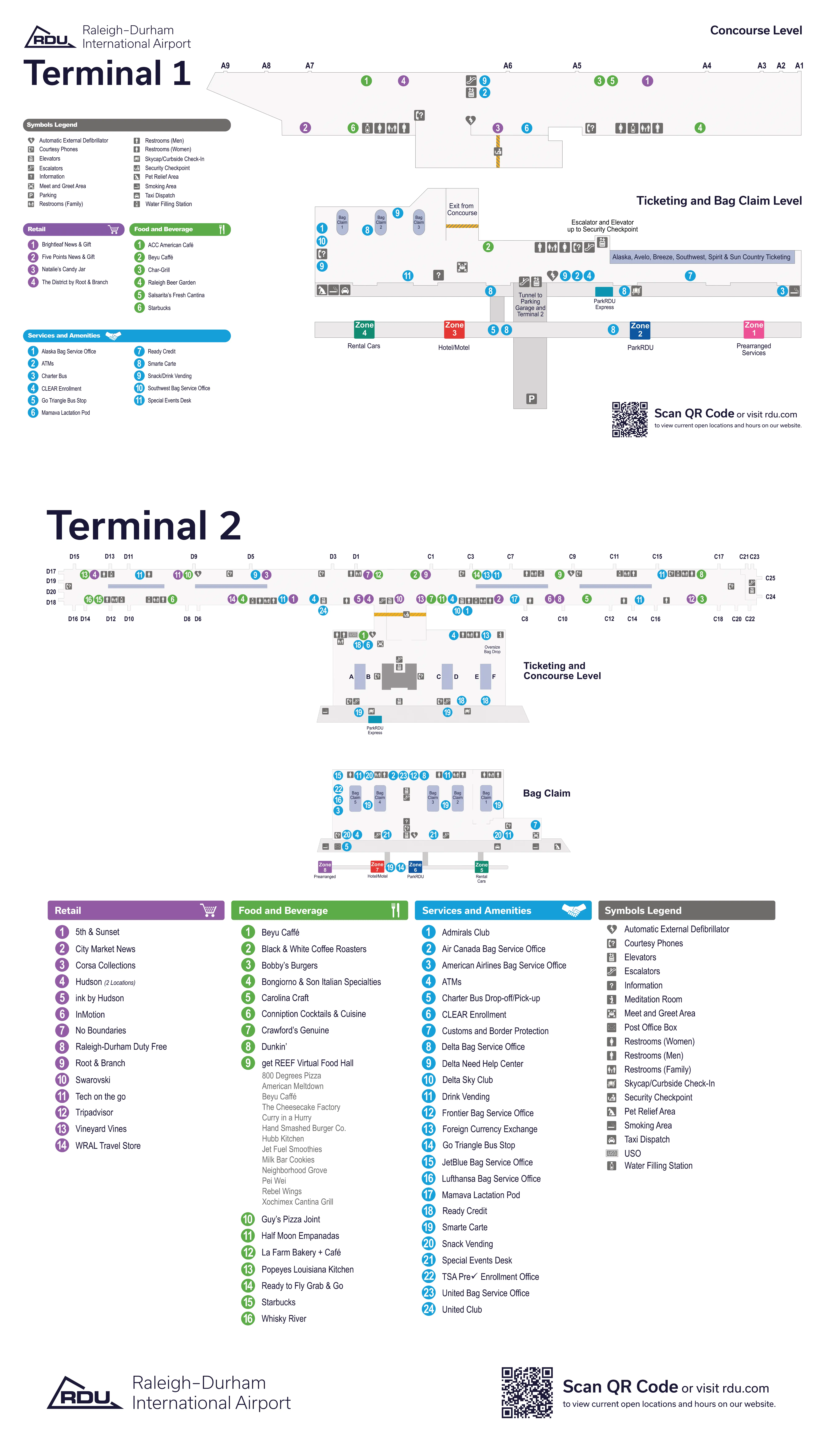
Raleigh Durham International Airport Map (Most Up-To-Date)

RDU’s passenger layout is a two-terminal split with Terminal 2 doing the heavy lift: a long, shallow “great hall” on the departures level feeding a single, centralized security array, then a post-checkpoint marketplace that splits to Concourse C (right/south) and Concourse D (left/north). Landside movement is mostly lateral (door-to-door along the curb), while the biggest orientation trap is vertical: pickups and most ground transport live downstairs even though parts of the parking shuttle system operate upstairs within the Triangle’s main airport hub.
Map Table
| Terminal | Key Airlines | Primary Function | Transfer Mode |
|---|---|---|---|
| Terminal 2 | American, Delta, United, JetBlue, Frontier, Alaska, international arrivals | Primary legacy + international processor | landside roadway loop; no airside T1/T2 connector |
| Terminal 1 | Southwest, Spirit | Low-cost departures | landside roadway loop; separate security system |
| Terminal 2 Concourse C | mixed carriers | C gates; intl arrivals positions | walk from central marketplace |
| Terminal 2 Concourse D | mixed carriers | D gates | walk from central marketplace |
Raleigh-Durham International Airport Map Strategy
- Treat the Terminal 2 checkpoint as a single point of failure: if the line is visible beyond the roped stanchions, expect it to expand sideways across ticketing toward the American Airlines counter frontage (and, at extremes, toward the doors/curb).
- Defuse the CLEAR bottleneck mentally: the slowdown isn’t “mystery delay,” it’s the merge zone near the checkpoint entrance where CLEAR inserts into screening lanes, creating stop-and-go in the adjacent standard flow.
- Lock in level rules before you exit: taxis/rideshare/bus are downstairs on arrivals/commercial island, but ParkRDU Express pickup is upstairs at Door 5—don’t follow the crowd down and wait in the wrong place.
- Commit to a pickup mode before stepping outside: taxis cluster at the north end; rideshare is geofenced to Zone 8 at the far south end; the bus stop is near Zones 6/7, so walking the wrong direction creates avoidable backtracking.
2026 Raleigh Durham International Airport Map + Printable PDF
Terminal 2’s map-relevant reality in 2026 is still dominated by a single-checkpoint model and queue geometry: when the checkpoint saturates, the line expands laterally into ticketing and can spill toward airline counter frontage and even the curb. Ground transport remains level-dependent (arrivals/downstairs vs departures/upstairs), with the ParkRDU Express “upstairs pickup” at Door 5 continuing to be the most common wrong-level mistake for returning drivers.
Archive Raleigh Durham International Airport Map
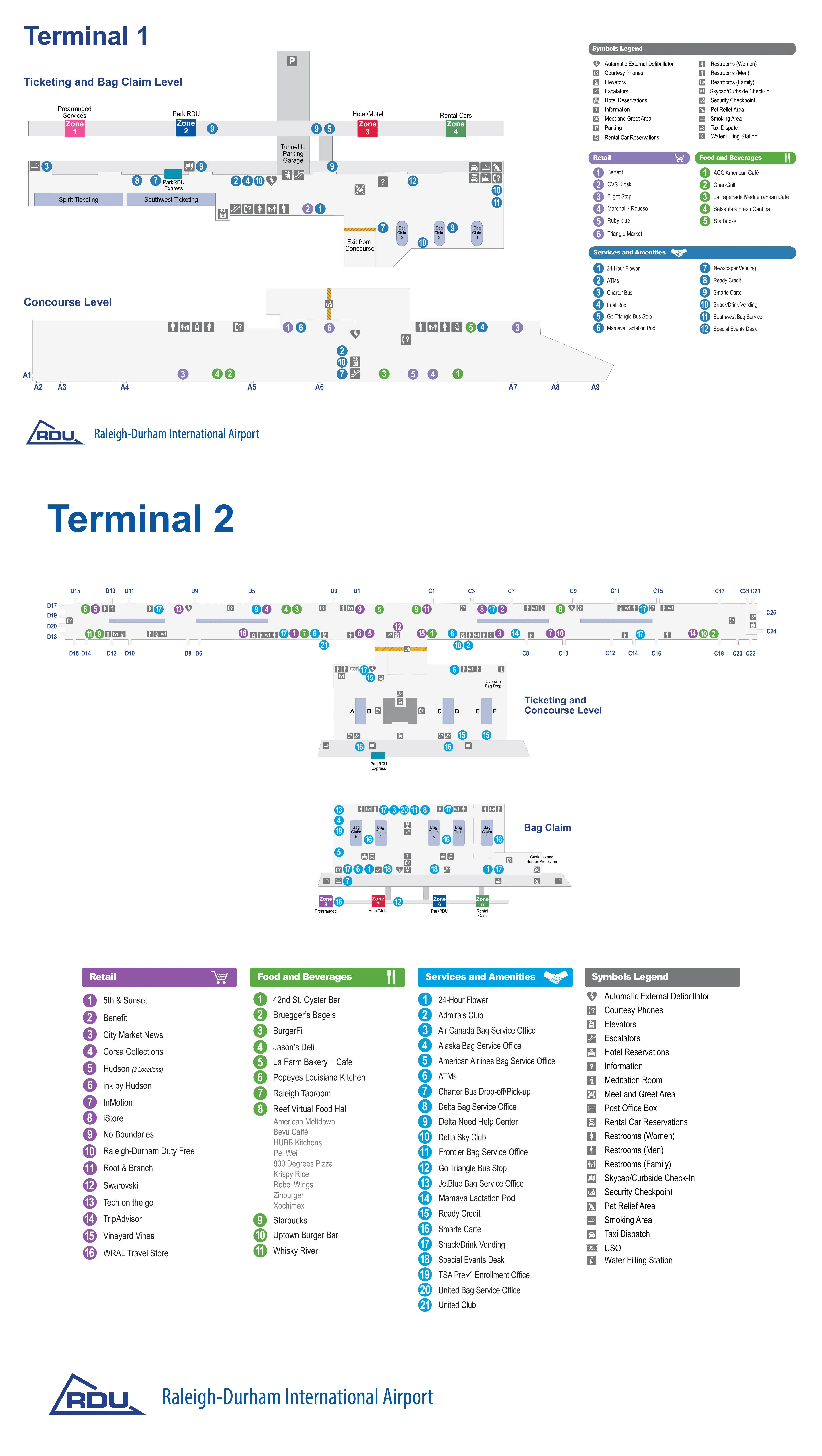
Below are all historical map versions for Raleigh Durham International Airport. Each year includes the official map available for that period, presented as both WebP and PDF.
2022 Raleigh Durham International Airport Map
2026 Raleigh Durham International Airport Map Guide
What is the exact walking distance from the Terminal 2 main entrance to the nearest TSA checkpoint queue start point (where the line physically begins)?
Walking is about 50–100 meters (roughly 150–300 feet) from a Terminal 2 departures entrance door to the point where the TSA queue physically begins at the checkpoint stanchions. The variability comes from which numbered door you enter (Door 1–Door 5) and whether the “start point” is still inside the roped area or has already spilled into the open ticketing hall.
During normal flow, the queue start is the stanchion入口 directly in front of the central checkpoint on the upper-level ticketing hall, opposite the check-in counter wall. In early-morning surges, the practical “start” shifts outward into the lobby circulation space, so the first visible tail of the line may be closer to the entry doors—especially for travelers entering near the middle doors (around Door 3/4) versus the far ends.
Where does the TSA queue overflow extend to in Terminal 2 during peak backups (specific landmark-by-landmark path)?
The overflow line extends laterally across the upper-level ticketing lobby, then snakes back toward the American Airlines counter frontage, and in extreme peaks can push out through the departures doors and onto the curb. The most reliable “you’re at peak backup” landmark is the line reaching the window/counter area by the AA counters.
The typical overflow progression is: checkpoint stanchion maze fills at the central screening entrance → tail breaks out into the open ticketing hall circulation lane → line continues sideways along the airside face of ticketing toward the American Airlines side of the hall → tail wraps near the AA counter windows; on rare holiday/Monday-morning surges, it continues to the nearest departures doors and visibly extends outside along the curb line.
What is the precise location (map pin) of the CLEAR queue entrance relative to the standard TSA line in Terminal 2?
The CLEAR queue entrance sits pre-security on the upper-level ticketing hall across from the Delta Air Lines ticketing counter, positioned adjacent to the checkpoint entry so it can feed into the screening lanes ahead of the standard serpentine. Relative to the standard TSA line, it’s offset to the Delta-side of the checkpoint frontage rather than starting at the main stanchion tail.
From a wayfinding standpoint, use this triangulation: face the central security checkpoint from the ticketing hall → locate the Delta ticket counter bank behind/near you → the CLEAR entrance is in that same central-north sector, near the checkpoint approach, where CLEAR kiosks and ambassadors stage before escorting members forward. If you’re standing at the visible tail of the standard line that has spilled toward the American Airlines counters, the CLEAR entrance is back toward the center of the hall, nearer Delta, not out at the AA-side overflow.
What is the minimum corridor width / pinch point location where the CLEAR setup constricts passenger flow (exact spot on the plan)?
The pinch point is the merge zone at the checkpoint entrance where the CLEAR biometric kiosks feed into the same screening-lane mouth as PreCheck/standard passengers. That constriction happens right at the front end of the stanchioned checkpoint approach—where ambassadors physically escort a CLEAR member across/into the active entry stream toward the belt/ID-check position.
On the plan, anchor it as: upper-level ticketing hall → central security checkpoint frontage → across from the Delta ticketing area → the narrowest functional “corridor” is the gap between CLEAR’s kiosk/queue footprint and the adjacent standard flow immediately before the ID check / lane assignment point. When that gap is occupied by a CLEAR escort movement, the neighboring line momentarily pauses, creating the stop-and-go effect travelers attribute to “CLEAR geometry.”
Where is the nearest alternative checkpoint a traveler can reroute to once they see the Terminal 2 line spill out (exact reroute path on the map)?
There is no alternative security checkpoint in Terminal 2, so you can’t reroute to a different entrance once the line spills into ticketing. The only workable “reroute” is choosing a different queue type at the same central checkpoint (standard vs TSA PreCheck vs CLEAR) if you’re eligible.
Terminal 2 funnels all Concourse C and Concourse D departures through the single central checkpoint on the upper-level ticketing hall, and Terminal 1 is not an airside workaround because the terminals aren’t connected after security. If you encounter a spill that’s already snaked toward the American Airlines counter frontage, the fastest move is to keep walking back toward the central checkpoint face (near the Delta-side area) and enter the correct dedicated lane entrance rather than joining the first visible tail you see.
What is the exact walking distance from the Terminal 2 airline check-in counters to the TSA queue entrance (front-to-front)?
Walking is under 50 meters from the front edge of the Terminal 2 check-in counter line to the TSA queue entrance at the central checkpoint stanchions. It’s a short cross-hall movement rather than a corridor walk.
The ticketing lobby is a shallow rectangle: counters run along the landside wall, while the checkpoint sits centrally on the opposite (airside) side. In low congestion, you can go from a bag-drop position at the counter frontage straight across the open floor to the stanchioned queue start in well under a minute. In peak periods, the practical travel time is longer because you’re threading through perpendicular bag-drop lines and any security overflow that has spilled into the same circulation strip.
Where is the bag-drop / checked-bag acceptance physically positioned relative to Door numbers / curbside zones in Terminal 2 (exact placement)?
Checked-bag acceptance is on the upper-level ticketing hall directly inside the departures curb doors, running in a long, continuous counter line parallel to the curb from roughly Door 1 through Door 5. The functional placement is “immediately landside” of the entrances: step in from the curb doors and the airline counter frontage is the dominant edge of the room.
Landmark triangulation within Terminal 2: Door numbers (1–5) line the departures curb → inside each door is the same ticketing hall → the check-in/bag-drop counters form the long wall opposite the central security checkpoint. The most map-useful anchors from your audit context are that Delta’s counter bank is in the central-north sector (near where CLEAR stages), while American’s counter frontage sits on a flank that becomes a common spillover basin when the TSA line snakes laterally toward the AA window/counter area.
What is the exact shuttle drop-off point for major offsite lots at Terminal 2, including the level (upstairs curbside vs downstairs)?
ParkRDU Express uses the upper-level departures curb at Door 5 for both drop-off and pickup at Terminal 2, which is the key “wrong level” anomaly. Economy parking shuttles follow the standard terminal-serving pattern and drop passengers at the terminal curb on the departures level for flights.
Use these anchors: ParkRDU Express → Terminal 2 → Door 5 → upstairs (departures) curbside. If you’re returning to parking after landing, the practical instruction is to go up from baggage claim/arrivals to the ticketing/departures level and exit at Door 5, because waiting downstairs on arrivals won’t match where ParkRDU Express actually loads.
What is the exact walking distance from the Terminal 2 shuttle drop-off to the closest airline check-in row?
Walking is about 10–20 meters from the ParkRDU Express drop-off at Door 5 to the nearest section of the Terminal 2 check-in counter frontage. The distance is essentially curb-to-lobby: step off the shuttle, enter Door 5, and you’re immediately at the end of the ticketing hall where the counter line begins.
The key landmark chain is: upper-level departures curb → Door 5 → immediate entry into the ticketing lobby → nearest airline counter positions along the long check-in wall. The only meaningful variability is whether you measure to the very first counter position inside the door or to your specific airline’s counter bank, which may require a longer lateral walk down the hall.
Where is the pedestrian-safe route from economy/remote parking shuttle stop to the Terminal 2 entrance (no-road-crossing path)?
There is no pedestrian-safe walking route from the remote economy/overflow lots to Terminal 2, so a “no-road-crossing” path doesn’t exist as a practical option. The pedestrian-safe solution is to stay on the shuttle all the way to the terminal curb and enter from the departures doors.
The remote lots are separated from the terminal core by airport road infrastructure and distance, and the workable, intended connection is the Economy shuttle system that serves the terminals. If you’re at the economy/remote stop and trying to minimize exposure to traffic, the safest protocol is to treat the shuttle as mandatory, then use the terminal-side curb/sidewalk directly into the nearest departures door rather than attempting any cross-lot or roadway walk toward Terminal 2.
Where is the taxi pickup zone located on the terminal curb map (exact curb segment / door range)?
The taxi pickup zone is on the Terminal 2 lower-level arrivals curb at the north end of the commercial ground-transport area. It’s separated from the private pickup curb and from rideshare by both signage and physical distance along the same linear curb frontage.
Use this landmark chain: go downstairs to baggage claim/arrivals → exit to the curb → cross to the commercial island area used for for-hire modes → walk toward the north end of that island to the taxi stand line. If you find yourself near the rideshare “Zone 8” signage, you’re at the opposite end and need to walk back north for taxis.
Where is the rideshare (Uber/Lyft) pickup zone relative to the taxi stand (exact separation on the curb layout)?
Rideshare pickup is on the Terminal 2 lower-level arrivals commercial island at Zone 8, positioned at the far south end, while the taxi stand is at the north end of the same lower-level commercial curb. They’re at opposite poles of the curb frontage rather than adjacent bays.
The practical separation is a long, linear walk along the commercial island: exit baggage claim to arrivals → cross toward the commercial island → for rideshare, walk right/south down the platform to Zone 8; for taxis, walk left/north to the taxi queue area. If you’re standing at the taxi line and decide to switch to Uber/Lyft, expect a significant trek down the island to reach the Zone 8 geofenced pickup area.
What is the exact walking distance from baggage claim to the ground-transport pickup curb used for taxis?
Walking is about 30–50 meters from the Terminal 2 baggage claim exit doors to the taxi pickup curb on the lower-level arrivals side, assuming you head directly toward the north-end taxi stand after stepping outside. Most of that distance is the curb-to-island movement rather than an indoor corridor.
The route is: exit the baggage claim hall to the arrivals curb → move through the marked pedestrian crossing area to the commercial island → continue toward the north end where the taxi queue forms. If you exit near a more central door, the distance stays in that 30–50 meter range to reach the taxi curb edge, then increases slightly if you have to walk further along the island to the active front of the taxi line.
Where is the airport bus stop (Route 100 / transit) located relative to Terminal 1 vs Terminal 2 entrances (exact stop position)?
The Route 100 public transit stop at Terminal 2 is on the lower-level arrivals commercial curb around Zones 6/7, while Terminal 1’s corresponding stop area is around Zones 2/3. That places Terminal 2’s bus stop near the same south-end cluster that also includes rideshare signage and the walk toward Zone 8.
Use this anchor logic: if you’re at Terminal 2 and see Zone 8 rideshare wayfinding, you’re close—Zones 6/7 are just up-island from that. If you’re at Terminal 1, look for the much earlier zone numbering (2/3), which sits closer to the terminal’s own arrivals frontage rather than the far end of a long commercial island.
What is the shortest indoor walking route from the transit stop to the Terminal 2 ticketing hall (exact turns/landmarks)?
Walking goes from the Zone 6/7 bus stop into the nearest lower-level Terminal 2 arrivals doorway, then to the central “Meeting Place” area, then up by elevator/escalator to the upper-level ticketing hall. That’s the shortest fully indoor path once you’ve stepped off the bus at the commercial curb.
Use these landmarks in order: Zone 6/7 signage on the lower-level commercial island → cross into Terminal 2 through the closest arrivals doors → follow the interior flow toward the Meeting Place anchor in the arrivals hall → take the nearest escalators/elevators up to departures/ticketing → exit onto the upper-level ticketing lobby where the check-in counters line the long wall and the central security checkpoint sits opposite.