Lisbon Humberto Delgado Airport Map (Most Up-To-Date)

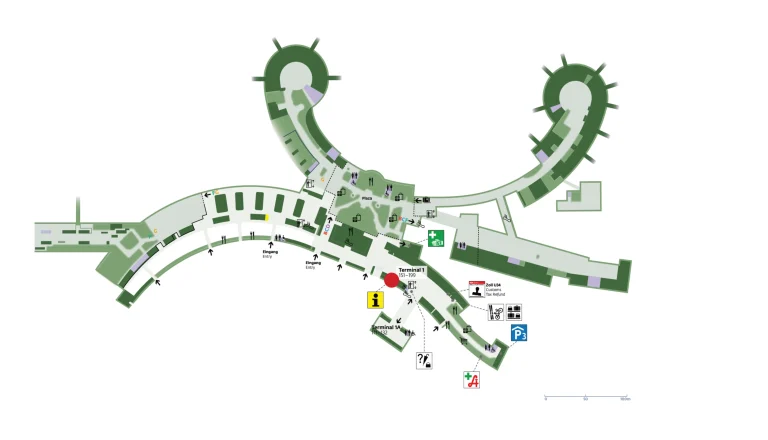
Lisbon Airport’s terminal layout is a two-node system: a dense, multi-level Terminal 1 spine with Schengen vs Non-Schengen splits, plus a simple Terminal 2 satellite about 1 km to the west. Most passenger flow compresses into a few choke corridors—security, passport control, and bus-gate stairs—so “short” walks can still feel high-risk. This terminal map focuses on recovery moves inside the Lisbon metro air hub when one delay starts cascading.
Map Table
| Terminal | Key Airlines | Primary Function | Transfer Mode |
|---|---|---|---|
| Terminal 1 | TAP Air Portugal, Star Alliance, most carriers | All arrivals, most departures | Walk, escalator/elevator, passport control split |
| Terminal 2 | Ryanair, Wizz Air, easyJet | Low-cost departures only | Free landside shuttle from T1 Departures curb |
| Remote stands / bus gates (T1) | Mixed carriers | Bus boarding, bus arrivals intake | Downstairs holding areas, apron buses |
Lisbon Humberto Delgado Airport Terminal Map Strategy
- Treat passport control and security as time-variable chokepoints, not “steps”; build your buffer around the queue entrance, not your gate number.
- Lock in the Terminal 1 ↔ Terminal 2 transfer rule: the free shuttle is a landside move from T1 Departures level, not the Arrivals curb.
- Assume remote stands/bus gates add an extra vertical move plus a bus wait; if your boarding pass shows a bus gate, stop lingering in Praça Lisboa.
- Avoid wrong-queue penalties at immigration: aim for the split point first, then commit to the correct lane (e-gates vs staffed booths vs all-passports).
2026 Lisbon Humberto Delgado Airport Map + Printable PDF
Peak-hour operations at LIS still behave like a “cascade failure” system: remote-stand bussing spikes queues, security and passport control volatility destroys buffers, and the Terminal 1 ↔ Terminal 2 dependency adds a hidden landside step. Printing a 2026 terminal map is most useful when you mark three things before you arrive: the T1 passport-control interfaces, the T1 departures-level shuttle access for T2, and the downstairs bus-gate paths.
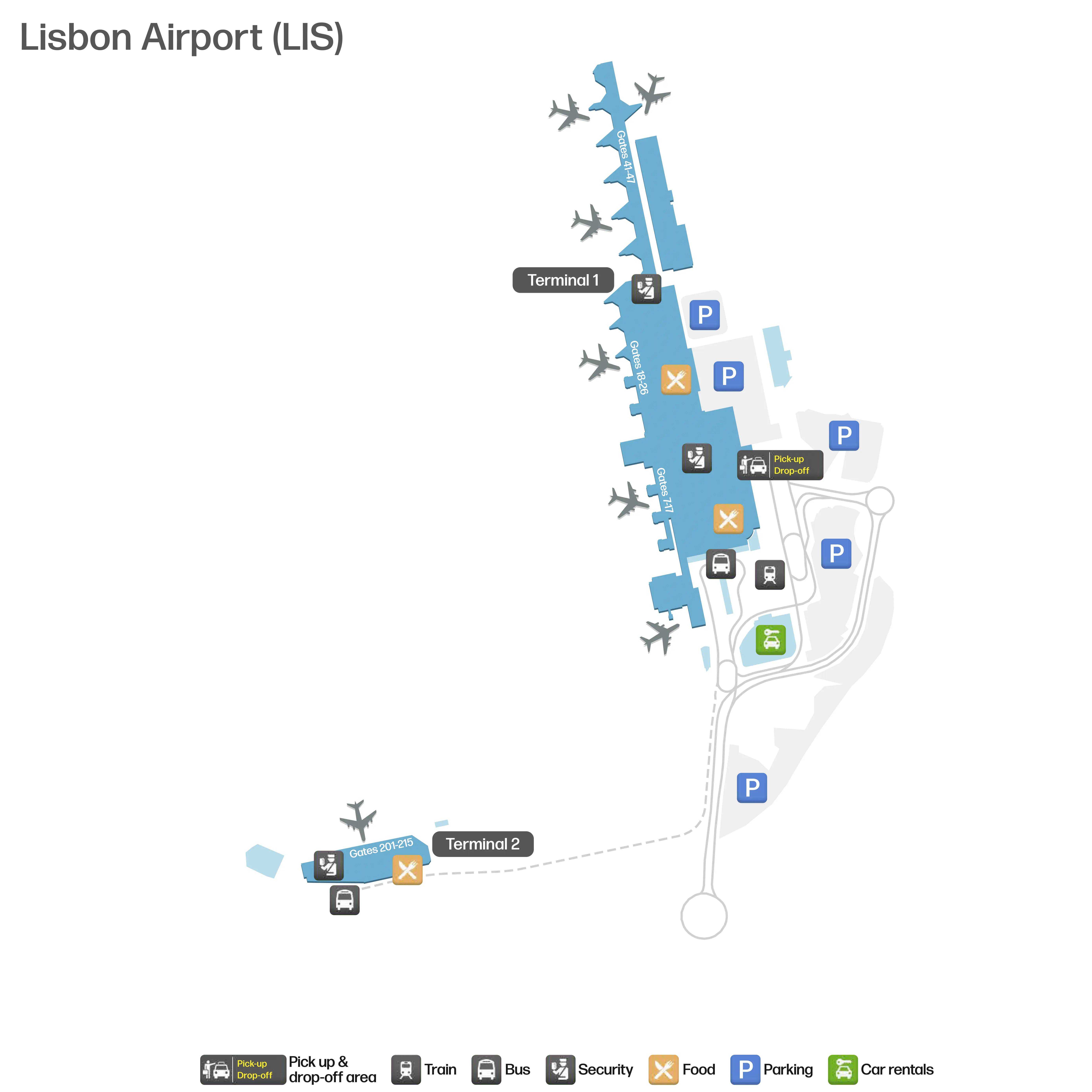
2026 Lisbon Humberto Delgado Airport Map Guide
What is the exact walking distance (meters) from the Arrivals passport-control exit in Terminal 1 to the first baggage-claim belt area?
The walk is about 250 meters from the Terminal 1 Arrivals passport-control exit to the first baggage-claim belt area.
| Segment | Landmark triangulation | Distance |
|---|---|---|
| Passport control exit → transition corridor | glass exit doors from Immigration Hall → “Baggage reclaim” overhead signs | ~60 m |
| Transition corridor → baggage hall entry | main corridor bend → baggage reclaim hall threshold | ~120 m |
| Baggage hall entry → first belt area | hall entrance → first carousel cluster on nearest side | ~70 m |
Where is the nearest restroom to the Arrivals passport-control queue area in Terminal 1 (exact location by corridor/landmark), without exiting into landside?
No restroom access exists once you commit to the Terminal 1 Arrivals passport-control queue without backing out of the line.
Restrooms sit in two practical places relative to the immigration hall: in the arrivals pier corridor just before the immigration entrance, and again only after you exit passport control into the baggage-claim side. The “point of no return” is the serpentine queue mouth at the immigration hall entrance—once you pass into the taped/railed lanes, you’re inside a sterile holding pen with no facilities until baggage reclaim.
From Terminal 1 Arrivals, what is the exact door/level you must reach to board the free shuttle to Terminal 2?
The free Terminal 2 shuttle boards from Terminal 1 Departures Level 1 at the main curbside bus stop, not the Arrivals level.
Arriving into Terminal 1, you start on Level 0 (Arrivals). Stay inside the building, follow signage toward Metro/Departures, then take the nearest escalators or elevators up to Level 1 (Departures). Exit through the main Departures doors to the curb; the Terminal 2 shuttle stop is the signed stop on the Departures curb, positioned to the right-hand side as you face outward toward the roadway.
What is the shortest walking route (and distance) from the Terminal 2 shuttle drop-off point to the Ryanair check-in counters (or the main low-cost check-in zone)?
The walk is under 50 meters from the Terminal 2 shuttle drop-off to the Ryanair check-in and main low-cost check-in zone.
| Step | Landmark triangulation | Distance |
|---|---|---|
| Shuttle door → Terminal 2 entrance doors | curb drop-off point → main Departures doors | ~10–20 m |
| Entrance doors → check-in hall counters | inside entry line → left-side check-in/bag drop bank | ~20–30 m |
After clearing Security in Terminal 1, what is the exact walking distance to the non-Schengen exit passport-control queue entrance?
The walk is about 300–400 meters from the Terminal 1 Security exit to the Non-Schengen departures passport-control queue entrance.
| Segment | Landmark triangulation | Distance |
|---|---|---|
| Security exit → duty-free funnel end | security outflow → end of the mandatory duty-free maze | ~150–220 m |
| Praça Lisboa → passport-control queue mouth | central food court (“Praça Lisboa”) → “Gates N” signage and queue rails at the border entrance | ~150–180 m |
Where exactly are the e-gates positioned relative to staffed passport booths in Terminal 1 departures (which side/approach lane), so travelers don’t join the wrong queue?
The e-gates sit on the right or far-right side of the departures passport-control approach in Terminal 1, with staffed passport booths to the left/center.
Approaching the Non-Schengen border from Praça Lisboa, follow the “Gates N” signs until you reach the queue-rail mouth. The lanes typically split at the approach: e-gates on the right-hand bank (often with green/automatic-gate indicators), and manual processing feeding into left/center lanes for staffed booths (“All passports” and special cases like families/minors or e-gate rejections). If the pre-border crowd overflows backward, the first crush point can hide the split—push to the triage point before committing to a lane.
What is the shortest path (distance + turns) from the Terminal 1 central food/duty-free zone to the passport-control queue entrance (so stopping briefly doesn’t cause a wrong-turn delay)?
The path is a straight, forward traverse of Praça Lisboa to the “Gates N” border, about 150–180 meters beyond the central food/duty-free exit.
| Move | Landmark triangulation | Distance |
|---|---|---|
| Exit duty-free → enter Praça Lisboa | duty-free funnel exit → open atrium/food court seating | ~0–20 m |
| Go straight through Praça Lisboa | food court core → far end where “Gates N” signs dominate | ~120–150 m |
| Reach the queue mouth | “Gates N” overhead signs → first queue rails/passport-control entry | ~30 m |
Where are the “bus gate / remote stand” departure holding areas in Terminal 1 (exact corridor/zone), and what is the walking distance from Security exit to that zone?
The bus-gate / remote-stand departure holding areas sit on Terminal 1’s ground level below the main concourse, reached by stairs/escalators from the airside retail/gate spine.
Bus boarding is routed “downstairs” from the primary departures level: Schengen-side bus gates are typically accessed from the S-concourse spine, while Non-Schengen-side bus gates are accessed from the N-gates side using similar down-routes near the border-controlled corridor. Look for gate screens and signs that direct you to a lower-level holding pen rather than to a jet-bridge pier.
| Route | Landmark triangulation | Distance |
|---|---|---|
| Security exit → descent access point | security outflow → nearest “Bus gates / Boarding by bus” signs near the central spine | ~150–250 m |
| Descent → holding pen entry | top-of-escalator/stairs → ground-level holding area doors/queue lanes | ~30–60 m |
If you arrive on a remote stand and are bused to the terminal, what is the exact drop-off entry point into Terminal 1 (door/level), and where does that funnel you next?
The remote-stand bus drops you at a ground-level intake on Terminal 1’s northern perimeter at Level 0, feeding straight into the transfer/immigration funnel.
Unlike jet-bridge arrivals that often feed into higher-level corridors before you descend, bus arrivals are injected at ground level and can feel disorienting after a 10–15 minute apron drive. From that Level 0 intake, follow the passenger flow toward Arrivals processing; Non-Schengen arrivals are funneled directly toward the passport-control hall bottleneck, while all flows ultimately converge toward the post-control transition corridor that leads into baggage reclaim.
Where is the largest seating cluster located after passport control in Terminal 1, and what is the walking distance from passport control exit to that seating area?
The largest “after passport control” seating cluster in Terminal 1 is effectively the gate seating spread across the Non-Schengen N-gates holdroom, not a single centralized lounge-style seating zone.
Post-border, the amenities drop off sharply compared with Praça Lisboa, so the densest seating you’ll find is the aggregate around the individual N-gates, with smaller café seating pockets (often cited near spots like “First Class Café” / “Specially,” depending on what’s open). From the passport-control exit into the Non-Schengen airside, the first meaningful gate-seating area is typically a short walk down the N-gates corridor.
| Segment | Landmark triangulation | Distance |
|---|---|---|
| Passport control exit → first N-gates seating | border exit doors → first gate holdroom seating bank | ~50–120 m |
What is the exact location of the TAP/contract lounge area relative to passport control (before vs after), and what is the walking distance from lounge exit to passport control entry?
The TAP Premium Lounge Tejo is before departures passport control, while the TAP Premium Lounge Atlântico is after passport control in the Non-Schengen N-gates zone.
| Lounge | Relative to passport control | Landmark triangulation | Walk from lounge exit → passport-control entry |
|---|---|---|---|
| TAP Premium Lounge Tejo | Before | above Praça Lisboa food court (upper level) | ~150–220 m (includes a level change down to the Praça Lisboa spine) |
| TAP Premium Lounge Atlântico | After | Non-Schengen airside near the N-gates corridor | ~30–80 m (reverse walk back toward the border approach) |
From Terminal 1 baggage claim, what is the exact signed route (doors/level) to the official Uber/Bolt pickup zone?
The official Uber/Bolt pickup is in the P2 Car Park on Level 2, reached from Terminal 1 Arrivals by following the “Pre-Reservas Online / Ride Sharing” routing out of the terminal.
Exit baggage reclaim into the public Arrivals hall on Level 0. Turn left and walk past the Starbucks on your left, then follow the blue wayfinding that reads “Pre-Reservas Online” (often used as the ride-share/online pre-booked pickup cue). Exit the terminal and cross into the P2 car park structure, then go up to Level 2 by elevator or ramp to reach the designated ride-share pickup area.
From Terminal 1 Arrivals, what is the shortest indoor route (with elevators/escalators) to the Metro station entrance (Aeroporto / Red Line access point)?
The route is an immediate right turn from the Terminal 1 Arrivals hall to the northern exit doors, with the Metro entrance about 50 meters outside along the terminal wall.
After you exit customs into the public Arrivals hall (Level 0), turn right immediately and head toward the northernmost set of doors. Once outside, the Aeroporto (Red Line) Metro entrance is the standalone access point adjacent to the terminal, marked by the red “M.” Use the long escalators down to platform level, or take the elevator if you need step-free access.
Where do the EU vs non-EU passport-control queues physically begin (exact split point/landmark), and which corridor(s) do they block first when they overflow?
The EU vs non-EU split begins at the immigration hall entrance triage point immediately before the passport-control booths, where the lanes divide toward e-gates on the right and manual/all-passports lines to the left/center.
In normal conditions, you’ll see the split where queue rails start and overhead lane signs become readable; that’s the decision point to choose e-gates (typically right/far-right) versus staffed booths. When the system overloads, the first blockage happens before that split: the pre-immigration approach corridor backs up into a single undifferentiated mass, which physically blocks access to the faster EU/e-gate lanes until you push through to the triage mouth. Staff in vests may attempt manual sorting there, but overflow often defeats the signage first.
What is the shortest route (and distance) from Terminal 2 security exit to its farthest departure gates (highest-numbered gates), identifying the main choke corridor?
The walk is under 200 meters from the Terminal 2 security exit to the farthest departure gates, with the main choke being the single common departure lounge corridor where queues form.
| Step | Landmark triangulation | Distance | Choke point |
|---|---|---|---|
| Security exit → main lounge spine | security outflow → open common waiting area | ~20–40 m | immediate crowding at the release point |
| Lounge spine → farthest gate doors | central lounge → highest-numbered gate end of the hall | ~120–160 m | narrowest pedestrian lane where gate queues protrude |