Kingsford Smith International Airport Map (Most Up-To-Date)

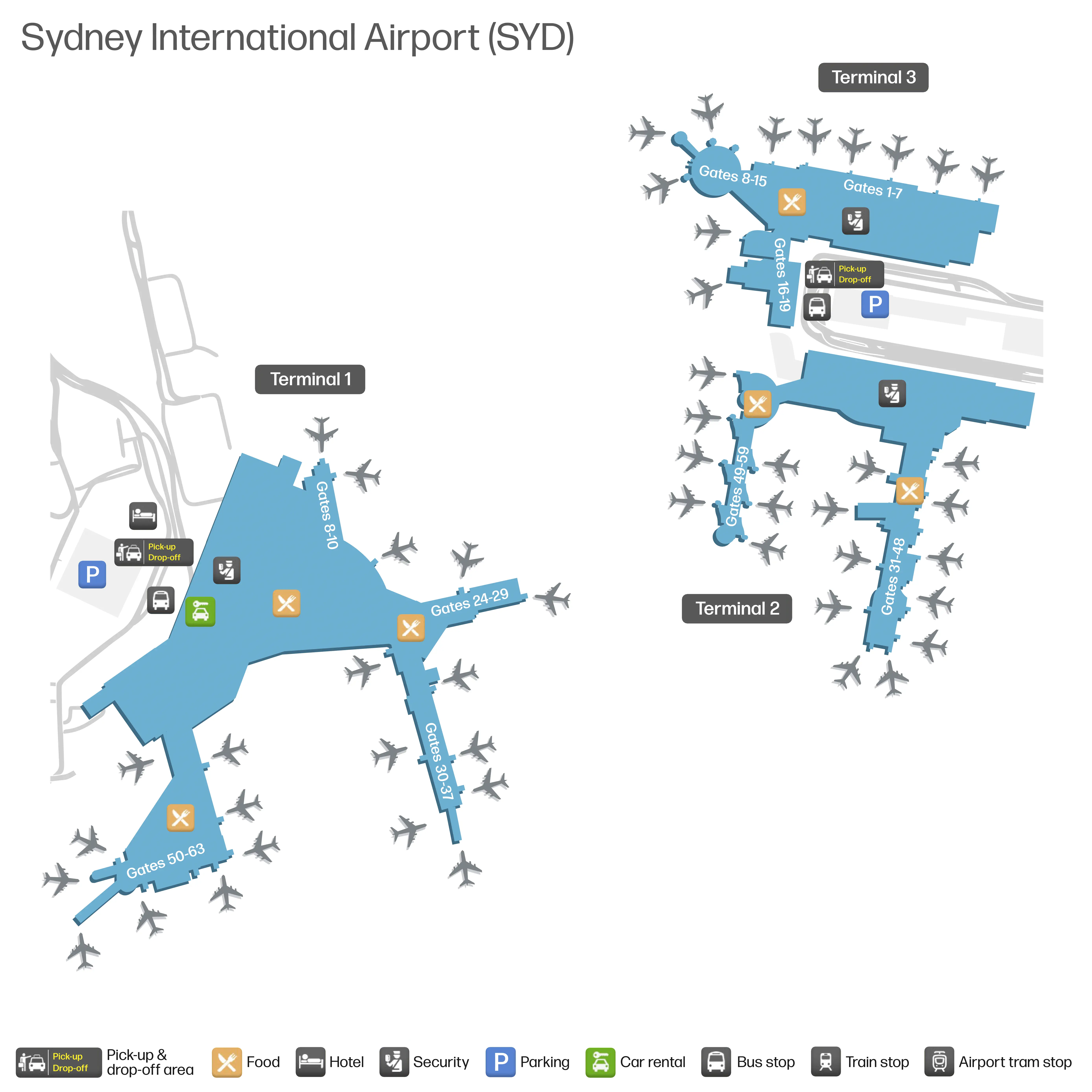
Kingsford Smith International Airport is a split-precinct layout with Terminal 1 (International) in the northwest sector and Terminals 2–3 (Domestic) grouped in the northeast, separated by runways and perimeter roads. The terminal footprint is long and linear at T1, with Arrivals Hall A and B anchoring opposite ends of the landside flow, while T2/T3 sit closer together with a direct pedestrian link. Transfers are landside-only across the SYD hub via road shuttles or rail.
Map Table
| Terminal | Key Airlines | Primary Function | Transfer Mode |
|---|---|---|---|
| Terminal 1 (International) | Qantas International, Emirates, Singapore Airlines | Immigration, baggage reclaim, biosecurity, arrivals halls A/B | Airport Link rail, T-Bus (Hall B), Uber Rank C, P9 Express Pick-up |
| Terminal 2 (Domestic) | Virgin Australia, Jetstar, Rex | Domestic check-in, security, gates | T-Bus to T1, walk link to T3, rail via Airport Station |
| Terminal 3 (Domestic) | Qantas Domestic | Domestic check-in, gates, Qantas transfers | Gate 15 airside transfer bus, T-Bus curbside, walk link to T2 |
Kingsford Smith International Airport Map Strategy
- Treat SYD as two airports: T1 vs T2/T3. Budget extra buffer for any cross-precinct move because it’s road/rail dependent, not an internal tram.
- Decide your “A/B end” before you exit customs at T1. Arrivals Hall B is the fastest path for T-Bus and rideshare; Arrivals Hall A is the fastest path for Airport Link rail and the shortest approach toward P9.
- For T3→T1 connections, avoid the landside trap: Gate 15 transfer is airside-only for eligible through-checked bags; once you exit to baggage/curbside, you’ve committed to the slower re-check + rescreen path.
- For pickups, memorize the color logic: Yellow signage for P9 Express Pick-up (15 minutes free) vs Green signage for priority/paid zones; one wrong turn can become a paid “penalty route.”
2026 Kingsford Smith International Airport Map + Printable PDF
Recent wayfinding risk at SYD still concentrates around Arrivals Hall A vs B mismatches, stacked exit queues, and curbside zoning that can funnel you into paid “wrong-lane” pickup routes. Current operational notes also include ongoing flow-capture upgrades in T1 arrivals processing (extra kiosk capacity added upstream of immigration) and continued reliance on landside transfers between T1 and the domestic precinct.
2026 Kingsford Smith International Airport Map Guide
Where is the Gate 15 transfer-bus pickup point inside T3 (exact corridor/landmark reference)?
The Gate 15 transfer-bus pickup point is inside the secure departures concourse at the northeastern end of Terminal 3, using the Gate 15 lounge/holding area as the staging point for the Qantas “Seamless Transfer” bus. It’s not reachable from landside without re-entering security.
Follow “International Transfer” wayfinding with the Qantas kangaroo logo and stay on Level 2 (Departures). Keep moving away from the central escalator banks that drop to baggage reclaim, then continue along the departures pier toward the higher-numbered gates until you reach Gate 15’s gate lounge area, where staff desks verify boarding passes and through-checked baggage before loading.
What is the walking distance (meters) from T3 Arrivals exit to the Gate 15 transfer-bus queue area?
No direct walk exists from the T3 Arrivals exit to the Gate 15 transfer-bus queue because Gate 15 is airside and the Arrivals exit is landside. Once you exit via baggage reclaim doors, you must use the landside re-check path to regain airside access.
The practical walking distance via the landside process is about 265 meters. The route runs from the T3 baggage reclaim glass-door exit along the arrivals concourse to the Qantas transfer/check-in desk area (about 215 meters), then through the dedicated security screening and onward corridor into the airside transfer holding area (about 50 meters more).
In T1 arrivals, where is the “Nothing to declare” exit path located relative to the baggage carousels (which side/end of the hall)?
The “Nothing to declare” path is on the outer edges of the customs/biosecurity hall after baggage claim, not in the center. The green-channel lanes flank the central “Goods to declare” (red-channel) processing area.
After you leave your baggage carousel and enter the customs/biosecurity hall, look toward the exit wall: the green-channel lanes run along the far left and far right sides, with the declare/inspection flow in the middle. Carousel position effectively determines which side you’ll be pushed to—southern carousels (roughly 1–4) tend to feed the right-side green lanes toward Arrivals Exit B, while northern carousels (roughly 8–12) tend to feed the left-side green lanes toward Arrivals Exit A.
Where are the self-service declaration/kiosk machines positioned in T1 arrivals relative to the main passenger flow from gates?
The self-service kiosks are positioned before passport control, intercepting you while you’re still walking in from the gates and again in a large bank just before the immigration queue. They are not placed in the public arrivals hall after customs.
After you leave the aircraft and move down the arrivals piers (notably the long Pier B / Pier C corridors), kiosk clusters sit along the sides so you can complete the step without breaking the walking flow. The biggest concentration is in the Arrivals Ticket Hall immediately before the passport control area, facing the approach into the SmartGate/immigration entry point. If you reach the immigration queue without using a kiosk, you’re typically forced to backtrack into that ticket-hall zone.
If the Gate 15 bus isn’t running, where is the replacement transfer-bus pickup point on T3 Departures level (exact door/bay)?
No replacement transfer bus picks up on the T3 Departures level because the elevated roadway is private-vehicle drop-off only and doesn’t have shuttle bus bays. The fallback pickup is on the Arrivals level curb (Ground) using the T-Bus or Qantas landside shuttle stop between T2 and T3.
From inside T3, exit to Ground/Arrivals and go out through the arrivals glass doors. Outside, turn right and follow the sheltered walkway toward Terminal 2. Watch for the fixed orange “T-Bus” signage marking the stop in the curbside/median area between the terminals (not upstairs at departures).
What is the walking distance (meters) from the replacement bus pickup point to the nearest T3 security entry used for onward domestic processing?
The walking distance is about 150–160 meters from the T3 Arrivals-level replacement bus drop/pickup area to the main T3 security entry on Departures (Level 2). The route is short but can be slow when escalators and the atrium choke up.
From the curbside stop, cross into the T3 Arrivals Hall (about 40 meters), continue to the central escalator/elevator bank in the main atrium (about 60 meters), go up to Level 2, then walk from the top landing back toward the central security checkpoint (about 40 meters).
Where is the “15-minute Quick Pick-up” area for T1 International (exact car-park/zone name and pedestrian exit it connects to)?
The 15-minute Quick Pick-up area is the P9 Public Pick-up Zone (often signed as Express Pick-up with yellow signage) located in the open-air P9 car park off Centre Road. It connects most directly to the Arrivals Hall A end of the terminal for the shortest pedestrian approach.
For the cleanest approach, aim to exit the terminal at the Arrivals A end (near the northern side of T1). From that side, follow the pedestrian crossings over the loop road toward the P9 facility entrance. This avoids mixing up the yellow Express/P9 routing with the green Priority/Paid pickup routing that can funnel drivers into a paid zone.
What is the walking distance (meters) from T1 Arrivals (exit doors) to the Quick Pick-up pedestrian meeting point?
The walking distance is about 350–400 meters from the T1 Arrivals exit doors to the P9 Quick Pick-up pedestrian meeting point. The walk is longer than most people expect because P9 is a remote lot across the loop road.
From either arrivals end, you cross the forecourt and then use the marked pedestrian crossings over Airport Drive/Centre Road into the open-air P9 Public Pick-up Zone. If you exit closer to Arrivals Hall A, you’re typically near the low end of that range; starting at Arrivals Hall B adds extra terminal-length walking before you even begin the road-crossing segment.
Where exactly is the Terminal Transfer Bus stop at T1 (outside Arrivals Hall B)—which curb/side and what fixed landmarks identify it?
The Terminal Transfer Bus (T-Bus) stop is immediately outside T1 Arrivals Hall B on the inner curbside lane closest to the terminal building. It’s meant to be a short, straight walk from the Hall B glass doors.
Exit through the Arrivals Hall B doors and look across the paved forecourt to the curb where buses stage; the stop is marked by orange “T-Bus” wayfinding/signage and sits directly in front of the Hall B frontage rather than out toward the outer traffic lanes. Ignore older “Bus Bay 21” references and use the fixed landmark of “Outside Arrivals Hall B” to anchor your search.
What is the walking distance (meters) from T1 Arrivals Hall B doors to the Terminal Transfer Bus stop?
The walking distance is about 20–50 meters from the T1 Arrivals Hall B doors to the Terminal Transfer Bus stop. It’s essentially a forecourt crossing from the glass doors to the inner curb lane.
Exit Hall B, walk straight across the paved area in front of the terminal facade, and you’ll reach the marked T-Bus zone at the curb closest to the building. The main variable is exactly which door panel you exit through and where the bus is staged within the Hall B frontage.
Where is the door “on the left” after customs that connects to the Virgin Australia transfer desk (exactly which exit bank / nearby signage)?
The Virgin Australia transfer-desk access is the Arrivals Exit A side, where the first left turn after clearing the secure customs doors puts you into the public Arrivals Hall facing the Virgin Australia Transfer Desk area. This is the A-end exit bank that tends to receive passengers funneled through the Arrivals A green-channel flow.
As you come out of the customs/biosecurity zone and pass through the exit doors into the public meet-and-greet hall, orient to the Arrivals A side amenities and wayfinding (train direction/McDonald’s end). The transfer desk sits against the interior wall on that left side, positioned to intercept connecting passengers before they drift deeper into the hall or out to curbside.
What is the distance (meters) from that Virgin Australia transfer-desk door to the bus queue pickup area used for onward terminal transfer?
The distance is about 180 meters from the Virgin Australia transfer-desk door area near Arrivals Hall A to the T-Bus pickup zone outside Arrivals Hall B. This is a terminal-length traverse through a crowded meet-and-greet environment.
After dropping bags at the Virgin Australia Transfer Desk, you continue along the public arrivals frontage toward the opposite end of the terminal (A → B). The most direct path is the straight interior walk past the landside shops and waiting area toward Hall B, then out to the Hall B curb where the T-Bus zone is staged.
Where is the rideshare pickup zone at T1 (level + named area) that the green signs route you to?
The rideshare pickup zone at T1 is on the Arrivals level (Ground) at Rank C. This is the dedicated rideshare queue area positioned close to the terminal frontage rather than in the multi-storey car parks.
Follow the green wayfinding for rideshare from inside T1 arrivals and aim for the Hall B end of the terminal, where Rank C is staged near the building facade. At Rank C, the flow is set up for rapid loading from a managed queue (often using PIN-based boarding for standard rideshare services), with adjacent ranks used for higher-tier pickups.
Which single pedestrian exit from T1 most directly feeds into the rideshare pickup queue (minimizing wrong-lane/paid-zone mistakes)?
The Arrivals Hall B exit most directly feeds into the rideshare pickup queue at Rank C. That door puts you onto the correct curbside frontage with the shortest walk and the least chance of drifting into paid pickup zones.
If you arrive at the Arrivals Hall A end, stay inside the terminal and walk to Hall B before exiting. Exiting at Hall B places you closest to the Rank C staging area near the building facade and keeps you aligned with the rideshare queue flow instead of crossing lanes or following signage that can lead toward other pickup products.
Where is the Airport Link train station entrance from T1 (exact internal connection point), and which doors lead to it?
The Airport Link train station entrance is at the northern end of T1 at Arrivals Hall A, connected internally from the landside arrivals concourse near the Hall A amenities cluster. The closest exterior access is via the Arrivals Exit A doors.
Inside T1, follow “Trains” wayfinding toward the Arrivals Hall A end (the McDonald’s/Exit A side). From the public arrivals hall, the station access point is reached by continuing toward that A-end connection rather than exiting at Hall B. If you exit via Hall B, you’ll need to walk the length of the terminal landside to reach the Hall A station entrance.
What is the shortest mapped walking route distance (meters) between T2 and T3 via the P1 car park pedestrian path?
The shortest mapped walking route distance is about 245–250 meters between T2 and T3 using the covered pedestrian link via the P1 (Prime Park) path. This is the most direct level-grade connection between the terminals.
The route runs from a T2 Arrivals door to the start of the pedestrian walkway (about 50 meters), then across the covered walkway section (about 145 meters), then from the far end of the walkway to a T3 Arrivals door (about 50 meters). This surface link is typically faster and simpler than routing via the underground rail concourse because it avoids vertical escalator transitions.