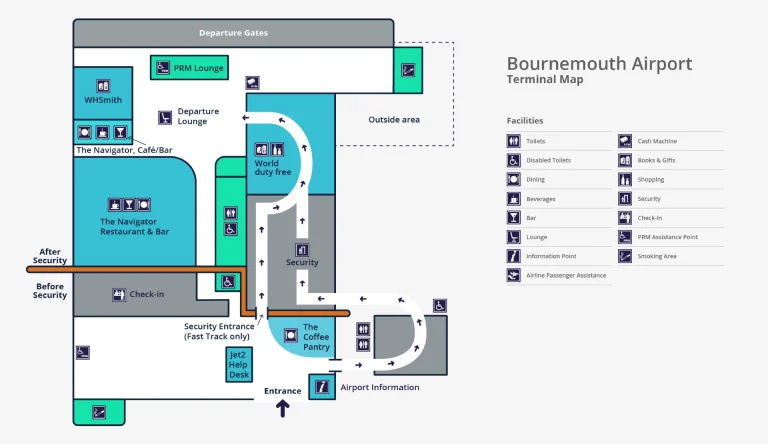
I Gusti Ngurah Rai International Airport Map (Most Up-To-Date)

I Gusti Ngurah Rai International Airport uses an L-shaped terminal layout with long, linear gate corridors and clear vertical separation by floor: International Arrivals on the ground level, International Departures above, and a higher commercial/lounge layer within Bali’s main airport gateway. The biggest navigation risk is missing the last “decision nodes” before queues lock you in—especially at immigration and at landside pickup areas—so this map focuses on where to turn, where to commit, and where not to stop.
Map Table
| Terminal | Key Airlines | Primary Function | Transfer Mode |
|---|---|---|---|
| International Terminal | Wide mix; long-haul + regional | Arrivals immigration; Departures check-in; airside gates | Landside walk; rideshare lounge pickup |
| Domestic Terminal | Indonesia domestic networks | Domestic arrivals/departures | Covered walkway; golf cart via parking garage |
| Parking structures | N/A | Pickup staging; terminal connectors | Pedestrian bridges; escalators/elevators |
| Landside transport zone | Official taxi; prebooked drivers; rideshare | Ticketed taxi booth; name-sign meetups; Grab dispatch | “Clean path” right-turn; lounge-based pickup |
I Gusti Ngurah Rai International Airport Map Strategy
- Treat immigration as a one-way commitment: decide autogates vs manual before you enter the stanchions, and avoid any “toilet stop” in the long hallway if the hall ahead is already stacking.
- Use map-verified landmarks after customs to stay out of the solicitor swarm: WHSmith → Starbucks → branded rideshare totem → Grab Lounge, instead of stopping in the central arrivals crush zone.
- Expect inconsistent departures throughput: pick the shorter first-stage security entry by walking to the far left or far right edges of the departures frontage, not the busiest center access.
- Reduce pickup confusion by pre-choosing one target: official taxi booth via an immediate right turn, or prebooked/Grab via the landmark corridor—mixing both routes is what triggers backtracking and unwanted approaches.
2026 I Gusti Ngurah Rai International Airport Map + Printable PDF
Peak-flow conditions at I Gusti Ngurah Rai International Airport in 2026 still hinge on burst arrivals (including bus-gate dumps) feeding directly into immigration and then into the customs exit funnel, where signage and queue discipline can break down. Autogates remain a major throughput lever when eligible, but the last switch point is tight. Landside, rideshare pickups continue to depend on official lounge/staging routing rather than curb pickup, so printing a map that shows the arrivals exit, Starbucks/WHSmith spine, and the rideshare lounge route prevents dead-end wandering.
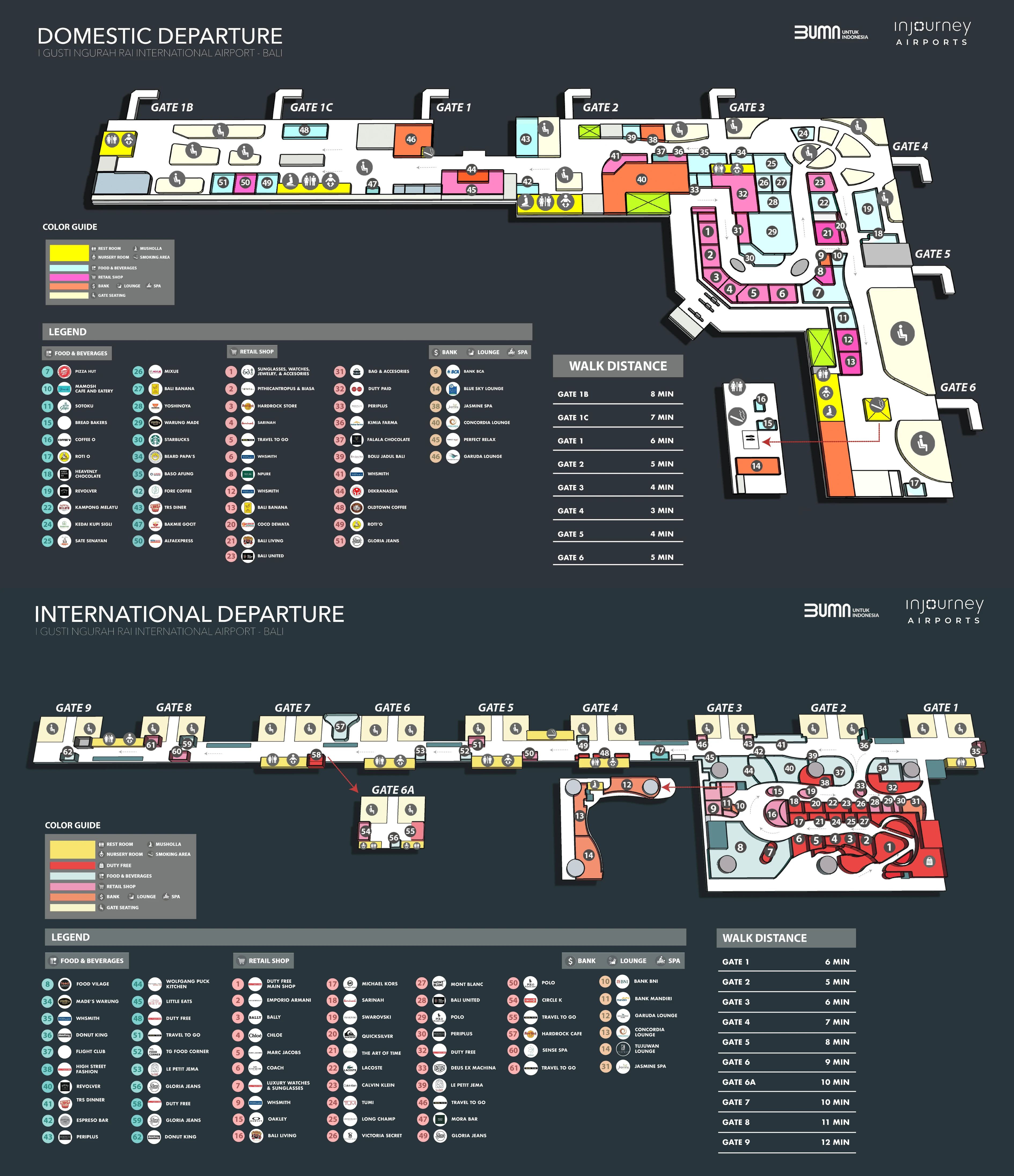
I Gusti Ngurah Rai International Airport Domestic Terminal Departure Map 2026
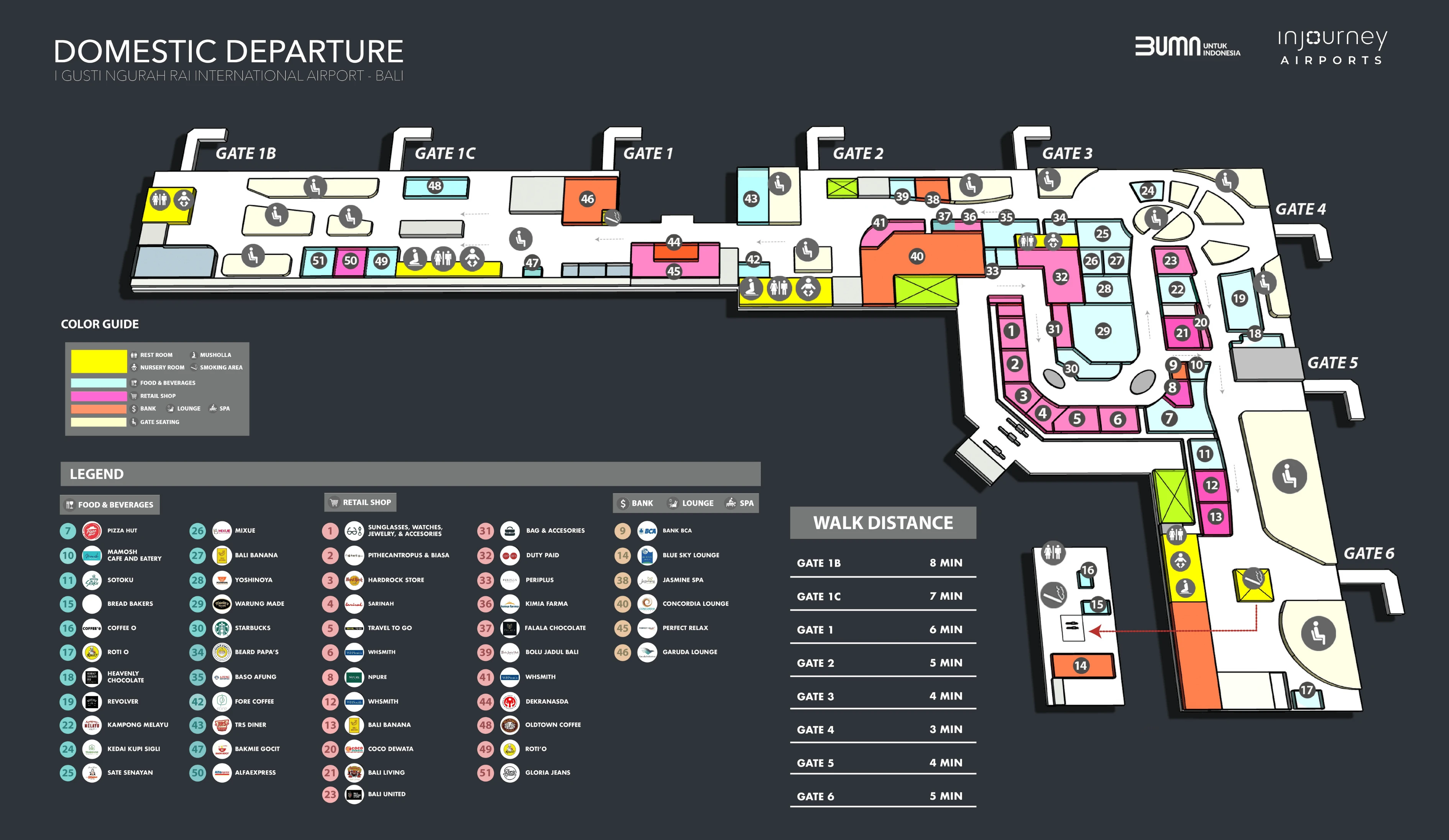
I Gusti Ngurah Rai International Airport International Terminal Departure Map 2026
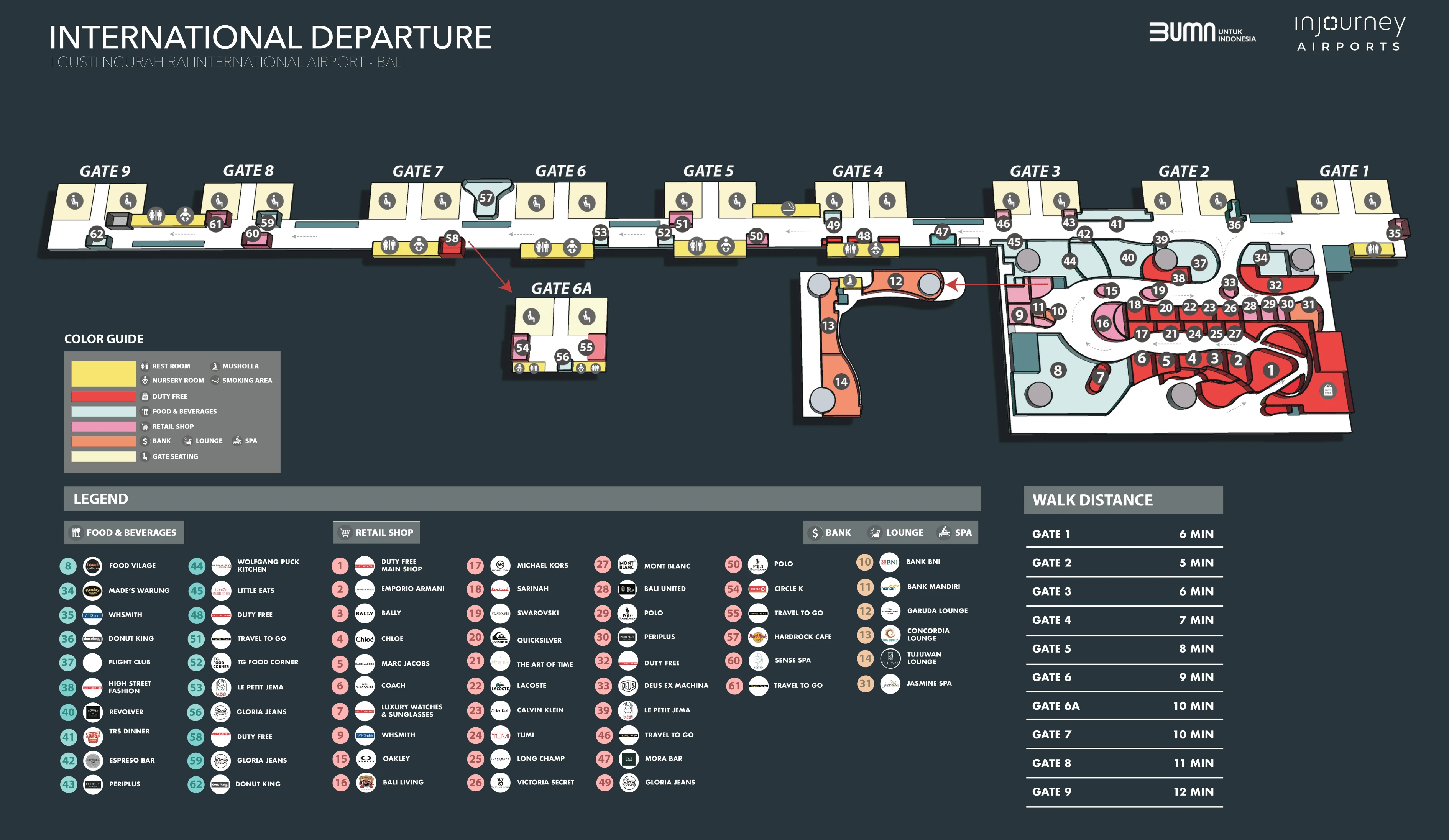
2026 I Gusti Ngurah Rai International Airport Map Guide
What is the exact walking route (door-by-door) from International Arrivals exit to the official Grab pickup point (including the parking-structure crossing and level)?
Grab pickup at I Gusti Ngurah Rai International Airport is not allowed at the arrivals curb, so the route must run through the arrivals public hall to the dedicated Grab Lounge and then out to the marked vehicle bay.
Exit customs into the public arrivals hall through the glass doors, then walk straight through the money-changer frontage toward the main pedestrian spine. Stay on the ground level and pass WHSmith, then continue straight past Starbucks. Keep following the same corridor as it trends toward the Domestic Arrivals side, watching for the vertical Grab branding pillar (“Grab Totem”). At the totem, continue forward to the dedicated Grab Lounge (bright green, air-conditioned). Inside, get a dispatcher pickup number, then exit the lounge and turn right to the designated Grab pickup point in the adjacent landside pickup area.
Where is the exact “riders wait here” staging area inside Arrivals described as the “cafe thing,” and what is the shortest path from baggage/customs exit to it?
The “cafe thing” staging area is the Klook lounge cafe near the landside arrivals spine, positioned just beyond the Starbucks-side corridor where name-sign pickups commonly cluster.
From the customs glass doors, walk forward into the public hall and aim for the Starbucks landmark on the ground floor. Continue past the taxi counter frontage without stopping in the central crowd, then follow the left-hand corridor that runs along the arrivals spine. The Klook-branded cafe/lounge appears ahead as a fixed meet point where staff and drivers hold name signs. If your booking references an alternate landmark, Circle K is used by some operators (for example, KKday) in the same general arrivals-hall zone, so the shortest path still keys off Starbucks as the first anchor.
From baggage claim belt area to the start of the main immigration hall queue, what is the walking distance and which chokepoint (corridor/turn/merge) causes the line to stack?
This route is not applicable because immigration is cleared before baggage claim at I Gusti Ngurah Rai International Airport’s international arrivals flow, so you cannot walk from baggage belts back to the start of the immigration queue without reversing through controlled boundaries.
Immigration sits upstream of baggage reclaim: passengers leave the gate corridor, enter the immigration hall, clear passport control (manual booths or autogates), and only then reach the baggage belts. The stacking chokepoint that triggers the worst queue compression is the immigration hall entrance where the long arrivals corridor feeds into the stanchioned queue banks, especially when bus arrivals release a synchronized surge. Toilet clusters along the corridor create a secondary friction point because stopping there costs positions before the hall entry compresses into the queue lanes.
Where are the auto-gate/e-kiosk banks positioned relative to the manual immigration booths, and what is the last decision point where you can switch lanes without backtracking?
The autogate bank is positioned as a separate processing block from the manual immigration booths, with both options fed from the same immigration hall entry but splitting into distinct stanchioned queue banks.
Inside the immigration hall, follow the initial flow to the front edge of the stanchions where signage and staff direct passengers to either the autogates (biometric gates) or the manual booth lanes. The last clean decision point is the immigration hall entrance at the start of the stanchioned queue area—before you step into either serpentine lane. Once you enter the manual-booth serpentine, crowd density and barriers make lane changes effectively impossible without pushing backward through people, so commit at the stanchion mouth rather than after you’ve started weaving.
At International Departures, where exactly are the two entry sides (the “other side of the line”) used to find a shorter queue, and how do you reach the alternate side from the check-in hall?
The two alternate entry sides are the far left and far right ends of the departures frontage where first-stage security screening feeds into the same check-in hall but often runs shorter than the central access.
From curbside drop-off, enter the departures level and identify the first-stage security point (the luggage X-ray screening that gates access into the check-in hall). If the center queue is congested, walk along the outside edge of the departures façade toward either extremity of the frontage—far left or far right—until you reach a parallel security entry with its own stanchions. After you clear that screening, you are inside the same check-in hall with the same counter rows. From inside the hall, reaching the “other side” simply means walking laterally along the counter frontage toward the opposite end before committing to a security-entry queue, rather than joining the first line you see.
What is the exact route from check-in counters to outbound passport control and then to the first gate corridor—identifying the single tightest pinch point where queues stack?
The route runs as a straight-through sequence from the check-in hall into secondary screening, then into outbound passport control, and finally into the airside commercial level before you drop into the gate corridors.
After checking in on the departures level, walk toward the central departures processing corridor that collects multiple check-in rows into one flow. Clear the secondary security screening that sits between the public check-in zone and the controlled departures zone, then continue straight into outbound passport control. The single tightest pinch point is the merge where several check-in-row streams converge into the passport control queue mouth, creating a sudden compression at the stanchion entry. After passport control, proceed into the airside commercial zone on the upper level, then follow signs down into the main gate corridors that extend along the terminal’s L-shaped spine.
For a self-transfer, what is the precise walking path between the domestic-side arrival exit and the international check-in hall (including any connector segments)?
This self-transfer is landside only with no airside connector, so you must exit the domestic terminal, cross via the covered walkway, and enter international departures from the public side.
After you exit Domestic Arrivals into the public area (with bags collected), turn toward the inter-terminal pedestrian connection and enter the covered walkway that links the domestic and international buildings. Stay on the marked pedestrian path and follow the signage toward the International Terminal; do not use vehicle ramps or flyovers. The walk typically takes under 10 minutes end to end and delivers you to the landside frontage of International Departures. Enter the international departures building on the departures level and proceed to the check-in hall with the counter rows. If you need reduced walking or have heavy luggage, the alternate connector is the golf cart shuttle that routes through the parking garage, accessed by walking from the domestic exit toward the parking structure shuttle node.
Where is the exact meeting zone for prebooked drivers (name-sign pickups) after customs, and what fixed landmarks separate it from unofficial-driver approaches?
The prebooked name-sign meeting zone is in the arrivals public hall near the Klook lounge cafe along the Starbucks-side corridor, where operators cluster with branded staff rather than free-roaming solicitors.
After customs, use Starbucks as the first fixed anchor on the ground floor arrivals spine, then continue along the corridor toward the Klook-branded cafe/lounge where name-sign pickups commonly stage. The separation cue is spatial: official meetups stay tight to fixed commercial landmarks (Starbucks frontage, the Klook lounge cafe, and in some cases the Circle K convenience-store landmark used by certain operators), while unofficial drivers position themselves in the central open concourse immediately outside the customs doors and along the densest pedestrian crush. If you keep moving past the first crowd cluster and only stop at the branded cafe/lounge landmark, you avoid the highest-contact solicitation pocket.
Where are the official taxi queue and booth positioned relative to Arrivals, and what is the shortest “clean path” that minimizes contact with solicitors?
The official taxi booth is just to the right after you exit customs into the public arrivals hall, positioned beyond the first crowd cluster and after the hotel-driver waiting zone.
Use a “clean path” that avoids the central concourse. Step through the customs glass doors, do not stop in the first open crowd pocket, and turn immediately right along the edge of the hall. Keep to the right-hand wall past the hotel-driver waiting area until you reach the small official taxi counter (Koperasi Jasa Angkutan Taxi Ngurah Rai Bali). Pay at the booth for a fixed zone price and take the printed ticket, then follow the directed path to the taxi queue/pickup. This right-edge routing minimizes exposure to the main solicitor corridor that forms straight ahead of the customs exit.
Where are the airside lounges (e.g., Premier / Concordia) located relative to the main departures spine, and what is the walking distance from lounge entrance to the nearest gate cluster?
Premier Lounge is airside on the upper commercial level near Gates 1–2, and Concordia Lounge is also airside on the same upper layer off the departures spine, with access via a left-side lift or stairs after passport control.
Both lounges sit after outbound passport control, where passengers enter the airside commercial zone before branching into the gate corridors. Premier Lounge is anchored closest to the early gate cluster around Gates 1 and 2, so the nearest-gates walk is only a short hop from the lounge entrance into that cluster. Concordia Lounge requires a small vertical move (lift or stairs) on the left side after clearing passport control, then returns you to the same airside spine. For far gates on the long L-shaped corridor (for example, Gates 10–14), the walk can stretch to roughly 10–12 minutes from the lounge area due to the terminal’s length.
What is the exact location of the most reliable Wi-Fi connection zone inside the terminal (closest to Arrivals flow) so travelers can book rides without stopping in high-congestion corridors?
The most reliable Wi-Fi zone is on the ground-floor arrivals spine near the Starbucks and WHSmith cluster, close enough to the customs exit flow to connect without standing in the main choke corridors.
After you clear customs into the public hall, move forward along the pedestrian spine until you are adjacent to WHSmith and the nearby Starbucks frontage. This pocket consistently holds strong signal for the “NgurahRaiFreeWifi” network and gives enough standing space to open apps and confirm bookings without blocking the customs-door outflow. If you’re continuing to rideshare, the signal typically remains strong inside the dedicated Grab Lounge as well, letting you finish ride confirmation in a controlled, air-conditioned staging area instead of lingering in the busiest arrivals concourse.
Where is the nearest legal smoking area relative to Arrivals exit, and what is the shortest route that does not force you through driver-waiting bottlenecks?
The nearest legal smoking area is immediately to the right after you exit customs into the public arrivals hall, positioned near the open-air transport pickup edge.
Exit through the customs glass doors and avoid the central crowd by turning right straight away. Walk past the official taxi counter area and continue roughly 20 meters toward the open-air pickup zone on the right side, where the designated smoking area sits adjacent to the transport frontage. This route stays on the hall’s right edge, which bypasses the densest driver-waiting pocket that forms straight ahead and along the main central arrivals spine.