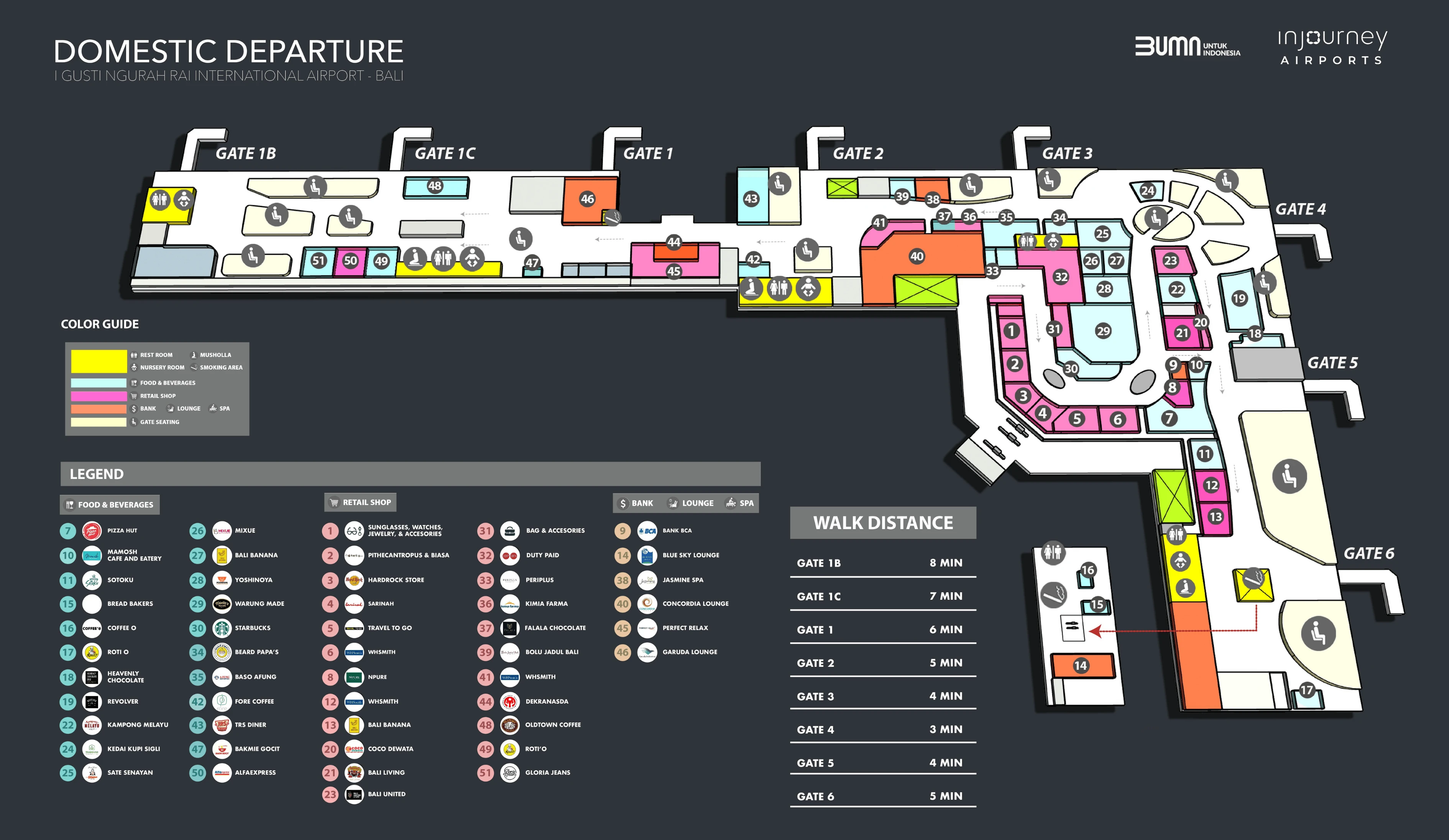
I Gusti Ngurah Rai International Airport Domestic Terminal Map (Most Up-To-Date)

The Domestic Terminal at I Gusti Ngurah Rai International Airport (DPS) is an L-shaped, two-level terminal with Arrivals on the lower level and Departures stacked above, stretched along a linear gate pier that concentrates crowds near the main security throat. It sits beside the international building within Bali’s main airport complex, but the practical connection is a long landside corridor that runs through public zones, parking structure segments, and curbside roads.
Map Table
| Level | Primary Function | Key Nodes | Landside Connections |
|---|---|---|---|
| Lower | Arrivals | baggage belts (x5), arrivals exit, official taxi counter | Domestic parking building, rideshare routing, park/meet zone |
| Upper | Departures | check-in hall (62 counters), first security entry, escalators/elevators | curbside drop-off, inter-terminal pedestrian approach |
| Airside | Gates | Gate 1–6, lounge cluster (Gate 1 / 2 / 6) | post-security retail/seating spine |
I Gusti Ngurah Rai International Airport Domestic Terminal Map Strategy
- Treat International → Domestic as a landside, partly exposed transfer: follow “Domestic Connections” signs from International public arrivals into the parking-structure corridor, then out to the road approach; plan for heat, luggage drag, and stop-start crowding near kiosk chokepoints.
- Pick one route and commit early: start tracking signs immediately after international customs exit (public arrivals retail pinch), then keep to the parking-structure path when signage is clearest; avoid curbside wandering if you lose the first sign cluster.
- Defuse missed-connection anxiety with “recovery nodes”: use indoor AC pockets (public indoor zones, then domestic departures hall), toilets at the ends of the domestic check-in hall, and paid lounge options airside near Gates 2 or 6 once through the second screening.
- Know what won’t save time: no true airside International ↔ Domestic sterile connector for self-transfers, and no guaranteed continuously covered/air-conditioned walkway—so baggage reclaim delays plus outdoor walking can’t be “made up” by shortcuts.
2026 I Gusti Ngurah Rai International Airport Domestic Terminal Map + Printable PDF
2026 operations at DPS Domestic keep the same stacked flow: curbside up to check-in, then a two-stage control sequence that can turn queues into the main time risk. The terminal still behaves like a repurposed older footprint, so heat exposure on landside walks and crowding at the first security entry remain the practical constraints to plan around before printing a map.
2026 I Gusti Ngurah Rai International Airport Domestic Terminal Map Guide
What is the measured walking distance (meters) from International Arrivals exit doors to the Domestic Terminal Departures entrance along the signed pedestrian route?
The signed International Arrivals → Domestic Departures walk is about 1,200 meters (roughly 1,100–1,400 m depending on doors and detours). The route is landside and not a straight indoor connector, so heat exposure and crowding can stretch the same distance into a longer transfer.
| Segment landmark chain | Approx. distance |
|---|---|
| International Arrivals exit into public hall, past the retail pinch (near Starbucks / WHSmith zone) to “Domestic Connections” wayfinding start | 150–250 m |
| Wayfinding corridor into the parking-structure approach | 350–500 m |
| Out of the parking structure and along the curbside road approach toward the domestic building | 400–550 m |
| Final approach to the Domestic Departures entrance above the curbside drop-off (escalators/elevators up to check-in level) | 100–200 m |
Which exact path connects International → Domestic (via parking garage vs curbside sidewalk) and where do the directional signs begin?
The clearest signed International → Domestic path runs through the public International Arrivals hall into the parking-structure corridor, then exits the garage to the road that fronts the Domestic Terminal. Directional signs for “Domestic Connections” begin in the International Terminal’s public arrivals area right after exiting customs, before you drift into the curbside pickup crowd.
| Route option | Where it starts | Key wayfinding anchors | Why travelers choose it |
|---|---|---|---|
| Parking-garage alignment (most signed) | International public arrivals hall after customs exit | retail chokepoint (Starbucks/WHSmith area) → “Domestic Connections” signs → hallway toward parking structure → through garage → out to road → Domestic building in view | most consistent signage; fewer “which curb?” decision points |
| Curbside sidewalk drift (less reliable) | International curbside pickup frontage | curb lane crowd → roadside walk parallel to traffic → reconnect near domestic frontage | easier to fall off signage; hotter/exposed; more stop-start with luggage |
Where is the domestic re-check / check-in counter hall entrance relative to Domestic Terminal curbside drop-off, and what is the shortest indoor path to reach it?
The domestic check-in hall entrance sits directly above the Domestic Terminal curbside drop-off on the Departures level and is reached by the nearest escalators/elevators from that curb. The shortest indoor path is to enter at the main Departures doors above the drop-off, then stay inside the upper-level hall and angle straight toward the check-in counter islands rather than walking the curb line.
From the curbside drop-off, go inside via the closest Departures entrance, take the escalator/elevator up (or walk in on the same level if you’re already at Departures), then keep to the central aisle until the check-in counters open up in front of you. If you arrive from the inter-terminal road approach, aim for the first set of Departures doors you see above the drop-off lanes—those feed directly into the check-in hall without detouring through arrivals-side congestion.
Where is the first security checkpoint for Domestic Departures (exact doorway/zone), and how far is it from the start of the check-in counters?
The first Domestic Departures security checkpoint is at the landside entry into the Departures zone, positioned as the “gatekeeper” screening line at the terminal-entrance side of the upper-level departures hall before you can proceed fully airside. It’s the checkpoint where tickets/ID are checked and bags are X-rayed as you enter the departures processing area.
The checkpoint sits just beyond the main Departures entry doors and ahead of the deeper airside controls, so it functions as the first choke point after you leave curbside. From the start of the check-in counter area, the distance is short—typically about 50–120 meters—depending on which counter island you start at and which entrance bay you used. If you stand at the front edge of the check-in islands and face back toward curbside, the first security entry is the nearest visible queue-and-X-ray doorway zone between the doors and the counters.
For separate-ticket transfers, where is the exact baggage reclaim exit point you must use before starting the walk to the Domestic Terminal?
The baggage reclaim “point of no return” for a separate-ticket transfer is the Arrivals-level exit from the domestic baggage hall into the public arrivals hall immediately after the conveyor belts. It’s the door line you pass after collecting bags at the five carousels, where you leave the reclaim area and emerge into the landside arrivals public zone.
That exit is the correct launch point because it’s the first place you can reorient to landside wayfinding without backtracking through the belt area. From the public arrivals hall, follow the terminal’s outward flow toward the curb/transport frontage, then take the signed landside route (or assistance pickup if using it) toward the Departures entrance. If you try to start the inter-terminal walk before fully exiting into the public arrivals area, you’ll get trapped in belt/crowd circulation and lose the clearest wayfinding cues.
Where are oversize/odd-size baggage drop points in the Domestic Terminal, and what is the walking distance from there to the security entry?
Oversize baggage drop happens at your airline’s check-in row, then at the dedicated oversize screening bay on the outer edge of the main check-in hall. The walk from the oversize drop bay to the first Domestic Departures security entry is typically about 80–150 meters.
| Step | Exact place to go | Adjacent anchor | Typical distance |
|---|---|---|---|
| 1 | Airline check-in counter for tagging/weighing | main check-in counter islands | 0 m (start point) |
| 2 | Oversize screening/drop bay at the periphery of the check-in islands | edge lane of the check-in hall, away from the central queue mass | 10–40 m from your counter |
| 3 | First security entry (ticket/ID + X-ray) near the Departures entrance side | back toward the main doors/entrance-facing queue throat | 80–150 m from oversize bay |
Where are the fastest-access toilets and water/drink purchase points on the Domestic Departures level before security, relative to the main queue area?
The fastest pre-security toilets on Domestic Departures are at the ends of the check-in hall, outside the densest central queue lanes. Drink purchases are quickest from the small kiosks/convenience outlets along the landside edge of the departures hall rather than trying to buy from airside-only options.
Toilets are easiest to reach by peeling out of the main check-in queue mass toward either far end of the hall, then cutting back in—this avoids pushing through the tightest counter-front lines. For water or drinks before security, aim for the landside-facing retail strip and kiosks you pass when moving from the entrance doors toward the check-in islands; free refill points are more reliably found after security near the gates, so pre-security hydration typically means buying a bottle.
Where is the closest “cool-down” indoor/AC space (lounge or seating zone) to the Domestic check-in queues, and what is the shortest route to it?
The closest reliable “cool-down” AC space is airside in the lounge cluster, with Concordia Lounge opposite Gate 2 typically the nearest target once you clear the second screening. The shortest route is to finish check-in, pass the first security entry, complete boarding-pass scan and the second screening, then walk straight down the airside spine to Gate 2 and enter the lounge opposite it.
Landside near the domestic check-in queues, the departures hall itself is the only immediate indoor option, but its cooling can feel inconsistent during peaks. If you need guaranteed AC, the practical move is to prioritize getting through the control sequence, then use the first lounge you can reach without backtracking: head toward Gate 2 for Concordia, or continue further toward Gate 6 for Blue Sky Premier if Gate 2 is crowded or warm.
What is the exact location of the rideshare/taxi pickup point for the Domestic Terminal, and which exit door leads to the shortest curbside path?
GrabCar pickup is on the 3rd floor of the Domestic Parking Building, not at the immediate arrivals curb, while official taxis load at the primary curb directly outside the Domestic Arrivals exit. The shortest curbside path to official taxis is the first main Arrivals exit doors that spill straight onto the taxi frontage; the shortest path to rideshare is the Arrivals exit that lets you turn left toward the domestic arrival park and the parking-building escalators.
From Domestic Arrivals, use the exit that places you facing the arrivals transport frontage, then go left toward the domestic arrival park zone and walk past the anchor tenants commonly cited on the route (A&W and Indomaret) to reach the escalator up into the parking building. Go up to Level 3 and enter the car park for the GrabCar pickup area. If you want the quickest “walk-and-load,” skip the parking building entirely and use the official taxi counter and curb immediately outside the arrivals hall.
Where is the inter-terminal assistance transport pickup (golf cart/shuttle if present), and what is the shortest path from International Arrivals to that pickup point?
The inter-terminal assistance pickup (golf cart) is near the parking-structure transfer corridor that you reach by following “Domestic Connections” signs from the International Arrivals public hall. The shortest path is to exit international customs into the public arrivals area, lock onto the “Domestic Connections” signage at the retail chokepoint zone, then follow the hallway leading toward the parking structure to the designated waiting spot.
The pickup is positioned to run carts through the interior of the parking garage and out onto the road toward the Domestic Terminal, so you’re aiming for the garage-side staging area rather than the curbside lanes. If you find yourself outside in the general pickup swarm, you’ve usually gone too far into curbside chaos—backtrack inside to the arrivals hall and re-acquire the “Domestic Connections” signs that funnel you toward the parking-structure approach.
Inside the Domestic Terminal, what is the walking distance from Security to the furthest boarding gate, based on the published gate layout?
The walk from the final (second) security screening into the airside lounge area to the furthest domestic gate is about 300–500 meters. The furthest point is typically Gate 6 at one end of the pier or Gate 1 at the opposite end, depending on which direction the security exit feeds you.
The terminal’s airside is a straight, retail-and-seating spine rather than multiple concourses, so distance is modest but can feel longer in crowds. If you exit the second screening near the central airside throat, expect Gate 2 to be a quick reach, while Gate 6 requires the longest continuous walk past shops and seating pinch points. During peaks, the limiting factor is usually pedestrian congestion around retail clusters, not the raw distance.
Where is the luggage storage area (if available) relative to Domestic Arrivals/Departures, and which route avoids re-entering congested queue corridors?
The primary public luggage storage/lockers are outside the International Terminal, about a 100-meter walk to the right after exiting International Arrivals, at a stand marked “Lockers.” In the Domestic Terminal, the practical luggage-hold option is inside Concordia Lounge airside (opposite Gate 2) for lounge users.
To avoid re-entering congested domestic check-in and security queue corridors, don’t cut back through the check-in islands after you’ve committed to departures processing. If you need lockers, handle it on the international side first: exit International Arrivals, turn right, reach the lockers stand, then start the domestic transfer fresh. If you’re already inside Domestic Departures and want to avoid landside crowd churn, push forward through screening and use the airside lounge route to Gate 2 rather than backtracking into the landside check-in hall.