Hollywood Burbank Airport Terminal B Map (Most Up-To-Date)

Terminal B is a compact, linear concourse inside the BUR main terminal building, part of the Burbank airport hub’s two-terminal layout, arranged as a shallow “mouth-to-hallway” design: curb and lobby feed straight into a single TSA checkpoint, then immediately into the Gate B1 area. Gates B1–B5 sit along one narrow airside corridor, with the tightest circulation right where security empties into the first gate cluster. Everything is close in distance, but not in usable space.
Map Table
| Zone | Connection | Walk Time |
|---|---|---|
| Terminal A ticketing | Terminal B TSA entrance | 4–6 min |
| Terminal B curbside doors | Terminal B TSA entrance | <1 min |
| Terminal B TSA exit | Gate B1 / Jones Coffee node | 0–1 min |
| Gate B1 cluster | Gate B5 far end | 1–2 min |
| Terminal B entrance | RITC elevated walkway lobby | 6–8 min |
Hollywood Burbank Airport Terminal B Map Strategy
- Treat the TSA exit by Gate B1 as a collision zone; regroup only after you’ve cleared the first gate cluster so you’re not blocking the only airside ingress.
- Route like a single-lane hallway: pass Jones Coffee at B1 quickly, then stop later (near B4/B5) if you need space to repack, check boarding groups, or reorganize bags.
- Avoid the A↔B trap under time pressure; Terminal A and Terminal B require separate screening, so a wrong-checkpoint mistake forces a full exit, landside walk, and re-clear.
- During peak mornings, assume the TSA footprint can spill outside the sliding doors onto the curb; build extra buffer if you see the queue approaching the entrance line.
2026 Hollywood Burbank Airport Terminal B Map + Printable PDF
Terminal B remains a small-footprint concourse with a direct-feed security exit into Gate B1 circulation, so the “printable map” value is seeing where the single corridor narrows and where lines typically occupy walking space. For 2026, expect the same functional geometry: no airside link to Terminal A, a central amenity core near Gate B3, and crowd sensitivity during the morning departure bank.
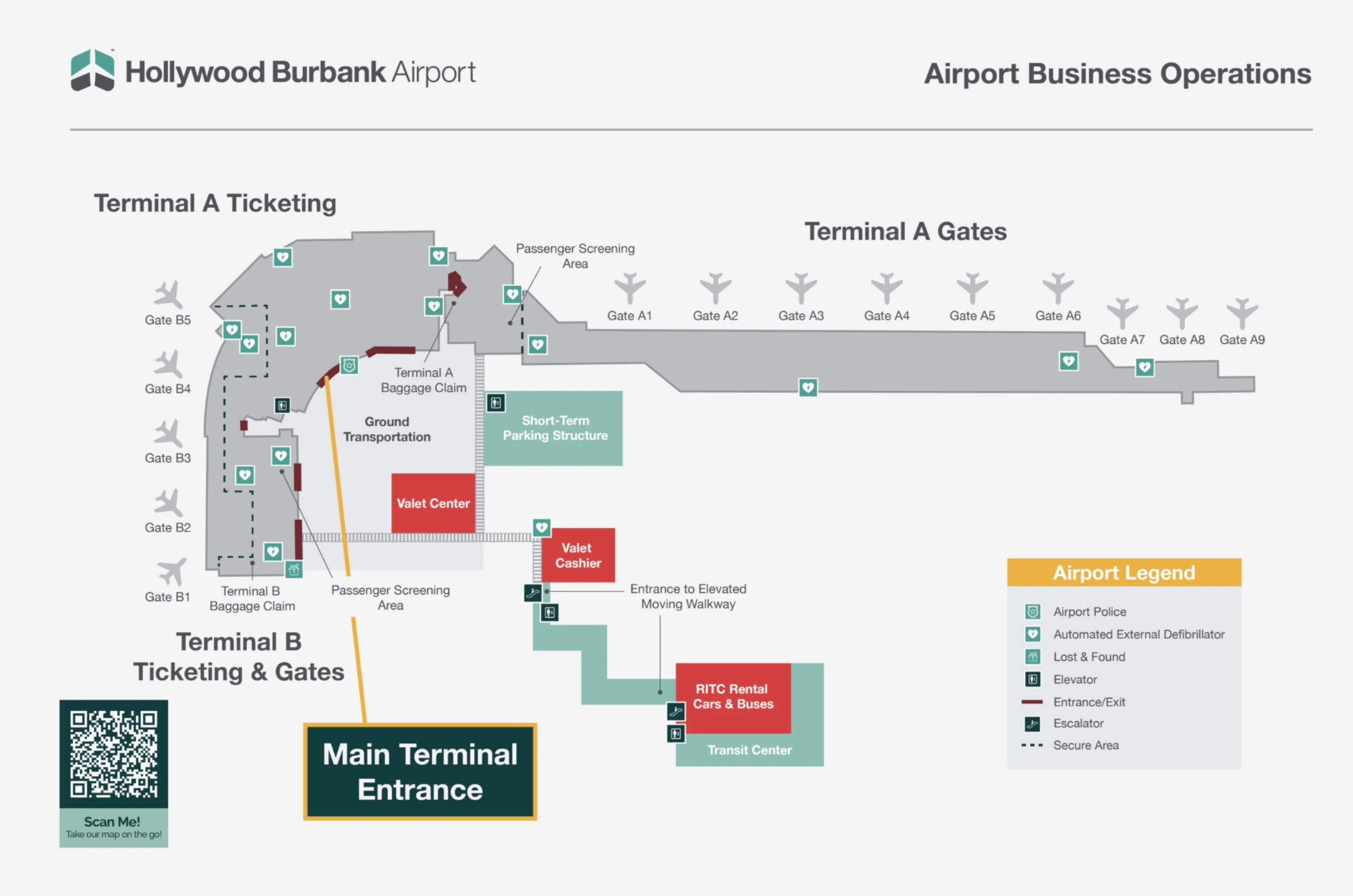
2026 Hollywood Burbank Airport Terminal B Map Guide
What is the exact walking distance (in feet/meters) from the Terminal A ticket counter area to the Terminal B security checkpoint entrance for travelers who must check in at A but fly from B?
Walking distance is approximately 700–850 feet (215–260 meters) from Terminal A ticketing to the Terminal B security checkpoint entrance using the landside interior/curbside progression. The practical walk time is usually 4–6 minutes, with luggage drag and curbside congestion as the main slowdowns.
| Route segment | Landmark anchors | Distance |
|---|---|---|
| Terminal A ticket counter area → Terminal A baggage claim frontage | ticketing hall to baggage claim zone | ~250–350 ft (75–110 m) |
| Terminal A baggage claim frontage → Valet Center / rental interface | crosswalk + valet/rental node | ~200–300 ft (60–90 m) |
| Valet Center / rental interface → Terminal B baggage claim frontage | curbside sidewalk past Terminal B claim | ~150–250 ft (45–75 m) |
| Terminal B baggage claim frontage → Terminal B TSA entrance | sliding doors to screening entry | ~100–150 ft (30–45 m) |
Where is the post-security “pinch point” in Terminal B located (the spot where the security exit feeds directly into the crowded gate/queue area)?
The pinch point is the immediate TSA exit area that dumps directly into the Gate B1 frontage beside the Jones Coffee Roasters kiosk. This is the first airside node after screening, where the corridor is already being used for Gate B1 boarding and the coffee line.
The choke happens at the security egress “mouth” into the concourse: screened passengers step out into the same narrow circulation strip used by the Gate B1 boarding queue and the Jones Coffee queue. The practical landmark triangulation is “TSA exit doors → Jones Coffee → Gate B1 podium,” with the blockage forming right where those three functions overlap, before you can move downstream toward Gates B2–B5.
How many seats are physically available in the primary seating cluster nearest the first Terminal B gates (the area reported as short on seating when two flights overlap)?
Fewer than 80 seats are available in the immediate Gate B1/B2 primary seating cluster during typical layouts. The constraint is not just the count but the cluster’s placement inside the narrowest early-concourse segment, so standing passengers and boarding groups occupy the same footprint as the “walking lane.”
The most seat-scarce zone is the first gate cluster immediately downstream of the TSA exit—roughly the Gate B1 frontage through the Gate B2 area—because that space must also absorb shoe/bag recomposition, the Jones Coffee queue, and Gate B1 staging. When two flights stack (commonly B1 plus B2), the seating capacity covers well under half the combined load, so overflow stands along the perimeter walls and columns, reducing passable corridor width toward Gates B3–B5.
Where do the food/coffee lines form in Terminal B post-security, and what is the exact corridor segment they encroach on (the circulation path people must cross to reach gates)?
Food and coffee queues form at Gate B1 (Jones Coffee Roasters) and near Gate B3 (Guy Fieri’s Kitchen and Bar), and they encroach on the single main airside corridor that connects the TSA exit to Gates B2–B5. The most disruptive segment is the early concourse immediately outside the TSA exit at Gate B1, where the coffee line and Gate B1 boarding both occupy the only through-path.
| Concession node | Where the line forms | Corridor segment it blocks |
|---|---|---|
| Jones Coffee Roasters (near Gate B1) | parallel to the TSA exit flow, then perpendicular across the hall as it grows | TSA exit → Gate B1 frontage → entrance to the Gates B2–B5 corridor |
| Guy Fieri’s Kitchen and Bar (near Gate B3) | along the central “waist” of the concourse near the restaurant waiting area | Gate B2/B3 approach zone → center concourse pinch near B3 en route to B4/B5 |
During peak mornings, where does the Terminal B TSA line physically extend to (furthest point / landmark) when it surges beyond the normal queue footprint?
The Terminal B TSA line extends out through the automatic sliding doors onto the curbside sidewalk and can run down the frontage walkway toward the Terminal A connector during peak-morning surges. The furthest practical landmark is the exterior curbside sidewalk beyond the Terminal B entrance, spilling into the shared landside pedestrian path.
Terminal B’s lobby depth between the entry doors and the ID-check area is shallow, so once the structured stanchion footprint fills, the queue “breaches” outside. The visual cue is the line tail sitting on the curbside sidewalk (not inside baggage claim), with passengers effectively queuing in the outdoor pedestrian zone that links the terminals. During the heaviest stacking window, that tail can align in the direction of Terminal A rather than staying contained in front of the Terminal B doors.
What is the exact walking time from Terminal B curb drop-off to the Terminal B TSA entry point, using the shortest indoor route?
Walking time is under 1 minute from Terminal B curbside drop-off to the Terminal B TSA entry point on the shortest indoor path. The distance is under ~150 feet from the curbside doors to the screening entrance when the queue is fully inside.
From the curb, the shortest route is straight through the main Terminal B sliding glass doors, past the immediate baggage-claim edge, to the Passenger Screening Area entrance. The key constraint is that the “indoor route” only exists when the TSA line is contained; during morning surges, the queue commonly occupies the entrance zone and pushes outside, turning that sub-1-minute walk into an outdoor curbside wait plus a short interior advance once the doors clear.
What is the shortest pedestrian route between Terminal B and the Terminal A security entrance, and what is its measured distance?
No airside route exists between Terminal B and Terminal A, so switching checkpoints requires exiting to landside and re-clearing security. The shortest pedestrian route is the exterior frontage sidewalk along the curbside road between the terminal entrances, measured at about 650 feet (≈200 meters).
The practical path is: exit/approach landside at Terminal B → walk the curbside/frontage sidewalk toward Terminal A → enter Terminal A’s main doors → proceed to the Terminal A security entrance. The landmark anchors are the shared curbside frontage and the terminal entry doors; the key “not possible” constraint is that you cannot walk from Gate B areas to Terminal A security without leaving the secure zone.
Where are the nearest restrooms post-security in Terminal B relative to the gate cluster, and what is the walking distance from the most crowded gate area?
The nearest post-security restrooms are centrally located near Gate B3, adjacent to the Guy Fieri’s Kitchen and Bar core. Walking distance is about 150 feet from the most crowded area at the TSA exit / Gate B1 cluster to that restroom block.
From the congestion hotspot, the route is straight down the only airside corridor: TSA exit and Gate B1 frontage → pass the first seating/standing zone → continue toward the central concourse waist near Gate B3. This restroom location is effectively the single central sanitation node for Terminal B, so when the concourse is packed, restroom lines can spill back into the same Gate B3 corridor segment that people must traverse to reach Gates B4–B5.
Where are the usable power outlets / charging points located in Terminal B post-security seating areas, and which seating zone has the highest outlet density?
Usable outlets are scarce and mostly limited to perimeter-wall runs and a few structural columns in Terminal B post-security. The highest outlet density is typically along the perimeter walls near the primary seating edges rather than in the center aisle, because the concourse lacks modern “power-at-every-seat” furniture.
Expect the most reliable charging to be where people naturally line walls: the wall-side seating/standing edges near the gate areas (especially downstream of the Gate B1 crush, where you can actually access the wall). In crowd conditions, those same wall outlets are often physically blocked by standing passengers and bags, so the practical strategy is to move past the TSA exit/Gate B1 collision zone and look for open wall space closer to the less-compressed end of the corridor (toward B4/B5) rather than trying to charge in the first gate cluster.
What is the walking distance from the Terminal B entrance to the closest outside waiting/work fallback (e.g., strip-mall Starbucks / nearby lobby options) for travelers avoiding Terminal B crowding pre-boarding?
Walking distance is about 1,200 feet (≈365 meters) from the Terminal B entrance to the Regional Intermodal Transportation Center (RITC), the closest practical conditioned-space fallback for waiting or working. No comparable strip-mall café or hotel-lobby option sits within an easy sub–0.5-mile walk from the terminal frontage.
The most usable fallback route is the elevated walkway connecting the terminal area to the RITC: Terminal B entrance → follow terminal-side wayfinding toward the elevated pedestrian connection → cross the walkway to the RITC rental car/bus lobby space. This works as a pressure-release option when Terminal B’s pre-security lobby or curbside queue becomes a holding pen, but it’s a meaningful detour both directions compared with staying at the curb.