El Dorado International Airport Map (Most Up-To-Date)

El Dorado International Airport is a large, multi-level, H-shaped main terminal complex with a long central spine and four color-coded gate piers branching north and south. Within Bogotá’s primary air-travel hub, the biggest orientation job is choosing the correct processing flow (stay airside vs exit + re-clear) and the correct building (Main Terminal vs Puente Aéreo Terminal). Floor 1 is arrivals and ground transport; Floor 2 is departures and security.
Map Table
| Terminal | Key Airlines | Primary Function | Transfer Mode |
|---|---|---|---|
| Main Terminal | Avianca, LATAM, Copa, long-haul internationals | International + most domestic | Airside connection corridor, landside vertical core, landside shuttle |
| Puente Aéreo Terminal | Clic Air, JetSmart, Satena | Domestic regional / low-cost | Landside shuttle, outdoor walk |
El Dorado International Airport Map Strategy
- Decide your connection type first: single-ticket international transfer stays airside; separate tickets or bags tagged only to Bogotá force immigration, customs, and a full re-clear through Floor 2 security.
- Treat the Main Terminal vs Puente Aéreo Terminal split as a hard fork: no sterile transfer exists, so the shuttle decision point inside the Main Terminal matters more than gate proximity.
- Use the vertical rule to avoid dead-ends: arrivals and transport on Floor 1, check-in and security on Floor 2—commit to the central escalator and elevator core fast.
- For pickups, pick the correct curb before you exit: official taxi workflow starts inside on Floor 1; app pickups align to the departures-level curb on Floor 2 to avoid wrong-floor cancellations.
2026 El Dorado International Airport Map + Printable PDF
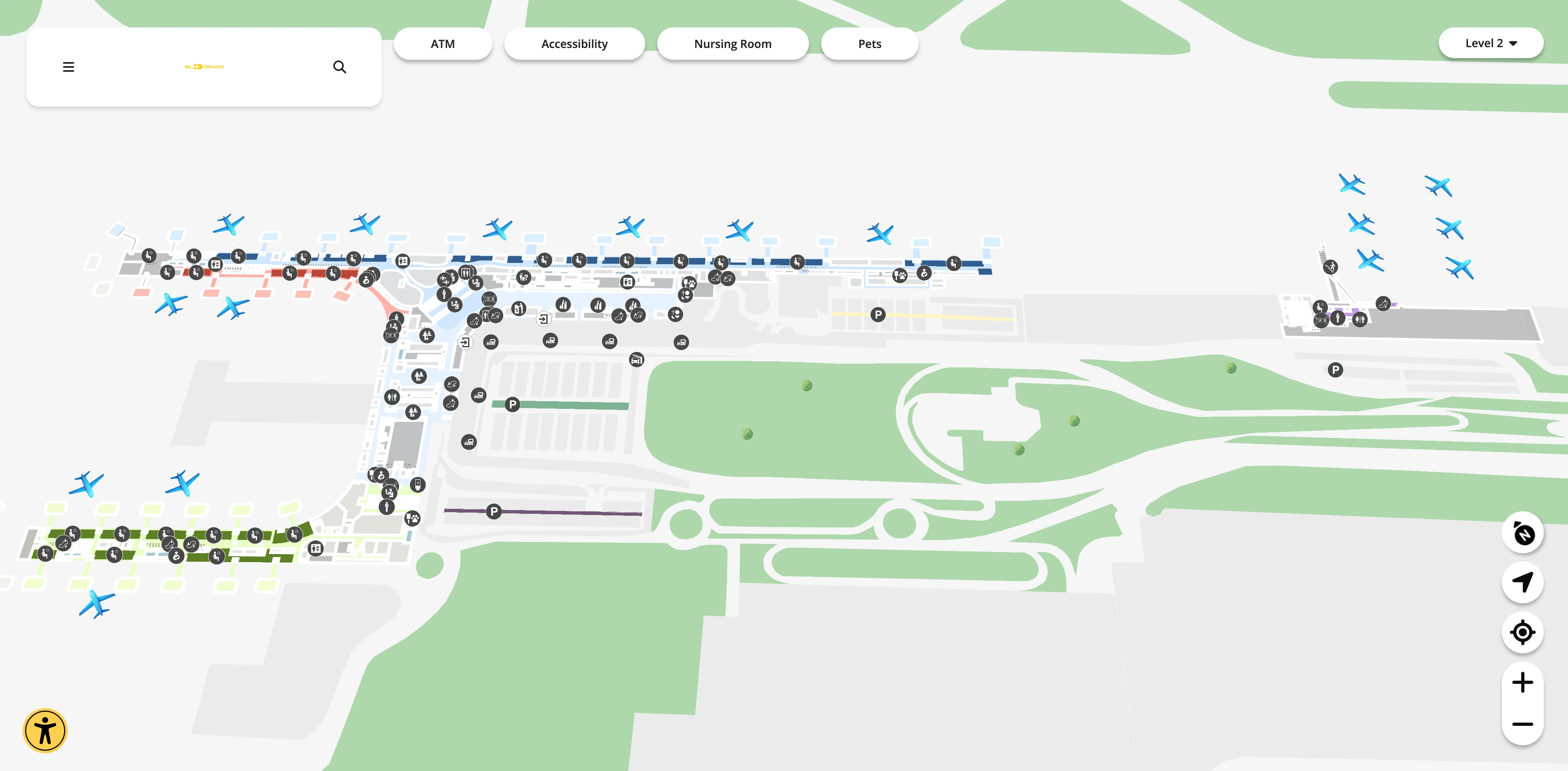
Current terminal operations still hinge on the same hard constraints: the Main Terminal and Puente Aéreo Terminal are not connected airside, arrivals run on Floor 1, and departures and security run on Floor 2. The most map-critical navigation layer is the color-coded pier system (Blue A/B for international; Orange C and Green D for domestic) that dictates which security portal you must use.
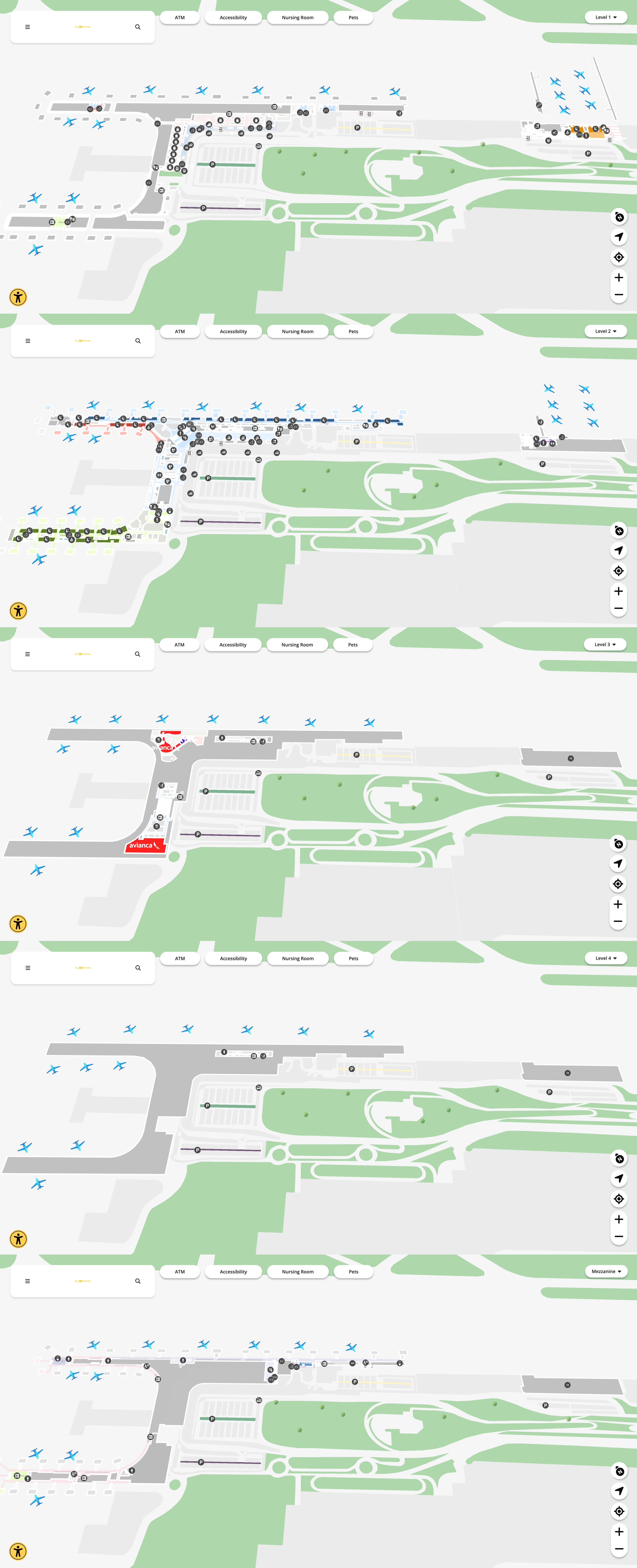
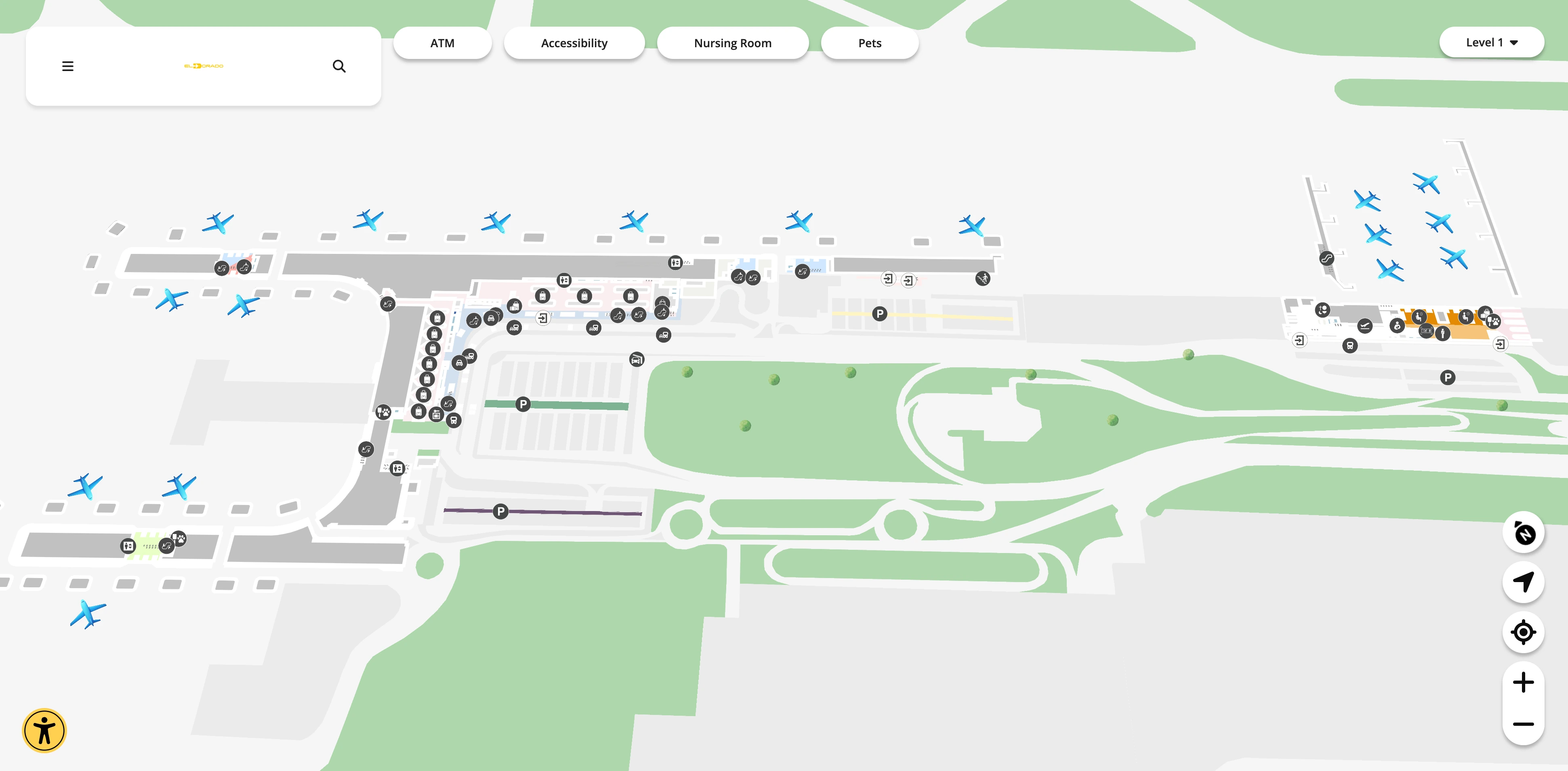
El Dorado International Airport Level 1 Map 2026
El Dorado International Airport Level 2 Map 2026
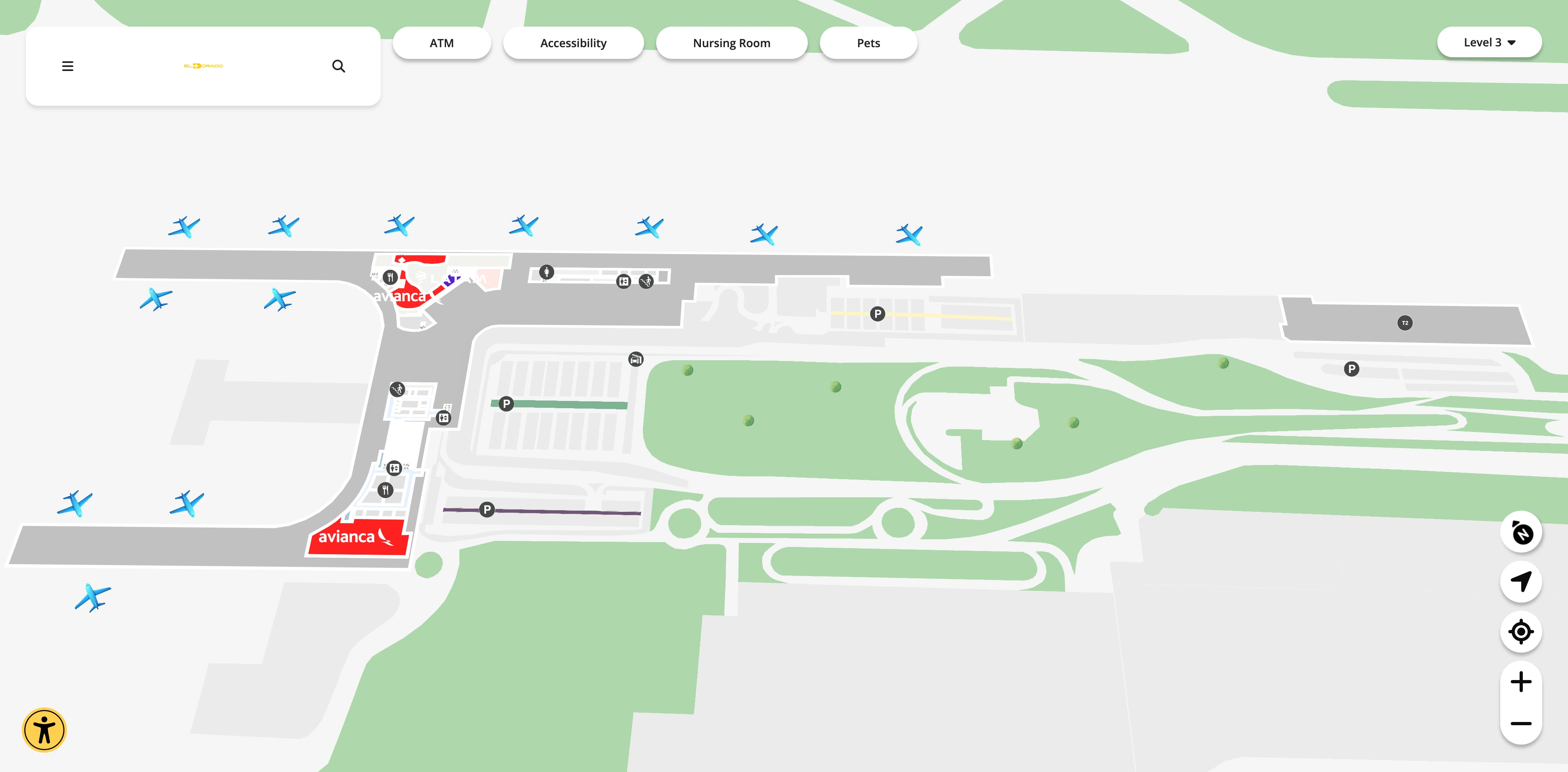
El Dorado International Airport Level 3 Map 2026
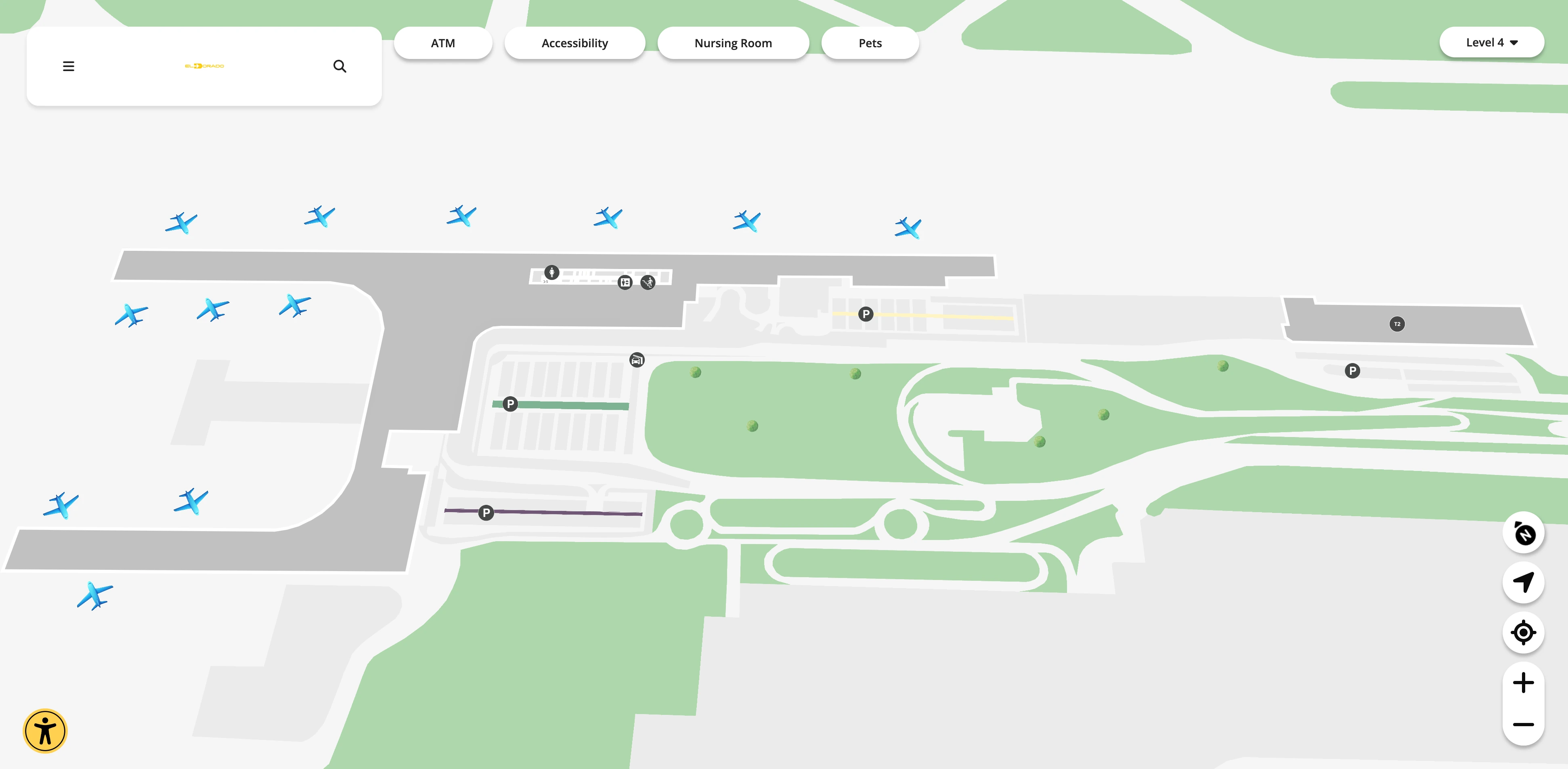
El Dorado International Airport Level 4 Map 2026
El Dorado International Airport Mezzanine Map 2026
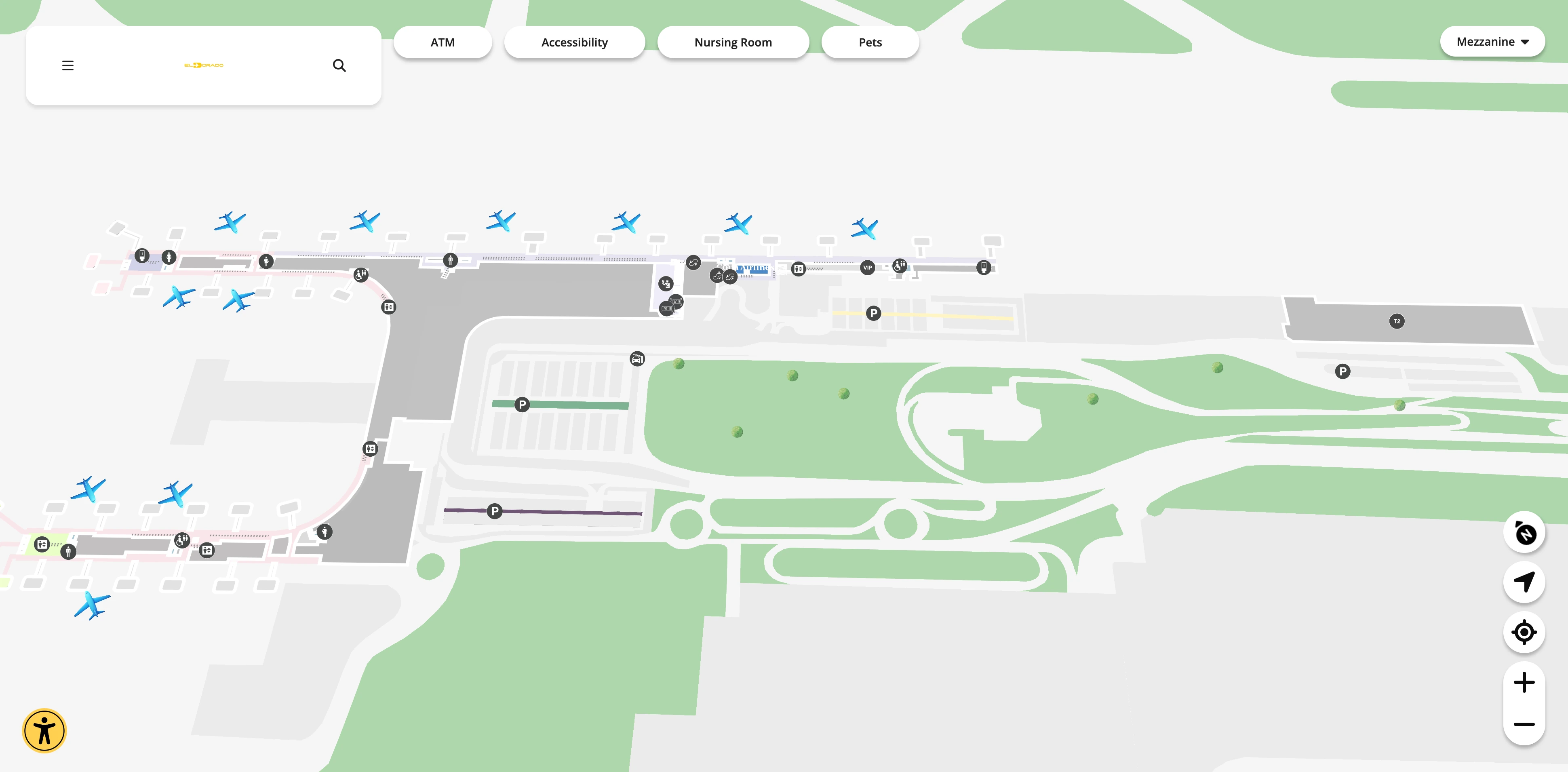
2026 El Dorado International Airport Map Guide
Where are the free shuttle/bus stops at Terminal 1 and Terminal 2 (Puente Aéreo), and what are the exact curbside labels/landmarks at each stop?
There is no airside shuttle between the Main Terminal and Puente Aéreo Terminal, so the free transfer bus is a landside curbside stop at each building. The Main Terminal stop is on Floor 1 (Arrivals level) at NEAA Puerta 2, and the Puente Aéreo Terminal stop is at Puerta 11.
| Stop | Exact curbside label | Level | What to stand next to |
|---|---|---|---|
| Main Terminal → Puente Aéreo bus | “NEAA Puerta 2” | Floor 1 (Arrivals) | Door 2 curb zone, bus-loading bay at the arrivals curb |
| Puente Aéreo → Main Terminal bus | “Puerta 11” | Floor 1 | Door 11 curb zone, main curbside ingress/egress point for Puente Aéreo |
If your domestic flight uses Puente Aéreo, what is the exact “last indoor point” in Terminal 1 where you should commit to exiting toward the shuttle transfer route?
Exit Door 2 on Floor 1, labeled “NEAA Puerta 2,” is the last indoor commitment point for the Puente Aéreo shuttle transfer route. Passing it and exiting later doors forces a longer, more congested curbside backtrack with luggage.
The most reliable sequence is to stay inside Terminal 1 on the arrivals level until you see the Door 2 signage, then exit directly to the curb at that door. Door 2 is the shortest interception point for the landside “Bus Aeroportuario / Eldorado Shuttle Bus” loading area. Using Door 5 or Door 6 typically puts you into heavier exterior pedestrian flow and increases wrong-direction walking along the active vehicle curb.
Where is the first post-arrival security checkpoint located for passengers following International Connections (airside), and how far is it from the arrival gates?
The first post-arrival checkpoint is a dedicated transit security screening point on the international airside route, reached by following the yellow “International Connections” signs before entering the main international departure concourse. It sits inside the sterile area and is separate from the large public security portals on the departures level.
Walking time from arrival gates to this transit security point is typically about 25 to 45 minutes end-to-end for the full airside transfer path, with the biggest variable being how far your arrival gate is from the connections corridor entry. After clearing this localized transit security, you feed directly into the international departures gate areas (the Blue international sector) without going through immigration or customs, assuming your itinerary is through-checked.
What is the exact walking route from International Arrivals exit to the domestic check-in counters in Terminal 1 (including the first “must-turn” landmark)?
The fastest route is to turn inward to the central escalator/elevator core immediately after you exit customs into the public arrivals hall, then go up to the departures level for domestic check-in. Walking straight toward the street doors first is the common mistake that adds backtracking.
After DIAN customs, you enter the Floor 1 public Arrivals Hall; your first must-turn landmark is the central escalator and elevator bank on the interior spine. Take those escalators up to Floor 2 (Departures). On Floor 2, orient away from the Blue international sector and follow the main spine toward the south end to reach the domestic check-in zones for the Orange (Pier C) and Green (Pier D) areas.
Where is the re-check (bag drop) point located after clearing customs when you have a separate domestic ticket, and what is the shortest path to it?
There is no dedicated post-customs re-check desk, so bag drop happens at the public domestic airline check-in counters on Floor 2 after you exit customs into the landside arrivals hall. This forces a full reset: landside, then back up to departures, then back through security.
After DIAN customs, you step into the Floor 1 public Arrivals Hall and immediately turn inward toward the central escalator/elevator core rather than heading to the curb. Go up to Floor 2 (Departures) and join your domestic carrier’s check-in line in the south domestic zones aligned to the Orange (Pier C) and Green (Pier D) routing. Once your bags are accepted, continue forward to the general domestic security screening portal for Pier C/Pier D access.
Which corridor/vertical transition (stairs/escalator/elevator) takes you from international departures security to the correct international gate pier, and where does it begin?
The international gate routing starts at the Floor 2 international security checkpoint that feeds the Blue international sector, and the key vertical transition to most lounges is the set of elevators and stairs off the post-security corridor before you commit deep into Pier A or Pier B. This corridor is the shared entry for both international piers.
From the departures check-in hall on Floor 2, enter the international security portal used for Blue (Pier A/Pier B). After screening, you immediately pass outbound passport control and continue into the shared international corridor that splits toward Pier A and Pier B. The vertical transitions (elevators and stairs) that take you up to Floor 3 lounge level begin along this corridor near the start of the international concourse, before the long walk to the deeper A-gates and B-gates.
What is the exact walking path from domestic arrivals to the international departures check-in hall in Terminal 1 (including the correct floor change point)?
The correct path is to walk north along the Floor 1 public corridor from the domestic arrivals side to the central escalator/elevator core, then go up to Floor 2 and continue into the Blue international check-in sector. The floor change point is the central escalator bank on the main terminal spine.
After collecting bags and entering the Floor 1 public area, keep to the interior corridor and move toward the central core rather than exiting curbside. Use the central escalators/elevators to ascend to Floor 2 (Departures). On Floor 2, continue farther into the north side of the hall where the Blue-coded international airline service counters are located; the south end is primarily oriented to the Orange (Pier C) and Green (Pier D) domestic check-in zones.
What is the exact walking distance from Terminal 1 baggage claim to the official taxi stand, and which doors place you closest to it?
The official taxi rank is immediately outside Terminal 1 on Floor 1 near doors 2, 3, 5, and 6, after you generate a prepaid taxi ticket at the authorized counters inside the arrivals hall. The most reliable “closest doors” alignment is exiting via Door 2 or Door 3 when you want the shortest curbside walk to the dispatcher-managed queue.
From baggage claim, follow the flow through DIAN customs into the public arrivals hall and stop at the official taxi counter inside to receive a printed fare/assignment slip. Then exit to the curb via Door 2, Door 3, Door 5, or Door 6; these doors align directly with the regulated taxi lanes and the visible dispatcher zone. A precise meter distance from baggage claim to the curb varies by carousel and hall position, but the taxi stand itself is anchored to those doors on the arrivals level.
Where is the most common rideshare pickup zone (or meeting point) for app-based pickups, and which doors/signs align with it to avoid wrong-curb confusion?
Rideshare pickups are on Floor 2 (Departures level) in the far-left lane of the departures curb, not on the arrivals curb where you collect bags. Waiting on Floor 1 is the classic wrong-curb failure that triggers driver cancellations because the app geolocates the car one level above you.
After you arrive and reach the public area, take the central escalators/elevators up to Floor 2 and exit to the departures curb rather than staying at the arrivals doors. On the curb, move to the far-left lane where vehicles can briefly stop without blocking standard drop-offs; this lane is the practical “meeting strip” drivers use for app pickups. Use departures-level door signage (Gate/Door numbers on Floor 2) as your pin, and confirm in-app that your pickup point is set to Departures (not Arrivals).
Where are the airside lounges located relative to the main international departure gates (which direction from the central food court / main spine)?
Airside international lounges cluster in the Blue sector near Pier A, with several options either beside early A-gates or one level up above the main concourse. From the central airside food court area (Zona R), most lounge routing is a short move toward Pier A, then a vertical climb for the lounges on the upper level.
LATAM Lounge sits on Floor 3 opposite Gate A1, reached via stairs/elevators near the start of Pier A. Copa Club is on the main gate level beside Gate A6, partway down Pier A. El Dorado Lounge is positioned farther along the concourse in front of Gate A8. Wait N’ Rest sleep pods are between Gates A12 and A13 near Zona R, and the Avianca VIP Lounge (international) is deeper in the terminal near Gate 32.
Where are the quietest, lowest-traffic seating zones inside Terminal 1 that travelers commonly use for overnight waits (by gate/section location)?
Gate 32 and the Gate A12/A13 area are the most commonly cited quieter airside zones for overnight waits, with better seating layouts than the busiest central concourse. Landside, the domestic arrivals corridor immediately before the baggage claim carousels is the lowest-traffic fallback when you’re blocked by the international access timing rules.
Gate 32 is noted for lounge-style chairs that make long waits easier than standard gate seating. The area around Gates A12 and A13 has pockets of bench seating that can be easier to stretch out on, and it sits near the Zona R food court and the Wait N’ Rest pod location. If you cannot access airside, stay inside on Floor 1 in the domestic arrivals pre-claim corridor rather than at the exterior doors, where foot traffic and noise tend to spike.
Where are the help/information counters placed along the Terminal 1 “spine,” and which one is closest to the international connections decision point?
The most useful Terminal 1 information counter for spine-level wayfinding sits on Floor 2 between entrance gates 5 and 6, close to the mid-spine split between domestic and international zones. This is the best positioned desk for resolving “which side” decisions before you commit to the wrong security portal.
On the departures level (Floor 2), the gates 5–6 counter is centrally placed so you can pivot either toward the Blue international security entry for Pier A/Pier B or toward the Orange/Green domestic routing for Pier C/Pier D. If your issue is a connections-path decision (airside international connections vs landside re-clear, or which pier system applies), this mid-spine location is the quickest intervention point before you walk deeper into the wrong concourse or queue.