Calgary International Airport Map (Most Up-To-Date)

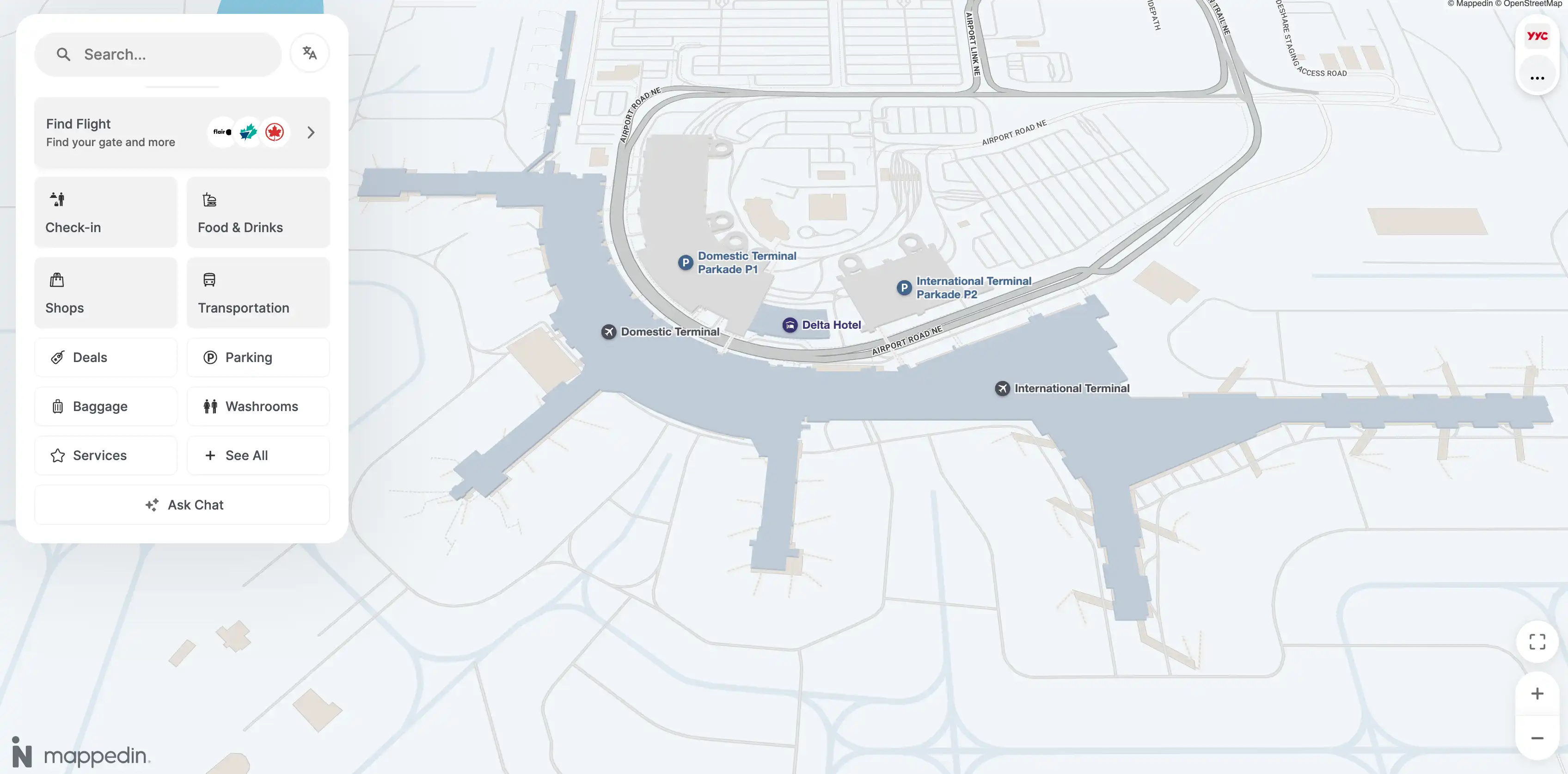
Calgary International Airport is a long, linear terminal campus with Domestic Concourses A–C stretched west-to-east, stitched to the newer International Terminal (Concourses D/E) by a connector spine that’s easy to underestimate under time pressure. The biggest orientation cue is “vertical separation” in the international building: international departures run on Level 2, while U.S. transborder flows live upstairs after U.S. preclearance. Within Calgary’s main airport hub, most missed connections come from committing to the wrong corridor or the wrong queue.
Map Table
| Terminal / Concourse | Primary Function | Key Processing Constraint | Fastest Transfer Mode |
|---|---|---|---|
| Terminal A–C (Domestic) | Canada departures | Centralized security funnel | YYC Link “High Road” |
| Terminal D (International) | Non-U.S. international | Long arrivals walk to CBSA | Moving walkways “Low Road” |
| E (Transborder) | U.S. departures | Security + CBP preclearance bottleneck | Direct to Checkpoint E |
Calgary International Airport Map Strategy
- Treat E70–E75 as a “decision-point corridor,” not a simple gate walk: follow E-level signage first, then commit only at the final portal down into the holdroom area.
- Enter Checkpoint E with a queue plan: identify the Verified Traveller/NEXUS entry before you join any stanchions, because wrong-line traps can force a full restart.
- Assume U.S. preclearance is a one-way door: once you step into the CBP process area, plan as if you cannot exit to fix a mistake without losing your place and time.
- Budget for long-walk + level-change segments: E flows add a short post-security transition into the CBP hall, then a longer sterile corridor walk to the low-number gates (E70–E76).
2026 Calgary International Airport Map + Printable PDF
Centralized Security Screening (Phase 1) remains the dominant “funnel” change shaping how people reach A–C, while the International Terminal still behaves like a two-level system: D (international) below, E (U.S.) above. The operational reality that matters most on a 2026 map is where travelers get trapped by commitment points—especially entering U.S. preclearance, where backtracking is effectively not an option and queue choice mistakes can cost 30–60 minutes.
2026 Calgary International Airport Map Guide
What is the exact walking distance (meters) from the Checkpoint E exit to the start of the US CBP preclearance queue (first stanchion/merge point)?
The walking distance is approximately 30–50 meters from the Checkpoint E exit to the first CBP preclearance queue stanchion/merge point. That span is essentially the short post-security transition corridor that feeds directly into the CBP hall “holding pen,” where stanchions begin and passenger flow starts consolidating toward primary inspection.
This segment begins right after you clear CATSA at Checkpoint E (belt exit area) and ends where the CBP hall’s first serpentine stanchions/merge point forms near the bag-status holding area. If you see the CBP hall opening up and the first organized stanchion line forming ahead, you’re at the merge point; if you’re still in the narrow corridor immediately after security, you’re still in the 30–50 meter transition.
Where is the physical entry point to the NEXUS/verified-traveller lane at Checkpoint E, relative to the general queue entrance (left/right + nearest landmark)?
The NEXUS/Verified Traveller entry is on the flank of the Checkpoint E / CBP hall approach, set off from the main serpentine entrance rather than inside it. Relative to the general queue mouth, it is typically positioned to the far left side of the flow, signed to bypass the main stanchions.
Look for priority-traveller signage and the split where most passengers are funneled straight into the broad stanchioned corral; the NEXUS/Verified Traveller access peels off at the edge nearest the CBP hall boundary, before the main merge point. If you reach the first dense serpentine stanchions and you’re boxed into the general queue, you’ve passed the lane entry and will usually need to exit the corral to correct it.
From the central post-security holding area (call-to-gate lounge), what is the walking time (minutes) to Gate E70 using the fastest marked route?
Walking takes roughly 4–6 minutes from the central post-security holding area to Gate E70 on the fastest marked route. That time assumes a normal airport pace and using the straight-through sterile corridor that leads away from the main retail/dining hub toward the low-number E gates.
The route starts at the Concourse E central hub area you enter after CBP (near duty-free and the main plaza), then continues down the long glass-lined corridor toward gates in the E70 range, using the moving walkway segments where available. If you find yourself drifting back into the denser food/retail cluster or doubling back toward the CBP exit, you’ve lost the direct line; the fastest path stays in the quieting, linear corridor where gate numbers count down toward E70.
On the route to E70–E75, where is the exact decision point where passengers must choose to continue straight vs turn around behind the stairs/elevators (identify the nearest fixed landmark)?
The decision point is the E70–E75 gate-portal area where the main Concourse E corridor meets the vertical access (stairs/elevators/escalator) that drops down into the shared holdroom/boarding level. That portal is where passengers either continue straight along the Level 3 sterile corridor or turn back/loop behind the vertical core if they realize they’re approaching the wrong entry.
This choice happens at the point where signage for “Gates 70–75” concentrates and the corridor visually narrows into a quieter spur, with the stair/elevator bank acting as the fixed landmark. If you can see the down-access into the gate holdroom area (and the corridor feels like it’s committing you to the E70–E76 spur), you’re at the commitment/decision zone; once you descend, reversing direction is difficult and time-costly compared with correcting course up on the main corridor.
What is the exact walking distance (meters) from Podium A to Gate C73 via the “Low Road” corridor?
The walking distance is approximately 800–1,000 meters from Podium A to Gate C73 via the “Low Road” corridor. That span covers the main pedestrian concourse path past the retail-heavy B zone and through the B/C connector into the far end of Concourse C.
The Low Road route runs on the primary public concourse level, using segmented moving walkways where available but losing time at gaps and cross-traffic near the B hub and food/retail pinch points. The distance starts at Podium A in Concourse A and ends at the C73 gate area near the C-wing extremity closest to the International Terminal connection; if you reach the C-side connector where the terminal begins to feel less retail-dense and more gate-focused, you’re in the final stretch.
What is the exact walking distance (meters) from Podium A to Gate C73 via the “High Road” corridor?
The walking distance is effectively minimized by the YYC Link “High Road” shuttle, with a short on-foot segment of under 2 minutes on the C end after you get off. In practical map terms, the corridor span served by the shuttle is about 620 meters, with only brief walking at each station.
| Segment | Distance (meters) | Nearest fixed landmark |
|---|---|---|
| Podium A to YYC Link Station A access | ~50–150 | Elevator/escalator up to YYC Link level |
| YYC Link corridor (ride) | ~620 | YYC Link branded shuttle lane |
| Station C to Gate C73 | ~100–200 | Station C exit down to Concourse C gates |
If you can see “YYC Link” branding and the station platforms, you’re on the High Road; if you’re in the retail-heavy public concourse with moving walkways, you’re on the Low Road instead.
For passengers transiting to the U.S. with checked luggage, where is the US baggage drop point located relative to the US preclearance entrance (distance + which side of the flow)?
The U.S. baggage “drop” is usually not a physical drop before preclearance for through-checked connections; it’s handled virtually inside the CBP hall after you enter the preclearance process. In that common case, the relevant location is the CBP holding-pen area just beyond Checkpoint E, where bag-status screens/kiosks govern when you can advance.
For the physical re-introduction point used when bags are pulled or need to be re-cleared, the connection belt is located immediately after the CBP primary inspection counters, just before the exit into the sterile Concourse E departures area. This places it on the forward side of the flow (after you’ve committed to preclearance), not before the entrance; if you’re still outside preclearance or in the stanchioned queue, you have not reached any physical bag-drop point.
From an International Arrivals gate, what is the walking distance (meters) to the first Canadian immigration processing point, and does the fastest route include any moving walkways?
Walking distance is approximately 850–1,000 meters from a far International Arrivals gate to the first Canadian immigration processing point in the CBSA hall. That longest-case measurement aligns with arrivals from the D90s, where the sterile corridor run is extended and fatigue becomes a real factor.
The fastest route does include moving walkways, but they are segmented rather than continuous. You’ll enter a glass-walled sterile arrivals corridor, encounter intermittent moving-walkway sections, then continue on standard flooring into the CBSA processing hall. If you’re passing long stretches overlooking the apron/departures level and the flow is one-way with no retail, you’re on the correct arrivals channel; once the corridor opens into the immigration hall footprint, the walk segment is complete.
Where is the rental car shuttle pickup located relative to International Arrivals exits, and what is the shortest indoor walking route to reach it?
The rental car shuttle pickup is at Bus Bay #22 on the Arrivals roadway, reached after exiting International Arrivals near Doors 15/16. That places it outside on the curbside bus-bay line rather than inside the terminal.
The shortest indoor route starts from the International Arrivals Hall exit area, follows the interior corridor toward the Domestic Terminal frontage direction, then exits to the Arrivals roadway at the bus-bay zone for courtesy shuttles. If you instead want the on-site Rental Car Centre (not a shuttle), the fastest mostly-indoor path is to go up to Departures Level and use the link/bridge to the parkade, then take the elevator lobby across the roadway to the rental car level.
In the E70–E75 swing-gate zone, where are the corridor-control doors/portals that separate domestic vs transborder flows (the points that must be “electronically configured”)?
The corridor-control portals are the glass partition doors and locking panels at the junctions where the shared swing-gate corridor splits between the D (international) access path and the E (transborder) sterile path. These are magnet-locked, electronically controlled doors positioned at the crossover points that prevent passengers from stepping between the parallel D and E corridors when a gate is assigned.
They sit at the corridor interfaces leading into the E70–E75 gate holdroom portals, where signage funnels you toward “Gates 70–75” but the physical entry is only open from the correct side and level. If you reach a heavy glass door line with restricted-access hardware (card reader / secured frame) and the adjacent corridor looks like the “other” flow, you’re at the configured separation point; when the gate swings, one side locks while the other opens to maintain sterility.
After clearing security, where is the nearest high-capacity seating cluster to the E70–E76 gate area, and what is the walking distance (meters) from that seating to E73?
The nearest high-capacity seating cluster is in the quieter tandem-beam seating zone along the E70–E76 corridor spur, positioned before you fully commit down into any single gate holdroom. That cluster is the best “base camp” for E70–E76 because it’s closer than the central retail hub but still allows you to move toward multiple gates.
The walk from that seating area to Gate E73 is short—roughly 100–200 meters—because E73 sits within the same E70–E76 gate band along the sterile corridor. Use the corridor’s gate-number progression as confirmation: if the seating is already in the low-70s zone (not back at the duty-free/food hub), the remaining distance to E73 is a quick, straight-line segment without needing to return toward the CBP exit.
What is the shortest indoor route (turn-by-turn decision points) from International Arrivals baggage claim to the rideshare pickup zone, minimizing level changes (stairs/escalators)?
The shortest route is a same-level walk from International Arrivals baggage claim to the Arrivals curb at Doors 16 or 17. That path avoids stairs and escalators entirely because rideshare pickup is on the Arrivals Level outside the International Arrivals hall.
- Exit the baggage claim area into the public International Arrivals hall on Level 1.
- Follow overhead signs for “Ride App / Rideshare” toward Doors 16–17, staying on the main hallway without taking any escalators.
- Keep to the right as the hall opens to the curbside doors; the “Ride App” curb zone is directly outside Door 16 or Door 17.
- If you reach taxi/limousine stands closer to the center frontage and the signage shifts away from “Ride App,” backtrack toward Doors 16–17.
From the domestic baggage belts (1–4 area), what is the exact walking distance (meters) to the US preclearance secure-zone entrance, including the correct doorway/escalator choice?
Walking distance is approximately 1,000–1,200 meters from the domestic baggage belts (1–4 area) to the U.S. preclearance secure-zone entrance at Checkpoint E. That distance includes the landside transfer from Domestic Arrivals to the International Departures frontage and then up to the U.S. departures screening entry.
The route starts at the Domestic baggage belt area on Level 1, exits toward the Domestic terminal curbside (Doors 1–4 area), and continues landside toward the International terminal frontage (Doors 15–17 area). From there, take the vertical access up to the departures/check-in level and follow U.S. departures signage to the dedicated Checkpoint E entrance marked by prominent U.S. identifiers. If you remain on Level 1 and drift along the curb without transitioning up near the International departures processing zone, you’ll add time and risk missing the correct Checkpoint E approach.