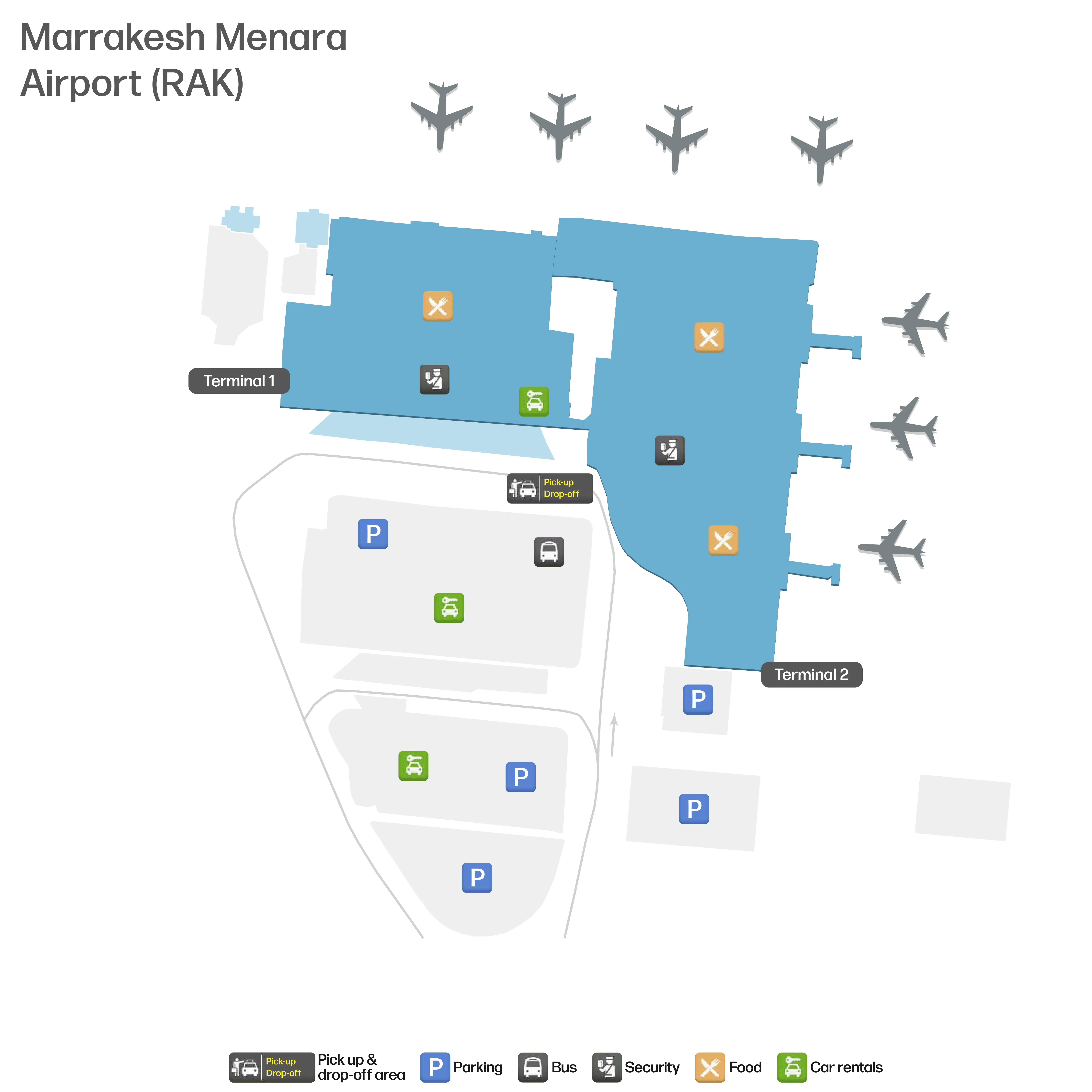
Marrakech Menara Airport Terminal 2 Map (Most Up-To-Date)

Marrakech Menara Airport’s “Terminal 2” departures run through a single connected terminal complex with a compact footprint (about 183 m long by 84 m wide) and a mostly straight, ground-floor landside flow feeding into a one-way airside level change. Within Marrakech’s primary airport gateway, the real challenge is the stacked checkpoints (entry screening, check-in stamp, security, passport control, second stamp check), not long walks.
Map Table
| Zone | What “Terminal 2” Means | Primary Flow Shape | Hard Commitment Point |
|---|---|---|---|
| Landside check-in hall | Historical internal zone, not a separate building | Straight hall, centralized security | Security entry document filter |
| Security + immigration | Adjacent, continuous | Queue stack, serpentine | Post-immigration stamp check |
| Airside lounge + gates | Upstairs lounge, split A/B gates | Up via escalators, forced duty-free path | Escalator up to airside |
Marrakech Menara Airport Terminal 2 Map Strategy
- Treat “Terminal 2” as an internal label, not a curbside destination; follow universal Departures signage to the connected check-in hall and confirm your zone at the main FIDS board just inside entry screening.
- Lock in the stamp first: the airline check-in/bag drop counter is the stamp/validation point, and security will hard-deny you without the physical ink stamp—no shortcut, no stamping at security.
- Use commitment points to reduce panic: once you join your airline’s check-in queue, don’t peel off “to try security”; once you’re filtered into security, switching lanes late is costly because the gender split happens near the belts.
- Keep passport + boarding pass in-hand all the way past the second “stamp-checking-the-stamp” officer after immigration; only then commit to the escalator up, because the airside level change is effectively one-way with no practical backtracking.
2026 Marrakech Menara Airport Terminal 2 Map + Printable PDF
Operational flow at 2026 RAK departures still behaves like a compact walk with heavy “stamp-gate” sequencing: entry X-ray at the doors, then check-in counters for the mandatory ink-stamped boarding pass, then a stamped-pass filter at security, then passport control followed by an immediate second stamp verification, and finally a one-way escalator up through duty-free to the departures lounge and gates.
2026 Marrakech Menara Airport Terminal 2 Map Guide
What is the exact walking route from the terminal entrance screening/X-ray point to the first airline check-in bank for “Terminal 2” departures?
Walking runs straight into the check-in concourse and typically takes 30–70 meters total, with the main FIDS board as the first must-hit landmark. After you clear the entrance X-ray at the sliding doors, walk 10–20 meters to the large Flight Information Display (FIDS) inside the hall, then follow the Zone A/Zone B assignment shown there. From the FIDS, continue another 20–50 meters along the linear row of counters to the first check-in bank for your flight. The only real “turn” is aligning yourself with the correct counter row after reading the FIDS; there are no escalators or level changes on this landside segment.
Where is the boarding pass stamp/validation desk located relative to the main check-in counters (distance + nearest landmark/sign)?
The boarding pass stamp is issued at the airline’s own check-in/bag drop counter, not at a separate “stamp desk.” The stamp happens in the same queue line as document check and baggage drop, typically 20–50 meters beyond the main FIDS board that sits just inside the entrance screening area. Use the large FIDS screen as your anchor: once it shows your flight’s Zone A/Zone B, walk along the counter line to your airline’s bank and get the physical ink stamp from the agent. If you reach the central security entrance and see staff filtering people by stamped boarding passes, you’ve gone too far without stamping and must backtrack to the counters.
After check-in, what is the exact walking distance from the check-in area to the primary security checkpoint entrance (including turns/escalators)?
Walking from check-in to the primary security entrance is about 60–80 meters on a flat, straight, ground-floor path with no escalators. From the counter line, head toward the centralized departures threshold; you’ll pass the small landside retail cluster—Paul café, a pharmacy, and a convenience store—on the right side of the concourse as you approach the security queue mouth. The only decision point is the document filter at the front of security where staff check for the ink-stamped boarding pass; that spot is the hard commitment point, because an unstamped pass triggers immediate denial and a forced walk back to the check-in queues.
Where are the men vs. women security queue entrances (or dividers) located, and how do you identify the correct lane before committing?
The men vs. women split happens deep in the security queue immediately before the X-ray belt feeds, not cleanly at the first entrance. Because the divider is close to the trays/belts, the safest way to choose correctly is to pause at the point where the queue begins to fan into multiple belt lines and look for the lane that is already predominantly your gender, then follow the directing gestures/commands from the officers managing belt access. Switching late is costly because the separation occurs at the highest-density area right at the belts, and mixed-gender companions should expect to be split into different belt lines and reunite only after collecting bags at the outfeed side.
What is the precise route from security exit to the start of the passport control queue for departures (including floor/level changes)?
The route is immediate and stays on the same level, with no corridor walk or escalators between security and passport control. After you collect trays and bags at the security outfeed, step forward into the adjacent serpentine lines feeding the immigration booths; the queue mouth begins within roughly 10–15 meters of the X-ray exit point. Keep your passport and stamped boarding pass in-hand as you leave the belt area, because the flow is continuous and you’ll be funneled straight into the passport control holding lanes without an intervening seating or retail buffer.
Where is the second “stamps, stamps” passport verification checkpoint located immediately after passport control (meters from booths + what it looks like)?
The second “stamp check” is positioned just a few meters beyond the immigration booths—typically about 3–10 meters from the booth exit—and it looks like a short, tightly constrained mini-queue feeding a single officer doing a rapid visual audit. After the booth stamps your passport, you’ll be funneled forward into a narrow choke point where an officer re-checks that the fresh exit stamp is present before letting you proceed. Keep your passport open to the stamped page and your boarding pass visible until you clear this officer, because it’s not bypassable and it often backs up, spilling toward the booth exits.
In the connected terminal complex, what signage/landmarks mark the boundary of “Terminal 2” (so you can confirm you’re in the right zone)?
Terminal 2 for departures is effectively a virtual label inside a single connected departures hall, so the practical “boundary” is confirmed by the main FIDS assignment and universal Departures wayfinding, not by a distinct building threshold. The most reliable confirmation point is the big Flight Information Display (FIDS) just inside the entrance X-ray: it will route your flight to Zone A or Zone B check-in, which is the real operational zoning. If you’re seeing the centralized security entrance area near Paul café/pharmacy/convenience retail, you’re already in the correct unified departures concourse; there isn’t a separate curbside “Terminal 2” doorway you can validate by exterior signage.
What is the shortest walking path from the last document/stamp checkpoint to the main departures lounge seating area closest to the most-used gates?
Walking is about 20–30 meters plus a mandatory escalator ride, with the duty-free exit as the key landmark. After you clear the second passport “stamp check” immediately past immigration, follow the one-way flow to the escalators (or adjacent lift) up to the departures level. At the top, you’ll be deposited directly into the duty-free store and must weave through its forced path; take the most direct aisle line toward the visible openings at the far side of duty-free. The main seating hub starts right after duty-free near the lounge entrances (Pearl Lounge/Oasis Lounge area) and clustered cafés.
Where are the final boarding gate information displays located relative to the departures lounge (so you’re not waiting in a dead zone)?
The final gate information displays are concentrated in the central departures lounge hub right after duty-free, not only down the gate corridors. After exiting the duty-free path, look immediately around the main seating and café cluster—near the Pearl Lounge/Oasis Lounge area and the food/coffee counters—where the central FIDS screens are placed so you can monitor gate assignments without committing to an A or B gate walk. If you’re sitting where you can’t see any central screens, you’re likely too far into a side seating pocket or already drifting toward a corridor.
What is the exact walking distance from the central departures lounge to the farthest commonly-used gates for EU/UK flights (worst-case gate walk)?
Walking is roughly 80–100 meters in the worst case, and it usually includes a down-escalator move to the ground-floor B-gates zone used heavily by EU/UK low-cost flights. From the central lounge hub just past duty-free, walk to the descending escalator for B gates, ride down, then continue along the ground-floor gate corridor to the farthest common B gate area; crowd density in that zone often makes it feel slower than the distance suggests. There are no moving walkways or internal shuttles, and once you commit down to B gates, going back up to the main lounge can be awkward against boarding flow.