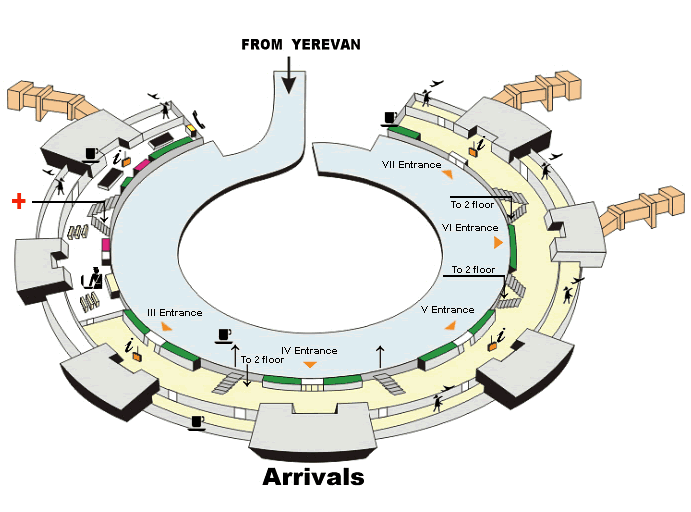
Ministro Pistarini International Airport Terminal A Map (Most Up-To-Date)

Terminal A at the Buenos Aires main airport hub now functions as a one-way international arrivals processor on the east end of the landside frontage. Arriving passengers flow from gates into immigration, down to baggage reclaim, through customs X-ray, then out into a crowded public hall and curb. The primary orientation cue is the landside exit: once outside, the New Departures “Zeppelin” hall sits leftward along the same covered sidewalk corridor.
Map Table
| Zone | Connection | Walk Time |
|---|---|---|
| Immigration hall | Arrivals corridor | 2–6 min |
| Baggage reclaim | Customs X-ray/“traffic light” | 5–10 min |
| Arrivals public hall | Landside sidewalk to “Zeppelin” Departures | 3–5 min |
| Arrivals exit doors | Inter-terminal frontage toward Terminal C | 10 min |
Ministro Pistarini International Airport Terminal A Map Strategy
- Treat processing time as the main variable: immigration, baggage delivery, and the customs X-ray funnel can stack unpredictably, so the map’s job is to show where each queue layer starts and where it releases you landside.
- Anchor every decision to the landside exit doors: the correct departure path begins with an immediate left turn toward the Zeppelin glass facade, not a search inside Terminal A for check-in.
- Assume international→domestic requires landside exposure: no sterile airside bridge, so plan the full loop (immigration → bags → customs → public hall → walk → re-entry).
- Flag hidden time traps early: US-bound secondary screening happens near the gate area (not at main security), and ground transport pickup points sit across active lanes where crowds and solicitation slow movement.
2026 Ministro Pistarini International Airport Terminal A Map + Printable PDF
Terminal A remains the international arrivals-only building in the current EZE layout, with all departures consolidated into the New Departures “Zeppelin” terminal between the legacy footprints. That shift makes older “Terminal A for departures” maps misleading for check-in and security. Use a 2026 map to confirm the exact landside exit doors, the left-turn departure vector, and where customs and curb pickup pinch points form.
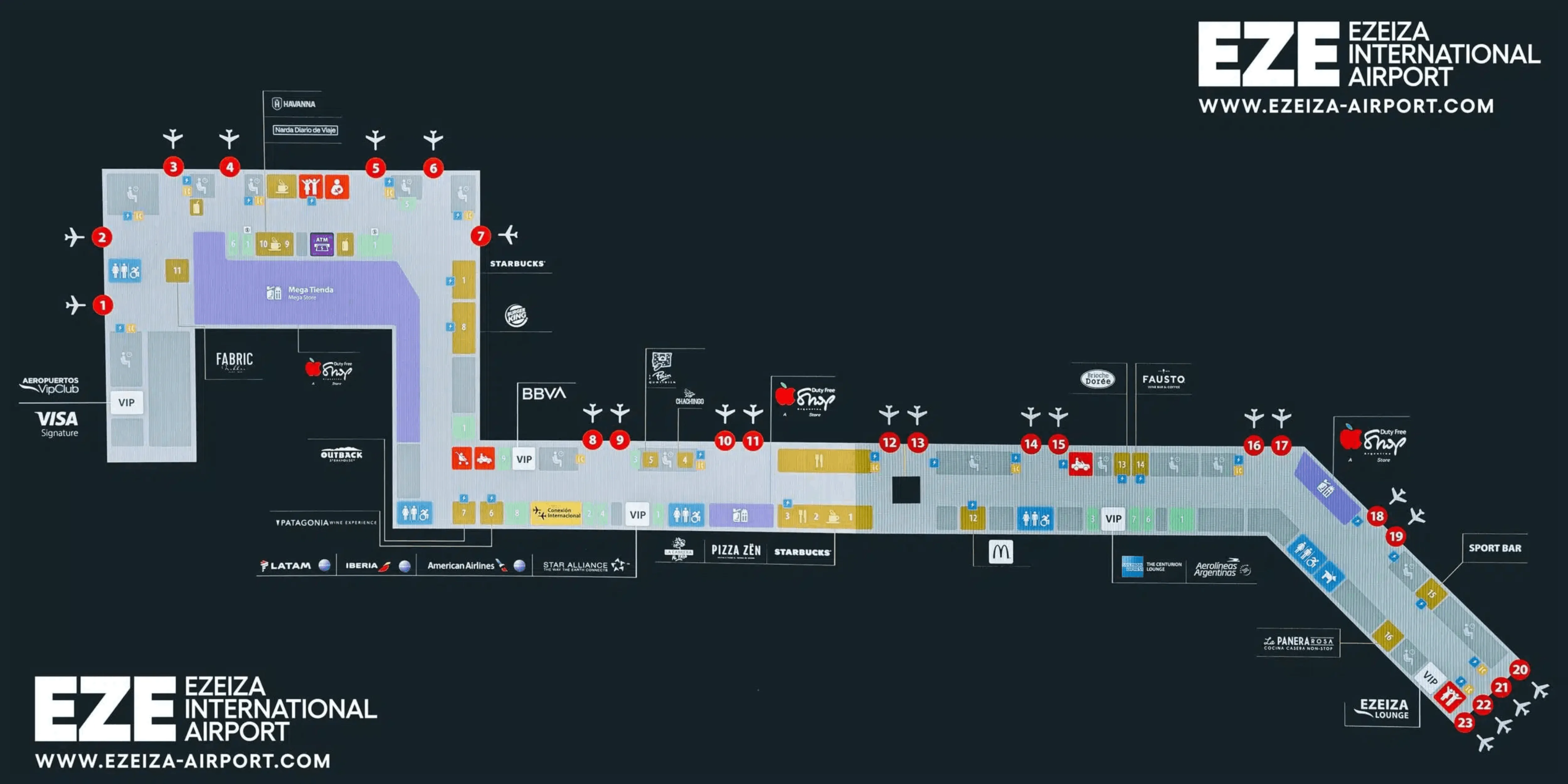
2026 Ministro Pistarini International Airport Terminal A Map Guide
What is the shortest walking distance (meters) from Terminal A international arrivals exit to Terminal C domestic check-in counters via the landside route?
The shortest landside walk is about 600–700 meters, but it leads to a dead-end for departures because Terminal C no longer has active check-in counters. The practical “departure” walk from Terminal A is to the New Departures “Zeppelin” terminal instead, at roughly 200–300 meters.
Terminal A sits on the east end of the frontage, the Zeppelin hall is central, and Terminal C is farther west. From the Terminal A customs exit doors, the most direct landside path runs along the covered sidewalk frontage past the central hub toward the Terminal C footprint. Expect about 10 minutes on foot with bags, with slowdowns at the crowds immediately outside the sliding doors and any curb crossings near the bus/taxi lanes.
Where is the exact point you must enter Terminal A departure security if you’re coming from Terminal C to exit Argentina (first controllable choke point)?
There is no Terminal A departure security entry, because Terminal A is arrivals-only in the current EZE layout. The first controllable choke point for exiting Argentina is the single security entry at the top of the main escalators inside the New Departures “Zeppelin” terminal.
From the Terminal C landside frontage, follow “Partidas / Departures” signage along the public sidewalk toward the central glass Zeppelin building. Enter the main facade and orient to the check-in islands; the escalator bank sits center-rear of the hall, and every passenger is funneled upstairs to one security-and-migration intake zone. If staff stop you at any other doorway in the legacy buildings, the correct reroute is always back to the Zeppelin main entrance for the escalators-up security funnel.
What is the walking time (minutes) from Terminal A check-in hall to the exit immigration booths using the fastest signed path (no lounge detours)?
There is no operational Terminal A check-in hall for departures, because Terminal A is arrivals-only in the current EZE layout. The fastest signed walk from the Zeppelin check-in hall to the exit emigration (Migraciones) booths is about 5–7 minutes of pure walking, before any queue time.
From the check-in islands in the Zeppelin ground-floor hall, move straight toward the central escalator bank (center-rear of the space), ride up to the upper level, and stay on the main flow line into the security queue entry. After security, continue forward into the migration area where lanes split for citizens/residents vs foreigners. The main slow point is the escalator landing where multiple flows compress into the single upstairs intake, so even “fastest path” walking can stall there if the queue backs up.
Where is the US-bound extra screening checkpoint location (questioning/passport check + slip) relative to Terminal A check-in and security?
The US-bound extra screening happens after main security and migration, near the US departure gate area, not at Terminal A check-in or the main security entrance. It is typically positioned at the entrance to the specific gate “pen” used for US flights or directly at the boarding gate queue.
Relative to the departure flow: check-in occurs in the Zeppelin hall, then you go upstairs to the single security funnel, then through Migraciones to the duty-free/airside concourse. The US screening point appears later in that concourse at the gate cluster assigned to the US flight, where staff run an additional document/boarding-pass control and bag inspection step. Build time for it as a separate choke point: arriving at the gate late can fail even if you cleared the main security and emigration lines.
What is the distance (meters) from the Terminal A security exit to the nearest Terminal B lounge access point (if terminals are connected airside), and what physical connector is used?
There is no Terminal A security exit for departures, because Terminal A is arrivals-only in the current EZE layout. From the Zeppelin post-migration exit (the point where you emerge airside after security and Migraciones), the nearest major Terminal B/connector-area lounge access is about 300–400 meters, reached via the main airside concourse walkway.
Airside connectivity for international passengers is largely continuous across the stitched-together A/B pier areas: you follow the retail-lined corridor that links the newer Zeppelin-side airside space into the older concourse toward the Gate 9 area. Lounge entrances in that zone are typically one level up from the main walking plane, accessed by stairs/elevator off the concourse rather than a separate tunnel or train.
If you are denied security entry in Terminal A/B because your departure is in Terminal C, where is the nearest official reroute point/signage that directs you to the correct terminal entrance?
There is no alternate security entrance in Terminal A or Terminal C for departures, so the reroute is always back to the New Departures “Zeppelin” main entrance. The nearest official reroute point on-site is the central Information Desk on the Zeppelin ground floor, where staff and signage redirect you to the correct processing path.
If you’re stopped at any legacy doorway (A/B/C) while trying to “find security,” follow “Partidas / Departures” signs along the landside frontage toward the large glass Zeppelin facade. Once inside, the correction loop is simple: re-orient at the Information Desk and the FIDS screens to the check-in islands, then proceed to the central escalators for the single upstairs security-and-migration funnel. If you’re physically at Terminal C, the corrective walk to the Zeppelin is about 400 meters.
Where is the Tienda León bus departure point relative to the Terminal A exit doors (direction + approximate meters), using the most direct pedestrian path?
The Tienda León bus departure point is about 50–70 meters from the Terminal A arrivals exit doors, typically across the vehicle lanes at the dedicated bus bay area, with Tienda León branding visible on the stand and buses. The most direct path is straight out the sliding doors and then a short walk to the marked stop area after the curb crossing.
From the customs exit into the public arrivals hall, keep moving to the main exterior exit doors without drifting into the taxi solicitation crowd. Outside, look for the bus lane/stand area that sits opposite the arrivals curb zone; the main slowdowns are the door crowding, the crosswalk timing/traffic, and people clustering around the curb. If you can see the orange/white Tienda León visuals, you’re already on the correct vector.
What is the shortest path from Terminal A baggage claim to the authorized taxi / ride pickup zone, and what pinch points (doors, crossings, ramps) slow it down?
The shortest pickup path is a straight-line exit from baggage claim through the customs X-ray/“traffic light” area to the arrivals sliding doors, then immediately to the curb for authorized taxis or 50–100 meters farther to a ride-share meeting point like Parking E1 or the middle-lane island. Pinch points are concentrated at the exit boundary where crowds and traffic compress movement.
From baggage reclaim, follow “Salida / Exit” to the customs screening funnel; that X-ray line is the first merge choke point. After clearing, cut directly through the public arrivals hall to the main sliding doors, where solicitors and meet-and-greet clusters block the cleanest line. For authorized taxis, the curb zone is right outside; for app rides, you often have to cross at the marked crosswalk to a safer pickup island or the E1 parking entrance, where the crosswalk traffic and curb ramps slow carts and rolling bags.
Where are the primary queue merge points in Terminal A departures between check-in and exit immigration (where multiple lines funnel into fewer lanes)?
There are no Terminal A departures queues, because Terminal A is arrivals-only in the current EZE layout. The primary departures merge points occur in the Zeppelin flow, where multiple check-in streams compress into a single upstairs security-and-migration intake.
The first major merge happens at the base-to-top transition of the central escalator bank: passengers from multiple check-in islands converge toward the same escalators, then compress again at the escalator landing where the queue for security can back up into the circulation space. The next merge point is the security queue entrance, where general and any fast-track style lines (when present) converge toward fewer open lanes. After security, flows compress again at Migraciones, where lane availability fluctuates and citizen/foreigner splits can force late-stage line switching.
What is the walking distance (meters) from Terminal A arrivals to the nearest inter-terminal walkway/connector signage that leads toward Terminal B/C?
The nearest connector signage is within about 10–20 meters of the Terminal A arrivals exit doors, typically pointing left toward “Partidas / Departures” and the central corridor to the Zeppelin/old B area. It appears essentially at the moment you enter the public zone and face the landside frontage.
From the customs exit into the arrivals hall, keep your line toward the exterior doors; immediately outside (or just inside near the doors, depending on crowd control), look for overhead or wall-mounted wayfinding that directs passengers along the covered sidewalk frontage. The key navigation move is the immediate left-turn vector: it places you onto the continuous landside walkway that leads first to the Zeppelin building and then onward toward the Terminal C end of the complex. The main disruptor is visual noise—solicitors and crowd density can hide the signs unless you look up.
If you must exit and re-enter to switch international→domestic at EZE, where is the exact re-entry door for the domestic side relative to Terminal A’s arrivals exit?
There is no separate domestic re-entry door, because all departures now re-enter through the main “Partidas / Departures” facade of the New Departures “Zeppelin” terminal. From the Terminal A arrivals exit, that re-entry point is roughly 250 meters to the left along the covered landside walkway toward the large glass building.
Exit Terminal A through customs to the public arrivals hall and out the main sliding doors, then orient left and keep the frontage on your right as you walk. The Zeppelin entrance is the first dominant structure you reach, and it serves as the universal re-induction point for both domestic and international departures. If you walk past the Zeppelin and continue farther west, you’re moving toward the Terminal C footprint, which is not where you re-enter for departures.
What is the shortest inside-the-terminal route from the Terminal A gates area back to immigration/services if a gate change forces repositioning late?
The shortest route is to follow “Arribos / Transfer” signage from the gate concourse back to the central connector node where arriving passengers are fed into the immigration stream, because there is no simple “reverse” door straight back to landside services. In practice, this is a full loop that can force you into the arrivals processing path.
From the Terminal A gate area (typically the lower-numbered gate zone), walk along the main airside concourse toward the junction where corridors converge between the older A pier and the connector/Zeppelin-linked concourse. Look for staff-controlled access and overhead signs that direct arriving flows; that corridor is the functional backtrack route into immigration/services. Plan it as distance plus control points: the walk alone can approach ~800 meters to reach landside exit points, and once you’re routed into immigration, you may face processing steps that make “late repositioning” operationally expensive rather than a quick turnaround.