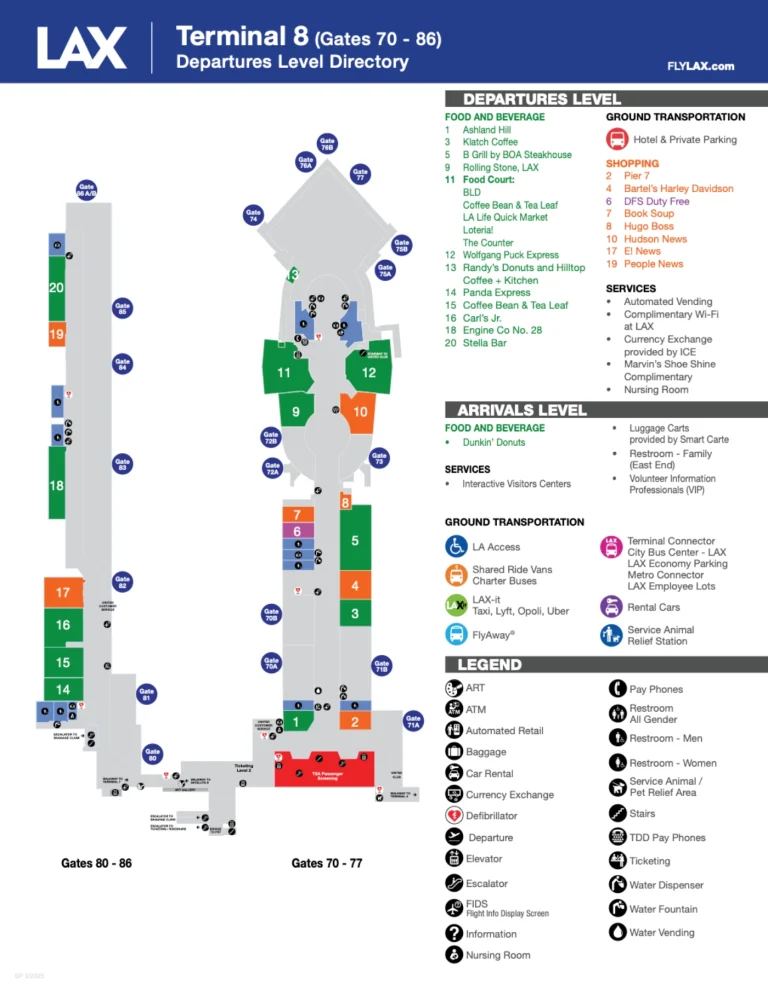
Melbourne Airport Terminal 3 Map (Most Up-To-Date)

Melbourne Airport Terminal 3 is a multi-level domestic terminal with a “vertical zigzag” flow: departures check-in sits on the upper public hall, while the main security checkpoint is one level down on a mezzanine, then gates spread laterally along a long airside pier and into the connected Terminal 4 precinct. Within Melbourne’s main airport hub, Terminal 3 runs between Terminal 2 and Terminal 4, so most time loss comes from level changes and choosing the correct left/right path at key exits.
Map Table
| Zone | Connection | Walk Time |
|---|---|---|
| Departures check-in hall (upper public level) | kiosks → bag drop → escalators down | 2–6 min |
| Mezzanine security | exits → lounge (right) / gates (left/straight) | 1–4 min |
| Airside T3 gates (1–10) | security → main concourse spine | 3–7 min |
| T3 ↔ T4 connector (airside) | T3 concourse → T4 gate precinct | 10–15 min |
Melbourne Airport Terminal 3 Map Strategy
- Bag drop + security time risk is highest when you drift laterally on the check-in level; treat “Security Screening” as a down-move and aim for the escalator banks immediately after bag drop rather than searching for a checkpoint on the same floor.
- Terminal 3 ↔ Terminal 4 errors happen when you commit to the wrong connector: if your boarding pass shows a higher-numbered gate in the T4 precinct, plan the airside connector walk as a full segment, not an afterthought.
- Rideshare speed comes from choosing the correct exit decision at arrivals: turn left for the Terminals 1–3 rideshare queue at the Terminal 2 forecourt (PIN/queue model), or turn right for the Terminal 4 car-park transport hub pickup option.
- Stress spikes (security interactions, lounge entry bottlenecks, limited early amenities) drop sharply once you’re airside; if you’re eligible, prioritize clearing security first, then use the immediate post-screening right turn to the Virgin Australia Lounge area as your reset point.
2026 Melbourne Airport Terminal 3 Map + Printable PDF
Terminal 3’s core layout in 2026 still revolves around the non-intuitive descent from check-in to mezzanine security, then a lateral split to gates and the Terminal 4 connector. The two “gotcha” areas remain the post-bag-drop hunt for the down-escalators to screening and the ground-transport geofence that forces a left/right walk to designated rideshare zones instead of curb pickup.
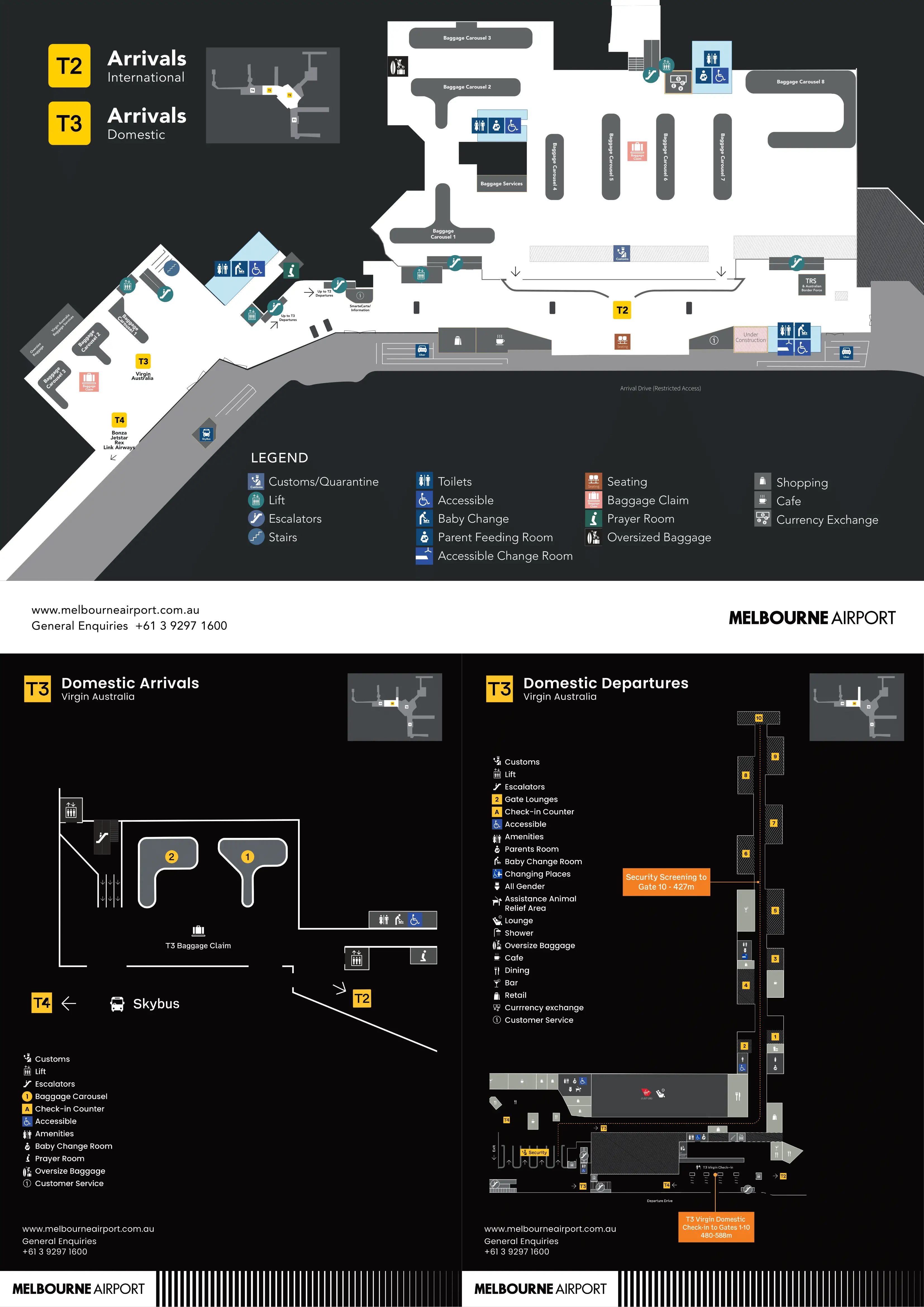
Melbourne Airport Terminal 2 and 3 International Arrivals Ground Floor Map 2025
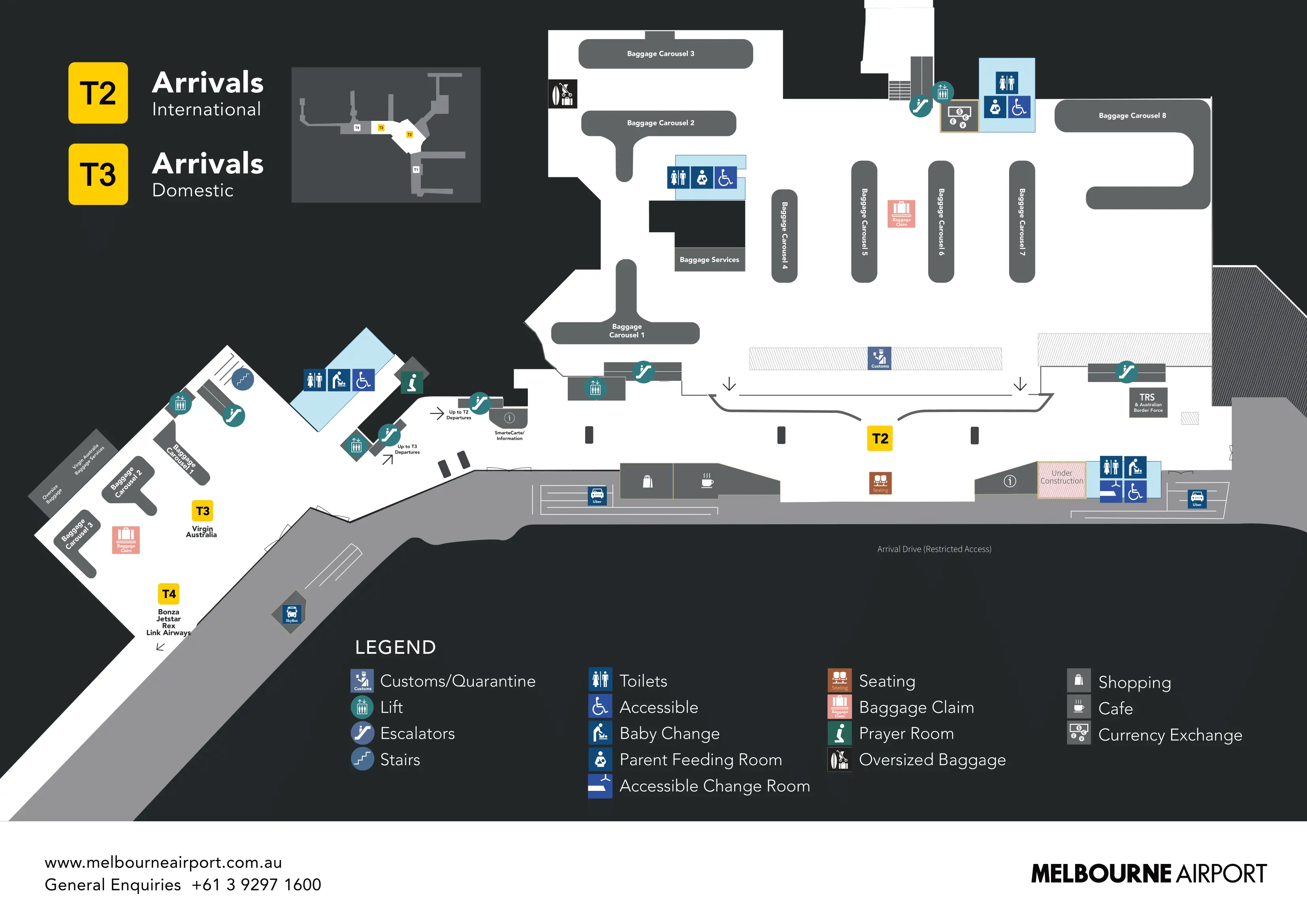
Melbourne Airport Terminal 3 Domestic Arrivals Ground Floor Map 2025
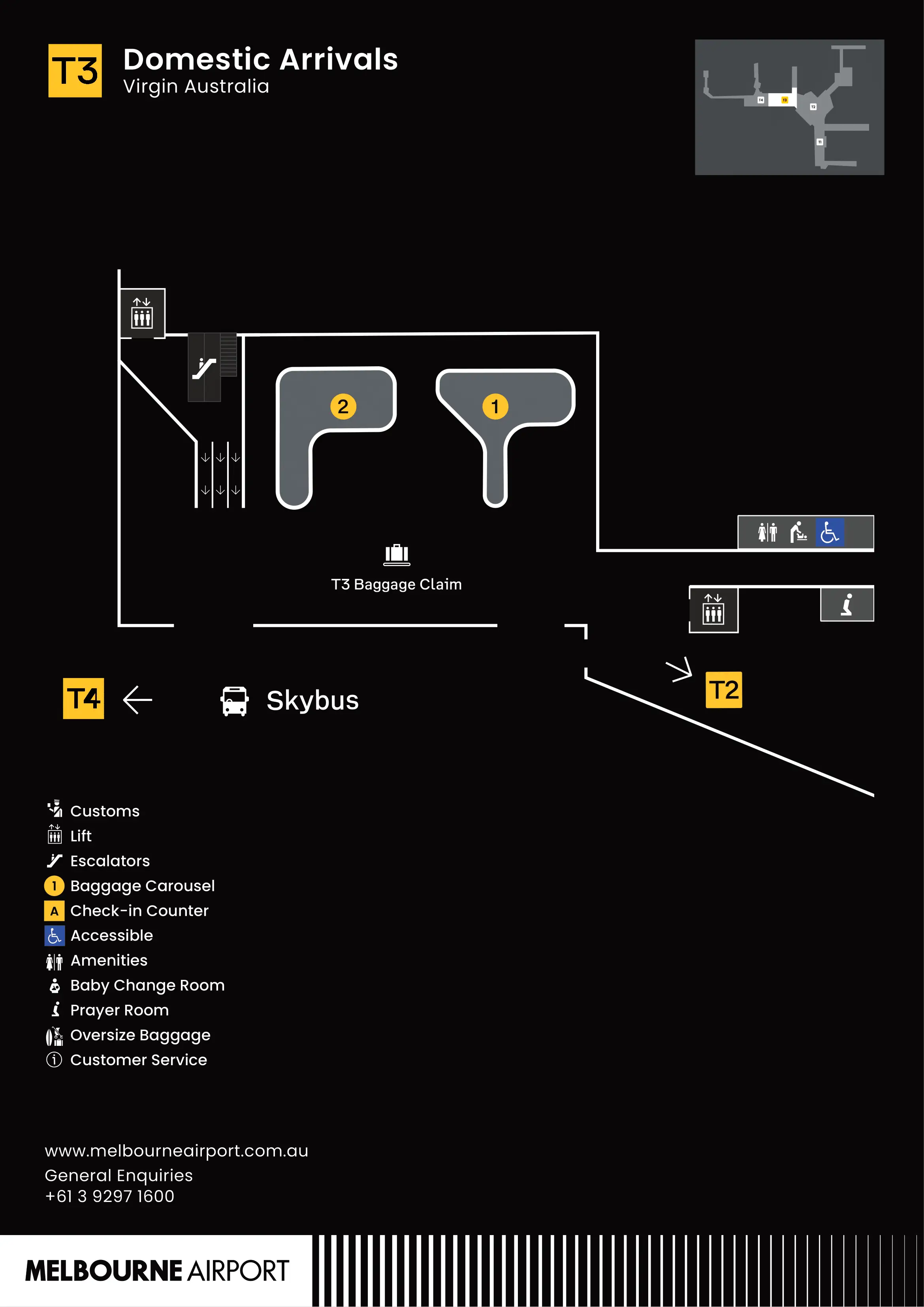
Melbourne Airport Terminal 3 Domestic Departures First Floor Map 2025
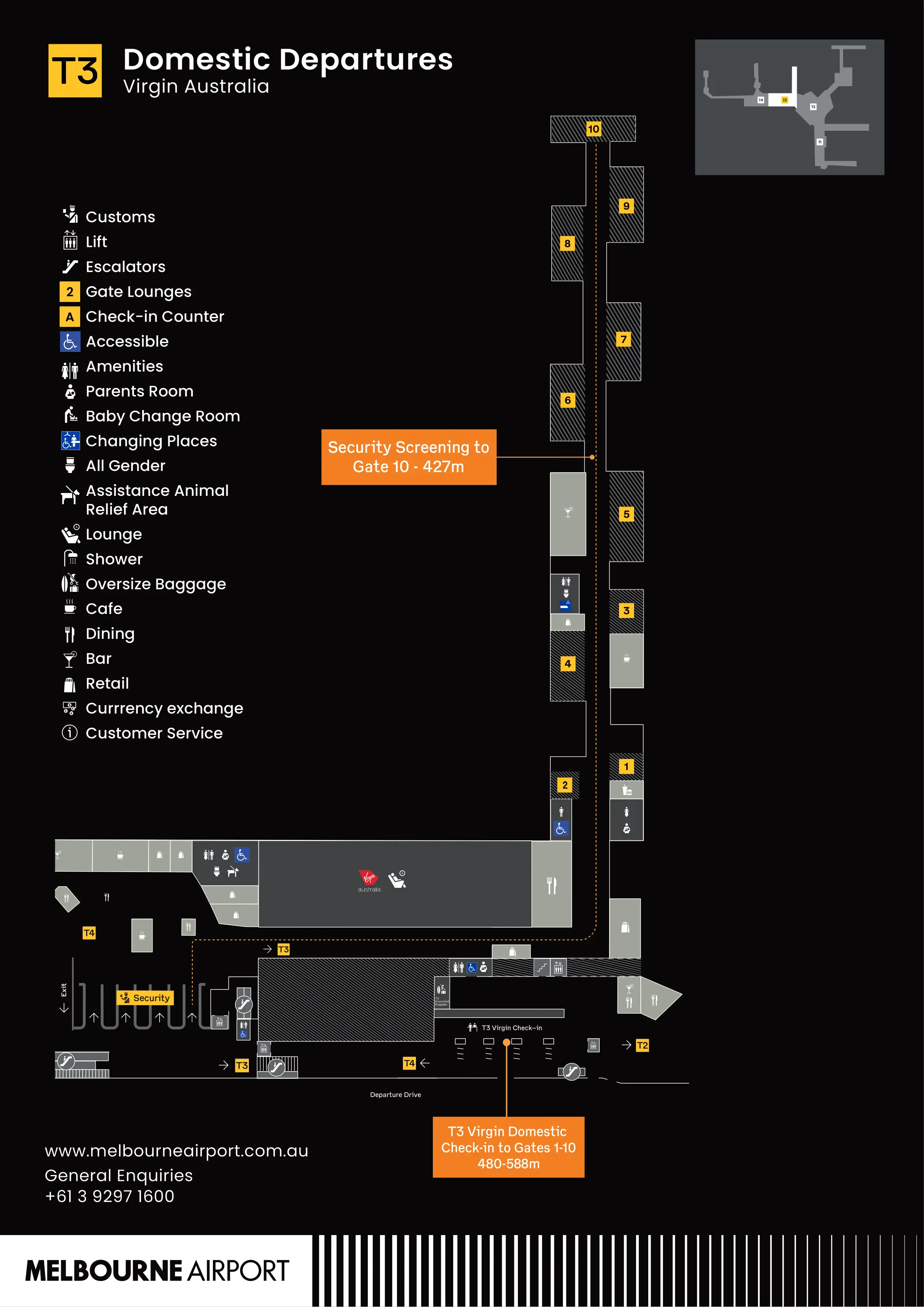
2026 Melbourne Airport Terminal 3 Map Guide
What is the shortest walking route (by distance) from Virgin check-in/bag drop in Terminal 3 to the Terminal 3 security screening entry point?
The shortest route is the direct “bag drop → down-escalators → security queue” path, with no lateral detours toward cafés or the Terminal 2/T1 direction. From Virgin’s bag drop machines, walk straight to the nearest escalator bank signed for Security Screening, descend one level to the mezzanine, then follow the barricades into the main screening queue.
After tagging and dropping your bag, stay inside the Virgin check-in hall footprint and look for the downward-pointing “Security Screening” signage rather than searching for a checkpoint on the same level. The critical landmark is the escalator/elevator cluster that initiates the level change; if you can see the down-escalators, you’re on the correct line. At the mezzanine landing, the security entry is immediately ahead as the corralled queueing area begins.
Where exactly is the Terminal 3 priority/express security lane entry (the physical start point), relative to the main security queue?
The priority/express security lane begins at the mezzanine-level security forecourt alongside the main screening entrance, splitting off at the head of the primary queue corral rather than starting upstairs near check-in. It presents as a separate, shorter entry channel adjacent to the standard queue lanes, so you only benefit once you’ve already descended to the mezzanine screening level.
The most reliable way to find it is to follow the same down-escalators to “Security Screening” that all passengers use, then scan for signage indicating premium/priority screening at the front edge of the queue barricades. The express entry is positioned to bypass the longest switchbacks of the general line, but it still feeds into the same screening lanes and officer-controlled belt-loading area. If you reach the point where the main queue starts snaking back from the belt-loading zone, you’ve gone too far; look for the priority split before committing into the full switchback maze.
What is the exact walking distance from Terminal 3 security exit (post-screening) to the Virgin Australia lounge front desk entrance?
The distance is a very short right-turn segment immediately after the security exit, because the Virgin Australia Lounge entrance sits on the same mezzanine airside level just off the screening outflow. The walk is typically under a minute at normal pace, and the key risk is overshooting it by walking straight toward the gates.
From the point where you collect your items and step out of the screening area into the airside corridor, reorient first, then take the near-immediate right-hand turn toward the lounge frontage. The closest fixed anchor is the post-security retail walling that visually blocks a long sightline; the lounge is tucked into that right-side edge rather than presented as a large open doorway. If you find yourself flowing into the main concourse stream toward gates, you’ve passed the decision node—turn back toward the security exit and take the first clear right.
Where is the T3 mezzanine-level walkway entrance that connects toward Terminal 4, and what is the closest fixed landmark (shop/service) immediately adjacent to that entrance?
The mezzanine-level connection toward Terminal 4 begins airside by committing southbound along the main concourse spine from the security exit area, following the Terminal 4 / higher-numbered gate signage into the connector corridor. The entrance is not at check-in; it’s the airside “branch” you enter only after clearing security and orienting toward the gates rather than the lounge.
From post-screening, move into the main passenger flow and follow signs for the Terminal 4 precinct and higher-numbered gates until the concourse narrows into a dedicated connector walkway. The best way to validate you’re at the correct entrance is that it transitions from the more open Terminal 3 gate/retail zone into a long, corridor-like passage used by through-walkers headed to T4. If you’re still in a wide seating-and-retail area where people are stopping for food, you’re not at the connector mouth yet; keep tracking the “T4 / Gates 11+” direction until the corridor becomes unmistakable.
What is the exact walking distance from Terminal 3 baggage claim to the designated Uber pickup area for Terminals 1–3 (the “rank/queue” location)?
The walk is about 200–250 meters from Terminal 3 baggage claim to the Terminals 1–3 Uber rank/queue in the Terminal 2 forecourt (Lane 1). The distance is driven by the leftward cross-terminal walk along the covered front-of-terminal promenade rather than anything inside the baggage hall.
| Segment | Route cue | Approx. distance |
|---|---|---|
| Baggage claim exit to public forecourt | Leave the carousel area to the main public doors | short, within hall |
| Terminal 3 doors to Terminal 2 direction | Turn left outside and stay on the covered walkway frontage | ~150–200 m |
| Terminal 2 forecourt to Uber rank/queue | Continue to the Lane 1 rideshare queue area (PIN/queue system) | ~50 m |
Which single curbside door number / exit point from Terminal 3 arrivals yields the shortest walk to the T1–T3 Uber pickup lane?
The shortest walk comes from exiting Terminal 3 arrivals and immediately committing left along the covered forecourt toward Terminal 2’s Lane 1 rideshare queue, using the first practical set of doors that put you on the main frontage path without detouring through the car park bridges. The key is minimizing lateral backtracking: get outside quickly, then stay on the straight, covered walkway line to the Terminal 2 forecourt.
Inside the arrivals public area, aim for the doors that exit directly to the front-of-terminal promenade (not the paths that pull you into parking structures or rental-car corridors). Once outside, the “fast” route is a clean left turn and continuous walk to the Terminal 2 forecourt rideshare queue, where the PIN/queue system loads you into the next available vehicle. If you exit at a door that forces you to cross traffic islands or climb toward parking walkways, you’ll add distance even if it feels closer on a map.
What is the shortest indoor path from Terminal 3 arrivals to Terminal 3 departures check-in hall (minimizing level changes and backtracking)?
The shortest indoor path is the direct “arrivals hall → vertical rise → departures check-in hall” route using the nearest escalator/elevator bank from the Terminal 3 arrivals public area up to the upper-level check-in floor. It minimizes distance by avoiding the landside frontage walk toward Terminal 2 or Terminal 4 and avoids unnecessary re-entry through alternate door sets.
From baggage claim/public arrivals, stay inside the Terminal 3 footprint and look for the main vertical circulation point (escalators and lifts) that links ground-level arrivals to the upper public check-in hall. Go up one level, then follow the internal wayfinding to Virgin Australia check-in rather than exiting to the curb and re-entering upstairs. If you find yourself walking along the outdoor promenade or drifting into the Terminal 2 retail/rental-car corridors, you’ve already added lateral distance that the direct up-and-forward route avoids.
What is the exact walking distance from the Terminal 3 security exit to the nearest high-capacity seating cluster airside (the first place with substantial seating)?
The nearest high-capacity seating cluster is immediately beyond the post-security reorientation zone on the Terminal 3 airside concourse, reached by continuing forward/left into the main gates spine rather than turning right to the Virgin Australia Lounge. The walk is typically 1–3 minutes because substantial seating appears once you clear the retail pinch-point and enter the broader gate concourse.
From the security exit, collect belongings and move out of the belt area, then follow the primary passenger stream into the main concourse where the space widens and seating banks become obvious. The key landmark is the transition from the tighter post-screening retail walling into the open gate-holding zone; the first “real” seating cluster is positioned in that widened area where people stop to regroup, check FIDS, and wait. If you turn right toward the lounge frontage, you’ll bypass the first large public seating bank entirely.
What is the exact walking distance from Terminal 3 departures to the nearest outdoor route that clearly leads to Terminal 4 (the “go outside and follow signs” fallback path)?
The nearest outdoor fallback route starts at the Terminal 3 departures curb on the upper-level forecourt, where you exit to the covered frontage and walk laterally toward Terminal 4 following external terminal signage. The distance is short to “get outside” (seconds), then becomes a continuous frontage walk, typically a few minutes, until the Terminal 4 direction is unambiguous.
From Terminal 3 departures check-in hall, use the doors that open directly onto Departure Drive/forecourt (the upper-level curb). Once outside, orient toward the Terminal 4 side of the precinct and follow the covered walkway line rather than cutting through parking structures. The clearest validation point is when you’re fully committed to the Terminal 4 frontage—fewer international cues, more budget-domestic wayfinding—and you’re no longer parallel to Terminal 2’s forecourt activity. If you remain in the Terminal 2-heavy zone, you’re walking the wrong lateral direction for the T4 fallback.
Where is the closest staffed service counter (airline or airport) to Terminal 3 security exit that a passenger can physically reach fastest when bag drop/check-in delays put them at risk of missing boarding?
The fastest staffed help point is the Virgin Australia airside Guest Services desk located near the security exit and lounge area on the mezzanine airside level. It is reachable without backtracking landside, so it avoids the re-screening risk and the longer walk back up to the check-in hall when you’re already time-critical.
From the point you step out of security, stay in the immediate post-screening zone and look toward the lounge-adjacent area rather than flowing down the concourse toward the gates. This location is strategically better than landside counters during irregular operations because it keeps you inside the sterile area and closer to boarding points. If you’re already late because bag drop ran long, the priority is resolving boarding/rebooking at the closest airside desk first, then moving directly to the gate corridor once you have an updated instruction or new boarding pass.