Manchester Airport Terminal 1 Map (Most Up-To-Date)

Manchester Airport Terminal 1 is a long, layered processing spine that runs from the upper-forecourt departures frontage into an airside retail maze, then funnels east toward Terminal 3 via a dedicated connector corridor. The footprint is narrow and linear, with wayfinding dominated by level changes (Skylink mezzanine up to Level 5) and forced post-security flow. Inside the MAN hub, “terminal” and “gate” don’t always match, so expect diversions and longer-than-posted walks.
Map Table
| Zone | Connection | Walk Time |
|---|---|---|
| Upper Forecourt | Drop-off → Level 5 Departures | 2–5 min |
| Skylink Mezzanine | The Station → T1 retail/food node | 5–10 min |
| Level 5 Departures | Check-in A → Main Security hall | 3–8 min |
| Airside Connector | World Duty Free exit → “Terminal 3 / Gates 40–59” corridor | 5–10 min |
Manchester Airport Terminal 1 Map Strategy
- Treat Terminal 1 as processing only: check-in and security in T1, then assume a forced airside diversion toward Terminal 3 gates via the post–World Duty Free split labeled “Terminal 3” and “Gates 40–59,” with barriers preventing access to legacy T1 lounge areas.
- Build a “security volatility buffer”: plan for Security A saturation and the possibility of staff-directed diversion to Security B via the metal stairs down from Level 5; accessibility is constrained and queues can back up onto the stairs.
- Assume every walk is longer than the sign: budget a full 15 minutes from security exit (start of Duty Free) to the first Terminal 3 hub/gate zone, with extra minutes lost inside the Duty Free maze and at any lift/escalator transitions near the T3 end.
- Lock down landside decisions early: for rail, prioritize the Level 5 lift/escalator nodes from the Skylink/food-court mezzanine; for vehicles, commit to the upper-forecourt “Drop Off” ramp after the Hilton/Clayton landmark pair and avoid pickup behaviors in drop-off (fine risk and forced loops).
2026 Manchester Airport Terminal 1 Map + Printable PDF
Terminal 1 remains active as a “zombie terminal” processor in 2026, with check-in and security still operating while large parts of the classic T1 departures lounge function are closing or blocked. Expect frequent live-flow changes that push passengers from T1 airside retail into Terminal 3 gate and shopping zones. Mechanical aids on Skylink routes should be treated as unreliable.
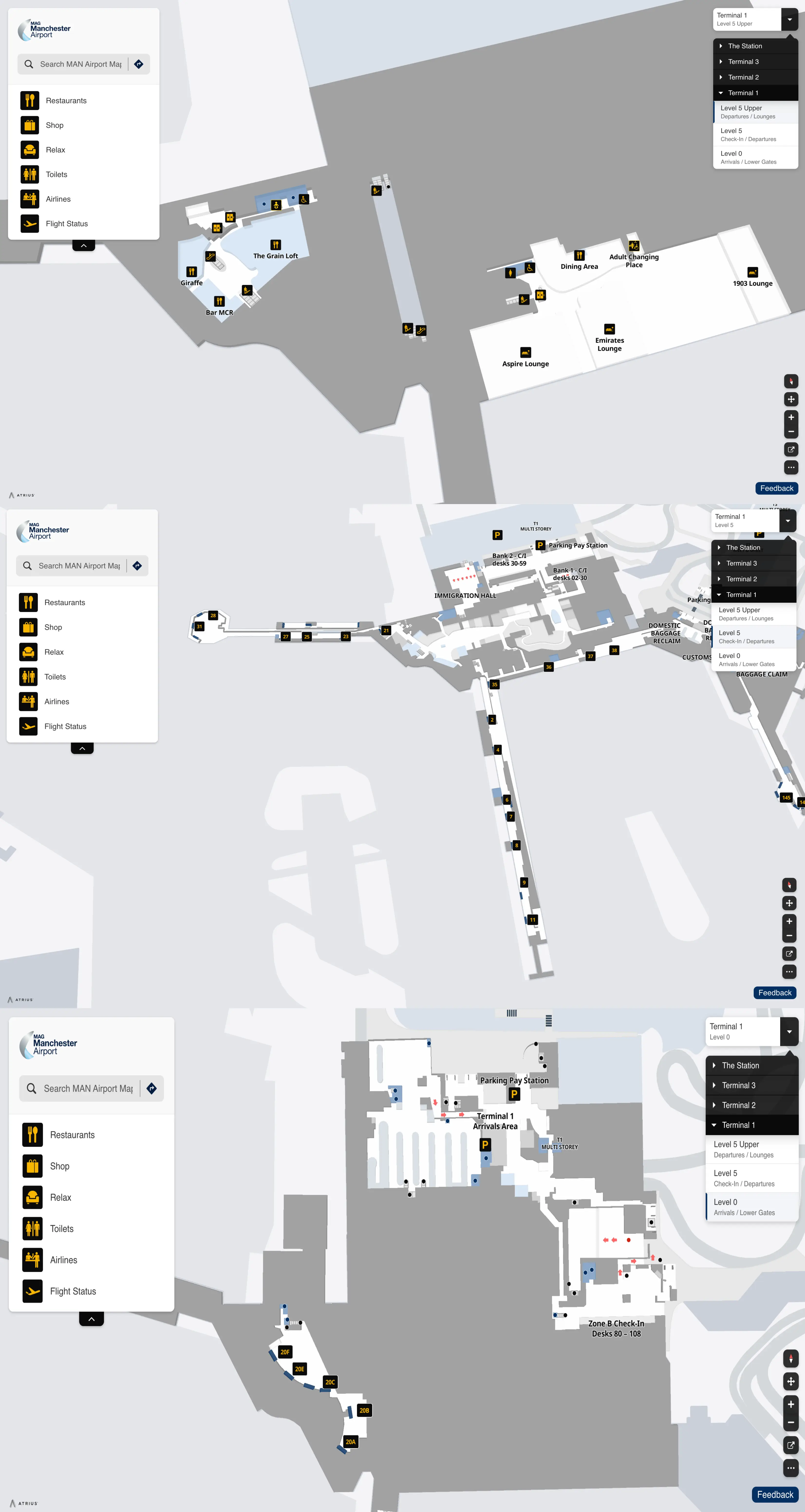
Manchester Airport Terminal 1 Level 0 Map 2025
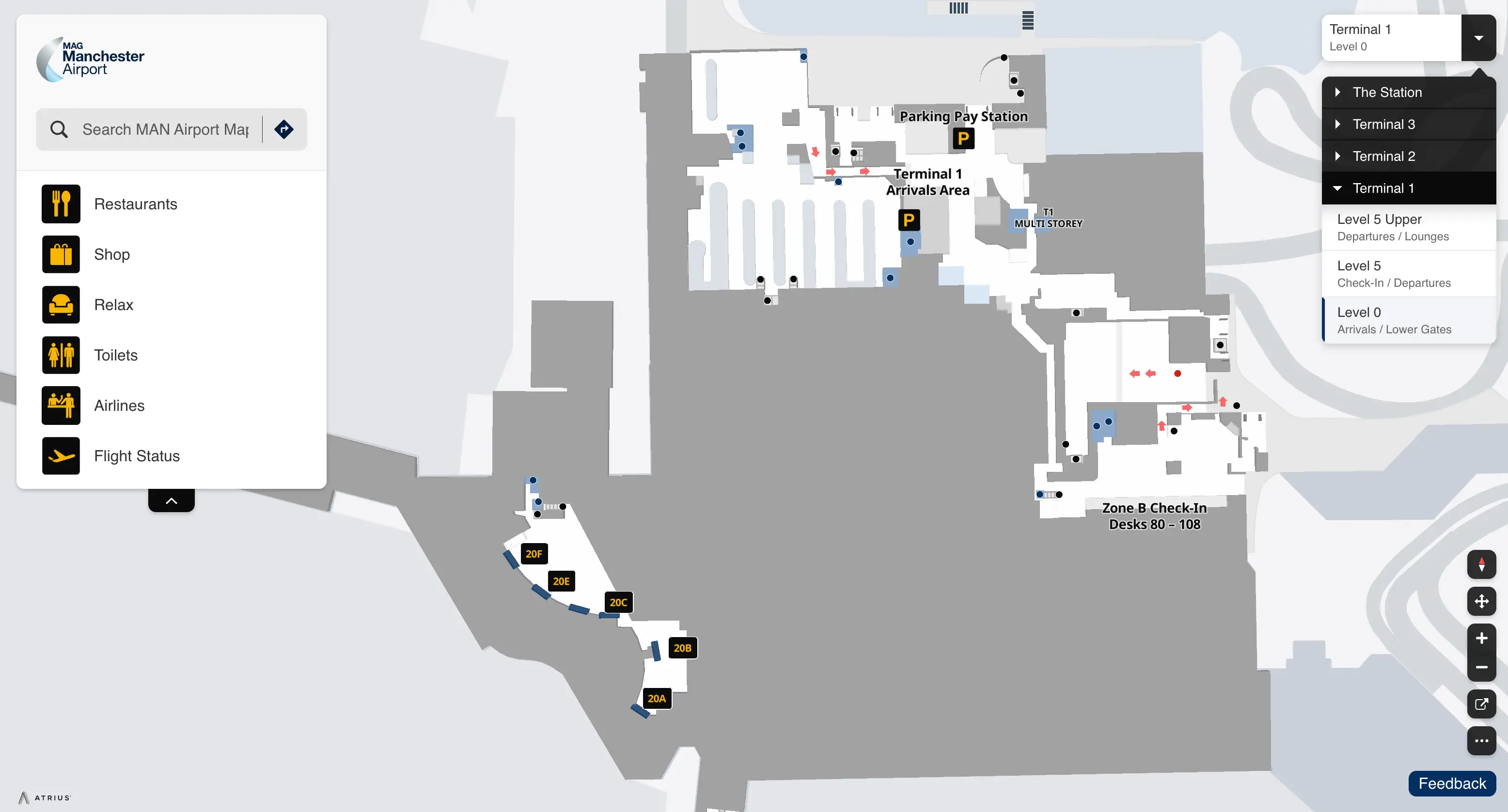
Manchester Airport Terminal 1 Level 5 Check In and Departure Map 2025
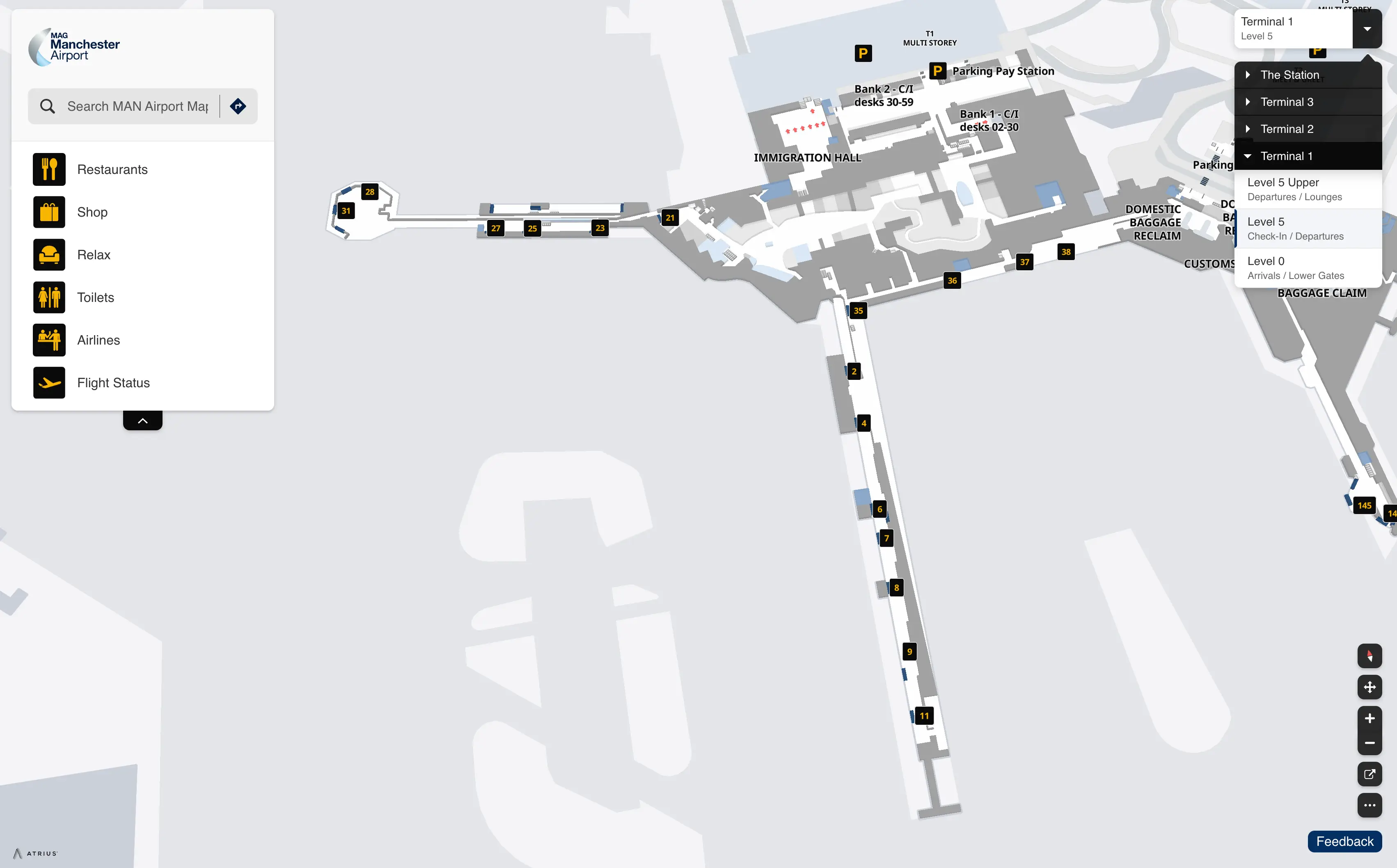
Manchester Airport Terminal 1 Level 5 Departures and Lounges Map 2025
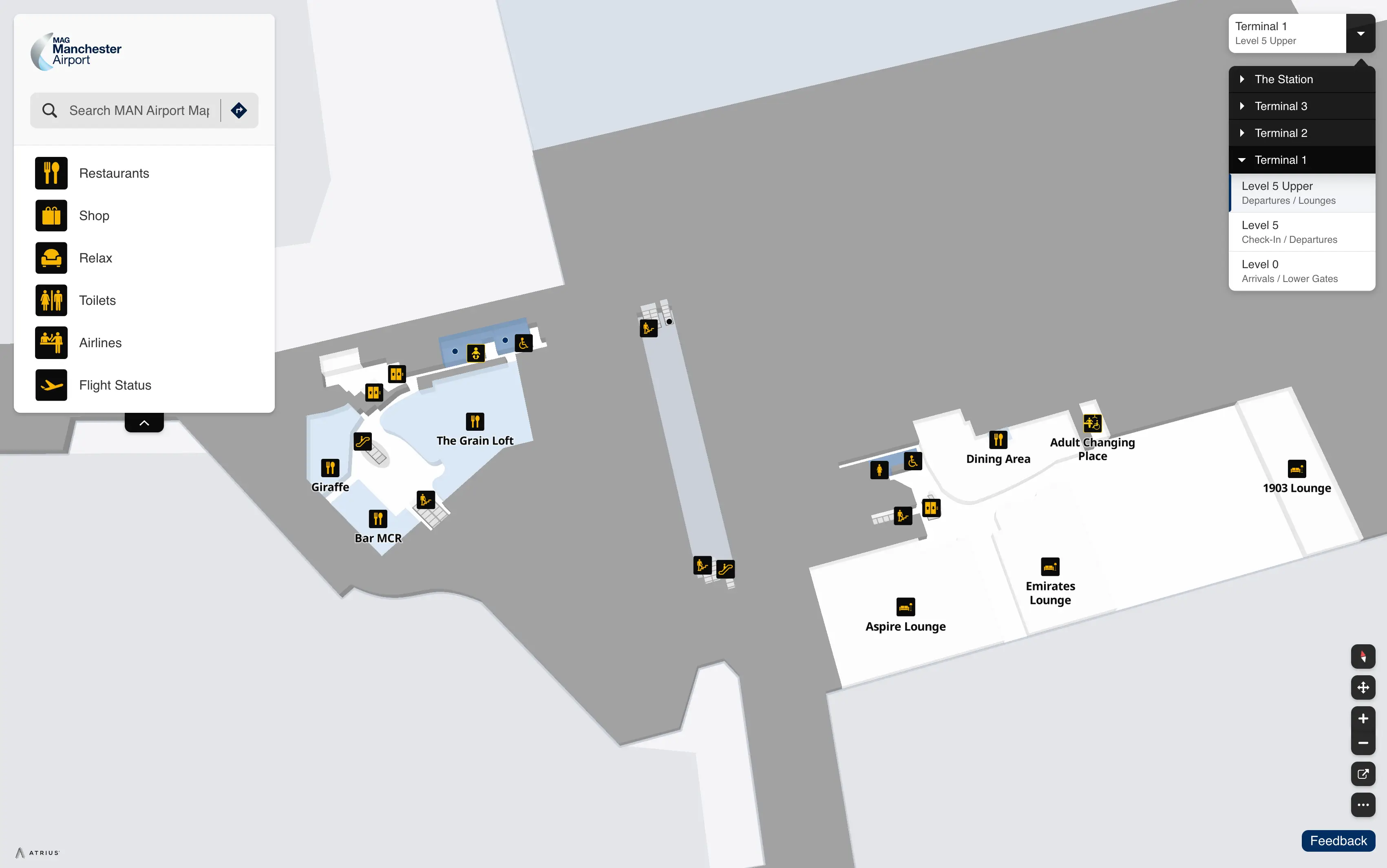
2026 Manchester Airport Terminal 1 Map Guide
Where is the exact diversion point after T1 World Duty Free where passengers must enter the T1→T3 corridor, and what is the signage label at that split?
The diversion point is the exit of the World Duty Free maze, where barriers block the old Terminal 1 departures lounge direction and force flow into the connector corridor toward Terminal 3. The split is typically marked by overhead wayfinding that calls out “Terminal 3” and a gate-range prompt such as “Gates 40–59”, sometimes also referencing “Pier B” depending on which gate branch is being used.
The practical “you’ve hit it” landmark is the moment you clear the last Duty Free tills/displays and see a more sterile corridor opening with airport-standard directional signage rather than retail signage. If you see any signage implying the former T1 lounge/pier areas to the right, treat that as a dead-end risk—current flow control uses physical barriers to prevent that access and push you toward the Terminal 3 corridor.
What is the measured walking distance from the end of T1 security exit to the first T3 gate-area entrance when forced through the corridor route?
The walking distance is roughly 700–900 meters from the T1 security exit to the first T3 gate-area entrance when you’re forced through World Duty Free and the connector corridor.
| Segment | Adjacent anchor points | Distance |
|---|---|---|
| Security exit → Duty Free exit | security comb → World Duty Free final tills/exit | 150–250 m |
| Duty Free exit → start of T1→T3 corridor | Duty Free exit split with “Terminal 3 / Gates 40–59” signs → sterile connector mouth | 50–100 m |
| Connector corridor → first T3 entrance | corridor spine → T3 commercial hub / first gate-zone threshold | 400–650 m |
| Typical total | end of T1 security → first T3 gate-area access point | 700–900 m |
Which curbside bays are the actual Terminal 1 passenger drop-off bays, and what fixed landmark label sits directly beside them?
The actual Terminal 1 passenger drop-off bays are the Upper Forecourt drop-off bays reached via the left-hand ramp signed “Drop Off” on the T1/T3 approach road. The fixed micro-landmark beside the bay area is the “613 Squadron” commemorative tag/marker positioned near the bus stop infrastructure adjacent to the drop-off line.
The reliable approach confirmation is visual: after the M56 J5 spur, you pass the Hilton Hotel then the Clayton Hotel on the left, then commit to the ramp up to the upper forecourt rather than staying on the ground-level arrivals circulation. Once on the forecourt, the drop-off bays sit between the circulation lane and the terminal façade; if you can see the “613 Squadron” reference near the bus stop elements, you’re in the correct bay zone rather than drifting toward arrivals or the relocated pickup areas.
From the rail station exit, what is the shortest signed route to the T1 security entrance, including the specific lift/escalator nodes used?
The shortest signed route is The Station → Skylink (Terminal 1 & 3) → T1 mezzanine/food-court entry → lifts/escalators up to Level 5 Departures → T1 Main Security. It depends on a single vertical move at the terminal end: the Level 5 lift/escalator bank.
| Step | Follow signs | Vertical nodes | Adjacent anchor points |
|---|---|---|---|
| 1 | “Skylink / Terminals” from station concourse | platform escalators/lifts up to concourse (if arriving by train) | rail platforms → The Station concourse |
| 2 | “Terminal 1 & 3” (left split) | none | ticket barriers → Skylink entry |
| 3 | Continue “T1 / T3” along Skylink | travelators (often off) | Skylink spine → T1 building penetration near food/retail |
| 4 | “Departures / Check-in / Security” | lift bank or escalators up to Level 5 | food-court mezzanine → Level 5 departures hall |
| 5 | “Security” | none | Level 5 check-in hall edge → security queue entrance |
Where is “Security B” (the metal staircase) located relative to the main T1 security hall, and what corridor/approach feeds into it?
Security B is below the main Level 5 T1 security hall, reached by a metal staircase descending from the Level 5 departures/security approach area into a basement-style overflow screening zone. The feed into it is not a separate landside corridor—it’s an internal diversion off the Level 5 security approach, typically activated when the main hall (“Security A”) saturates.
The navigation cue is behavioral as much as spatial: you approach the normal Level 5 security lanes, then staff direction or temporary wayfinding pushes you toward a side opening that leads to the industrial-looking stairs. The failure mode is that queues can trail up the staircase back into the Level 5 space, and the route can be intermittently open/closed—so if you’re sent down and find doors closed, you may be forced to reverse back up against the flow.
After clearing T1 security, where is the nearest toilets location before you reach T3 gate areas, and what are the map labels for those restrooms?
The nearest toilets are immediately after the security exit, before you commit into the World Duty Free maze, and they are the last reliable restroom opportunity before the T1→T3 connector corridor. The corridor itself is a sterile “no-amenities” tube, so the post-security zone is the critical stop.
The practical anchor is the water-faucet/taps point just after security; toilets sit in that same immediate post-screening area, before retail flow forces you deeper into Duty Free. On most Manchester Airport wayfinding, these are labeled simply as “Toilets” (often accompanied by standard WC icons, sometimes split as Male / Female / Accessible Toilets depending on the panel). Once you pass into Duty Free and then the connector toward “Terminal 3 / Gates 40–59,” assume you won’t see restrooms again until the Terminal 3 commercial hub/gate zone.
Where are Ryanair bag-drop/self-service kiosks located inside T1, and what is the shortest path from that point to the start of the security queue?
Ryanair bag-drop and self-service are in Terminal 1, Level 5, Departures A inside the main T1 check-in hall. The shortest path to security is a direct hall traverse from Departures A into the Level 5 main security feed, without dropping levels or attempting to use Terminal 3 landside.
From the desks/kiosks in Departures A, turn toward the central open span of the Level 5 departures hall and follow the overhead “Security” wayfinding into the main queue mouth. The key negative constraint is directional: do not “follow your booking that says T3” and walk landside to Terminal 3—T3 may not offer Ryanair processing, and that detour can burn the exact buffer you need for volatile security. If you hit the security approach and see staff managing overflow, you may be diverted toward the Security B stair route from the same Level 5 approach zone.
On the landside transfer route T1 arrivals → T2 departures, where do the moving walkways begin and end, and what are the segment distances?
The moving walkways are on the Skylink sections connecting the terminal complex via The Station, but they are operationally unreliable—plan the transfer as a full walk. The key practical segment for T1 arrivals → T2 departures is the long Skylink run from The Station toward Terminal 2, where travelators are installed but frequently out of service.
| Segment | Begin → End (anchors) | Distance |
|---|---|---|
| T1 arrivals exit → Skylink access | T1 ground-level arrivals ejection → signed route into Skylink / The Station | 200–300 m |
| Station interface | station concourse zone → Skylink continuation toward T2 | 100–200 m |
| Travelator-equipped long leg | The Station → Terminal 2 entrance threshold | 300–400 m |
| Typical total (landside transfer) | T1 arrivals → T2 departures access point | 800–900 m |
From T1 Short Stay pedestrian exits, what is the exact indoor entry point into the T1 check-in hall (door/bridge name on the map)?
The indoor entry point is the dedicated pedestrian bridge link from T1 Short Stay (multi-storey / “Mid Stay”) into the T1 Departures level, which deposits you directly onto the Level 5 departures/check-in hall edge rather than into arrivals. The map labeling most commonly presents this as the “Short Stay Car Park” pedestrian bridge / link bridge into “Terminal 1 Departures”.
The practical verification anchors are sequential: you leave the car park via the signed pedestrian exits for Terminal 1, enter the enclosed bridge, and emerge into the departures-side circulation that feeds straight into the main check-in space (where Departures A sits for Ryanair). If you end up at ground-level arrivals doors, you’ve taken the wrong core—Short Stay’s tactical advantage is that the bridge bypasses arrivals chaos and lands you at departures/check-in height.
Which gate pier branch is being used for current T1/T3 combined operations (e.g., Pier B / Gates 2–11), and where does that pier branch off from the main airside spine?
The active pier branch is Pier B, the Gates 1–15 side, retained for the current T1/T3 combined operating pattern while the Pier C (Gates 20–32) side is the primary closure/demolition candidate. Pier B is the branch that stays logically “closest” to Terminal 3 apron activity.
Pier B branches off after security once you clear the World Duty Free exit split—the main airside spine effectively becomes the forced flow toward “Terminal 3 / Gates 40–59”, and access toward the older right-hand lounge/pier directions is commonly blocked by barriers. The functional branching cue is the first major post–Duty Free decision node: if signage references Pier B alongside Terminal 3 or low gate numbers (1–15), that’s the pier direction; if you see cues for the old T1 lounge/pier areas, treat them as dead-end risk under current flow controls.
Where is the T1 Fast Track / Priority entry relative to the main security queue, and which side of the queue line does it sit on?
The T1 Fast Track / Priority entry is in the Level 5 main departures hall at the security frontage, and it sits to the far left of the general security queue when you are facing the security checkpoints.
The practical approach is to enter the Level 5 security area from the check-in hall and immediately scan left for the Fast Track branding and lane separators before you get pulled into the main serpentine. This left-side placement is a common failure node: passengers drift right into the main queue by default, then discover the Fast Track lane only after they’ve committed to stanchions. If you checked in via any lower or alternate processing area, the negative constraint still applies—Fast Track is anchored to the main Level 5 hall, so you must be on that level to use it.
From T3 arrivals hall, what is the signed pedestrian route back to T1 parking / pickup areas, and what is the door-to-door walk distance?
The route is an external, covered landside walk—there is no internal cut-through back into Terminal 1 arrivals due to one-way security and shuttered flows. The signed path typically uses “Terminals 1 & 3” and/or “Mid Stay Car Park” (sometimes “T1 Multi-Storey” legacy wording) to pull you onto the inter-terminal covered walkway and into the car park cores.
The sequence is: exit T3 Arrivals (ground level) → follow signs for Terminals 1 & 3 / Parking → stay on the covered connector along the façade → enter the parking/core access for the T1-side car parks rather than trying to re-enter T1 arrivals doors. The door-to-door walk distance is roughly 400–800 meters, which typically lands as 5–10 minutes depending on which parking level/core you need and how direct the sign run is.