
Kingsford Smith International Airport Terminal 3 Map (Most Up-To-Date)

Sydney (SYD) Terminal 3 (Qantas Domestic) is a long, linear terminal with a central departures atrium upstairs and a ground-level arrivals hall running parallel to the kerb. The layout stretches north–south, with the Gate 15 transfer node toward the northern pier and the quickest landside exits nearer the southern carousel end. It sits within Sydney’s main airport complex, where the Horseshoe road geometry shapes every transfer.
Map Table
| Zone | Connection | Walk Time |
|---|---|---|
| Arrivals Hall (Ground) | Carousels 1–2, station access node | shortest egress |
| Arrivals Hall (Ground) | Carousel 5, Qantas Baggage Services | longer internal traverse |
| Kerbside / Median Strip | T-Bus bays 4–7 (shared T2/T3) | 250–300 m / ~4 min |
| Landside link | T3 ↔ T2 via P1 car park walkway | 450–500 m / 5–7 min |
Kingsford Smith International Airport Terminal 3 Map Strategy
- Treat SYD T3 as three timed segments: carousel-to-doors, doors-to-exact-bay/curb, then screening-to-gate; measure each segment, not just “terminal-to-terminal.”
- Lock in exact pickup geometry under pressure: T-Bus uses the shared median strip bays (not the immediate arrivals curb), while rideshare uses Shiers Avenue kerbside.
- Use the northern/alternate security position when heading to Gate 15 or the far-north pier gates; it avoids the central retail-core pinch point.
- Apply hard negative constraints: no “fast” pedestrian route to T1 with luggage; the viable options are landside T-Bus, train, or eligible airside transfer via Gate 15.
2026 Kingsford Smith International Airport Terminal 3 Map + Printable PDF
2026 wayfinding at SYD T3 still hinges on a few “make-or-break” nodes: the shared T-Bus bays in the Horseshoe median, the covered P1 car park pedestrian link to T2, and the Gate 15 airside transfer lounge. Security throughput is supported by two screening positions (central and northern/alternate), with CT scanner upgrades influencing what you can keep in your bag and how fast lines move.
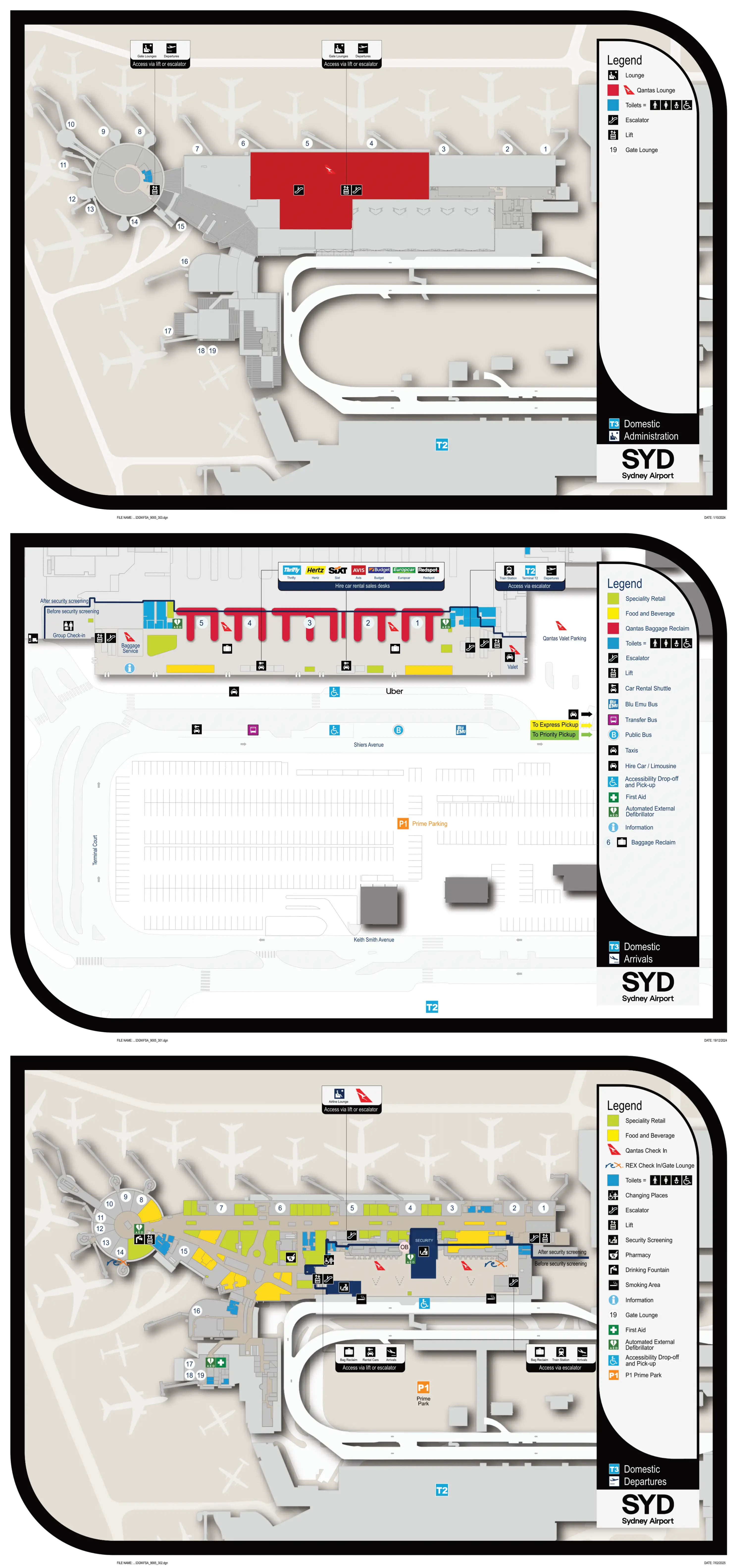
Kingsford Smith International Airport Terminal 3 Domestic Administration Map 2025
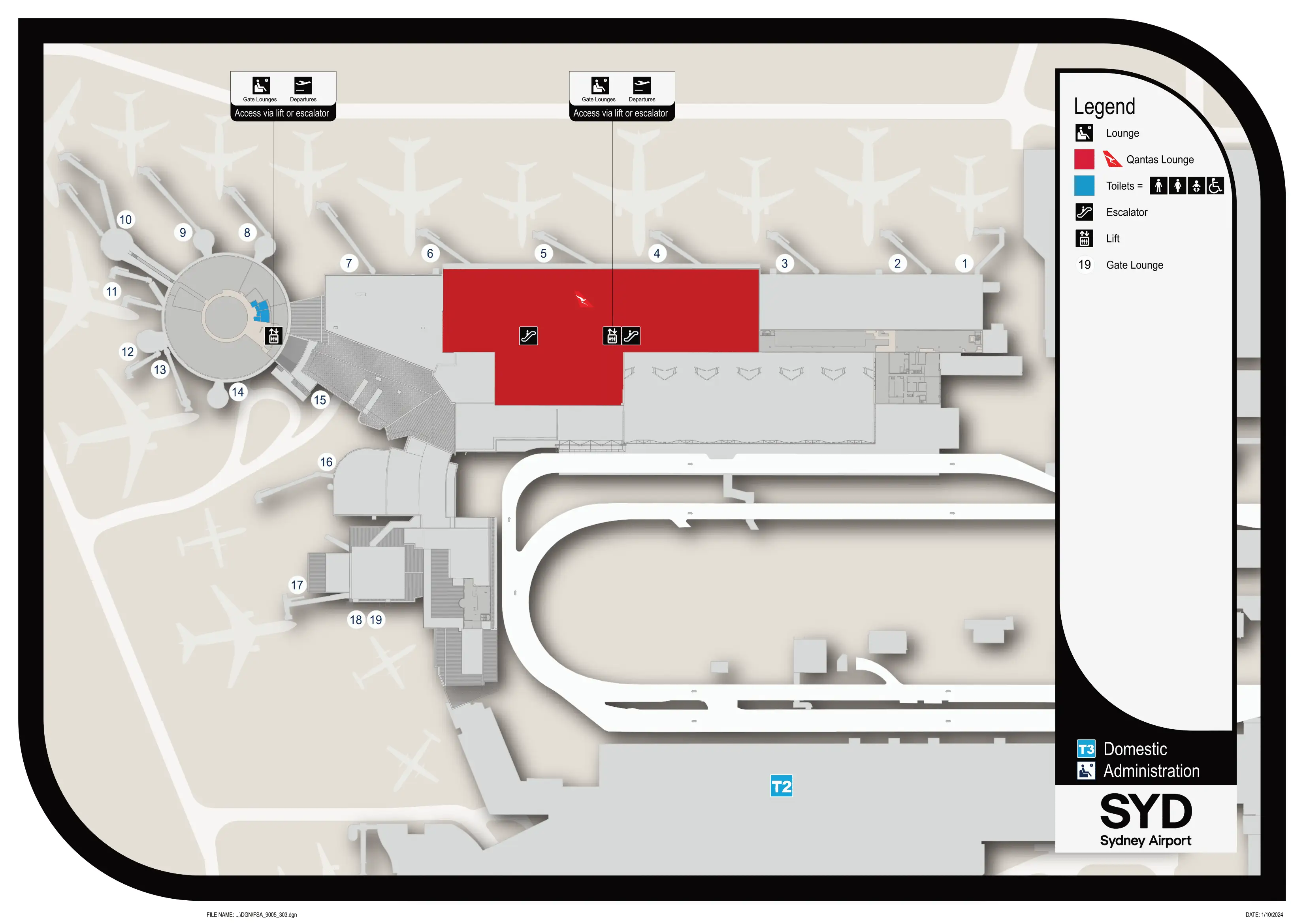
Kingsford Smith International Airport Terminal 3 Domestic Arrivals Map 2025
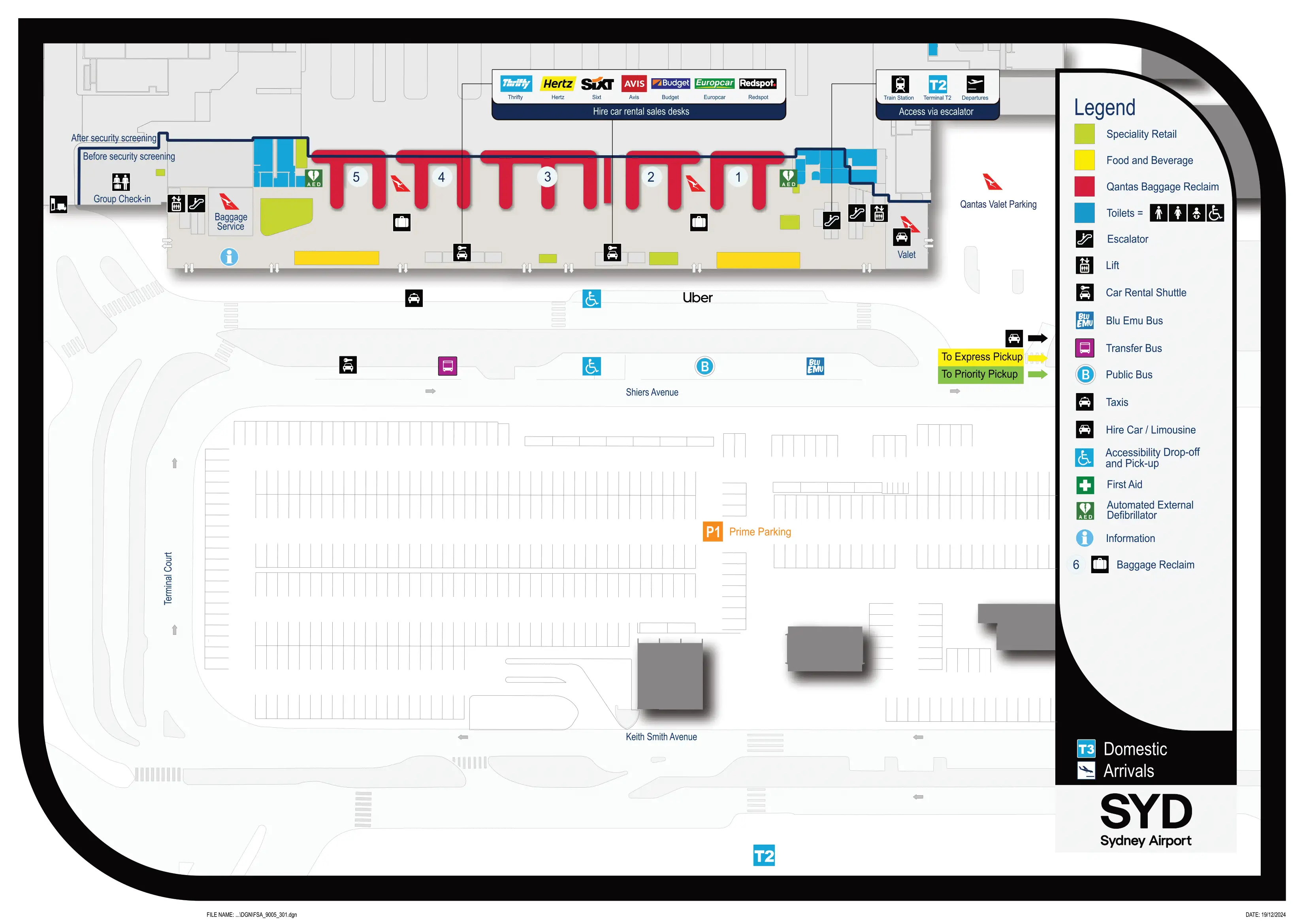
Kingsford Smith International Airport Terminal 3 Domestic Departures Map 2025
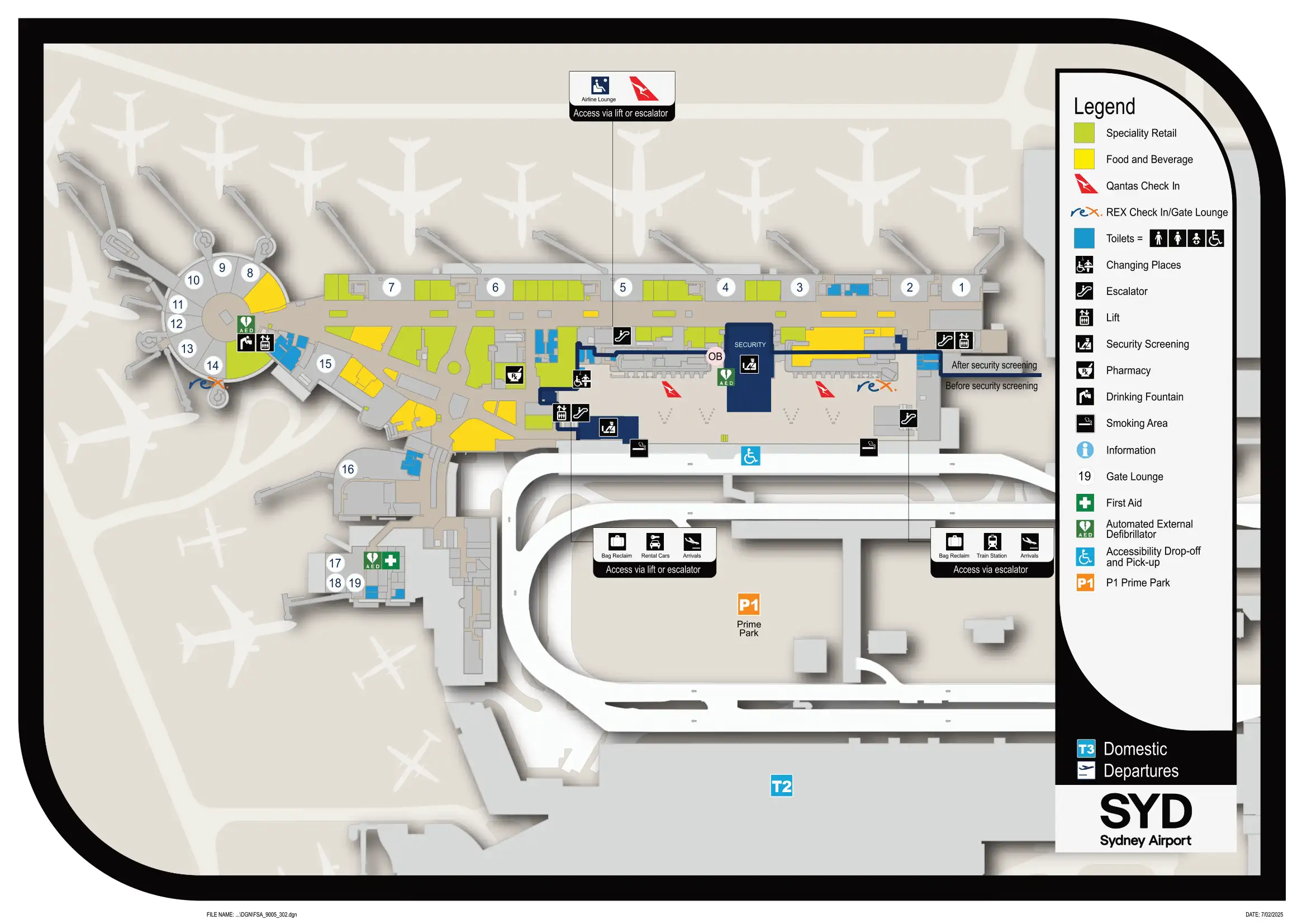
2026 Kingsford Smith International Airport Terminal 3 Map Guide
Where is the T-Bus (free Transfer Bus) pickup point on T3 Arrivals (exact curb/door location)?
The T-Bus pickup for SYD Terminal 3 is in the median strip bus bays between Terminal 2 and Terminal 3, specifically Bays 4–7 (with Bay 4 the key anchor). From T3 Arrivals, it is not on the immediate curb outside the doors—you have to cross the active pickup/taxi lanes to reach the central island.
Exit the T3 Arrivals Hall to the kerbside and turn right along the terminal frontage footpath until you reach the signed pedestrian crossing into the Horseshoe road median. The T-Bus lines up in the numbered bays on that island (Bays 4–7), alongside other shuttle operators, so the bay numbers matter more than “which door.”
What is the walking distance (meters) from T3 baggage claim exit to the T-Bus stop?
Walking is about 250–300 meters from the T3 baggage reclaim exit doors to the T-Bus stop (Bays 4–7), which typically maps to roughly 4 minutes at an unimpeded pace. The distance is measured from the Arrivals Hall egress point rather than a specific carousel, so it can run longer if you’re starting from the far-north end near Carousel 5.
The path is effectively three linked segments: leave baggage reclaim via the automatic glass doors, follow the sheltered terminal-front footpath toward the Horseshoe bend, then use the designated pedestrian crossing to the median strip where Bays 4–7 sit. Peak-hour kerbside crowding and waiting for a safe crossing are the usual time variables.
What is the shortest signed pedestrian route from T3 to T2 (exact corridor/bridge path shown on maps)?
The shortest signed route from SYD T3 to T2 is the covered pedestrian walkway through the ground level of the P1 multi-storey car park. This is the practical “critical path” because the Horseshoe road is one-way and makes vehicle transfers slow and indirect.
Exit T3 to landside and follow the signs toward Terminal 2 via P1. The route cuts through the P1 car park as an undercover corridor, then continues out the other side toward the T2 terminal frontage. The total separation is about 450–500 meters and usually takes 5–7 minutes on foot, with the car-park interior (pillars/parking bays) acting as the main visual landmark that you’re on the correct link.
What is the walking distance (meters) from the Airport Link Domestic station exit to the T3 departures check-in hall entrance?
Walking is about 150 meters horizontally from the Domestic Airport Station exit for T3 to the terminal’s check-in/departures core, plus the vertical ascent from platform level up to Arrivals and then up to Departures (Level 2). The key anchor is the station access emerging near Carousel 1 at the southern end of the T3 Arrivals Hall.
From the fare gates, take escalators/lifts up to the T3 Arrivals Hall near Carousel 1, then traverse the arrivals concourse to the vertical transport that rises to Level 2. Once upstairs, you enter the central departures atrium that feeds the check-in zones. In time terms, this is commonly ~2–3 minutes when escalators and lifts are flowing, but lift queues can stretch it to ~5–7 minutes at peaks.
Where is the “additional screening” / alternate security lane in SYD T3 (exact position relative to the main security entry)?
The alternate (“additional”) screening point in SYD T3 is at the northern end of the Departures level, adjacent to the Qantas Business/Priority check-in area (Counter D zone). It is separate from the central security entry that sits behind the main retail atrium and draws most passengers by default.
From the check-in hall, the main security entry is the central, obvious funnel behind the retail core. Instead of joining that, follow the departures hall flow north toward the premium check-in counters; the alternate screening position is located in that same northern precinct and typically feeds you airside nearer the Qantas Club/Business Lounge side of the concourse. This placement makes it the better choice for Gate 15 and the far-north gates (15–19).
Which security exit point (post-screening) gives the shortest walk to the farthest gate shown on the current T3 map?
The northern (alternate) security screening exit gives the shortest walk to the farthest gates, which are the northern pier gates around 15–19. Using the central security exit forces a longer northbound walk through the retail-core pinch point before you even reach the start of that pier.
The far-north area is anchored by Gate 15 (the transfer bus lounge function) and the “heritage” gates beyond it. Clearing security via the northern checkpoint places you airside close to the lounge-side entry of the concourse and near the pier lead-in, trimming roughly 100–150 meters versus entering airside from the central checkpoint and then hiking north through the busiest part of the terminal.
Where is the Qantas “airside / seamless transfer” shuttle pickup inside/near T3 (exact spot referenced around Gate 15)?
The Qantas airside “seamless transfer” shuttle pickup is at Gate 15 inside SYD Terminal 3. Gate 15 functions as a dedicated transfer bus lounge rather than a typical aircraft boarding gate.
Proceed airside to Gate 15 on the northern pier, where staff scan boarding passes to confirm eligibility (through-checked baggage and a qualifying Qantas/Oneworld onward flight). From the Gate 15 lounge area, passengers then descend via stairs or lift down to apron/tarmac level to board the orange “Qantas Terminal Transfer” buses that run to Terminal 1. This is distinct from the landside T-Bus in the Horseshoe median.
What is the walking distance (meters) from that airside shuttle pickup to the nearest T3 landside exit leading toward T-Bus / terminal transfer?
Walking is about 350–400 meters from Gate 15 (airside shuttle pickup) to the nearest landside exit that drops you back to Arrivals for T-Bus/terminal transfers. This assumes you reverse-flow from the northern pier back toward the central terminal hub where the secure exit doors are located.
The route is effectively: Gate 15 back toward the central retail hub (~200 m), then through the one-way security exit path down to Arrivals (~100 m), then across the Arrivals hall to the glass exit doors (~50–100 m). Once you’re landside at the Arrivals doors, you still have the external walk-and-crossing movement to reach the Horseshoe median Bays 4–7.
Where is the fastest landside walking route from T3 Arrivals to the T1 International terminal entrance (as shown on airport maps)?
No fast landside walking route exists between SYD T3 Arrivals and T1 International that’s suitable for travelers; the perimeter path is about 2.5–3 km and takes roughly 30–40 minutes. Airport guidance effectively treats walking as “not possible” because the only on-foot option leaves the precinct and runs through exposed industrial streets.
The on-foot perimeter route requires exiting the domestic precinct and following the Coward Street/Alexandra Canal cycleway-side alignment toward Marsh Street/Airport Drive to reach T1. For passengers with luggage, the viable transfers are the landside T-Bus from the Horseshoe median (Bays 4–7), the train (fast platform-to-platform), or—if eligible—the airside transfer via Gate 15.
Where are the rideshare pickup bays for Terminal 3, and which Arrivals door number is closest?
Rideshare pickup for SYD Terminal 3 is on Shiers Avenue at the kerbside, in a dedicated zone with multiple (seven) Uber bays about 80 meters from the terminal exit. The closest Arrivals-side anchor is the southern end of the Arrivals Hall near Baggage Carousels 1–2, where the station access and fastest egress points cluster.
From baggage reclaim, head out through the main Arrivals glass doors near the Carousel 1–2 end and walk straight ahead, crossing the taxi lane to the outer kerb of Shiers Avenue. Look for the green rideshare wayfinding with the “kerbside” cue; this zone is intentionally separate from the more distant “Priority Pickup” arrangements associated with the broader domestic precinct.
Where is the Sydney Airport Lost Property office travelers are told to visit “in person,” relative to T3 Arrivals (exact map location)?
No airport-managed Lost Property office sits inside SYD Terminal 3; the in-person point for items lost in T3 or on Qantas services is the Qantas Baggage Services desk in the T3 Arrivals Hall near Carousel 5. This is the north end of the baggage reclaim hall, away from the quickest exits by Carousels 1–2.
If you’re standing landside at T3 Arrivals, re-enter the baggage hall and walk north along the linear carousel line until you reach Carousel 5; the Qantas Baggage Services counter is positioned in that services node (also near the oversize baggage area). This creates a “return-trip” dynamic if you’ve already headed toward the station or rideshare area at the south end.
Which baggage carousel zone in T3 is closest to the exit route toward ground transport / transfers (shortest path on map)?
Carousels 1 and 2 are the closest carousel zone to the primary exit routes for ground transport at SYD T3. This southern-end placement is also the key anchor for the Domestic station access and the fastest walks to taxi/rideshare egress points.
Carousel 1 sits at the far southern end of the Arrivals Hall and is the most “exit-proximate” node; Carousel 2 is adjacent in the same high-efficiency egress pocket. By contrast, Carousel 5 is at the northern end near the services cluster (including Qantas Baggage Services/lost property), which adds a longer internal traverse before you even reach the Arrivals doors leading to kerbside pickup or the T-Bus walk-out.
Where is the domestic check-in/bag drop belt area that queues spill into during disruptions (exact T3 layout position)?
Queue spillover during disruptions concentrates in the central Departures atrium around the self-service kiosk banks and auto-bag drop units in Check-in Area C. This is the main-volume processing zone, so irregular operations tend to create “cloud” queues that expand outward into the primary circulation corridor.
On the Departures level, Area C sits in the middle of the terminal’s open-plan hall between the kerbside glass frontage and the retail edge, creating a constrained “canyon” where lines can block lateral movement. Premium check-in (Counter D) is further north and can act as a pressure valve for eligible travelers, but there’s no separate overflow room—spillover is visible in the public central void immediately in front of the Area C kiosk/bag-drop cluster.


