John F Kennedy International Airport Terminal 8 Map (Most Up-To-Date)

Terminal 8 is a two-part layout that feels like one building within the wider JFK airport complex until you hit the split: Concourse B (main hall) and Concourse C (satellite gates) connected by a long underground tunnel. Landside runs in stacked levels—Level 1 arrivals/ground transport, Level 2 AirTrain bridge entry, Level 3 departures/check-in/security—while airside “stretches” deep to far gates (40–47). Scale warning: the airside walk can approach a half-mile to the far end.
Map Table
| Zone | Connection | Walk Time | Landmarks |
|---|---|---|---|
| Level 1 Arrivals + Baggage Claim | Customs exit → arrivals hall | 0–5 min | baggage carousels, “Arrivals” doors |
| Ride App Pick Up Zone D | Level 1 doors → crosswalks → outer traffic island | 3–8 min | “Ride App Pick Up Zone D”, spot codes (G/H) |
| Official Taxi Stand | Level 1 doors → inner curb frontage | 1–4 min | taxi dispatcher booth, taxi queue |
| International Recheck Belt | Customs exit buffer zone | 1–2 min | “Connecting Flights / Bag Drop”, belt station |
| AirTrain Station (T8) | Level 2 skybridge link | 5–10 min (from L3) | enclosed bridge, AirTrain signage |
| Level 2 Mezzanine Entry | AirTrain bridge → terminal entry point | 1–3 min | welcome/office zone, vertical banks |
| Level 3 Departures Grand Hall | Level 2 → escalator/elevator bank | 2–6 min | AA check-in spans, central security |
| Central Security (T8) | departures hall core | 0–10 min (from check-in) | TSA lanes, recomposure tables |
| Concourse B Airside Core | security exit → main retail spine | 1–4 min | duty-free, luxury retail cluster |
| Tunnel to Concourse C | “Gates 40–47” direction → down escalators | 3–6 min (to descend/enter) | escalator/elevator throat, overhead LED screens |
| Underground Tunnel | Concourse B ↔ Concourse C | 4–10 min | moving walkways, LED “light show” |
| Concourse C Central Hub | tunnel exit node | 0–2 min | concessions pod, smaller duty-free |
| Far Gate Zone (e.g., 46) | Concourse C pier | 6–10 min (from hub) | gate hold rooms, power towers |
John F Kennedy International Airport Terminal 8 Map Strategy
- Treat Terminal 8 like two terminals: Concourse B for check-in/security/lounges, Concourse C for far gates; start your “gate clock” when you leave TSA, not when you see the first shops.
- For rideshare, commit to the outer traffic island pickup (Zone D) immediately—standing at the inner curb creates the classic “50 feet apart” miss with drivers geofenced to the island.
- For inter-terminal transfers, assume “exit → AirTrain → re-screening” risk until proven otherwise; avoid experiments when time is tight, and follow platform screens (not intuition).
- When you see “Gates 40–47,” expect a vertical drop + long tunnel; finish food, restroom, and charging before descending so one wrong turn doesn’t become a 15–20 minute time-debt.
2026 John F Kennedy International Airport Terminal 8 Map + Printable PDF
In 2025, Terminal 8 is fully operational as the American Airlines / British Airways Oneworld hub, with passenger loads densifying from late-2025 airline consolidation. The biggest “map reality” change is not the interior footprint—it’s curbside/roadway friction from broader JFK construction detours and enforcement, plus the ongoing decision-tree between Level 1 pickups, Level 2 AirTrain, and the Concourse C tunnel.
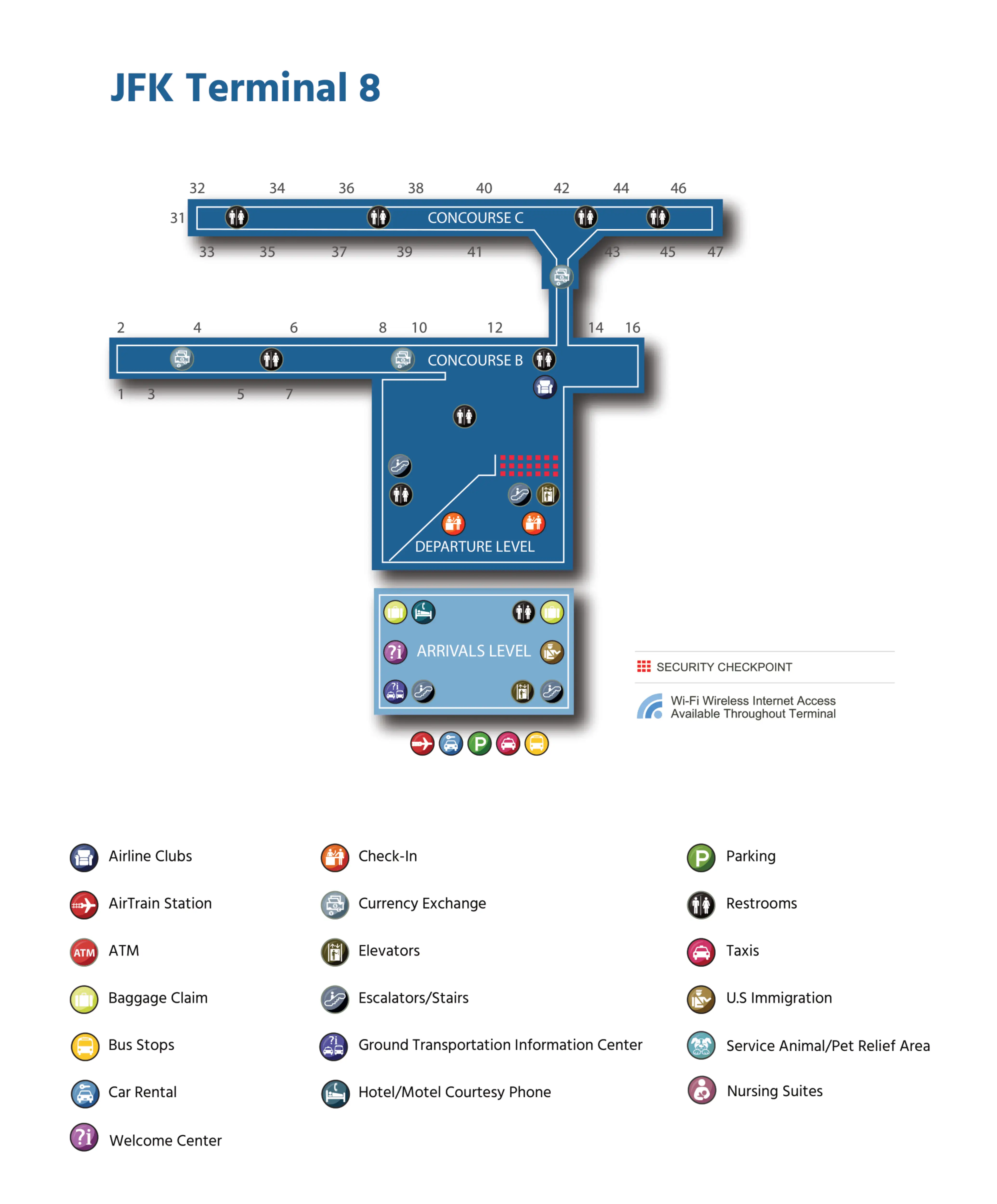
2026 John F Kennedy International Airport Terminal 8 Map Guide
What is the exact walking route (level + doors) from Terminal 8 baggage claim to the rideshare pickup area used at T8 (the “Area D” style pickup travelers describe)?
You must cross the roadway to the outer traffic island for Ride App Pick Up Zone D because Uber/Lyft pickups are geofenced away from the inner curb by the building. From baggage claim, the route stays on Level 1 the entire time and ends at a marked Zone D curb with alphanumeric “spot” codes.
| Step | Where | What to look for | Walk Time |
|---|---|---|---|
| 1 | Level 1 baggage claim | carousels, “Arrivals/Ground Transportation” flow | 1–3 min |
| 2 | Level 1 arrivals exit | glass automatic sliding doors to the curb | 0–2 min |
| 3 | Inner curb sidewalk | “Ride App Pick Up / Zone D” signs pointing across lanes | 0–1 min |
| 4 | Crosswalks | painted crosswalk spanning inner lanes toward the island | 1–3 min |
| 5 | Outer traffic island curb | “Ride App Pick Up – Zone D” + spot markers (e.g., G1/G2/H1/H2) | 1–2 min |
| 6 | Zone D “spot” position | match your app pickup pin to the exact letter/number post | 0–1 min |
From the Terminal 8 AirTrain platform, what is the exact indoor path to the correct check-in hall/security entrance (including which escalator/elevator bank to take)?
You must go up to Level 3 after entering Terminal 8 from the AirTrain bridge because the AirTrain delivers you into the terminal on Level 2, not the check-in level. The fastest “correct” path is the first central escalator/elevator bank at the bridge entry, then straight into the Grand Hall for AA check-in and the central security core.
From the AirTrain platform, walk off the train and follow AirTrain exit signs into the enclosed skybridge toward Terminal 8. The bridge enters the terminal on Level 2 (mezzanine); at the entry, take the immediately-visible central escalators up to Level 3 (or the adjacent elevator bank if you have heavy luggage). On Level 3, you emerge into the Grand Hall with American Airlines check-in spanning the floor; security is centered ahead/near the main hall core, so stay in the central aisle rather than drifting to curbside windows.
Where exactly are the narrow choke points on the main path between Terminal 8’s central hall and the escalators/tunnel toward AirTrain/satellite concourse?
The tightest choke point is the “wide-then-narrow” funnel where the Concourse B retail spine compresses into the escalator/elevator throat that drops down to the tunnel for Concourse C. The second choke point is the recomposure space just past TSA where people stop to repack, which backs up into the main flow toward the tunnel/AirTrain direction signage.
After security, the main hall opens into duty-free and high-end retail; as you follow overhead signs for “Gates 40–47,” the path turns inward toward the core and narrows as multiple streams merge (gate traffic + shoppers + people stopping to read the boards). The pinch happens right at the descent bank—escalators and adjacent elevators leading down to the subterranean tunnel—often under large hanging LED screens. A similar squeeze occurs at the AirTrain connector approach where travelers converge at the vertical banks between Level 3 and the Level 2 skybridge entry, especially around escalator landings.
What is the shortest Terminal 8 → Terminal 7 transfer route using AirTrain (which direction/loop), and where are the exact station entrances at both terminals?
You must take the Inner Loop (All Terminals / often Yellow) and verify the platform screen says “Next Stop: Terminal 7,” because the Outer Loop can send you away from the terminal core toward Federal Circle. The ride is very short—about 90 to 120 seconds—when you board the correct Inner Loop train.
| Segment | What to do | Direction check | Where the station entrance is |
|---|---|---|---|
| Terminal 8 → AirTrain entrance | go to Level 2 via the vertical banks, then onto the enclosed skybridge | “All Terminals” / “Inner Loop” | T8 station access via the Level 2 bridge connection |
| AirTrain ride | board the Inner Loop train | screen: “Next Stop: Terminal 7” | onboard |
| Terminal 7 arrival → terminal entry | exit at Terminal 7 and follow the connected walkway into the building | follow “Terminal 7” / departures | T7 station connected by walkway to Terminal 7 Level 2 (departures/check-in) |
Where is the exact tunnel/connector entrance from Terminal 8’s main building to the satellite concourse, and which landmark/gate signage confirms you’re on the right path?
The connector starts at the escalator/elevator bank you reach by following “Gates 40–47” signage from Concourse B’s post-security main hall, and it drops down into the underground pedestrian tunnel. The confirmation you’re correct is seeing sequential signs for “Gates 40–47 / Concourse C” as you descend and again along the moving walkways.
From the TSA exit, stay in Concourse B’s central retail spine (duty-free and luxury retail cluster) and look overhead for “Gates 40–47” (often also covering the higher-number gate ranges). Those signs pull you away from the bright window edge and toward the terminal core; you’ll arrive at a distinct “throat” where wide corridors compress into a bank of descending escalators with adjacent elevators, commonly beneath large hanging LED screens. Once you’re down, the tunnel is windowless with moving walkways; if you start seeing exterior windows/tarmac views, you have not committed to the tunnel path yet.
What is the exact walking distance from TSA exit in Terminal 8 to the far gate most complained about (e.g., Gate 46), and which turns/segments make people underestimate it?
Walking is roughly 2,600 feet (about 0.5 miles / 0.8 km) from the Terminal 8 security exit to Gate 46, and it commonly takes 15–20 minutes at a normal pace with carry-ons. The underestimation happens because the “Gates 40–47” sign feels like “just downstairs,” but the route is actually down to the tunnel, across a 1,500-foot underground corridor, then down the long Concourse C pier.
| Segment | Approx distance | Typical time | The underestimate trigger |
|---|---|---|---|
| TSA exit → Concourse B decision node | ~300 ft | 1–3 min | “airside arrival” illusion after TSA |
| Escalator/elevator descent + setup | — | 2–4 min | crowding at the escalator throat |
| Underground tunnel (with moving walkways) | ~1,500 ft | 4–10 min | windowless “time void,” few landmarks |
| Concourse C hub → Gate 46 | ~800–1,000 ft | 5–8 min | narrow pier feels longer when crowded |
Where does the priority/First check-in “security shortcut” physically merge into the security queue in Terminal 8?
The Flagship/First check-in shortcut merges at the lane header area at the front of the main public security checkpoint, not into a fully separate private screening lane. You come out of a dedicated corridor from Flagship Check-In and arrive right where the numbered/posted TSA lanes begin, so you must self-select the correct lane (especially if you need TSA PreCheck).
After Flagship Check-In, follow the dedicated exit corridor/tunnel out of the private check-in “walled” area. That corridor deposits you into a short buffer zone at the head of the general security queuing area on Level 3, adjacent to the lane signs. The common physical merge point is beside the “Priority AAcess” lane signage (often on the left side of the lane bank); TSA PreCheck is typically posted on a nearby lane (often more center-left). If you enter the “Priority” lane without a PreCheck sign, you can be routed into standard screening.
What is the exact route from Terminal 8 arrivals to the taxi stand / official ground transport pickup, and where are the decision points where people get intercepted or misdirected?
The official taxi stand is on Level 1 arrivals at the inner curb directly outside the terminal exit doors, controlled by a dispatcher/organized queue. The main mistake is engaging solicitors inside the terminal or drifting across the lanes toward rideshare Zone D when you actually want the regulated taxi line.
- From Level 1 baggage claim, follow “Ground Transportation / Taxi” signs toward the public arrivals exit and go through the glass sliding doors to the curb.
- Once outside, stay on the building-side curb (inner frontage road) rather than crossing to the outer traffic island; the official taxi line forms there with a dispatcher booth and marked queue.
- The interception points are (1) inside the arrivals hall where illegal “ride offer” hustlers approach before you reach the doors, and (2) immediately outside where rideshare signage pulls some travelers toward crosswalks.
- If you find yourself at a crosswalk facing the outer island, you’ve started toward Ride App Zone D, not the taxi stand.
Where are the closest seating clusters near the most complained-about gate area(s), and which nearby landmarks confirm you’re not stuck in a no-seats corridor?
The closest reliable seating near the far-gate complaints (Gates 44–47 / Gate 46) is in Concourse C’s central hub right where the tunnel escalators deposit you, with additional seating in each gate hold room further down the pier. If the pier feels like a narrow “no-seats” corridor, you’re usually between hold rooms—backtrack toward the hub.
- Concourse C central hub, immediately at the top of the tunnel escalators, near the concessions pod and smaller duty-free cluster
- Gate 44–47 hold rooms, directly under the gate-number signs and adjacent to the boarding door lines
- Gate 46 hold room, end-of-pier waiting area by the Gate 46 sign and boarding stanchions
- Concourse C pier pinch sections, “walking corridor” stretches between gates with few chairs; confirm by absence of gate-number placards overhead and no nearby boarding queue ropes
Where are the nearest charging outlets/charging stations relative to the far gate zones people complain about?
Charging is most consistently available in the Gate 44–47 hold rooms and at Concourse C’s central hub near the tunnel exit, usually via freestanding power towers and newer under-seat/beam seating power. There is no charging in the underground tunnel, so if you’re low on battery, charge before you descend or at the Concourse C hub.
- Concourse C central hub (tunnel exit), near the concessions pod: power poles/towers mixed into the seating cluster
- Gate 44–47 hold rooms: freestanding power towers (AC/USB) placed around the waiting areas
- Gate 46 hold room: under-seat/beam-seat outlets plus nearby power towers when not fully occupied
- Concourse B lounges/retail before the tunnel descent: better “open outlet” odds than the crowded end-of-pier gates
After arriving internationally into Terminal 8, where is the exact recheck/bag-drop point (if required) relative to the customs exit, and which corridor/door avoids accidental landside detours?
The bag recheck point is immediately after you clear Customs, inside the secure post-Customs buffer zone, before the sliding doors that dump you into the public arrivals hall. If you pass through the opaque glass sliding doors ahead without dropping bags, you cannot turn back and you’ll be forced to go upstairs to departures to recheck, adding major time.
- After passport control and baggage claim, you walk through the Customs officer point and enter a short secure “decision” area.
- In that buffer zone, look left/right for prominent “Connecting Flights / Bag Drop” signage and the recheck belt where you place checked bags for onward flights.
- Do not continue straight to the opaque/glass sliding doors leading into the landside arrivals hall (the meet-and-greet area).
- The correct corridor is the one that keeps you inside the controlled space with the bag-drop belt in view; only go through the sliding doors once your hands are free of checked luggage.
If a traveler is forced to do rideshare pickup at Howard Beach, what is the exact station exit path to the Ride App Pick Up & Long Term Parking area (the part people miss)?
You must avoid the main flow to the subway/LIRR at Howard Beach and follow “Ride App Pick Up & Long Term Parking” signage to the lower-level lot exit before the fare gates, because the default crowd stream leads you away from the rideshare lot. The correct path typically drops you down via elevator or stairs to the lot area (often referred to as Lot C).
- Exit the AirTrain at Howard Beach and follow signs for the station exit, but do not commit toward the big “Subway (A train)” entrance and turnstiles.
- Instead, look for the smaller directional signs labeled “Ride App Pick Up & Long Term Parking” at the divergence point where most people continue straight to transit.
- Take the elevator or stairs down to the lower level (the level beneath the main pedestrian flow), then follow the long-term parking/ride-app wayfinding to the designated pickup lot lanes.
- You’re on the right path when you see parking-lot wayfinding and open-air lot access rather than subway fare gates.