Václav Havel Airport Prague Map (Most Up-To-Date)

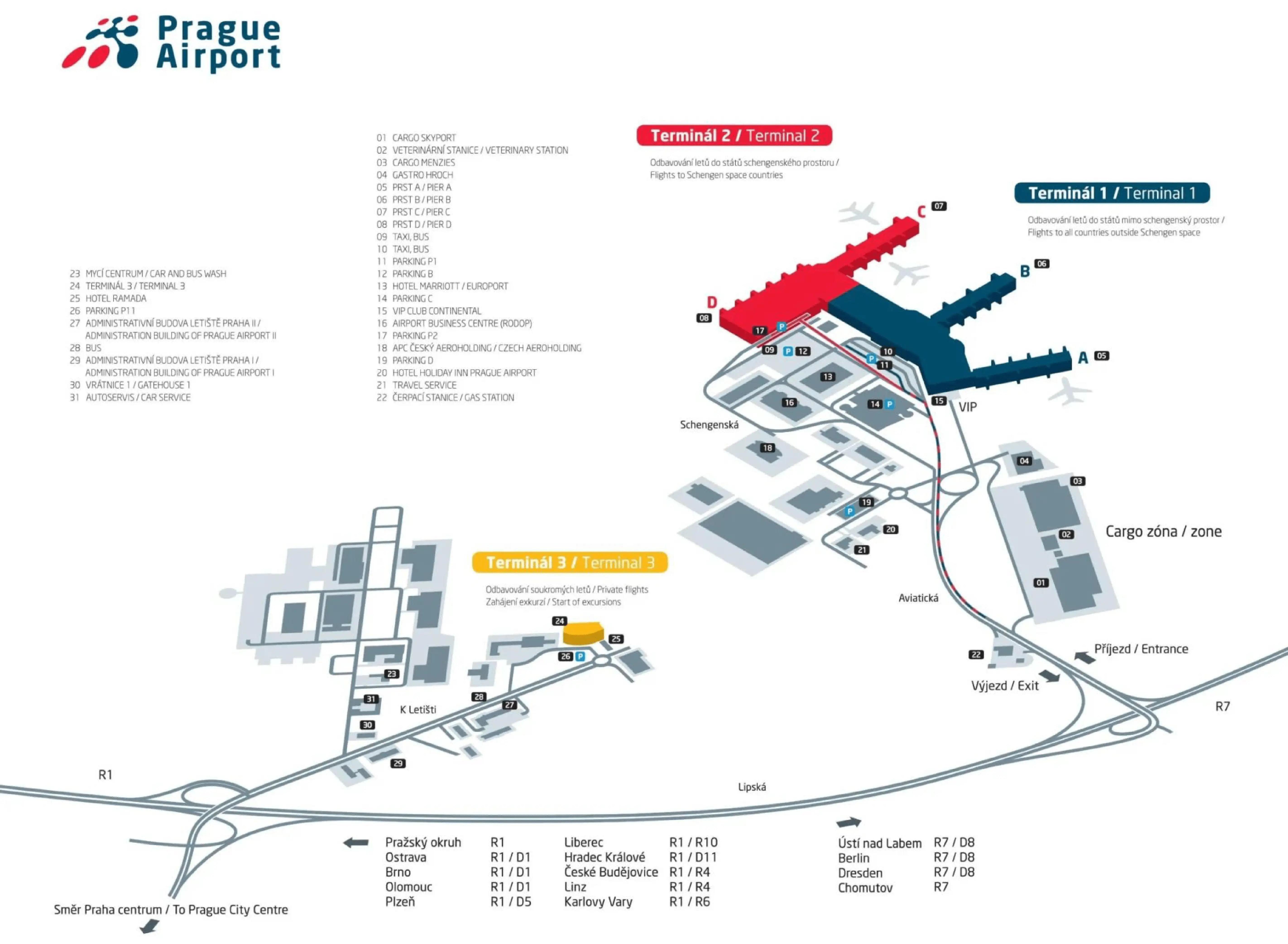
Václav Havel Airport Prague (PRG) runs as a compact, two-terminal footprint with a clear split: Terminal 1 for non-Schengen and Terminal 2 for Schengen. The buildings sit side-by-side with a short landside connector corridor (minutes on foot), but the “direction of travel” matters because the friction points are procedural, not distance-based. Within Prague’s main airport hub, most navigation failures happen at late-stage checkpoints and level-changes near transport pickups.
Map Table
| Terminal | Key Airlines | Primary Function | Transfer Mode |
|---|---|---|---|
| Terminal 1 | Non-Schengen carriers | Passport control + gate-side security | Landside corridor; limited airside transfer corridor |
| Terminal 2 | Schengen carriers | Central security + Schengen gates | Landside corridor; airside transfer to T1 with passport control |
Václav Havel Airport Prague Map Strategy
- Treat Terminal 1 as “two checkpoints,” not one: passport control first, then another security queue right at the gate clusters (especially Pier B bus gates on Level 0).
- Lock onto queue start landmarks early: Terminal 1 passport lines begin around the Relay shop and currency exchange booths, where choosing the wrong side traps you in the slowest flow.
- Use exits like coordinates: for Terminal 1 arrivals, Exits D/E are the clean path to both Uber routing (cross to Parking P1) and public buses (avoid taxi-rank looping).
- Reduce pickup anxiety with level rules: Terminal 1 Uber is not curbside; Terminal 2 Uber requires going up to Departures level before exiting to the pickup curb.
2026 Václav Havel Airport Prague Map + Printable PDF
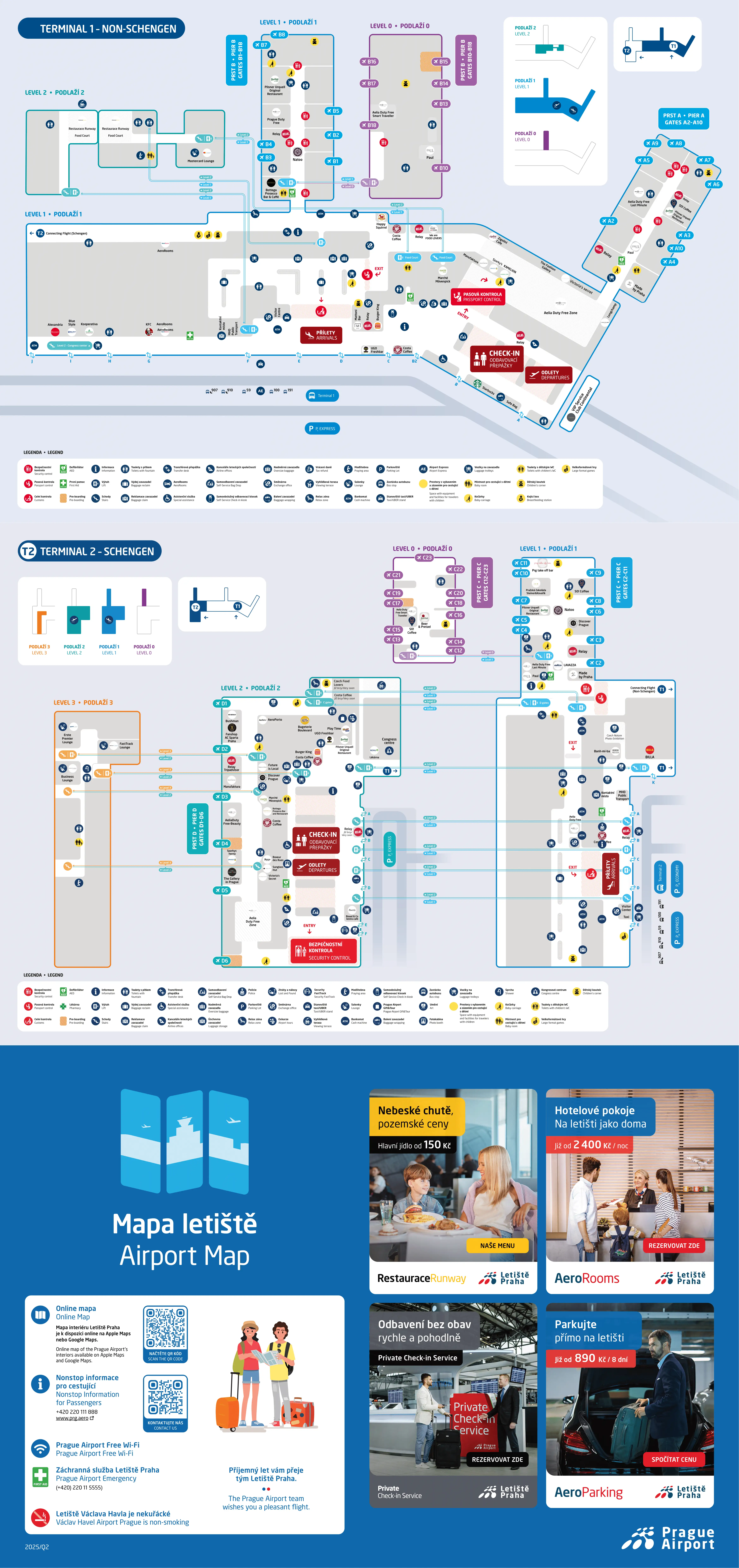
Current operations still hinge on PRG’s split logic: Terminal 1 pushes time-risk to passport control and then gate-side security, while Terminal 2 concentrates screening at one central checkpoint. Wayfinding pressure remains highest at Terminal 1’s Relay/newsstand landmark where passport queues form, and at the vertical/curbside rules for pickups (Uber zones and bus platforms). Printing a 2026 map is most useful when it labels queue start points and the correct exit doors.
2026 Václav Havel Airport Prague Map Guide
What is the exact location of the Terminal 1 non-Schengen gate-security checkpoint(s), and which specific gate clusters share the same screening point?
Security screening in PRG Terminal 1 sits at the entrance to the gate lounges, so “airside” can still hide a final checkpoint right before you enter the holding room. The shared bottleneck to watch is Pier B’s lower bus-gate cluster, where multiple flights funnel into one screening point on Level 0.
| Gate area | Checkpoint location | Shared screening |
|---|---|---|
| Pier A (A2–A10) | At gate-lounge entrance, Level 1 | Mostly individual or paired (e.g., adjacent gates sharing) |
| Pier B Upper (B1–B8) | At gate entry on main departure level, Level 1 | Generally per-gate or small shared entry points |
| Pier B Lower (B10–B18) | Bottom of the stairs/escalator down from Pier B concourse, Level 0 | Yes—consolidated checkpoint for the bus-gate cluster |
Where does the Terminal 1 departures passport-control queue physically start, and which corridor/landmark marks the “point of no return” where the line becomes unavoidable?
The Terminal 1 departures passport-control queue starts in the central atrium of the Terminal 1 departures hall (Level 1), between the check-in islands and the glass airside façade. The “point of no return” is the area around the Relay newsstand and the clustered currency-exchange booths, where the line wraps and blocks the natural walking corridor into the control zone.
The queue typically forms as a broad snake around the Relay shop footprint, then compresses toward the passport-control entrances. The key wayfinding move is committing to the correct side before you reach Relay: EU/EEA/Swiss and eligible biometric travelers should keep to the right flank toward automated lanes, while “All Passports” funnels left/center and is the side most likely to balloon and become unavoidable once you’re alongside the currency exchange counters.
What is the shortest walking route (and distance) from Terminal 1 arrivals exit to the Uber ordering kiosk, and then to the official Uber pickup level (“one floor below”)?
Uber pickup for Terminal 1 is not at the arrivals curb, so the shortest path is a straight exit and cross to Parking P1, about 70 meters door-to-car. The Uber help/ordering kiosk is inside the Terminal 1 arrivals hall near the exits, before you go outside.
| Segment | Minimum-walking route | Distance |
|---|---|---|
| Arrivals exit → Uber kiosk | Inside T1 arrivals hall near the exit doors (stay inside, near Exits D/E area) | Minimal detour (within the hall) |
| Terminal doors → official Uber pickup | Exit via Doors D or E → zebra crossing in front → enter Parking P1 → Uber pickup zone inside P1 | ~70 m |
From Terminal 1 arrivals, which exact door/exit gets you to the correct public-transport stop fastest (bus 59/100/AE), and what is the minimum-walking path that avoids looping through taxi queues?
Exit D is the fastest, most direct door from Terminal 1 arrivals to the public-transport stops for trolleybus 59 and bus 100, and it keeps you out of the taxi-rank flow. The clean path is to aim for Exits D/E immediately after Customs, then walk straight to the platform-side ticket machines without drifting toward the central curb.
From the Customs exit into the public arrivals hall, ignore the center “meet-and-greet” cluster and the taxi/premium shuttle desks, which pull you toward Exits A/B/C and the taxi queue. Instead, hold right toward Exit D (or E if D is congested), step outside, and you should land almost directly in line with the public-transport stop area and the yellow ticket machines/validators at the platform.
What is the indoor walking route (distance + turns) between Terminal 1 and Terminal 2, and where exactly is the connecting passage/corridor entrance on each side?
The Terminal 1–Terminal 2 indoor connector is a landside corridor that runs about 260–340 meters and takes roughly 4–6 minutes on foot. The route is essentially linear with only gentle building-curvature, so the main risk is missing the correct entrance rather than making wrong turns.
| Start point | Where to enter the corridor | What to follow inside | Distance |
|---|---|---|---|
| Terminal 1 | Far end of the departures hall near the Pier B check-in area | Continue along the connector past the Billa supermarket and McDonald’s | 260–340 m |
| Terminal 2 | Western end of the check-in hall near Zone D | Follow the same connector (Billa/McDonald’s confirmation) toward Terminal 1 | 260–340 m |
In Terminal 2 departures, where exactly does the security queue begin relative to the main check-in hall, and which alternative lane/entry point (if any) avoids the longest spillover?
Terminal 2 security screening is a single centralized filter on Level 2, and the queue usually begins centrally behind the middle check-in islands. The best “spillover avoidance” entry is the FastTrack side on the left of the main bank (near premium check-in), while the far-right lanes can be less dense when they’re open because fewer people naturally feed into them.
The line forms where the main passenger flow coming off the central entrance converges behind the check-in islands, then stretches back into the open hall when it’s busy. If you’re eligible for FastTrack, committing to the left-side approach early helps you avoid the center convergence. If you’re not, approaching from the far-right edge of the hall (when those lanes are operating) can reduce time spent stuck in the thickest part of the central queue mass.
Where are the bag drop/check-in zones by airline group located in Terminal 2, and which zone is most prone to line spillover into walking paths?
Terminal 2 check-in is organized into counter “islands,” and the most spillover-prone area is the Smartwings/ČSA self-service bag drop block at counters 284–295, where leisure-travel peaks push queues backward into the main walking axis toward security. Lufthansa Group and Eurowings are typically positioned in Zone D at the far end of the hall relative to the main entrance.
| Airline group | Typical Terminal 2 zone | Spillover risk |
|---|---|---|
| Lufthansa Group (LH/OS/LX) + Eurowings | Zone D (far end of the departures hall) | Lower (more edge-positioned) |
| Smartwings / ČSA | Central islands; Self-Service Bag Drop counters 284–295 | Highest (queues spill into main circulation path) |
In Terminal 1 arrivals, where are the baggage belts positioned relative to the passport-control exit, and what is the fastest path from immigration exit to the correct reclaim area?
The Terminal 1 baggage belts sit immediately after the passport-control booths, so immigration exit drops you straight into the baggage reclaim hall. The fastest path is simply to clear passport control and then follow the nearest flight-information monitors directly to the numbered belt row in the same rectangular hall.
There isn’t a long connecting corridor to reclaim: the passport-control exit opens into the belt area, with belt numbers and screens visible inside the hall. Once you identify your belt and collect bags, continue forward through the Customs channel; Customs exits into the public arrivals hall, where Exits D/E are the cleanest vector if you’re heading to buses or crossing to Parking P1 for Uber.
During a Terminal 2 evacuation, what is the designated external waiting/assembly area, and which exit doors feed into it?
The designated Terminal 2 external assembly area is the PB Express Parking Lot directly in front of the Terminal 2 arrivals façade. The exits that feed it are the ground-level emergency discharge doors that route people out from the terminal (including from airside via emergency stairwells down to Level 0), then point them away from the glass frontage and toward the open parking area.
Evacuation flow from Piers C/D and the departures level typically forces a vertical move first (down emergency stairs to Level 0 or Level 1), then uses non-standard ground-level exits that bypass the normal arrivals sliding-door loop. The practical landmark cue once outside is to keep moving away from the terminal’s glass face and cross the first roadway lane into the PB Express Parking Lot rather than clustering at the curb.
Where are the restrooms / water / basic essentials located immediately after Terminal 1 passport control (airside), and what is the shortest path from passport control to them?
Restrooms and water fountains sit immediately to the left and right as you exit Terminal 1 passport control, before the route narrows into the duty-free/commercial corridor. The shortest path is a simple 90-degree turn: clear the passport booth, then turn left or right to the perimeter walls to reach the restroom blocks and fountains.
These facilities are positioned in the transition space right after the booths, so you can handle essentials before committing to the shopping corridor toward Piers A/B. This matters because once you enter a Terminal 1 gate-security queue (and especially once you pass screening into a gate holding pen), amenities can be limited and you may not have restroom access inside the gate lounge.
For non-Schengen departures, what is the exact location of the final “gate hold” bottleneck (where multiple flights queue), and what is the earliest point on the map where a passenger should divert directly there?
The final bottleneck is the gate-side security checkpoint at Terminal 1’s gate lounge entrances, where passengers queue right before entering the hold room for their gate cluster. The earliest “divert now” point is the central Terminal 1 post-passport commercial/transit area—before you linger at duty-free or restaurants—when you should peel off directly into Pier A or Pier B based on your gate letter/number.
The highest-risk version is Pier B’s lower bus-gate set (B10–B18), where you must descend to Level 0 and the shared screening point can back up toward the stairs/escalators. Practical timing logic on the map: once you’re in the main shopping corridor between Piers A and B, that’s the last comfortable decision zone; after that, you want to be moving down your pier toward the gate-security queue at least 45–50 minutes before departure, especially for far Pier B gates.
What is the fastest route from Terminal 2 arrivals to the inter-terminal corridor (toward Terminal 1) without exiting outdoors, and where are the decision forks that commonly send people the wrong way?
The fastest indoor route is to stay inside Terminal 2 arrivals (Level 0) and walk toward the west end of the hall (left when facing the exit doors) to the signed connection for Terminal 1 and the Billa supermarket. The main wrong-turn fork is following “Train/Bus” or outdoor-ground-transport signs, which eject you outside and break the indoor connector path.
From arrivals, keep the terminal façade exits in front of you, then angle left along the interior edge toward the end of the hall where “Terminal 1 / Supermarket Billa” signage appears. A second common mistake is taking escalators up toward Departures/Uber logic; for the landside inter-terminal corridor, remain on the same indoor level chain and use the Billa/McDonald’s landmarks as confirmation you’re on the connector rather than drifting into curbside circulation.
Archive Václav Havel Airport Prague Map
Below are all historical map versions for Václav Havel Airport Prague. Each year includes the official map available for that period, presented as both WebP and PDF.
2024 Václav Havel Airport Prague Map