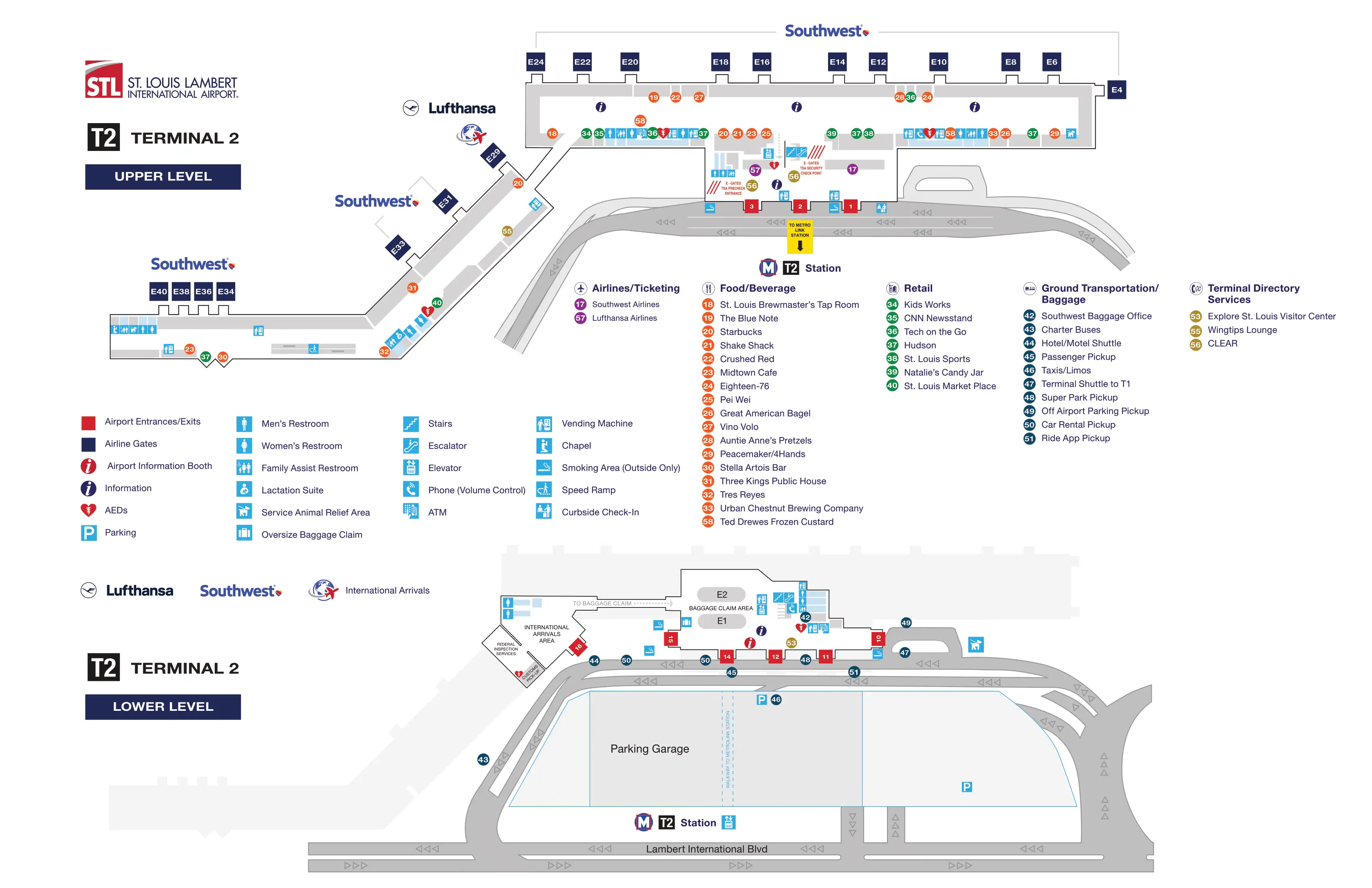
St. Louis Lambert International Airport Terminal 2 Map (Most Up-To-Date)

STL Terminal 2 is a compact landside box feeding a long, straight Concourse E spine. The building runs roughly parallel to the curb, with Upper Level Departures stacked above Lower Level Arrivals/Baggage Claim, and the concourse stretching outward to higher-numbered E gates. Within St. Louis’s main airport hub, the map is mainly about three things: the Terminal 2 loop decision point, the “hidden” garage ramp, and the linear walk to E30–E40.
Map Table
| Level/Area | Primary Use | Key Anchors | Known Friction Points |
|---|---|---|---|
| Upper Level | Ticketing, Departures curb, Security | Entries 1–3, Checkpoint E/F | curbside lane chaos, garage split confusion |
| Lower Level | Arrivals curb, Baggage Claim, Shuttle curb | Door/Exit 12, rideshare zone | arrivals choke point, shuttle “shadow,” crosswalk stops |
| Parking Garage | Terminal 2 garage, MetroLink access | pedestrian bridge, elevator core | entrance ramp hard-left, frequent FULL barricades |
| Concourse E | Gates E2–E40 | checkpoint exit near E10/E12 | long unassisted walk, mid-concourse pinch points |
St. Louis Lambert International Airport Terminal 2 Map Strategy
- Treat the Terminal 2 loop as a “commitment zone”: choose your target (Departures curb, Arrivals curb, garage, or Cell Phone Lot) before you reach the final Lambert International Blvd approach, because the one-way circuit turns a wrong choice into a full time-penalty loop.
- If you’re attempting the Terminal 2 garage, pre-position early and stay extreme-left through the approach, watching for the down-left ramp that appears at the start of the Departures ascent; if the entrance is barricaded, immediately abandon the attempt and continue the loop to exit cleanly rather than forcing a last-second merge.
- For pickups during heavy arrivals, default to the Upper Level Departures curb and have the passenger elevator up and exit via Entries 1–3 (Door 2 is the “meet-me” target), avoiding the structurally under-sized Lower Level queue.
- Use the Cell Phone Lot decision like a hard fork: take the Air Cargo Road turn before the Terminal 2 loop entrance, because missing that turn forces you into the loop and back into the same curb/garage merge pressure you were trying to avoid.
2026 St. Louis Lambert International Airport Terminal 2 Map + Printable PDF
Terminal 2 continues to function as STL’s Southwest-heavy terminal and a key processing point for international arrivals without preclearance, so peak banks still stress the same curb, loop, and garage geometry. The most useful 2026 printable map is one that clearly separates Upper vs Lower access, labels the garage split/ramp, and shows the straight-line Concourse E distances to E30–E40 for realistic walk-time planning.
2026 St. Louis Lambert International Airport Terminal 2 Map Guide
What is the exact driving path from I-70 to reach Terminal 2 departures curb without entering the arrivals queue?
Westbound I-70 traffic must use Exit 235C (Cypress Road), turn right onto Lambert International Boulevard, then stay committed to the Terminal 2 loop lanes that climb to the Upper Level Departures curb. Eastbound I-70 traffic must use Exit 238A, immediately follow the Terminal 2 divergence (not the Terminal 1 feed), and enter the same Terminal 2 loop approach that ramps up to Departures.
The clean “no-arrivals-queue” outcome depends on not taking the lower-level split as you enter the loop. From Lambert International Boulevard, follow Terminal 2 signs into the loop, then stay in the lanes signed for Upper Level/Departures as the roadway begins to rise along the terminal face. If you find yourself being pulled into the lower-level flow, you’ve missed the Departures commitment and will be forced into the Arrivals circulation before you can loop back.
Where is the precise intersection/merge point on the Terminal 2 loop where arrivals and departures traffic blocks each other?
The blockage starts at the Terminal 2 loop entry intersection off Lambert International Boulevard, about 500 feet before the roadway actually separates up to Departures and down to Arrivals. This is where vehicles begin weaving across each other under the “Arrivals / Departures / Garage” sign cluster.
From Lambert International Boulevard, the moment you commit into the Terminal 2 loop approach lanes, garage-bound drivers surge to the extreme-left while curb-bound drivers hold center/right for the terminal ramp. The conflict peaks just before the incline where the loop rises along the terminal wall, because the signage implies the split has already happened even though all traffic is still sharing the same approach footprint.
Where is the Terminal 2 cell phone lot entrance, and what is the last decision point before you get forced back onto the highway?
The Terminal 2 cell phone lot entrance is off Air Cargo Road, addressed as 9837 Air Cargo Road, St. Louis, MO 63134. The last decision point is the Lambert International Boulevard and Air Cargo Road intersection, because missing that right turn commits you into the Terminal 2 loop.
Approaching on Lambert International Boulevard, treat Air Cargo Road as the “hold-or-commit” fork just before the terminal complex. Turn onto Air Cargo Road into the Cargo City area, then follow cell phone lot signs to the holding area roughly a third of a mile east of the Terminal 2 loop entrance. If you continue past that Air Cargo Road turn, you’ll get pulled into the one-way Terminal 2 approach and will need to complete a full circuit to escape and reattempt.
Where is the Terminal 2 garage entrance, and what is the shortest indoor pedestrian route from the garage elevators to the Southwest ticketing level?
The Terminal 2 garage entrance is the narrow down-left ramp that splits off from the rising roadway as you approach the Upper Level Departures curb, and it is only reachable from the extreme left lane. Missing it commits you to the Departures curb and forces a full loop-out to retry.
| Segment | Exact Position Cue | Adjacent Anchor |
|---|---|---|
| Garage entrance ramp | down-left split at start of Departures ascent | terminal wall on driver’s left |
| Required lane | extreme left before the roadway inclines | approach lanes off Lambert International Blvd |
| Garage to ticketing | elevator core → pedestrian bridge → terminal lobby | bridge deposits near Entry 2 |
| Southwest ticketing access | immediately inside the Upper Level lobby | near Entries 1–3 cluster |
From the garage, take the elevators up to the bridge level, cross the covered pedestrian bridge into Terminal 2, and you’ll enter the Upper Level ticketing lobby near Entry 2 with Southwest counters within roughly 300–400 feet of the bridge threshold.
If the Terminal 2 garage is full, which alternative parking location drops you closest to Terminal 2 doors, and which door/curb zone is that?
Lot E drops you closest to Terminal 2 when the garage is full, with the shortest walk targeting the Terminal 2 east-side entrance doors. This is the practical “nearest” alternative because it stays walkable without a shuttle.
Lot E sits directly east of Terminal 2 and connects by sidewalk to the terminal frontage, typically putting you within about 1,000–1,200 feet of the building. If you’ve already committed to the garage lane and see barricades, continue through the Departures level, exit the loop cleanly, then follow outbound signs for Lot E rather than trying to re-merge last second at the split. Aim your pedestrian approach at the east-side terminal doors so you enter on the Upper Level ticketing side without having to detour through Lower Level arrivals traffic.
What is the walking distance from the Southwest bag-drop counters to the Concourse E security checkpoint?
The walk is about 50–100 feet and usually takes under 1 minute. This is a short, straight shot on the Upper Level ticketing lobby.
Southwest bag drop sits right inside the Departures-level doors near Entry 1, and the Terminal 2 security checkpoint complex (Checkpoint E/F) is immediately adjacent in the same central lobby zone. If the ticketing hall is crowded, stay tight to the checkpoint-facing side of the lobby rather than cutting through kiosk lines that can spill back toward the entry doors.
Where is the TSA PreCheck / priority lane entry point at Terminal 2 security relative to the main queue entrance?
TSA PreCheck enters at Checkpoint E, positioned to the left of the main general-queue entrance when you face the checkpoint from the Upper Level ticketing lobby. Entering the general stanchion maze first is the common mistake because the rigid dividers make it difficult to cross over to PreCheck without exiting.
From the Southwest-dominated ticketing hall, walk straight toward the checkpoint frontage and scan left before committing into any roped queue. The PreCheck podiums and banners are the visual anchor; the general boarding queue is centered/right and tends to look like the “default” entry when the lobby is crowded. If you’re using CLEAR, kiosks can feed into both Checkpoint E and Checkpoint F, but PreCheck screening access is still anchored on the left-side Checkpoint E entry.
What is the walking time from the Concourse E checkpoint exit to Gate E40?
Walking takes about 8–10 minutes in clear flow and can stretch to 12–15 minutes during boarding congestion for mid-concourse gates. Gate E40 is at the far end of the straight Concourse E extension.
The security exit drops you into Concourse E near the E10/E12 area, so E40 requires committing to the long right-hand corridor past the E20–E30 cluster where lines can spill into the walkway. Roller bags and family groups amplify the pinch points, so the reliable play is to budget a full 15 minutes if you’re assigned E30–E40 and you’re leaving the checkpoint near a peak departure bank.
Where are the moving walkways on Concourse E, and what route maximizes moving-walkway coverage to reach the far E-gates?
No reliable end-to-end moving walkway coverage exists on Concourse E, so there isn’t a “maximize moving walkway” route to Gate E30–E40. Any moving walkway segments, if present, are isolated rather than continuous along the primary corridor.
The practical routing strategy is therefore about minimizing friction, not hunting for mechanical assist. From the checkpoint exit near E10/E12, stay on the main right-hand axis toward E12–E40 and avoid getting trapped behind boarding queues around the E20–E30 area by using open sidewalk edges where available. If you need mobility support, the map-driven solution is to request wheelchair assistance rather than planning around walkways that don’t consistently span the concourse.
What is the shortest walking route from Terminal 2 baggage claim to the departures-level pickup curb?
The shortest route is Baggage Claim → elevators/escalators up to the Upper Level ticketing lobby → exit to the Departures curb at Door 2. This avoids the lower-level curb congestion and keeps the vertical move inside the terminal core.
From the Lower Level baggage claim, follow signs to the central vertical circulation bank and go up one level to Departures/Ticketing. Once you enter the Upper Level lobby, angle toward the curbside doors labeled for Entries 1–3 and use Door 2 as the meet-up anchor because it lands you on the Departures curb where vehicles can load faster during peak arrivals. If you exit the lower level first, you’ll be forced into the Arrivals curb footprint and may have to re-enter to go back upstairs.
Which specific Terminal 2 pickup doors/curb zones minimize conflict with rideshare congestion during peak arrivals?
Upper Level Departures pickup at Entries 1–3 minimizes rideshare conflict because rideshare queuing pressure concentrates on the Lower Level near the designated ride app zone between Entry 15 and Entry 16. The cleanest meet-up target is Departures Door 2, which typically sits outside the densest shuttle-and-rideshare turbulence.
On the Lower Level, private pickups backing up around Doors 11–14 can block downstream access to the rideshare zone, creating a single shared queue that traps everyone. During the 7:00 PM–10:00 PM arrival bank pattern, instruct the passenger to go upstairs to the Departures-level lobby and exit at Entries 1–3 instead of waiting curbside at baggage claim. The driver should commit to the Departures ramp and stage briefly at Door 2 for a load-and-go rather than entering the Arrivals loop.
Where is the Terminal 2 → Terminal 1 shuttle bus stop located (exact door/curbside zone)?
The Terminal 2 → Terminal 1 shuttle stop is on the Terminal 2 Arrivals (Lower) Level at Exit/Door 12. This is the dedicated inter-terminal transfer curb location.
From inside Terminal 2, use baggage claim as your landmark: exit the Lower Level through Door 12, then look immediately along the curb for the terminal shuttle signage rather than walking toward the rideshare bays (Entry 15–16) at the far end. The shuttle runs on an 8–15 minute cadence and drops at Terminal 1 at Exit 12 as well, so Door 12 is the “match the number” anchor for both ends of the transfer.
What is the walking distance from Terminal 2 baggage claim to the Terminal 1 shuttle stop?
Walking is about 150 feet and typically takes 1–2 minutes. The shuttle stop sits immediately outside the Lower Level at Door 12.
From baggage claim, follow signs toward the Arrivals curb and target Door 12 specifically, because the shuttle loading zone is keyed to that exit. Once outside, stay near the curbside shuttle signage rather than drifting toward the rideshare pickup area farther down the Arrivals level, which can look like the “main” pickup zone during peak congestion.
Where is the MetroLink station entrance for Terminal 2, and what is the shortest indoor route from baggage claim to the platform?
The MetroLink entrance for Terminal 2 is in the Terminal 2 parking garage, reached by crossing from the terminal at Door 12 and going up within the garage to the platform level. The route is short but the environment shift (terminal → garage) is what confuses first-time users.
From the Lower Level baggage claim, walk to Door 12, exit the building, and use the marked crosswalk to enter the parking garage directly across the roadway. Once inside the garage, follow MetroLink signs to the elevator/stairs and go up to the station platform. The total walk is about 600 feet and usually takes 5–7 minutes, with the key landmark being the Door 12 crosswalk that “locks in” the correct garage entry point.
Where is the nearest restroom to Gate E40 on the Terminal 2 map?
The nearest restroom is at the far east end of Concourse E in the E36–E40 cluster, adjacent to Gate E40. This is the end-of-pier restroom bank that serves the highest-numbered E gates.
If you’re walking out from the checkpoint near E10/E12, the next reliable mid-extension fallback is the restroom area around Gate E33, but the closest option once you’re at E40 is the east-end facility itself. For travelers with service animals, the relief area is also mapped at the far end near Gate E40, so the E40 cluster functions as a full “last stop” amenities node.