Rome–Fiumicino Leonardo da Vinci International Airport Map (Most Up-To-Date)

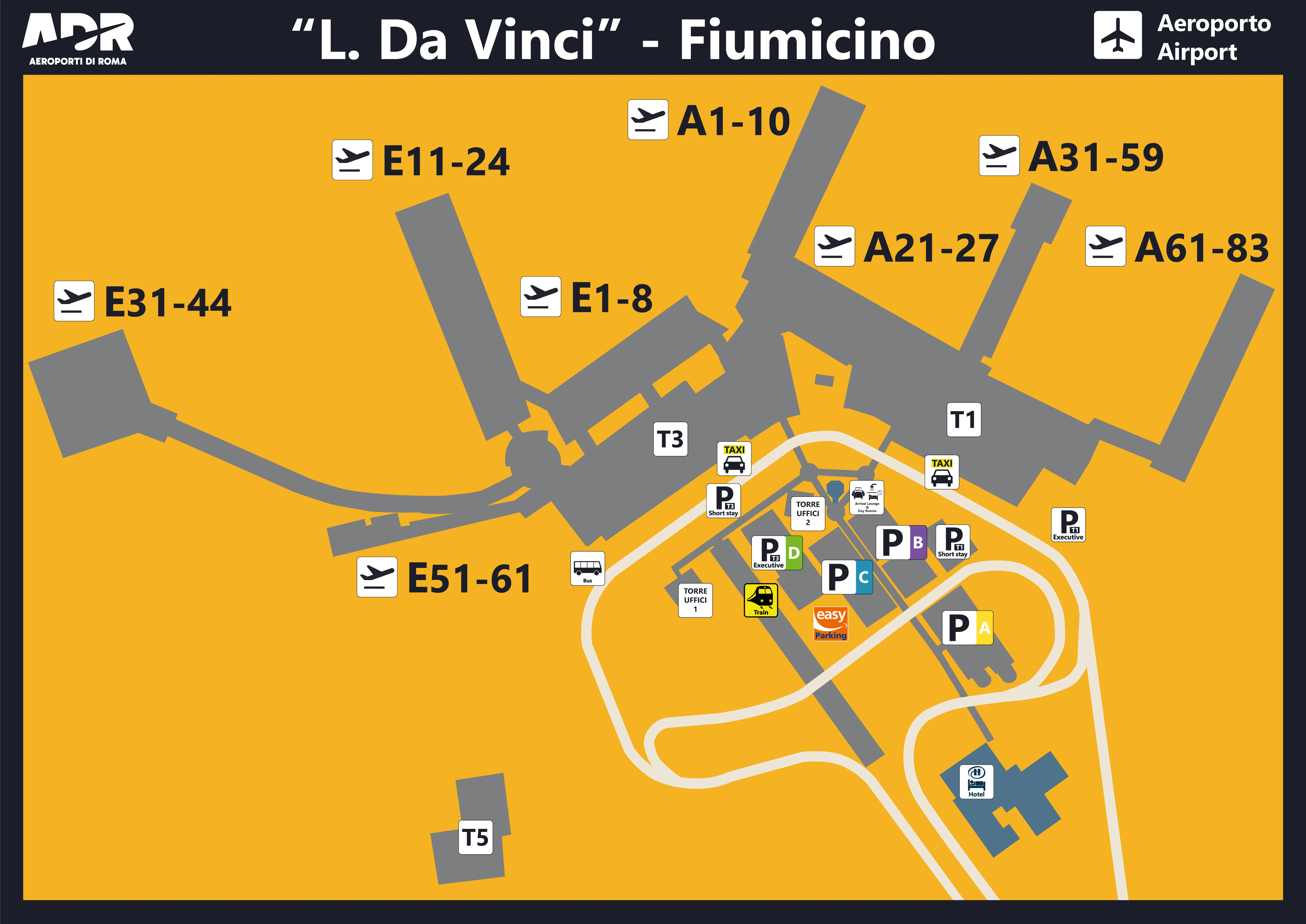
Rome Fiumicino is a single, connected terminal complex that “feels” like separate buildings: Terminal 1 and Terminal 3 sit as adjacent lobes along one long landside frontage, while the E-gate satellite (E31–E44) is detached and reachable only by an internal people-mover. Within Rome’s main airport complex, most confusion comes from vertical changes (arrivals vs. departures levels) and hard borders between Schengen (A) and non-Schengen (E).
Map Table
| Terminal | Key Airlines | Primary Function | Transfer Mode |
|---|---|---|---|
| Terminal 1 | ITA Airways, Schengen partners | Schengen / Domestic (A gates) | Indoor connector corridor |
| Terminal 3 | Long-haul carriers | Non-Schengen / International (E gates) | Connector corridor, landside walk |
| Satellite E (E31–E44) | Mixed long-haul gates | Remote E gates | APM / people-mover + long pier walk |
| Terminal 5 | USA/“sensitive” processing | Security processing node | Feeds into T3 airside |
Rome Fiumicino Airport Map Strategy
- Treat T3→T1 (non-Schengen to Schengen) as a process transfer, not a walk: transfer security plus mandatory passport control are the time sinks you cannot shortcut.
- Assume the T1↔T3 connector is longer than it looks, then add a vertical penalty (arrivals vs. departures levels) so you don’t lose minutes hunting escalators/elevators.
- For E31–E44, leave the main T3 departures “Piazza” early: the people-mover adds fixed latency (up to platform, wait, ride, down again) before the final long pier walk.
- Don’t choose corridors by instinct—follow “Connecting Flights/Connessioni” flow until you see the border-control commitment point; once you enter the wrong zone, recovery usually means backtracking into queues.
2026 Rome–Fiumicino Leonardo da Vinci International Airport Map + Printable PDF
Recent Terminal 3 modernization and ongoing airside reconfiguration mean the “shape” of Rome Fiumicino is stable, but the friction points move: where queues form, where partitions narrow corridors, and where satellite access time gets underestimated. A printable 2026 map is most useful when it highlights the connector between T1↔T3, the passport-control boundary, and the fixed-time penalty to reach E31–E44.
2026 Rome–Fiumicino Leonardo da Vinci International Airport Map Guide
What is the exact walking distance (meters) from Terminal 3 international arrivals exit to the Terminal 1 departures check-in hall entrance using the indoor connection route?
The indoor landside transfer distance is approximately 150–200 meters, not counting the required vertical change up to the departures level in Terminal 1. Starting from the Terminal 3 arrivals exit doors (the main sliding-door cluster), the fastest path is the covered frontage that runs past the connecting building (the former Terminal 2 area) until you reach the Terminal 1 entrance doors.
The distance number stays “short,” but time disappears at the level change: Terminal 3 arrivals sits on Level 0 while the Terminal 1 check-in hall is on Level 1, so you’ll add a few minutes locating and using the escalator/elevator banks immediately after entering Terminal 1.
Where is the first mandatory passport-control checkpoint located on the T3 → T1 connection path (landmark + corridor name), i.e., the point where you must join a queue?
The first mandatory passport-control queue is at the Polizia di Frontiera booths immediately after the Transfer Security re-screening area in the Terminal 3 transfer mezzanine. Following yellow “Connecting Flights/Connessioni” signs from the E-gate arrivals flow keeps you out of the main immigration/baggage route and feeds you into a sterile transfer corridor.
After you pass the metal detectors in the transfer-security zone, the passport-control booths sit directly ahead as the next physical barrier, before the airside connector corridor that leads toward Terminal 1 (A-gates). This is a no-bypass checkpoint: once you’re in that mezzanine channel, the only way forward is joining the queue.
What is the exact walking distance (meters) from the end of passport control to the entrance of the people-mover/train used to reach the E-gate satellite (E31–E44)?
The walk is approximately 250–350 meters from the passport-control exit to the people-mover access point for Gates E31–E44. The entrance you’re targeting is the base of the dedicated escalator/elevator bank up to the APM platform.
Exiting the Polizia di Frontiera booths, stay in the E-gates flow toward the main Terminal 3 departures concourse, then continue until you hit the Terminal 3 “Piazza” retail atrium (the open area beyond the Aelia Duty Free walk-through). From the Piazza, the APM access is a short 50–80 meter walk to the escalators at the rear/edge of the atrium signed for “Gates E31–E44,” then the vertical climb begins.
What is the end-to-end time and distance from T3 security exit to Gate E44 (include: walk to train, train segment, final walk)?
Reaching Gate E44 from Terminal 3 security takes about 25–30 minutes and roughly 800 meters in normal conditions. The fixed-risk piece is the people-mover cycle (up to platform, wait, ride, down again), which you can’t “run through” even if the terminal feels quiet.
| Segment | Distance | Time | Landmark triangulation |
|---|---|---|---|
| Security exit → Piazza | ~150 m | 3–5 min | Aelia Duty Free walk-through to the open retail atrium (“Piazza”) |
| Piazza → APM access (base of escalators) | ~50–80 m | ~2 min | Rear/edge of the Piazza signed “Gates E31–E44” |
| APM cycle (up + wait + ride + down) | n/a | ~6 min | Escalator/elevator to platform, shuttle interval, short ride, descent at Satellite E |
| Satellite station → Gate E44 | ~250–300 m | 4–5 min | Long, straight pier walk to the far tip of the satellite concourse |
Which arrival door/exit number leads directly to the official taxi queue, and what is the shortest mapped path that avoids the typical scam-driver intercept zone?
Door 3 (Uscita 3) in Terminal 3 Arrivals is the cleanest exit line to the official taxi queue. The intercept zone is the indoor 30–50 meter “buffer” between the Customs exit and the doors, where touts approach before you reach the curbside rank.
| Step | Shortest path (anti-scam) | Landmark triangulation |
|---|---|---|
| 1 | Exit Customs into Arrivals hall, no stops | Green/Red channel exit doors behind you |
| 2 | Walk straight to Door 3 and go outside | “Uscita 3” overhead sign, central sliding doors |
| 3 | Cross at the marked pedestrian crossing to the taxi island | Zebra crosswalk aligned with Door 3 |
| 4 | Join the curbside queue only | White taxis with roof “TAXI” sign under the exterior canopy |
What is the fastest mapped walking route from baggage reclaim exit to the Leonardo Express station entrance, including where the moving walkways begin/end?
The fastest route takes about 7–10 minutes and uses the Level 2 pedestrian bridge, not the street. From the baggage reclaim/customs exit in Terminal 3 Arrivals, the key is staying inside the terminal until you reach the escalators marked with the train icon, then committing to the enclosed bridge with moving walkways.
Follow the interior concourse west (toward Terminal 1 direction) until you reach the escalator/elevator bank signed for “Treni/Station.” Go up to Level 2 and enter the enclosed bridge (“passerella”). The moving walkways run in three consecutive sections along this bridge: they begin shortly after you enter the bridge corridor and end near the station-side concourse doors, depositing you directly into the rail station building for Leonardo Express.
If you arrive via shuttle bus from a remote stand, where exactly is the bus drop-off point inside FCO, and what is the shortest mapped path from that point to the T3→T1 connections corridor?
The remote-stand shuttle bus drops passengers on Terminal 3 ground level (Level 0) at dedicated bus-arrival portals that open into a sterile arrivals corridor beneath the boarding piers. This adds a built-in time penalty because you must climb up into the transfer level before you can commit to the connections flow.
From the bus corridor, follow “Connecting Flights/Connessioni” up via the first escalator/stairs bank you reach (the route is designed to funnel you upward). Once on the transfer level, stay with the yellow connection signage until you hit Transfer Security; after re-screening, passport control becomes the mandatory barrier, and immediately beyond it you’re fed into the connector corridor leading toward Terminal 1 (A-gates).
Where is the T3 ↔ T1 “Connections/Transit” corridor entrance located (exact junction/landmark), and which signage label marks it (e.g., “Connections/Connessioni”)?
The corridor entrance is the long, glass-walled airside walkway that begins after you clear the Schengen border process and are released toward the opposite terminal. From the Terminal 3 side, you don’t reach it directly from the public concourse: the entry point is downstream of Transfer Security and the Polizia di Frontiera passport-control booths.
From the Terminal 1 side, the corridor mouth sits off the main departure lounge retail spine as the flow trends east/right toward “Gates E / Terminal 3.” The signage label that consistently marks the correct commitment is “Connecting Flights/Connessioni” (yellow transfer wayfinding), then “Gates E / Terminal 3” once you’re in the connector approach. Look for digital boards that display walking time to the other terminal—those boards typically sit at or just inside the corridor start.
Where is the VAT refund/customs office located relative to check-in and the first security checkpoint, and what is the shortest mapped path between them?
The VAT refund and customs validation desks are landside in the Terminal 3 departures hall, clustered near the mid-hall check-in island area around rows 209–225 (commonly referenced near desk 210). This placement matters because the required sequence is customs validation before you hand over checked bags, so the stop must happen before you commit to airline check-in and the first security checkpoint.
From the departures entrance, move into the central check-in hall and aim for the check-in row number signage in the low-200s; the VAT/Global Blue/Planet desks sit adjacent to that check-in band rather than near the security entrance. After validation, the shortest path is simply back into the nearest check-in queue for your airline, then forward toward the main departures security filter that feeds the duty-free walk-through into the Piazza.
Where is the baggage-hall “construction bottleneck” pinch point located, and what is the nearest alternate exit route from arrivals that bypasses that choke location?
The main pinch point is the funnel into the single Customs Green/Red channel exit that collects passengers from the far end of the Terminal 3 baggage hall, especially those arriving from the E31–E44 satellite flow. After immigration, the walk to the higher-numbered belts and then back toward the customs exit creates a long convergence where the corridor narrows and everyone is forced into the same exit mouth.
The nearest bypass is behavioral rather than a secret door: stay inside the terminal and peel away along the interior concourse toward the west end (train-direction/T1-direction) immediately after clearing customs, instead of lingering in the densest central arrivals hall area. This avoids the highest tout-and-congestion zone near the main doors while keeping you on the efficient indoor path to escalators for Level 2 (rail bridge) or to a less chaotic curbside segment.
From the T1 security exit, what is the exact walking distance (meters) to the start of the T3 connector corridor (the point where you’re “committed” to the terminal transfer)?
The walk is approximately 150–200 meters from the Terminal 1 security exit to the start threshold of the Terminal 3 connector corridor. The “commitment” point is where the Terminal 1 duty-free/retail spine stops behaving like a lounge and becomes the signed transfer passage for “Gates E / Terminal 3.”
Exiting the main Terminal 1 security checkpoint, you’re deposited into the Aelia duty-free flow. Stay with the main passenger stream until you pick up signage for “Gates E / Passport Control / Terminal 3,” then follow the right/eastward trend. The corridor entrance is typically marked by a change in architecture (more linear, glass-walled walkway feel) and digital boards showing walking time to the other terminal.
Where is the decision fork where passengers must choose between A (Schengen) vs E (non-Schengen) gate directions, and what is the mapped distance from that fork to the passport-control entry?
The decision fork is effectively the passport-control border itself: it’s the point where the airport stops being one departures lounge and becomes two legally separated zones (A for Schengen, E for non-Schengen). In the Terminal 3 post-security flow, this fork occurs as you emerge from the Aelia Duty Free walk-through into the open “Piazza,” where signage splits you toward Gates E (straight/left) versus the connector back toward Terminal 1 (right).
The walk from that fork area in the Piazza to the passport-control entry is roughly 150–250 meters, depending on where you stand when you commit. The key landmark sequence is Piazza edge → connector direction (“Terminal 1 / Gates A”) → passport-control entry where queues form at the Polizia di Frontiera barrier; once you step into that queuing lane, there’s no alternate path around it.