Philadelphia International Airport Terminal D Map (Most Up-To-Date)

PHL Terminal D is a straight, narrow pier concourse (Gates D1–D16) fed by a central D/E security “hub” that sits right by the SEPTA bridge entry into the departures level. Within Philadelphia’s main airport complex, the layout is essentially one main stem: the D/E checkpoint exits into a junction, with Concourse D running one direction and the E-side connector running the other, plus airside links back toward C and B.
Map Table
| Zone | Connection | Walk Time |
|---|---|---|
| SEPTA C/D station bridge | Departures Level entry doors (D side) | 3–4 min |
| D/E security checkpoint | Concourse D entrance (D gates) | 0–1 min |
| Gate D1 area | D/E checkpoint recomposure zone | <1 min |
| Mid-pier (D10–D12) | C/D connector toward Terminal C | 12–15 min from Terminal B security |
| End of pier (D15–D16) | Distal restrooms, quiet endcap | 20–25 min from A-East security to D16 |
Philadelphia International Airport Terminal D Map Strategy
- Treat the SEPTA bridge doors as the go/no-go line: if the D/E queue tail is already visible near the bridge threshold, reroute landside toward Terminal B security before you get trapped in the crowd.
- After D/E screening, use the leftward “D Gates” orientation and assume Gate D1 is the immediate anchor; then budget by segments (D1 vs mid-pier vs end-pier) instead of gate-by-gate guessing.
- Use Terminal B security as the primary alternate checkpoint, then commit to the airside walk through the B/C Marketplace and C/D connector as the predictable bypass path to Concourse D.
- What’s not possible: any “shortcut” that requires leaving the sterile area to change terminals will force re-clearing TSA; only use post-security connectors if you’ve already screened and need to move between terminals.
2026 Philadelphia International Airport Terminal D Map + Printable PDF
Terminal D in 2026 still functions as a “throughput stress point” because the combined D/E checkpoint can overflow back toward the SEPTA-facing circulation space and escalators. For printing, prioritize a map that shows the SEPTA bridge doors, the D/E checkpoint queue footprint, and the airside connectors to C and B—those are the decision points that let you bypass the bottleneck without guessing.
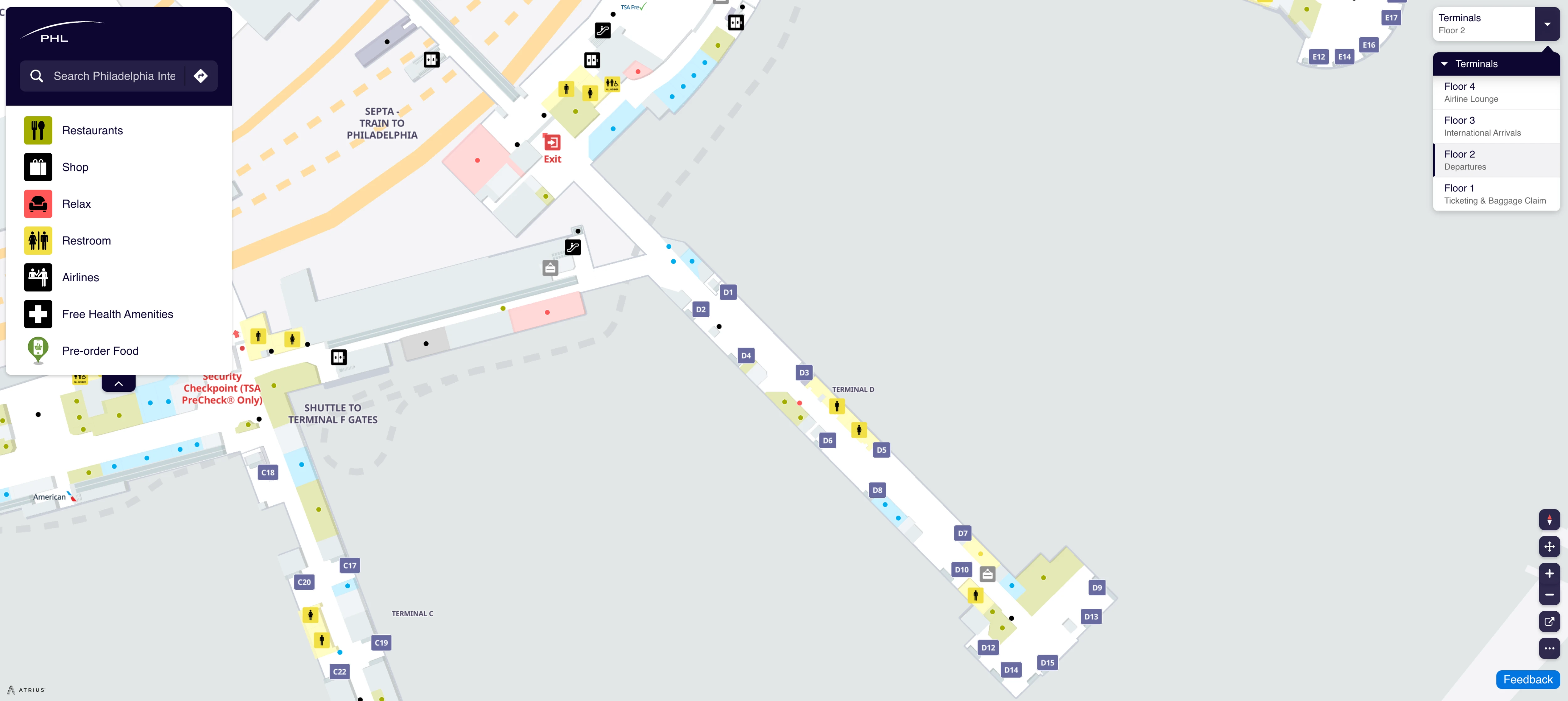
2026 Philadelphia International Airport Terminal D Map Guide
What is the exact walking distance from the Terminal D/E security checkpoint exit to Gate D1 (shortest valid route)?
Walking distance is under 150 feet (under 45 meters) from the Terminal D/E checkpoint exit to Gate D1 via the Concourse D entrance. From the screening lane exit, stay in the recomposure area only long enough to orient, then follow the first “D Gates” turn—D1 is the first gate position at the base of the D pier.
Congestion, not geometry, is the limiter here: the shoelace-and-bins “recomposure zone” can briefly choke movement right at the checkpoint discharge. If you’re timing this tightly, skirt the edge of that zone, keep the D-gates signage in view, and treat Gate D1 as the immediate landmark that confirms you’re on the correct stem into Concourse D.
Where is the physical entry point to the Terminal D/E security queue relative to the SEPTA Airport Line station entrance (closest landmark-to-landmark position)?
The Terminal D/E security queue entry sits immediately inside the Terminal D-side doors from the SEPTA pedestrian bridge, forming perpendicular to the flow coming off the bridge. The closest landmark-to-landmark relationship is: bridge exit doors → open ticketing atrium → queue tail area that often anchors right near the threshold.
In spillover conditions, the line expands laterally and backward into the same space you need to cross to reach counters and escalators, which is why it can feel like the queue “blocks” the terminal entrance. If you step off the bridge and can already see the queue massing toward the doors (often near newsstand/kiosk-style fixtures by the entry), that’s the practical signal that you’re at the choke point and should consider a landside reroute before committing.
What is the exact walking distance from the SEPTA station entrance to the Terminal D/E checkpoint entrance (fastest indoor path)?
Walking distance is about 250–300 feet (75–90 meters) from the SEPTA Airport Line C/D station entrance to the Terminal D/E checkpoint entrance via the pedestrian bridge and the departures-level entry doors. The fastest indoor path is the direct bridge approach into the Terminal D ticketing hall, then straight/slight-right to the checkpoint intake area.
This walk includes a vertical segment (escalator/elevator up to bridge level) plus the bridge crossing itself; time is typically 3–4 minutes at a normal pace because the elevation change and door threshold slow things down more than the raw footage suggests. The key landmark is the moment you pass through the automatic doors off the bridge—checkpoint signage and the queue footprint are immediately in the same atrium space.
What is the exact post-security walking distance from Terminal B checkpoint exit to Gate D10 (shortest route)?
Walking distance is about 2,400–2,600 feet (0.45–0.5 miles) from the Terminal B checkpoint exit to Gate D10 via the airside B/C Marketplace and the C/D connector. From the B screening exit, follow signs for “C, D, E, F Gates,” stay in the main marketplace corridor past the Terminal C pier entrance, continue into the C/D connector, then enter the D hub and walk down Concourse D to D10.
| Segment | Airside landmark anchors | Distance (approx) | Time (steady pace) |
|---|---|---|---|
| B checkpoint exit → B/C Marketplace main corridor | retail “marketplace” spine | — | — |
| Marketplace → pass Terminal C entrance | C pier entrance on your side | — | — |
| C/D connector → D hub | connector narrows into D rotunda/hub | — | — |
| D hub → Gate D10 | past D1–D9 | — | — |
This is fully sterile-side end-to-end, so it avoids re-clearing TSA. The only “gotcha” is psychological: the marketplace feels like a mall, so keep the overhead gate-group signs in view and resist turning into the C pier unless your gate is actually in C.
What is the exact post-security walking distance from Terminal A-East checkpoint exit to Gate D16 (shortest route)?
Walking distance is about 4,000–4,500 feet (0.75–0.85 miles) from the Terminal A-East checkpoint exit to Gate D16 via the airside A/B connector, B/C Marketplace, and C/D connector, then the full length of Concourse D. From A-East screening, head toward B first, continue through the marketplace spine following “C, D, E, F Gates,” pass the Terminal C entrance, enter the C/D connector, reach the D hub, then walk to the far end of D to D16.
This route stays entirely post-security, so it’s deterministic and does not require re-screening. The practical constraint is stamina and luggage: it’s a long, uninterrupted walk with intermittent moving walkways in connector areas, but you should still plan it as a straight 20–25 minute transit if you’re heading all the way to the D16 endcap.
Where is Baggage Claim D located relative to Terminal D arrivals (the precise corridor/turn sequence from the arrivals doors)?
Baggage Claim D is directly down from Terminal D arrivals via the main “Baggage Claim” descent at the Terminal D hub, then into the D-designated claim hall on the lower level. From the Concourse D arrivals flow, you move toward the central hub (where the concourse meets the terminal core), then follow the down-arrow baggage signs rather than continuing along the pier.
The precise sequence is: enter the terminal core from Concourse D → follow “Baggage Claim” signage → take the primary escalator/stairs down to Level 1 → turn into the Baggage Claim D hall (the D-labeled carousel area, separate from B/C). The key landmark is the first major vertical drop you reach once you’re off the concourse and back in the main terminal core.
What is the exact walking distance from Baggage Claim D to the rideshare pickup area used for Terminal D (shortest route)?
Walking distance is about 300–450 feet (90–135 meters) from the Baggage Claim D exterior doors to the Ride App pickup area (Zone 7) on South Commercial Road via the marked crosswalks. Exit Baggage Claim D to the arrivals curb, locate the signed Ride App / Zone 7 wayfinding, then cross from the inner curb to the center island and onward to the outer roadway where Zone 7 staging is signed.
This is short but operationally “high-friction” because it involves active vehicle lanes and partial exposure to weather once you leave the overhang. The navigation anchor is the crosswalk-to-island step: if you’re still on the inner arrivals curb, you’re not at the pickup yet—Zone 7 is across to the outer road, and verified app pickups occur there rather than at the first curb.
Where is the nearest restroom to Gate D5 (closest by walking distance)?
The nearest restroom to Gate D5 is the main Concourse D restroom core back toward the D hub at the concourse entrance, where the pier meets the central terminal/connector area. From D5, walk “upstream” toward the larger open hub space rather than farther down the pier.
This restroom location is typically positioned near the junction where passengers turn between the D pier and the D/E connector, so it’s also the highest-traffic (and often most stressed) restroom zone in Terminal D. Use the hub-side restrooms when you need the absolute closest option; if you can spare extra minutes, the farther-down concourse restrooms tend to be calmer because they aren’t used by cross-terminal foot traffic.
Where is the nearest restroom to Gate D15 (closest by walking distance)?
The nearest restroom to Gate D15 is the distal restroom core at the far end of Concourse D, adjacent to the endcap gates around D15/D16. From D15, you should not backtrack toward the hub unless signage indicates a closure; the closest option is the end-of-pier facility.
This endcap restroom is usually quieter because it mainly serves passengers for the last few D gates rather than the cross-terminal connector traffic. The landmark cue is the concourse “dead-end” zone where the hallway widens or turns at the end of the pier—restrooms are typically placed there so the farthest gates have a nearby facility without requiring a long return walk toward the D hub.
What is the single closest seating cluster to Gate D12 (by walking distance on the concourse map)?
The closest seating cluster to Gate D12 is the Gate D12 holdroom seating directly in front of the D12 podium/boarding area. If that holdroom is standing-room only, the next-closest cluster is the immediately adjacent gate seating (typically the neighboring holdroom around D11 or D13) sharing the same mid-pier concourse segment.
Mid-pier in Concourse D, seating availability is often functionally “shared” because boarding lines spill sideways into the aisle and compress the usable chair area for adjacent gates. When D12 is crowded, the fastest relief move is not farther down the pier (which can trap you behind another boarding queue), but a short backtrack toward the D/E connector side where the concourse opens slightly and foot traffic distributes across the hub area.
Where is the nearest re-route point from Terminal D to reach another terminal’s food options (closest connector node by walking distance)?
The nearest re-route point from Terminal D to reach broader food options is the C/D connector node at the D hub, where you turn westbound toward Terminal C and the B/C Marketplace corridor. From the D pier entrance area, follow the airside connector signage toward “C” (and onward to “B”), and you’ll hit the retail-heavy marketplace spine within a few minutes.
This move stays entirely post-security, so it’s a true reroute without re-clearing TSA. The landmark triangulation is: D hub open area → connector corridor that leads away from the D pier → the wider, mall-like B/C Marketplace zone with denser dining and seating. If you find yourself walking deeper into the D pier (toward higher-numbered D gates), you’re going the wrong direction for food diversity.