Narita International Airport Terminal 2 Map (Most Up-To-Date)

Narita Terminal 2 runs as a long, linear main building with a detached-feeling Satellite Building connected by an interior pedestrian corridor, all within Tokyo’s primary Narita gateway. The public side is stacked vertically (B1F rail, 1F arrivals/curb, 3F departures/security, 4F shops), while the arrivals hall stretches north–south and forces lateral walks. The biggest “map trap” is committing to the wrong vector: out to curbside buses vs down to trains vs onward to the satellite gates.
Map Table
| Zone | Connection | Walk Time |
|---|---|---|
| 1F Arrivals Lobby (Zone A / Zone B) | curbside buses/taxis, central down to B1F rail | long lateral hall |
| B1F Rail Concourse (JR / Keisei) | central escalators/elevators from 1F | vertical move, queue risk |
| 3F Departures + Security | north/south security → immigration → duty-free spine | checkpoint bottleneck |
| Airside Satellite Gates (80–99) | connector corridor, moving sidewalks | longest walk, 15–20 min |
Narita International Airport Terminal 2 Map Strategy
- Lock your transfer mode before you move: T2→T1 requires the landside inter-terminal shuttle (bus stops 8 or 18 on the 1F curb); T2→T3 starts outside at North Exit 1 on the blue rubberized walking path.
- Budget satellite penalties as fixed “dead distance”: gates 80–99, especially the far-end clusters like 96–99, can add roughly 800–1,000 meters from security to gate.
- Treat airside vs landside as a firewall: most terminal changes mean you’re on the public side, with extra vertical moves and potential re-screening steps.
- Time your recheck/rescreen nodes like checkpoints in a flowchart: customs exit → public hall lateral walk → counters/security routing, with the biggest losses coming from choosing the wrong exit/level and having to backtrack.
2026 Narita International Airport Terminal 2 Map + Printable PDF
2026 navigation still hinges on the same hidden time penalties: the Main Building–to–Satellite gate trek (treat gates 80–99 like a separate mini-terminal), and the hard landside reality of terminal-to-terminal transfers (T2↔T1 by shuttle bus; T2↔T3 by the outdoor “blue track” corridor). Plan your path by vector first: Out (bus/taxi/shuttle), Down (rail), Up/Through (departures/security → gates).
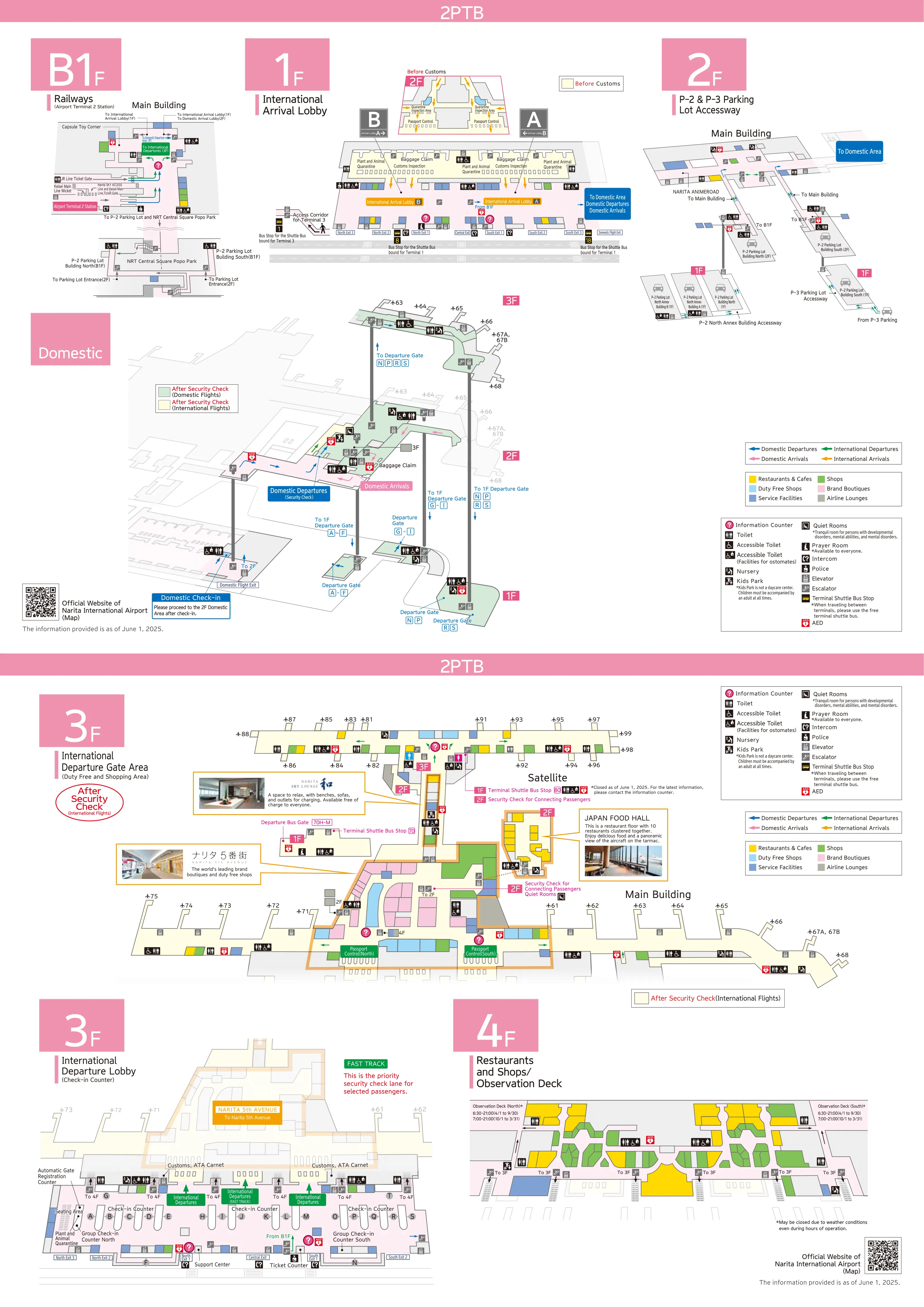
Narita International Airport Terminal 2 Level B1 1 2 Map 2025
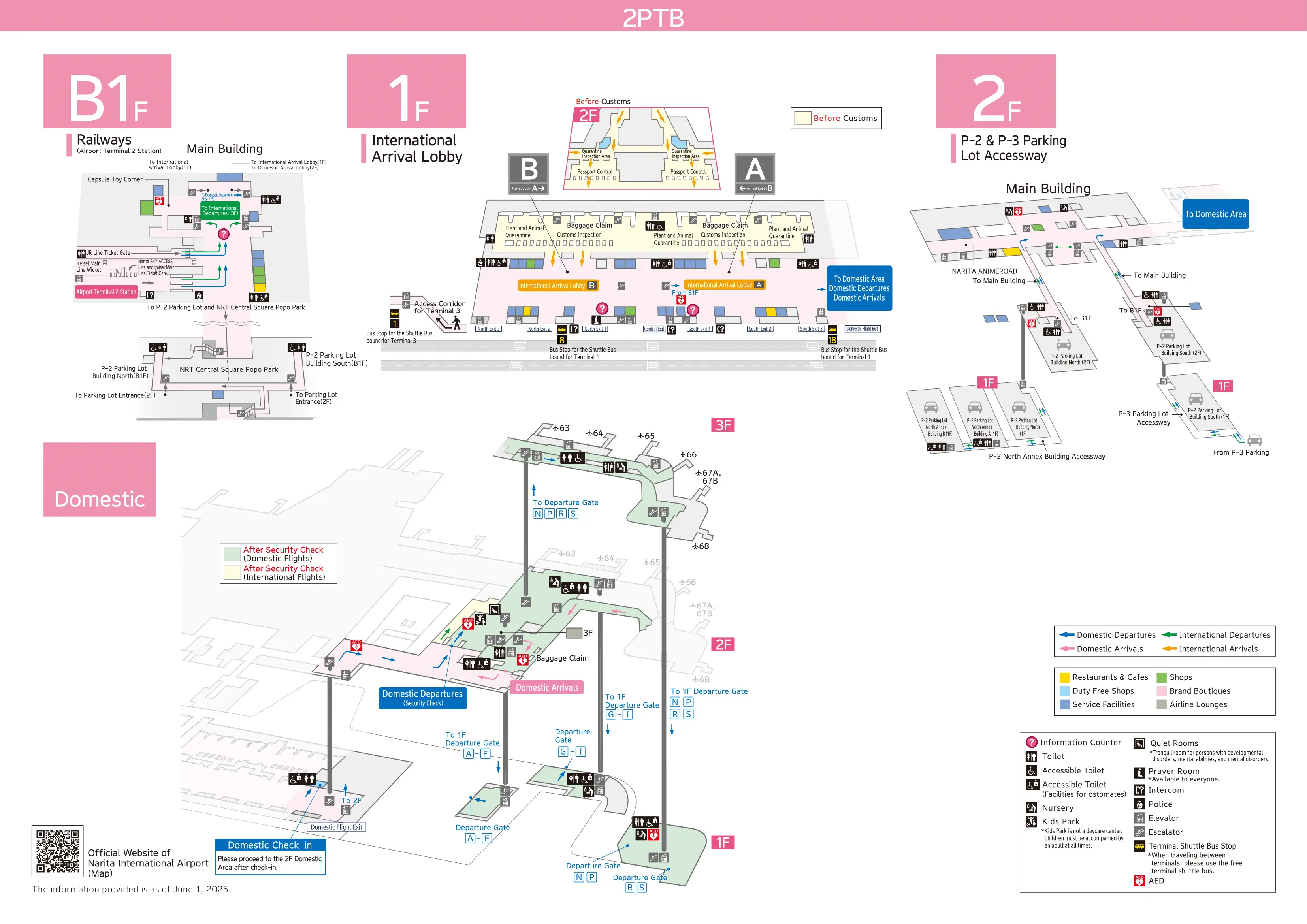
Narita International Airport Terminal 2 Level 3 4 Map 2025
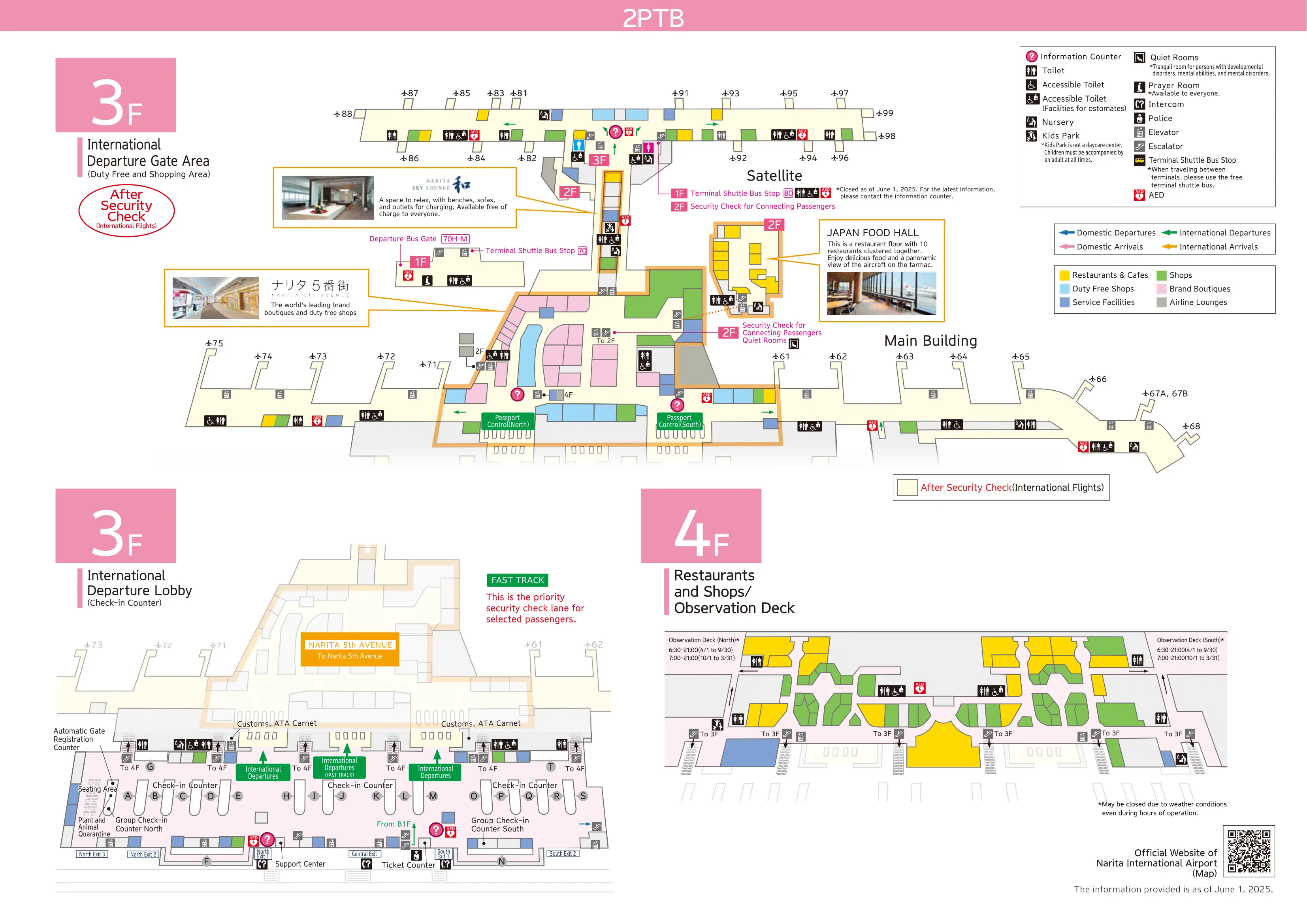
2026 Narita International Airport Terminal 2 Map Guide
What is the exact walking distance (meters) from Terminal 2 International Arrivals exit to the Inter-Terminal Shuttle Bus stop for Terminal 1?
The walking distance is about 50–75 meters from the central Terminal 2 International Arrivals exit to the nearest Terminal 1 inter-terminal shuttle stop (Stop 8).
Stop 8 sits on the 1F curbside in the central zone, so the “correct” move is to exit customs into the 1F public arrivals hall and go straight out to the bus curb rather than drifting toward the down-escalators for JR/Keisei. Stop 18 is the same shuttle route but positioned farther south for Zone B arrivals; choosing the wrong end of the hall can quietly add a couple hundred meters of extra curbside/lobby walking.
Where is the Terminal 2 → Terminal 3 landside walking path entrance located (floor + nearest landmark) from Terminal 2’s main public hall?
The Terminal 2 → Terminal 3 landside walking path entrance is on 1F outside at North Exit 1, marked by the start of the blue rubberized “running track” lanes.
From the 1F main public arrivals hall, move toward the north end (Zone A side) and follow signs for Terminal 3 / Access Corridor until you reach the sliding glass doors labeled North Exit 1. The entrance is not an indoor corridor; you must step outside to the curbside edge to see the blue track painted on the ground. If you find yourself being pulled toward the central “Trains” escalators down to B1F, you’re on the wrong vector and need to re-orient back toward the north exterior exits.
What is the walking distance (meters) from Terminal 2 Gate 47 area to the Immigration hall?
Gate 47 is not in Narita Terminal 2; it’s in Terminal 1, so a Terminal 2 “Gate 47 → Immigration” walking distance does not exist.
| Situation | What this means on the ground | What to do next |
|---|---|---|
| You’re standing in Terminal 2 and see “Gate 47” on your boarding pass | Wrong terminal, landside transfer required | Go to 1F curbside in T2 arrivals, take the inter-terminal shuttle to Terminal 1, then re-enter T1 departures flow for security/gates |
| You actually arrived at Gate 47 | You arrived in Terminal 1’s arrivals stream | Follow Terminal 1 “Arrivals/Immigration” wayfinding toward the immigration hall (stay in the inbound corridor; don’t exit to the public hall until after immigration) |
Where is the connections rescreening/security checkpoint located on the Terminal 2 airside transfer route (relative to the main escalators/elevators)?
International transit rescreening in Narita Terminal 2 is often closed, so the practical “location” becomes 3F departures security after you enter Japan, unless staff explicitly route you to an airside transfer lane.
When it is operating, the transfer security point sits on the arrivals-side circulation level (commonly described as the 2F arrivals transfer layer) at the convergence of inbound corridors before the Immigration Hall. On the ground, look for it beside the main vertical core: it branches off near the primary escalator/elevator banks that funnel passengers down toward immigration, with “Transfer/Connecting Flights” cues pulling you away from the downward flow. If you pass the down-escalators into the immigration queue, you’ve missed the diversion point.
Where is the domestic-connection baggage drop / recheck point located after customs in Terminal 2 (exact position relative to the exit flow)?
The domestic-connection baggage drop in Terminal 2 is landside in the public area after you exit customs, not an airside handoff right at the belt line.
After clearing customs you spill into the 1F International Arrivals Lobby; the recheck move is to stop in the public hall flow and make a lateral walk to the domestic check-in/baggage drop counters rather than heading straight out to curbside doors. The key positioning detail is that it’s not “outside the customs doors” as a dedicated drop belt—expect to haul bags into the open arrivals hall and follow domestic connection/check-in signage to the counter zone (airline-dependent), then proceed onward to the domestic security routing.
Which Terminal 2 gate range has the longest walk from the central post-security zone (identify the farthest gate cluster)?
The farthest walk from the central post-security zone is to the Satellite Building gates in the 80–99 range, with the end clusters around Gates 96–99 typically the longest.
The central post-security area opens into the main airside spine (duty-free “Narita 5th Avenue” feel), but Satellite gates require committing to the connector corridor first (the “tunnel” with moving sidewalks). Once you emerge into the Satellite concourse, the distance keeps accruing because the satellite itself is long and linear; the far-end gates add the final several hundred meters beyond the connector threshold. If your boarding pass shows a high-90s gate, treat it like a separate building for timing.
What is the walking distance (meters) from Terminal 2 security to the farthest international gate cluster inside Terminal 2?
The walking distance is roughly 800–1,000 meters from Terminal 2 security to the farthest international gate cluster (the far end of the Satellite gates, typically around 96–99).
That distance is a stack of three segments rather than one obvious corridor: the post-security core to the satellite connector entrance (about 200 m), the connector walkway itself (about 280–300 m, with moving sidewalks), then the remaining satellite concourse run (about 300–400 m) to the end gates. In real time-budget terms, it behaves like a 15–20 minute penalty with luggage and crowd friction, because the connector breaks line-of-sight and makes the trek feel shorter than it is until you’re already committed.
Which Terminal 2 exit door number is closest to the Airport Limousine Bus stop used for Tokyo-bound routes?
South Exit S1 and North Exit N2 are the closest Terminal 2 exit doors for Tokyo-bound Airport Limousine Bus stops, depending on which berth your ticket assigns.
| Arrivals position in 1F hall | Closest exit door | Adjacent landmark to confirm you’re right | What decides which one you need |
|---|---|---|---|
| Zone B / south side of the arrivals lobby | South Exit S1 | limousine bus ticket counter area inside the hall opposite the south curb doors | berth number printed on the ticket (then match to curb stop cluster) |
| Zone A / north side of the arrivals lobby | North Exit N2 | limousine bus ticket counter area inside the hall opposite the north curb doors | berth number printed on the ticket (then match to curb stop cluster) |
Where is the train station access point (JR/Keisei) located from Terminal 2 Arrivals (exact escalator/elevator bank and level)?
The JR/Keisei train station access is via the central escalator/elevator bank in the middle of the 1F Terminal 2 Arrivals Lobby, descending to B1F (Airport Terminal 2 Station).
From the customs exit into the 1F public hall, aim for the lobby’s central “Decision Diamond” area between Zone A (north) and Zone B (south). The station vector is Down, not Out: follow the large overhead “Trains / JR / Keisei” signage to the main down-escalators (with adjacent elevators) and continue to the B1F rail concourse where JR and Keisei facilities sit side-by-side but split at their respective gates and service counters. If you step through curbside exit doors, you’ve gone the opposite direction from rail.
Where is the last convenience-store-style purchase point located before security in Terminal 2 (exact landside location)?
The last convenience-store-style purchase point before security is the 7-Eleven on the landside 4F shopping/dining level of Terminal 2’s Main Building.
From the 3F departures/check-in hall, go up one level to 4F (the public “Shopping and Dining” floor) before you commit to security screening. This 4F 7-Eleven is the reliable “stock up” stop for normal-priced basics right in the departure flow; once you pass security, the mix shifts toward duty-free/souvenirs and you lose the easy convenience-store option. A second 7-Eleven exists on B1F near the rail concourse, but the 4F one is the last clean shot before the sterile-zone firewall.
Where is the Inter-Terminal Shuttle Bus stop located relative to Terminal 2 rail station signage (which direction and which exit)?
The inter-terminal shuttle bus stops are in the opposite direction from the rail station signage: you go Out to the 1F curbside exits for buses, while rail signs pull you Down to B1F.
In the 1F arrivals lobby, the “JR/Keisei/Trains” wayfinding funnels you toward the central escalators and elevators to B1F. For the Terminal 1 shuttle, ignore the downward rail vector and instead head to the curbside bus zone outside—commonly anchored by Bus Stop 8 (more central) and Bus Stop 18 (farther south). The practical rule is binary: Train = Down at the central bank; Shuttle bus = Out through the curbside exit doors nearest your stop.
What is the walking distance (meters) from Terminal 2 International Arrivals exit to the primary taxi/ride pickup area (exact curb/zone)?
The walk is about 20–50 meters from the Terminal 2 International Arrivals exit to the primary taxi pickup zone, typically centered on the 1F curb at Taxi Stand 30 near Central Exit 1.
From the customs exit you enter the 1F public arrivals lobby; stay on the “Out” vector toward the central curbside doors rather than drifting toward the “Trains” escalators. Once you pass through Central Exit 1, the taxi line is immediately on the curbside with dedicated “Taxi” signage and a managed queue lane, separate from the numbered limousine bus berths. If you find yourself walking along the curb past multiple bus stops, you likely exited at the wrong door and should backtrack toward the central taxi stand cluster.