Miami International Airport Central Terminal Map (Most Up-To-Date)

Miami International Airport’s Central Terminal is a curved, multi-level “arc” between the North Terminal (D) and the South Terminal, with Concourses E and F forming the main airside block and an off-building E Satellite reached by train. The secure-area geometry hinges on two connectors (D↔E and E↔F) and a vertical jump to the e Train platform. This zone sits inside the Miami hub complex, with the busiest pinch points clustering around E international arrivals and the E Rotunda.
Map Table
| Zone | Key Nodes | Airside Links | Walk Time |
|---|---|---|---|
| Concourse E (main) | Gates E2–E11, E Rotunda (E5/E7), Checkpoint 5 | D↔E connector (D30↔E2), E↔F connector (E5↔F4) | E2↔Rotunda: ~150 m / 2–3 min |
| E Satellite | Gates E20–E33, satellite station (L4), gate level (L2) | e Train only | Station→Gate E23: ~40 m / <2 min |
| Concourse F | Gate F4 node, Checkpoint 6 | E↔F connector | E5↔F4: ~150 m / 2–3 min |
| Central Terminal core (landside) | Level 1 arrivals/customs exits, Level 2 ticketing, CP5/6/7 frontage | Re-screen boundary (post-customs) | Customs (L1)→Departures (L2): 1 vertical bank |
Miami International Airport Central Terminal Map Strategy
- Treat “airside vs. landside” as binary: if you exit Customs (Level 1), plan on re-clearing TSA on Level 2 even for an E-to-E connection.
- Commit early on E Satellite trips: any gate in E20–E33 means e Train + Level 4, so aim for the E Rotunda (E5/E7 area) before you drift down the E2–E11 pier.
- Choose checkpoints by geometry, not habit: CP5 is the direct feed for E2–E11, but the E↔F airside connector lets you clear CP6 when CP5 is gridlocked, then walk back airside to E.
- Avoid the post-customs “flow trap”: after E international arrivals, go straight to the nearest elevator/escalator bank in the greeter lobby to regain Level 2, then pick the checkpoint before you get pulled into long curbside/baggage-claim circulation.
2026 Miami International Airport Central Terminal Map + Printable PDF
In 2026, Central Terminal wayfinding is defined by the post-Summer 2025 Phase 1 modernization that made E and F one contiguous post-security block via the new E↔F corridor. The big operational constants remain: E Satellite gates (E20–E33) are train-dependent, and all international arrivals that exit customs land on Level 1 and must re-clear TSA to reconnect to departures on Level 2.
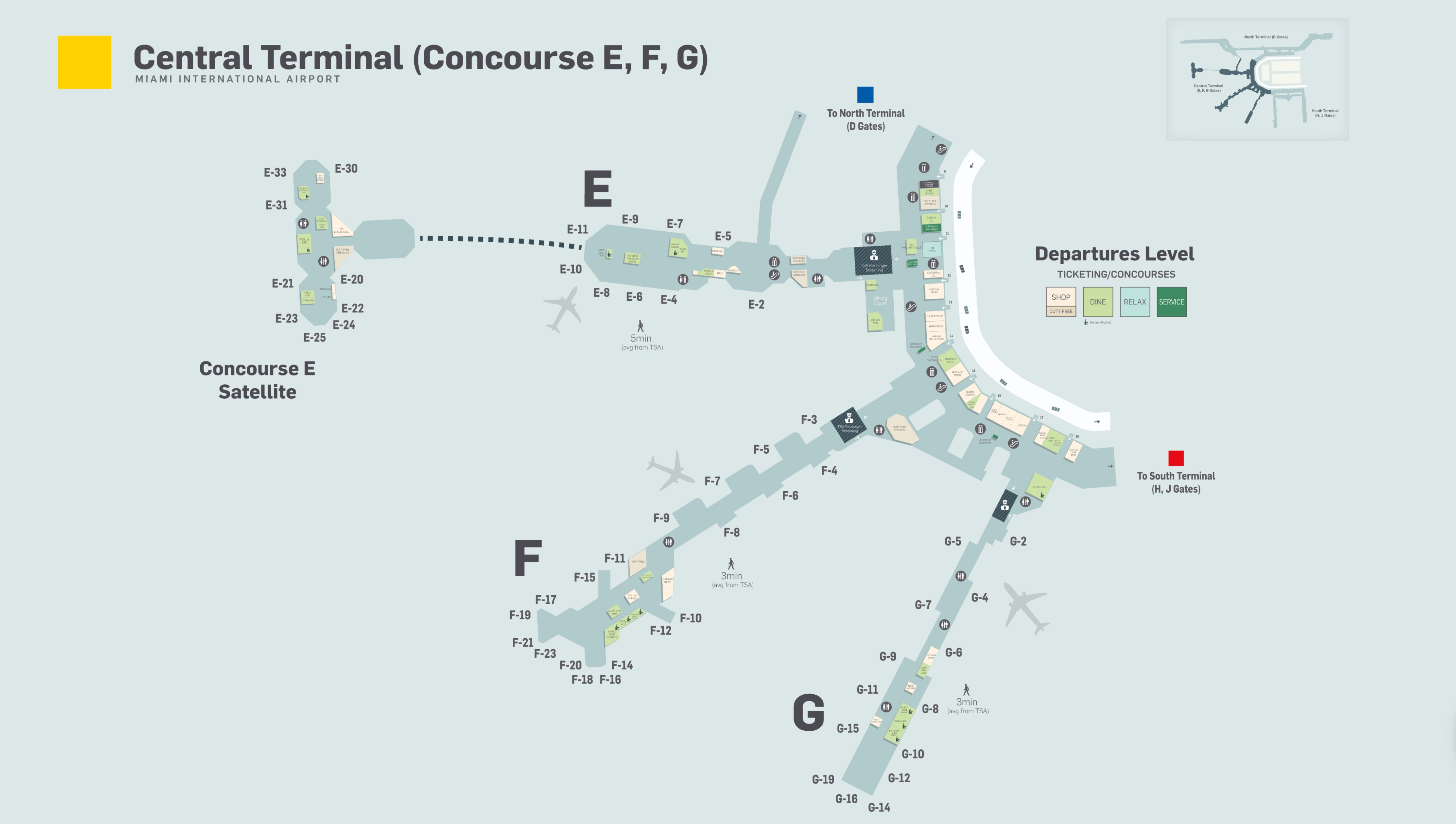
2026 Miami International Airport Central Terminal Map Guide
What is the exact airside boundary: where does the D↔E connector sit on the map (nearest gate numbers on each side)?
The D↔E airside connector sits near Gate D30 on the Concourse D side and directly opposite Gate E2 on the Concourse E side, and it stays entirely behind security for departing/connecting passengers. This corridor is the practical “sterile boundary” you use to move between the North Terminal hub and the Central Terminal E-gates without going landside.
The Concourse D end is best triangulated by the D30 node (also aligned with the nearby D-side circulation core), while the Concourse E end drops you at the root of Concourse E at E2, right by the E Rotunda approach. The connector itself is a short bridge-like hallway (about 120 m) that delivers you into E before the E2–E11 pier splits from the Rotunda retail core.
What is the walking distance (meters/feet) from the D↔E connector to the e Train station entrance in Concourse E?
The walking distance is about 150 meters (492 feet) from the D↔E connector exit in Concourse E to the e Train station entrance area. That measurement runs from the E-side connector node opposite Gate E2 to the E Rotunda vertical-circulation core used for “Satellite Gates E20–E33.”
From the connector, stay on the Concourse E spine heading toward the central retail rotunda anchored by the E5/E7 gate cluster and the Duty Free Americas storefront. The e Train access point is reached at the rotunda’s elevator/escalator bank that takes you up to the train platform level, so the “entrance” is effectively the rotunda lobby at that vertical core rather than the gate pier itself.
Where is the e Train station entrance located on the map (Concourse E), including the level/floor you must reach?
The e Train station entrance is in the Concourse E Main Retail Rotunda (near the E5/E7 gate cluster), and the train platform is on Level 4. The access point you’re looking for is the rotunda’s dedicated elevator/escalator core signed for Satellite Gates E20–E33, not a doorway down the E2–E11 pier.
From the Concourse E secure side, triangulate the entrance by the Duty Free Americas storefront and the rotunda node that sits between the E2 pier root and the connector approach. The functional sequence is: reach the rotunda on the departures concourse, then use the rotunda vertical-circulation bank to ascend from the departures level to Level 4, where the e Train platform is located before you ride to the E Satellite.
Which gate range specifically requires the e Train to the Concourse E satellite (exactly which gates are E Satellite)?
Gates E20–E33 are the Concourse E Satellite gates and require the e Train. Gates E2–E11 are the walkable Concourse E main-pier gates and do not require the train.
In the Central Terminal map logic, the split is absolute: the satellite building sits across the apron, so any boarding pass showing an E20–E33 gate should trigger a “Level 4 e Train” plan from the E Rotunda (E5/E7 area). Gate numbers commonly seen in the satellite cluster include E20, E21, E22, E23, E24, E25, E30, E31, and E33, but the operational boundary you should trust is the full E20 through E33 range.
What is the walking distance from the e Train station exit to Gate E23 (or midpoint of E20–E33) once you arrive at the satellite?
The walking distance is about 40 meters (131 feet) from the e Train arrival vertical-circulation landing to Gate E23 in the E Satellite. After the train drops you at the satellite station on Level 4, you descend to the gate concourse on Level 2, and the midpoint gates are only a short walk from that Level 2 landing.
Use the station’s elevator/escalator bank as your anchor point: the path is Train Platform (Satellite L4) → Down to Satellite Concourse (L2) → Gate E23. The satellite footprint is compact, so the dominant time factor is typically the vertical descent and any elevator wait, not the horizontal walk to the E20–E33 gate line.
Which of Central Terminal checkpoints 5/6/7 is geographically closest to Concourse E gates (E2–E11)?
Checkpoints 5 is geographically closest to Concourse E main-pier gates E2–E11. It feeds directly into the Concourse E secure-side root by the E Rotunda, so you start your airside walk already aligned with the E2–E11 gate spine.
On the map, triangulate Checkpoint 5 from the Central Terminal departures frontage on Level 2, then follow the post-security exit toward the retail rotunda anchored by the E5/E7 area. From that rotunda node, the E2–E11 pier is the immediate “attached” concourse, with Gate E2 sitting near the D↔E connector end and the higher E-gates continuing down the pier. Checkpoints 6 and 7 require extra lateral movement before you ever reach the E-pier.
What is the walking distance from Checkpoint 6 to a representative central Concourse E gate (e.g., Gate E10) using the shortest indoor route?
The walk is about 300 meters (984 feet) from Checkpoints 6 to Gate E10 using the shortest indoor, post-security route via the E↔F connector. This assumes the post-security E↔F corridor is open and you follow airside signage back toward the Concourse E Rotunda.
| Segment | Landmark anchors | Distance |
|---|---|---|
| Checkpoint 6 exit → connector entry | CP6 secure exit → “Concourse E” direction → corridor mouth near the F-root | ~30 m / ~98 ft |
| E↔F post-security connector | corridor linking near F4 ↔ opens into the E5/E7 rotunda zone | ~150 m / ~492 ft |
| E Rotunda → Gate E10 | E5/E7 retail core → down the E main pier past E9 → E10 | ~120 m / ~394 ft |
Which of Central Terminal checkpoints 5/6/7 is geographically closest to Concourse F gates?
Checkpoints 6 is geographically closest to Concourse F gates. It feeds directly into the Concourse F secure-side root, with the first major gate node (the F-spine start) sitting near the F4 area that also anchors the new post-security E↔F connector.
Checkpoints 5 and 7 sit farther east along the Central Terminal departures frontage and require additional lateral movement before you even reach the F-gate spine. If you clear at Checkpoint 6, you can go straight down Concourse F to the F gate range, or pivot through the E↔F corridor toward the E Rotunda if your best security option is in F but your gate is in E.
Where is the Concourse E ↔ Concourse F airside passage on the map (exact corridor/level and nearest gate references)?
The Concourse E ↔ Concourse F airside passage is a post-security corridor that runs between the Concourse E Rotunda near Gates E5/E7 and the Concourse F spine near Gate F4, all within the same sterile block. It sits behind security on the departures concourse level used for gate circulation.
On the map, the E-side mouth opens at the retail core anchored by the E5/E7 gate cluster, immediately adjacent to the central rotunda node (the same core used to reach the e Train vertical bank). The F-side mouth connects into the F concourse root by the F4 gate node, where Concourse F begins to extend down its pier. This corridor is the structural fix from the 2025 modernization that removed the old “E and F are isolated” dealbreaker.
From Central Terminal E international arrivals (post-customs, 1st level), what is the exact route on the map to return to departures/connecting flights (2nd level)?
You must re-clear TSA after exiting customs, so the route is Customs exit on Level 1 → nearest elevator/escalator bank in the greeter lobby → up to Departures/Ticketing on Level 2 → proceed to the correct checkpoint (usually Checkpoint 5 for Concourse E). Once you step through the customs glass doors, you are landside and cannot reach gates without going back through security.
From the Central Terminal E international arrivals exit, anchor yourself in the Level 1 greeter lobby and look for the main vertical circulation bank near the Central Terminal garage-direction signage (the Dolphin/Flamingo garage references are common anchors in this zone). Take that bank up one level to Level 2 ticketing, then follow checkpoint signage: CP5 for Concourse E gates (including the E Rotunda and the e Train access), or pivot to another checkpoint only if your connection is routed elsewhere.
Where is the courtesy trolley boarding point for passengers arriving in Concourse F who are routed to the Concourse D International Arrivals Facility?
Concourse F has no CBP processing, so international arrivals are routed to a sterile courtesy-trolley boarding node at the Concourse F arrival root, not to a public exit. After deplaning at the F arrival gates (typically the F3–F19 range), you are funneled into a segregated arrivals corridor and cannot mix with departing passengers.
Follow the “International Arrivals / U.S. Customs” wayfinding through the glass-walled sterile path toward the F-root ramp/corridor system (often described as Level 3 / sterile receiving node). The boarding point is a controlled, staff-managed holding area at that sterile node, before any landside doors, where passengers are staged and loaded for the airside transfer to the Concourse D International Arrivals Facility.
Where is the courtesy trolley drop-off point inside/near Concourse D IAF (exact landmark/door reference on the map)?
The courtesy trolley drops passengers at the sterile ground-level (Level 1) entrance on the tarmac side of Concourse D’s International Arrivals Facility (IAF), feeding directly into the CBP processing flow. This is not a public curbside door; it is an airside-controlled entry point that lands you inside the arrivals processing loop.
On the map, anchor the drop-off as the Concourse D IAF tarmac-side door that leads straight into the CBP primary/secondary queue area (the D-FIS/IAF intake). The key wayfinding reality is that you do not re-enter Concourse D gate circulation first; you enter the IAF processing path immediately upon drop-off, and your next public “escape” point is only after you clear customs and exit through the landside glass doors.
If you must exit security and re-clear TSA to move between terminal groups, where is the shortest landside path between the Central Terminal and the needed checkpoint entrance?
The shortest landside transfer runs along the Level 2 Departures/Ticketing corridor, which is the main public spine connecting terminal groups. If you need to re-clear in another group (for example, leaving Central Terminal and heading to the South Terminal’s Concourse J checkpoint), stay on Level 2 and walk the straight corridor rather than dropping to Level 1 curbside.
From the Central Terminal landside core, align with the long east–west ticketing frontage that parallels the glass façade and check-in counters. Move in the direction of your target concourse signage until you reach the desired checkpoint entrance; a representative Central-to-J move is about 600 meters (~0.37 miles) and typically takes 8–10 minutes at a brisk pace because crowd friction near check-in islands slows you down. The “shortest path” rule is simple: Level 2 the whole way, then re-enter at the checkpoint you’ve chosen.
From Central Terminal (ticketing/departures), what is the shortest mapped route to the MIA Mover station (for Rental Car Center / MIC)?
The shortest route goes up to Level 3, then follows the Skyride moving-walkway bridges to the MIA Mover Station between the Dolphin and Flamingo garages. From Central Terminal ticketing on Level 2, the fastest path is vertical-first; staying on Levels 1–2 traps you away from the bridges.
Start at the Central Terminal Level 2 ticketing frontage and take the nearest escalator/elevator bank up to Level 3, the moving-walkway level. Enter the Skyride corridor signed for Rental Car Center / MIA Mover, then stay on the bridges toward the parking structures until you reach the station doors positioned between Dolphin and Flamingo Garage. Plan about 400 meters total and 6–8 minutes, with most time spent on the moving walkways.
From Central Terminal baggage claim (1st level), what is the shortest mapped route to the primary ground transportation pickup area (taxi/ride app zones)?
The shortest route is a straight curbside exit from Level 1 baggage claim through the nearest numbered door, then a short walk to the taxi/ride-app curb zones. From the Central Terminal E baggage claim core (carousels in the E22–E27 area), you’re typically within 50 meters (under 1 minute) of the curb.
Use the door anchors that map cleanly to the curb: Door 20 (Concourse E side) or Door 24 (Concourse F side) are the common shortest exits from the Central Terminal baggage-claim hall. Once outside, the taxi stand is generally on the inner curb island directly in front of the doors, while ride-app pickups are signed to designated “Ride App” areas that may require a short cross to the marked median/outer curb lane. The key is not to wander the full arrivals hall—commit to the nearest door number and follow curb signage.
Where are the vertical transitions (escalators/elevators) that connect the Concourse E departures level to the e Train station level, and where do they sit relative to nearby gates?
The vertical transitions to the e Train are in the Concourse E Main Rotunda at a dedicated elevator/escalator core signed for Satellite Gates E20–E33, located by the E5/E7 gate cluster. This core is the required “level change” point from the Concourse E departures circulation to the e Train platform level.
On the map, anchor the vertical core to the Duty Free Americas storefront and the rotunda node that sits just off the main E concourse spine. Relative to gates, it is closest to the Gate E5 area and sits before you commit down the walkable pier toward E9–E11. If you are standing near the E5/E7 retail core and you can see the “Satellite Gates” wayfinding, you are at the correct vertical bank; taking it brings you up to the Level 4 train platform.
Where is the nearest restroom to the e Train station entrance in Concourse E, and what is the mapped walking distance?
The nearest restroom is adjacent to the Concourse E Rotunda by Gate E5, next to the Duty Free Americas storefront, and it’s about 20 meters (66 feet) from the e Train vertical-circulation core. This is the last reliably close restroom before you commit to the Level 4 platform and the satellite transfer.
Use the rotunda anchors to triangulate it: position yourself at the E5/E7 retail node, then look for the restroom bank immediately off the main concourse corridor near the Duty Free frontage. The practical routing is “restroom first, then elevators,” because the e Train dependency is a vertical-plus-mechanical sequence—once you go up to the platform, amenities are limited until you reach the E Satellite gate level.