Marrakech Menara Airport Terminal 1 Map (Most Up-To-Date)

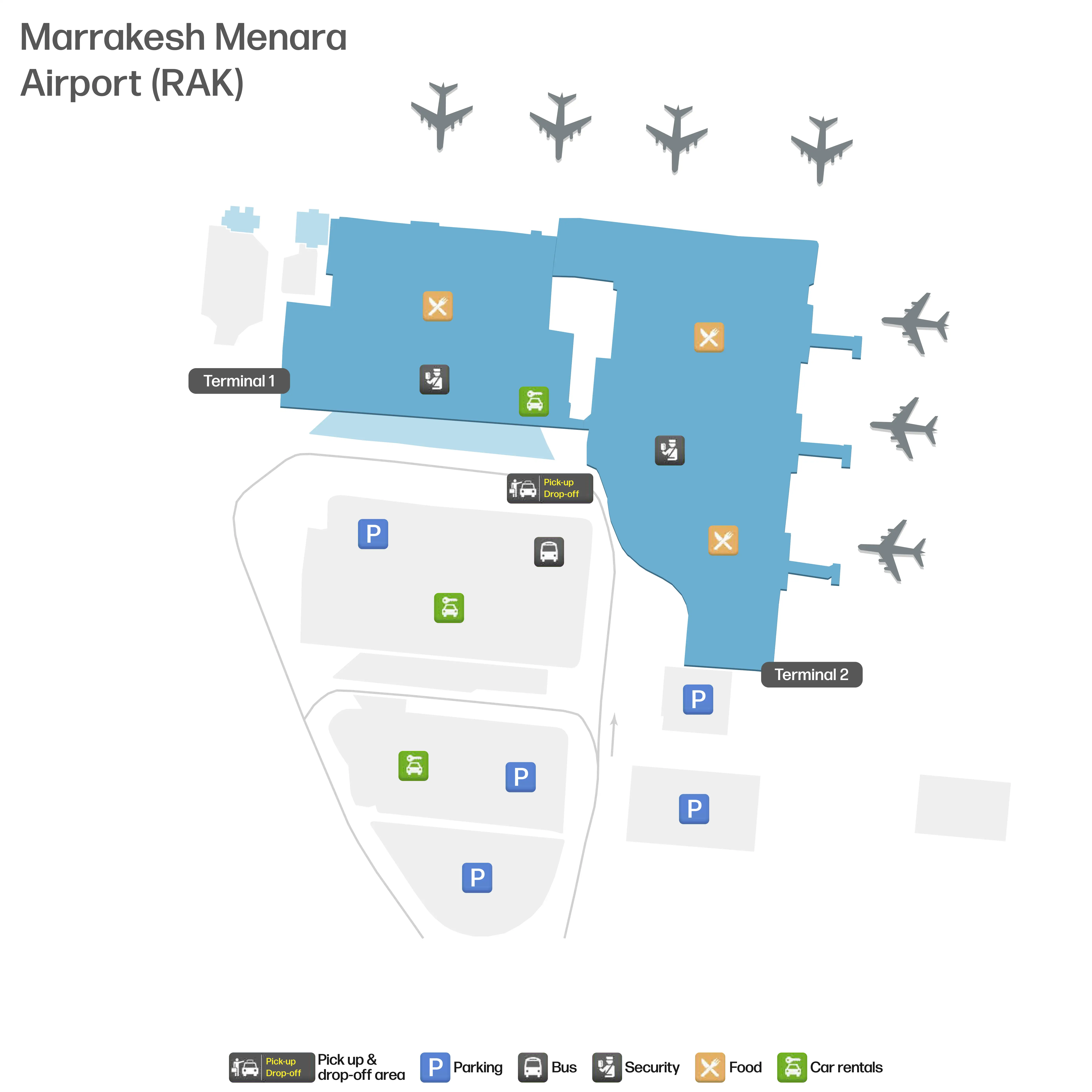
Marrakech Menara Airport Terminal 1 sits on the landside side of the connected RAK complex, feeding a mostly linear departure flow that pushes passengers forward into security, then passport control, then a post-immigration re-check before the long airside walk into Terminal 3. The building footprint feels wide at the check-in hall, then compresses into narrow processing corridors. Most wayfinding stress comes from stacked queues and the mandatory Terminal 1 → Terminal 3 connector inside Marrakech’s primary airport hub.
Map Table
| Zone | Connection | Walk Time |
|---|---|---|
| Terminal 1 landside check-in hall | Security screening zone | Short, direct |
| Security exit | Passport control hall | Immediate adjacency |
| Passport control exit | Stamp verification point | Steps past booths |
| Stamp verification point | Glass-walled connector | Continuous walk |
| Connector end | Terminal 3 departures lounge / duty-free | Arrival point |
Marrakech Menara Airport Terminal 1 Map Strategy
- Treat Terminal 1 as the queue zone and Terminal 3 as the gate zone; the stress point is the in-between corridor chain, not the gates themselves.
- Plan for stacked checkpoints: security first, then slow exit immigration, then a post-immigration stamp verification that can form a second surprise line.
- Lock in the Terminal 1 → Terminal 3 connector mentally as a single, enclosed glass corridor; once you clear the final verification, keep moving straight into that link.
- Reduce missed-flight anxiety by front-loading time for manual document checks at the desks, even if you already checked in online or have only carry-on luggage.
2026 Marrakech Menara Airport Terminal 1 Map + Printable PDF
Current layouts still funnel Terminal 1 departures into a stacked sequence of checks, with the biggest risk coming from unpredictable dwell time rather than pure walking speed. The operational reality is that Terminal 1 processing often leads to Terminal 3 gates through a fixed corridor link, and surprise re-checkpoints can appear immediately after passport control. For printing, prioritize a map that shows the connector and the checkpoint order in one continuous line.
2026 Marrakech Menara Airport Terminal 1 Map Guide
What is the exact walking route (turn-by-turn via corridors/links) from Terminal 1 bag-drop/check-in to the Terminal 3 departures entry point?
The route is a straight-ahead progression from Terminal 1 check-in into security, then directly into passport control, then through a post-immigration stamp-verification point, and finally along the enclosed glass-walled connector that deposits you into the Terminal 3 departures lounge by duty-free. This flow is effectively unidirectional, with no alternate passenger corridor shown for the Terminal 1 → Terminal 3 move.
After bag-drop/check-in in the Terminal 1 ground-floor hall, follow the “Departures / Embarquement” direction deeper into the building to the main security queue (stanchions and X-ray/metal detectors). Exit security and continue straight into the adjacent passport control hall for exit processing. After the immigration booths, stay in the same forward corridor to the stamp-verification re-check positioned just past the booth exits. Once cleared, continue straight into the long, enclosed glass corridor and walk it to its far end, where it opens into Terminal 3 departures and the duty-free entry area.
What is the exact walking distance (meters) from the Terminal 1 check-in hall exit to the first Terminal 3 security queue start?
The exact meter distance is not published on any available public terminal plan for Marrakech Menara Airport’s Terminal 1 → Terminal 3 departure flow. The walk is described consistently as a short, direct forward progression within the same contiguous Terminal 1 hall, from the check-in area toward the first stanchions of the main security queue.
In practice, the “check-in hall exit” and the first security-queue start point function like adjacent zones: you move forward from the desk area toward the screening lanes without a corridor choice or a level change. The nearest fixed landmark is the visible queue stanchions and tray/X-ray preparation area, which typically sits straight ahead of the check-in field rather than around a corner or inside a separate connector.
Where is the front-door baggage screening located relative to the Terminal 1 main entrance, and which entrances bypass it (if any) based on the terminal layout?
The front-door baggage screening is eliminated, so there is no longer a mandatory x-ray/metal-check choke point at the Terminal 1 entrance and no “bypass entrance” requirement. The entry threshold now behaves like a normal landside door line into the public check-in hall rather than an exterior queueing filter.
Older flows put scanners directly at or just inside the main entrance doors, creating a line outside the façade before passengers could reach the Terminal 1 hall. Under the updated operating setup, those entrance devices were removed and the screening function was pushed deeper into the departure sequence, meaning any public entrance into the Terminal 1 landside hall effectively serves the same access role.
Where is the first passport-control/immigration checkpoint located on the departure path, relative to security, on the Terminal 1 → Terminal 3 flow?
Passport control is positioned immediately after the main security screening on the Terminal 1 → Terminal 3 departure path. The first immigration desks come right after you exit the X-ray/metal detector area, before you enter the connector that leads into Terminal 3.
The layout runs as a single forward funnel: you clear security, then follow the same corridor line straight into the passport control hall for exit processing. The nearest anchor point is the security egress/tray collection zone, which feeds directly into the immigration queue and booths, and the flow does not branch into duty-free or a gate corridor until after passport control is completed.
Where is the post-immigration “stamp verification” checkpoint located, and what is the shortest path from that checkpoint to the first gate cluster?
The post-immigration stamp verification checkpoint sits immediately after the passport control booths, inside the same transitional corridor that leads toward the Terminal 1 → Terminal 3 connector. The shortest path to the first gate cluster is to proceed straight past this verification point and continue directly into the enclosed glass-walled corridor that ends in the Terminal 3 departures lounge at the duty-free entry.
Operationally, this is the “false finish line” point: you exit the immigration booth area and are immediately funneled into a second, tighter check where an official re-checks the exit stamp and the boarding pass stamp. Once cleared, there is no mapped alternate routing—stay in the same forward lane, enter the glass connector, walk it to its far end, and you arrive in Terminal 3’s main departures hall where gate directions split from the central lounge.
Which specific corridor/connector physically links Terminal 1 to Terminal 3, and where does it begin/end on the terminal plan?
The Terminal 1 to Terminal 3 link is the long, enclosed glass-walled connecting corridor that functions as the sole passenger artery between the older processing core and the Terminal 3 departures lounge. The connector begins immediately after the post-immigration stamp-verification point, and it ends when it opens directly into Terminal 3 departures at the duty-free / central lounge entry.
On the flow, the start landmark is the stamp-verification re-check positioned just past the passport control booth exits. The end landmark is the point where the corridor widens and deposits you into the Terminal 3 airside hall, where duty-free and the main waiting area sit before gate-direction signage fans out.
What is the distance from the end of security to the first available restrooms (airside), based on the Terminal 3 airside map?
The exact meter distance is not documented on publicly available Terminal 3 airside maps for Marrakech Menara Airport. The first airside restrooms are known to be inside the Terminal 3 departures lounge area, accessible after you complete the post-security sequence and traverse the glass-walled connector into the main duty-free / café zone.
From a practical navigation standpoint, the closest reliable landmark is the Terminal 3 central lounge immediately after duty-free entry: restrooms are positioned within that broader lounge/retail/café footprint rather than back inside the connector. If you need the earliest possible restroom, look immediately around the duty-free boundary and the first café cluster in the Terminal 3 hall, not along the corridor itself.
Where are the airline check-in desks commonly used for low-cost carriers positioned within Terminal 1 (left/right/zone), and what’s the shortest route from that desk zone to security?
Low-cost carrier check-in desks are in the main Terminal 1 ground-floor check-in hall, but their exact left/right zone positioning is not fixed on published layouts because counter assignments are dynamic. The shortest route from the LCC desk zone to security is a direct forward walk deeper into the same hall toward the main security queue, without a connector choice or level change.
Operationally, Ryanair and easyJet passengers are still forced to use the desks for a physical stamp on a printed boarding pass, so the effective “LCC zone” is wherever the departures board and stanchioned check-in lines for those airlines are set up that day. Once you finish at the desk, use the straight-ahead “Departures / Embarquement” direction to the visible security stanchions and screening lanes.
What is the exact distance from the Terminal 3 departures lounge area to the furthest numbered gate area, based on the map?
The exact meter distance from the Terminal 3 central departures lounge to the furthest numbered gate is not published on the available public maps for Marrakech Menara Airport. The layout is described as a central Terminal 3 lounge and duty-free core with gate corridors that fan outward, but the terminal plans do not provide scale distances for longest-walk gate planning.
What can be relied on is the geometry: the “Terminal 3 departures lounge area” functions as the anchor node after the glass connector ends and duty-free begins, and the furthest gate walk is whichever corridor runs to the most distant gate cluster away from that lounge node. If you’re timing risk, the dealbreaker variable remains the stacked checkpoint chain before you ever reach this lounge, not the final gate dispersion walk.
If a traveler is forced to rejoin a second queue after immigration, where is the nearest alternate lane/queue split point shown on the layout (i.e., where queues merge/diverge)?
No alternate lane or queue split point is shown for the post-immigration second queue at Marrakech Menara Airport. The layout is described as a rigid, single-file corridor immediately after the immigration booths, where the stamp-verification checkpoint forms and the line stacks backward into the same constrained space.
In this configuration, the merge/diverge behavior is essentially absent: the immigration exit funnels into one verification point, and exceptions are handled manually by pulling a passenger aside rather than routing them into a mapped rectification lane. The nearest physical anchor is the immigration booth exit itself—if the stamp-verification line backs up, it typically encroaches right into that exit corridor area rather than splitting into a parallel queue.
Where are the primary information/help desks located along the Terminal 1 → Terminal 3 departure path, and what’s the closest one after entering the building?
Primary information/help desks are described only generically as being near the main halls, with no precise placement marked on publicly available layouts for the Terminal 1 → Terminal 3 departure path. The closest assistance point after entering is therefore best treated as the first visible help/information counter in the Terminal 1 landside check-in hall, typically positioned in the open public area where passengers naturally pause to read screens.
Along the departure flow, the only reliable adjacent anchor point is the Terminal 1 main hall itself: look around the central sightlines near the departures screens and the densest passenger decision area before the check-in rows. Past the sterile boundary (security → passport control → stamp verification), mapped help-desk coordinates are similarly not provided, so you should not plan on a guaranteed, signposted assistance node inside the transition corridor.
What is the fastest mapped walking path from Terminal 3 gates back to Terminal 1 check-in (reverse direction) if a traveler is sent back to fix a check-in/bag-drop issue?
No passenger-accessible mapped reverse walking path exists from Terminal 3 gates back to Terminal 1 check-in because the security and immigration flow is enforced as strictly unidirectional. Returning landside after reaching Terminal 3 gates requires staff intervention rather than a public corridor you can simply walk.
In practice, the only workable “route” is procedural: you must contact airline staff or airport security at the gate area, be escorted through secured staff doors, and formally unwind the exit process so you can re-enter the public zone. The adjacent anchor is the Terminal 3 gate cluster itself—once you are there, you cannot legally backtrack through the glass corridor and immigration booths as a normal passenger, so any fix at Terminal 1 desks becomes an escorted exit-and-restart scenario.