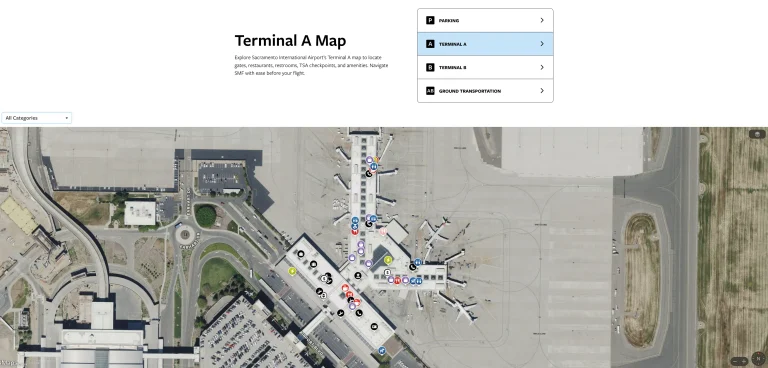
London Heathrow Airport Map (Most Up-To-Date)

London Heathrow Airport (LHR) functions like three separated clusters: Central (T2/T3), South (T4), and West (T5), with airside integrity maintained mainly by purple “Flight Connections” corridors, airside inter-terminal buses, and a few long underground links (T2A↔T2B; T5A↔T5B/C). The critical geometry is not “distance,” it’s one-way flows and process nodes (scan points + re-screening). Scale Warning: walking + level-changes can silently add 10–20 minutes.
Map Key
| Terminal | Key Airlines | Primary Function | Transfer Mode |
|---|---|---|---|
| Terminal 2 (Queen’s) | Star Alliance mix | T2A main + T2B satellite gates | underground pedestrian tunnel T2A↔T2B; airside buses to T5/T4/T3 |
| Terminal 3 | Virgin Atlantic; select long-haul partners | long piers; high gate sprawl | purple Flight Connections to airside bus pens; airside buses to T5/T4/T2 |
| Terminal 4 | SkyTeam + mixed long-haul | compact processing; standalone south campus | airside buses to T5/T2/T3 |
| Terminal 5 | British Airways hub | T5A main + T5B/T5C satellites | transit train A↔B/C; Level -4 walkway A↔B↔C; airside buses to T2/3/4 |
London Heathrow Airport Map Strategy
- Treat every purple “Flight Connections” choice as a decision-tree: one wrong corridor/level can eject you into Arrivals and force a full landside reset.
- Optimize for scan points, not walking: the boarding-pass conformance/checkpoint is the real deadline, and it sits downstream of the bus drop + the exact escalator/lift up to transfer security.
- After any airside bus, prioritize the transfer-security entrance immediately—don’t drift with the crowd; bus drop-offs are low-level, security is one level up, and the choke can erase your buffer.
- Assume satellite penalties by default: T5 A vs B/C and T2B “double-back” add hidden tunnel time + level changes; pick the shortest airside-safe path before you commit.
2026 London Heathrow Airport Map + Printable PDF
Heathrow’s transfer system is operational and structurally consistent with the “fragmented hub” pattern: terminals remain physically separated, airside inter-terminal buses remain the dominant connector, and transfer flows still depend on purple Flight Connections routing, scan/conformance control points, and re-screening security nodes—plus satellite penalties at T5 (A vs B/C) and T2 (T2B double-back).
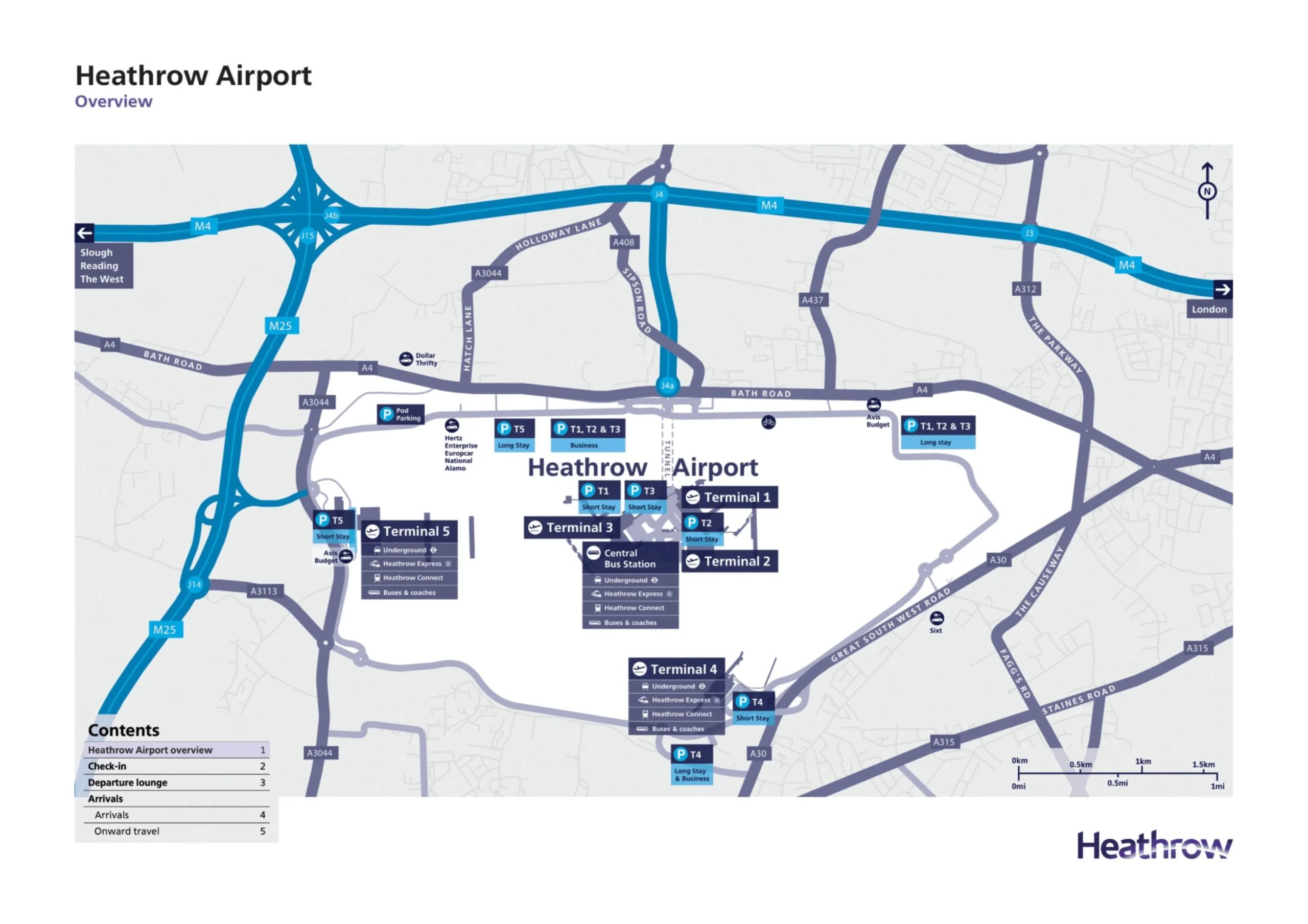
2026 London Heathrow Airport Terminal Map Guide
What is the exact level (e.g., departures/arrivals/apron-level) where Terminal 3’s Flight Connections bus area begins?
Terminal 3’s Flight Connections bus area begins at Ground Level (apron-facing bus/holding area), reached by following purple “Flight Connections” routing down from the terminal’s main passenger levels.
| Segment | Where you start | Level you must reach | What you’re aiming for |
|---|---|---|---|
| Typical transfer flow | T3 Arrivals stream | Ground Level | purple Flight Connections bus holding/queue area |
| If you’re on check-in/departures level | T3 Departures (check-in) | down to Ground (often via Level -1 transition) | purple Flight Connections route to bus pens |
| If signage pushes you through an underpass | central core access | Level -1 passage | connector down to Ground bus operation area |
In Terminal 5, what is the exact location of the “Flight Connections to T2/3/4” escalators/elevators relative to the domestic-arrivals exit?
The “Flight Connections to T2/3/4” escalators/elevators are positioned immediately off the domestic-arrivals exit corridor, before you spill into the main baggage reclaim/Arrivals hall, and they drop you down toward the Ground Level Flight Connections bus area.
Follow the purple “Flight Connections” signs as you leave the domestic arrivals gate area. The decision point comes before baggage reclaim: instead of continuing forward into Arrivals, peel off into the Flight Connections branch. The escalators/lifts are on that branch and take you down to the inter-terminal bus routing for Terminal 2/3/4.
What is the walking distance (meters) from Terminal 3 Flight Connections entry to the airside transfer-bus queue/loading point?
Walking distance from the Terminal 3 Flight Connections entry/core to the airside transfer-bus queue/loading point is about 200–300 meters.
| Start point | End point | Distance | Walk time |
|---|---|---|---|
| T3 Flight Connections entry/core (purple routing merge point) | T3 airside inter-terminal bus queue/loading pens | 200–300 m | 3–5 min |
| Far T3 arrival gates (e.g., high-numbered pier gates) | T3 bus queue/loading pens | ~1,200 m | 15–20 min |
What is the walking distance (meters) from Terminal 5 airside transfer-bus drop-off to the transfer-security queue entrance?
Walking distance from the Terminal 5 airside transfer-bus drop-off to the transfer-security queue entrance is about 100–150 meters horizontally, plus one level of vertical ascent via escalators/lifts.
After the bus drop-off, the flow runs straight into the boarding-pass scan/conformance checkpoint on the Ground Level Flight Connections side. From that scan point, you move a short corridor distance and then go up (escalator or lift) into the Transfer Security lobby, where the queue entrance begins. The distance is short, but the scan point and the “up one level” move are the time-loss thresholds.
Where is Terminal 5’s transfer-security entrance located (exact corridor/landmark) after arriving via the airside transfer bus?
Terminal 5’s transfer-security entrance is at the top of the escalators/lifts immediately after the Ground Level bus-arrivals boarding-pass scan/conformance point, inside the Flight Connections corridor on the north side of T5A.
You disembark the airside bus at Ground Level and walk into T5A via the purple Flight Connections entry. The first hard landmark is the boarding-pass scan/conformance gates. From there, take the escalators/lift up one level; the Transfer Security hall and its queue mouth are directly ahead at the top of that ascent, before you can drift into the general departures concourse.
Where is the Fast Track security door at Terminal 5 (exact position relative to the main security entrances)?
The Fast Track security door at Terminal 5 is immediately to the right of the main transfer-security entry flow, positioned on the edge of the standard queue “snake” shortly after the boarding-pass scan/conformance point and before you merge into the central escalator-fed crowd.
In the Transfer Security approach, most passengers are funneled straight into the main queue induction. For Fast Track-eligible travelers, look for a separate right-side opening (often a short side corridor or staircase spur) with “Fast Track” signage that bypasses the primary queue lane. The key landmark is that you identify it before you commit to the main queue switchbacks—once you’re inside the snake, backtracking is slow and socially difficult.
What is the exact level designation used to access the return path from T5 B/C back to A (the level travelers report using via elevator)?
The return path from T5 B/C back to A uses Level -4, selected via the elevator button labeled “-4” (sometimes annotated as “Walkway”).
From T5B or T5C, avoid the transit train back toward T5A if you’re a departing passenger. Instead, locate the lift bank in the satellite concourse and ride down to Level -4 to enter the pedestrian tunnel. Stay in the tunnel until you reach T5A, then take lifts back up into the departures concourse to preserve airside integrity.
What is the walking distance (meters) from Terminal 5 A-gates main concourse to the train entrance for B/C gates?
Walking distance from Terminal 5 A-gates main concourse to the transit train entrance for B/C gates is about 150–200 meters.
From the central T5A departures concourse (the main retail/core zone after security), follow signs for “Gates B/C” toward the transit station core. The train access point is the escalator/elevator descent into the transit platform area; the distance is short, but expect a level change down to the platform before you can board.
What is the walking distance (meters) from Terminal 2 satellite T2B arrival gates to the Terminal 2 Flight Connections centre in the main T2 building?
Walking distance from Terminal 2B arrival gates to the Terminal 2 Flight Connections centre in the main Terminal 2 building is about 800–900 meters via the underground pedestrian tunnel.
You leave the T2B gate pier and follow purple Flight Connections routing toward the long tunnel back to T2A. The penalty isn’t just meters: it includes a full descent into the tunnel, the long corridor walk (often perceived as longer under fatigue), and the ascent back up into the main building where the Flight Connections processing/security node is located.
What is the walking distance (meters) from the Terminal 2 Flight Connections centre back to typical T2B departure-gate corridors?
Walking distance from the Terminal 2 Flight Connections centre back to typical T2B departure-gate corridors is about 800–900 meters via the same underground tunnel.
After completing processing at the T2A Flight Connections centre, follow signs back toward Gates B and descend into the tunnel again. The return leg includes the same level changes (down into the tunnel, then up into T2B), and the lack of “return-direction” moving walkway assistance can make this leg feel slower—especially if you’re already time-pressured after security.
Where is the exact boarding-pass scan/check point that controls entry into Terminal 5’s departures flow for transfer passengers?
The boarding-pass scan/checkpoint for Terminal 5 transfer passengers is immediately inside T5A at Ground Level after you enter from the airside inter-terminal bus drop-off, before the escalators/lifts up to Transfer Security.
Transfer passengers arriving by airside bus step off at the Ground Level Flight Connections intake and walk into the purple-routed corridor. The controlling landmark is the conformance scan gates/turnstiles at the start of that corridor. Once you scan through, you proceed to the vertical move up into the Transfer Security hall; if you cannot scan through here, you are stopped before reaching security or the departures concourse.
What is the shortest mapped route from Terminal 5 transfer-security exit to the main A-gates flight-information screens (where gate info typically appears first)?
The shortest route from Terminal 5 transfer-security exit to the main A-gates flight-information screens is a straight walk forward out of the security exit into the central T5A departures atrium/plaza where the primary screens sit.
Exit transfer security and continue directly ahead into the main departures concourse rather than turning off toward lounges or side corridors. The first major flight-information display cluster is in the central retail/core zone (the main “square” feeling space) just beyond the security outflow, before the long lateral walks toward the far A-gates ends.