Larnaca International Airport Map (Most Up-To-Date)

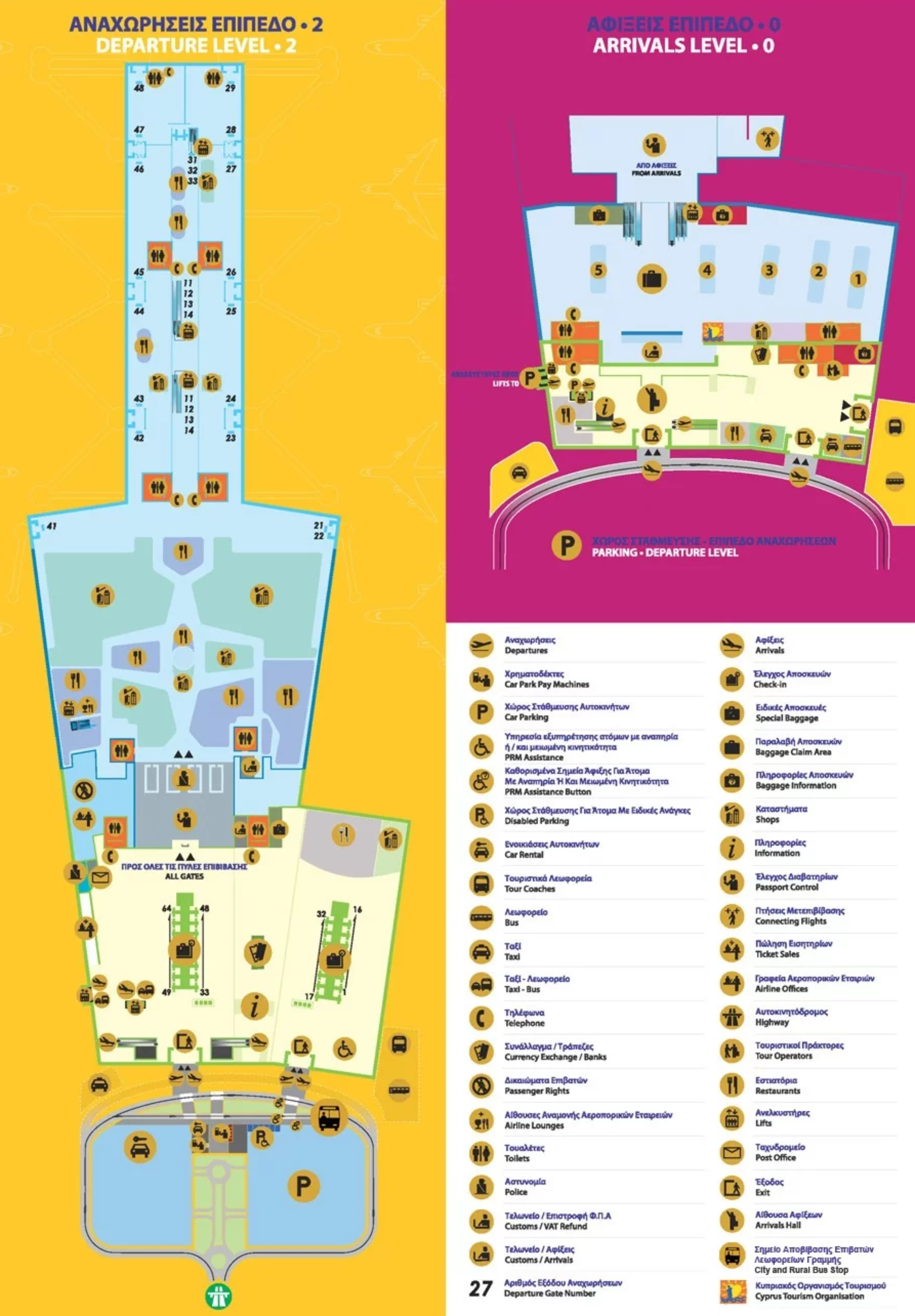
Larnaca International Airport (LCA) is a single-terminal, dual-level airport: Departures on the upper level (Level 2) and Arrivals on the lower level (Level 0). The building is a long, linear layout that funnels everyone into a central security interface before a single airside pier of gates. Within Cyprus’s main Larnaca air hub, landside vehicle flow currently skews toward the Departures frontage, so the practical “front door” orientation is up-level first, then down-level for arrivals exits.
Map Table
| Terminal | Key Airlines | Primary Function | Transfer Mode |
|---|---|---|---|
| Single terminal | Cyprus Airways, Aegean, Wizz Air, Tus Airways | Leisure + mixed legacy/LCC | Walk-only, single pier |
| Level 2 | Check-in, departures processing | Check-in, security, exit control | Escalators, elevators |
| Level 0 | Arrivals processing | Immigration, baggage reclaim, landside exit | Escalators, elevators |
| Airside pier | Gates 11–48 | Jetway + remote-stand boarding | Walk to gates, bus gates |
Larnaca International Airport Map Strategy
- Enter with a “queue-first” mindset: identify the security queue origin point immediately on Level 2, then decide whether you’re committing to standard flow or Express/Fast Track based on how far the line has spilled into the check-in hall.
- Treat Fast Track as a position tool, not a magic bypass: use the map to confirm the exact divergence gate and the exact re-join point so you know whether it skips the real bottleneck or only the staging line.
- Pre-plan landside pickup like a route, not a guess: use the map to lock in the correct curb/lot (especially if Arrivals frontage access is constrained) and the shortest indoor-to-outdoor walking line to taxi or pickup.
- For tight connections, prioritize “don’t exit by mistake”: use the map to spot the Connecting Flights corridor entrance from arriving flows, then follow it to transfer security without getting pulled into the main landside hall.
2026 Larnaca International Airport Map + Printable PDF
The 2026 operational reality at LCA is defined by capacity strain and a long-duration landside work zone that disrupts normal Arrivals access. The map is most useful when it shows where the departure queues actually begin, where the first choke points form, and how the Express/Fast Track lane diverges and then re-merges. It also needs the true walking paths for arrivals pickup, taxi, and self-transfer so timing doesn’t collapse under surprise detours.
2026 Larnaca International Airport Map Guide
What is the exact physical start point of the main Departures security queue (landmark + door) at Larnaca Airport?
The main Departures security queue starts on Level 2 in the Check-In Hall at the first queue-control barrier line facing the central Security/Passport Control interface, and during surges it can spill back to the main terminal entrance doors.
When the queue is contained, the practical “start” is the head of the roped serpentine lanes immediately before the security interface zone (the central processing throat that serves all passengers). When the system overloads, the start point shifts outward: the line becomes an open “snake” occupying the check-in hall circulation and, in worst peaks, runs back toward the Level 2 entrance doors—so the first visible join point is wherever the roped lanes stop and the free-form crowd line begins near the doors.
What is the walking distance (meters) from terminal entrance to the first document/checkpoint choke point that causes the queue to “stall”?
The first stall-point is the security interface entry throat on Level 2, and the walk from the Level 2 terminal entrance to that choke point is typically on the order of a few dozen meters in a straight line inside the Check-In Hall.
In practice, the choke point is not a “document desk” but the first hard restriction where flow compresses: the start of the controlled security/passport control approach area (where passengers funnel into the central queue geometry feeding the screening lanes). The distance can feel much longer because the line often doesn’t form as a neat ribbon—during peaks, you may join a spillback line near the doors and then advance in waves until you reach the roped lanes at the security throat, where progress slows sharply as it feeds the limited number of open lanes.
Where is the Fast Track / Express Lane entrance located relative to standard security (left/right, same level, exact junction)?
The Fast Track / Express Lane entrance is on Level 2 at the same security interface as standard screening, using a dedicated entry gate that peels off from the main staging queue before the roped serpentine lanes.
Relative to the standard line, it functions as a parallel access point at the head of the security approach: you stay on the same level in the Check-In Hall, walk toward the central Security/Passport Control throat, then take the Express gate at the junction where the crowd line transitions into the controlled queue area. It bypasses the long “standing line” in the hall and feeds you forward to the point where passengers are admitted toward the screening belts.
What is the exact merge point where Fast Track passengers rejoin the main flow (so you can see if it actually bypasses the bottleneck)?
Fast Track passengers rejoin the main flow at the security screening belt intake, where all passengers converge at the X-ray lanes.
The merge happens after the Express entry gate has skipped the hall’s staging queue: it delivers you forward to the same divestment/tray-loading area used by standard passengers, immediately before the X-ray machines. That means Express can remove the “standing-in-the-hall” delay, but it does not create a separate end-to-end screening system—if the real bottleneck is tray availability, divestment prep, or slow belt processing, you’ll feel that friction at the shared belt intake where both flows combine.
From check-in row, what is the shortest indoor route to Security (turn-by-turn via fixed landmarks), minimizing backtracking?
The shortest indoor route runs straight through the Level 2 Check-In Hall toward the central Security/Passport Control interface, using the central spine as your orientation reference.
Walk out from your check-in counter line into the main aisle, angle toward the middle of the hall where the ticket offices/information desks form a central spine, then continue forward to the obvious crowd/rope concentration at the security throat. If you’re on the charter-heavy side, cut across the open hall before you get trapped behind a transverse queue; if you’re on the scheduled-airline side, stay in the main right aisle until you’re aligned with the security interface, then move inward to the roped lanes. The goal is to reach the security-queue geometry without threading through overlapping check-in lines.
Where are the flight monitors located before security (so you can confirm gate/boarding changes without losing your place)?
Pre-security flight monitors are located in the Level 2 Check-In Hall near the central processing zone and decision nodes, so you can read them without stepping into the security belt area.
The most reliable pre-security “check point” is the central hall area facing the Security/Passport Control interface, where passengers naturally pause and where airport services cluster (information/ticketing spine). If you’re already in the security queue, your best tactic is to check screens before committing to the roped lanes, or have a companion step out to the central hall sightline and return—because once you’re near the belt intake, movement becomes socially and physically constrained and stepping away risks losing position.
Where is the arrivals pickup workaround area located now that the designated pickup zone is closed (exact curb/lot name and walking path)?
The arrivals pickup workaround is Parking P2 (Short Term Uncovered), directly opposite the terminal, accessed on foot from the Arrivals hall exit.
After you exit baggage reclaim into the landside Arrivals hall on Level 0, do not expect a normal curbside pickup line at the Arrivals frontage; instead, walk out and cross to Parking P2 using the pedestrian crossings in front of the terminal facade. Drivers should enter and wait in P2 rather than attempting a drive-by pickup on the lower frontage. If your driver insists on avoiding parking, the other workable fallback is pickup on the Departures level (Level 2), which requires you to go upstairs by elevator/escalator and meet at the upper curb—but that option is prone to ramp congestion.
What is the shortest walking route from Arrivals exit to the taxi rank (including which doors to use)?
The shortest route goes from the Level 0 Arrivals hall exit straight to the official taxi rank on the lower frontage, positioned to the right of the Arrivals exit.
After baggage reclaim, walk into the landside Arrivals hall and continue out through the main Arrivals exit doors to the lower-level frontage. Once outside, turn right along the frontage line to the designated taxi queue area (the one still permitted to operate on the lower level even when other curb access is constrained). This is faster than going upstairs to Departures for a taxi because it avoids the vertical transfer and keeps you on the same level as the official rank.
For self-transfer, what is the exact “Connecting Flights” corridor entrance (which door/sign cluster), and where does it drop you before transfer security?
Missing the “Connecting Flights” turn is the dealbreaker: the corridor entrance is immediately off the arriving passenger flow, marked by the “Connecting Flights” sign cluster before you commit to the main Immigration/Exit direction, and it feeds you into the dedicated transfer path that leads to transfer security.
After disembarking (especially from a bus gate), keep scanning for the “Connecting Flights” signage as soon as you enter the terminal’s arriving corridor. Take that signed divergence instead of following the mass movement toward passport control and landside exit. The transfer corridor delivers you to the airside transfer processing area just upstream of the dedicated Transfer Security checkpoint, keeping you out of the Level 2 check-in hall and its main security queue.
Where is transfer security located relative to arriving gates (same level vs stairs/escalator), and what is the distance to it?
Transfer security is positioned on the arrivals-side transfer path before you re-enter the main Departures level, and it is typically reached by following the Connecting Flights corridor and then moving through a short vertical transition rather than walking into the Level 2 check-in hall.
Operationally, arriving passengers are treated as “dirty,” so the transfer route funnels you to a dedicated Transfer Security checkpoint that sits before you’re released into the departure lounge. The distance is variable because it depends on whether you arrive at a near gate or a far pier gate (and whether you arrive by bus), but the transfer sequence budget implied by the terminal’s flow is roughly: 10 minutes to reach the transfer point, then transfer security, then another 10–15 minutes to your departure gate—meaning the checkpoint is not “right at the gate,” it’s a distinct mid-route filter that you must hit before you can walk the pier to the next flight.
Where are the least-crowded seating zones located after security (by gate ranges or landmark tenants) so you’re not stuck standing?
The least-crowded seating zones are most consistently found away from the central atrium, especially near Gates 30–31 and near Gate 46 where “lying chairs” and charging points have been identified.
After security, you’ll be forced through Duty-Free and then emerge into the central atrium where density spikes around the main bar/restaurant and the primary flight-information screens. If you need to sit, keep moving down the pier instead of stopping in the atrium zone. The quieter pockets reported are just before the Gates 30–31 area (comfortable lounge-style seating) and near Gate 46 (lying chairs), both of which sit beyond the highest dwell-time retail/food congestion and are better bets when gate rooms and metal benches closer-in are saturated.
Where is the nearest restroom cluster immediately after security (exact side + distance), so you don’t burn time hunting?
The nearest restroom cluster after security is reached by pushing through the Duty-Free exit into the airside concourse, then aiming toward the closest marked facilities near the early gate area, with a known cluster referenced near Gate 2.
Because the post-security path is forced through Duty-Free, the practical “immediately after security” restroom is not at the belt exit—it’s the first clearly signed toilets once you emerge into the airside public area. Use the first overhead toilet pictograms as soon as you clear the retail maze; if you miss that first signage, the next reliable anchor mentioned in the terminal layout is the restroom cluster near Gate 2, which functions as a dependable early-pier target when you want a known location rather than hunting along the concourse.
Where is the exact “queue enforcement” pinch point (rope/gate/staff post) where cutting tends to happen, so you can position before it?
The pinch point is the transition from the open check-in hall spillback into the controlled roped security lanes at the central security throat, where the line narrows and a single entry channel forms.
This is where social order tends to break: when the queue overflows the designed ribbon system, passengers self-form a crowd line in the hall, and cutting attempts cluster at the point where that amorphous line is forced back into a single roped entry. Positioning before it means joining earlier—upstream in the hall flow—so you’re already inside the “recognized” line before it compresses into the roped serpentine. If you arrive late and only see a dense crowd near the throat, expect the most friction right at the rope entry gate where staff presence is inconsistent and the geometry encourages lateral merging.
Where is the last reliable re-entry point to the main security line if you step out (water/bathroom), without losing your place?
There is no reliably “protected” re-entry point once you’ve left the security queue in an overflow situation, because the line often becomes an uncontained crowd in the check-in hall and is self-policed.
The closest thing to a defensible re-entry is before you commit to the controlled roped lanes at the security throat: step out while you’re still in the open hall and can return to the same edge position without having to cross a rope gate. Once you’ve passed into the roped serpentine and especially once you’re near the belt intake, leaving means you must cross a single-file merge point again—exactly where cutting disputes are most likely. If you must step out, do it early, keep a companion holding position, and return to the same rope-entry segment rather than trying to rejoin near the belt area.
Archive Larnaca International Airport Map
Below are all historical map versions for Larnaca International Airport. Each year includes the official map available for that period, presented as both WebP and PDF.
2022-2026 Larnaca International Airport Map (Official 2022 Edition)