
Juan Santamaría International Airport Domestic Terminal Map (Most Up-To-Date)

Juan Santamaría’s Domestic Terminal sits as a separate, smaller building across the landside frontage from the main international arrivals complex at Costa Rica’s main SJO hub. The setup is essentially two buildings with curb roads and sidewalks between them, so domestic connections require a short outdoor walk after you exit arrivals to the public curb. The space feels compact, but the “separate terminal” reality is what drives most timing mistakes and wrong-way curb turns.
Map Table
| Zone | Connection | Walk Time |
|---|---|---|
| International Arrivals exit | Outdoor sidewalk | 5–10 min |
| Curb frontage | Taxi/ride-hail lanes | 2–6 min |
| Domestic Terminal entrance | Check-in hall | 1–3 min |
| Domestic check-in | Security/gates | 5–15 min |
Juan Santamaría International Airport Domestic Terminal Map Strategy
- Treat “Domestic Terminal” as a separate building: plan for an outdoor curbside walk after you exit arrivals into the public hall.
- Lock in the route before you step into the curb chaos: pick the sidewalk that stays tight to the terminal frontage and avoids weaving into pickup lanes.
- Budget transfer time around the real time sink: baggage reclaim and the post-baggage customs/X-ray exit-to-curb bottleneck, not just the walk.
- Move past curbside solicitation zones quickly: stay on the inside edge of the sidewalk, keep rolling luggage moving, and don’t stop at the first cluster of drivers.
2026 Juan Santamaría International Airport Domestic Terminal Map + Printable PDF
Printing a 2026 map is most useful here because the domestic building is off-terminal: you’ll be outside, on the curb, and exposed to traffic flow and curbside pressure. The key is knowing the correct sidewalk line from the international arrivals exit to the domestic entrance, plus where you lose time (bags, customs, then curb congestion) before you even start walking.
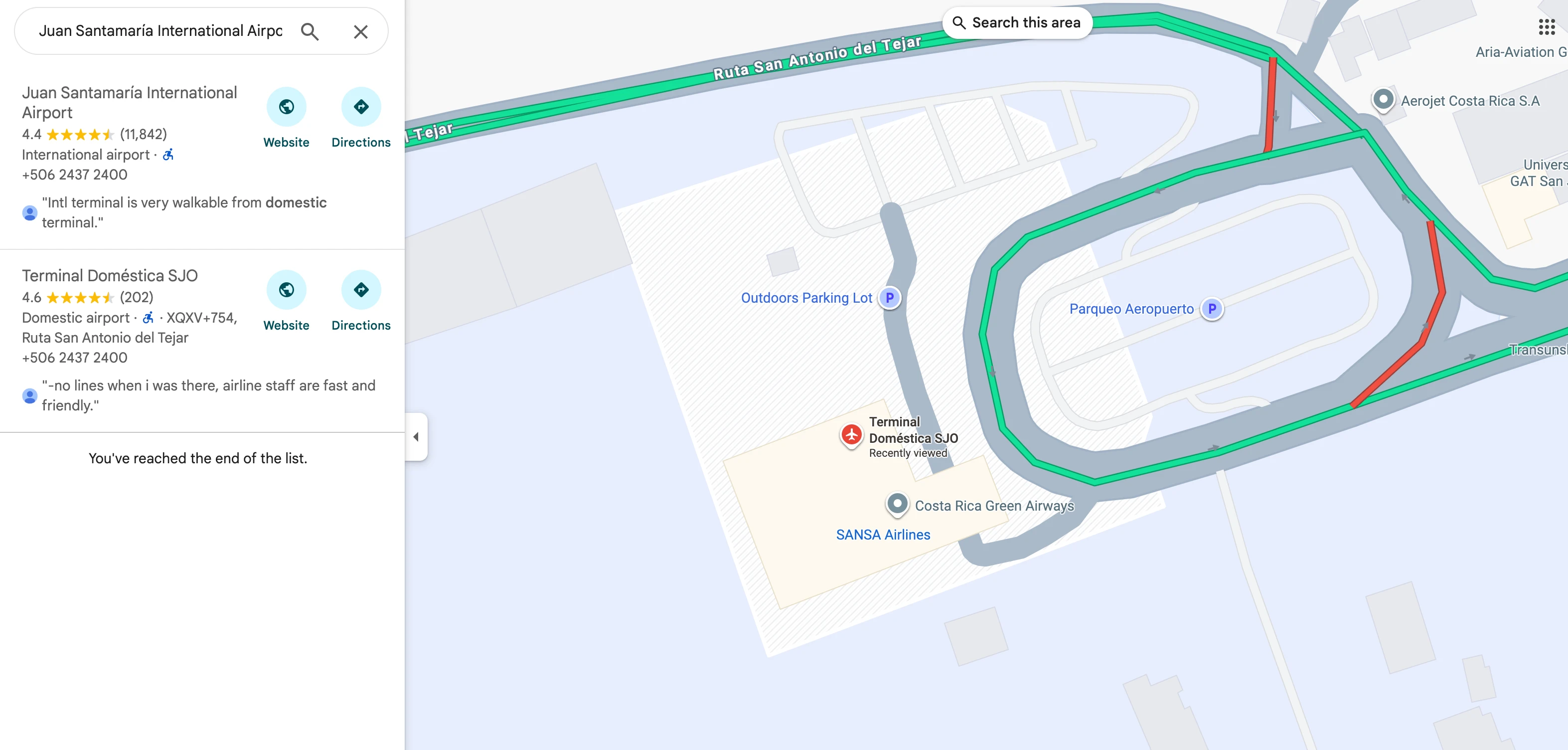
2026 Juan Santamaría International Airport Domestic Terminal Map Guide
What is the exact pedestrian route from the International Arrivals exit doors to the Domestic Terminal main entrance (turn-by-turn landmarks)?
The route is an outdoor curbside walk that starts at the international arrivals exit doors, then follows the terminal-front sidewalk to the separate domestic building entrance without crossing traffic lanes. After you exit to the public curb, the biggest risk is drifting into pickup lanes or stopping in the densest curb crowd instead of staying parallel to the building.
Walk it like this: exit through the international arrivals sliding doors into the public arrivals hall frontage, then turn toward the domestic-terminal direction immediately and commit to the covered sidewalk that runs along the terminal face (keep the terminal wall on your inside shoulder and the vehicle curb on your outside shoulder). Stay on that same sidewalk line past the busiest pickup cluster until the domestic building frontage comes into view, then continue straight to the main domestic entrance doors rather than cutting through curb gaps or crossing lanes near taxis.
What is the measured walking distance (meters) from International Arrivals exit to the Domestic Terminal entrance along the actual sidewalk path?
The sidewalk-path distance is typically about 250–350 meters from the International Arrivals exit doors to the Domestic Terminal main entrance, depending on which exit bay you come out of. That range reflects the real curb-following path (staying on the pedestrian sidewalk) rather than a straight-line “as the crow flies” estimate.
The clean measurement starts at the outer sliding exit doors of International Arrivals (where you first hit the public curb) and follows the terminal-front sidewalk without cutting through pickup lanes or parking aisles. The endpoint is the primary Domestic Terminal public entrance doors facing the curb. If you detour into taxi/ride-hail clusters or cross a lane at a curb gap, you’ll add distance even though the buildings look close.
What is the fastest realistic curb-to-entrance walking time (minutes) from International Arrivals exit to Domestic Terminal entrance at normal foot traffic?
Walking takes 6–8 minutes at a normal pace from the International Arrivals exit doors to the Domestic Terminal entrance if you stay on the sidewalk and don’t stop curbside. The fastest times happen when you exit cleanly and immediately commit to the terminal-front pedestrian line.
From the outer arrivals exit doors, turn toward the domestic-terminal direction and stay tight to the terminal frontage sidewalk (do not weave into pickup lanes). Keep moving past the densest taxi/ride-hail cluster without pausing, then continue straight until the Domestic Terminal curb-facing entrance doors are directly ahead. The time drops closer to 5–6 minutes only if the curb is unusually clear and you’re walking briskly with light bags.
Where is the customs/X-ray exit point located relative to the outdoor walkway start toward the Domestic Terminal?
The customs/X-ray exit point is immediately before the public arrivals exit doors, and the outdoor walkway toward the Domestic Terminal begins right outside those doors along the curbside sidewalk. Once you clear the last inspection point and pass through the sliding doors into the public arrivals frontage, you’re effectively at the “walk start.”
Baggage reclaim happens first, then the customs inspection area sits as the final barrier before you re-enter the public arrivals hall frontage. The key spatial cue is the transition from the controlled zone to the curb: the moment you step out of the arrivals exit doors, the correct path is the pedestrian sidewalk running parallel to the terminal face, not the vehicle lanes directly in front of you.
Where is the last possible place to re-orient (a clear landmark) after exiting customs before you can accidentally head the wrong way curbside?
The last reliable re-orientation point is the outer International Arrivals exit doors area, where the public crowd barrier/pickup curb begins. Standing just outside the sliding doors, you can still pause, look for directional signage, and choose the correct sidewalk line before you get pulled into the pickup lanes.
Use the curb layout as your anchor: keep the terminal building frontage as your reference wall, then commit to the sidewalk that runs parallel to the building rather than stepping forward into the vehicle curb. If you move past the first dense cluster of greeters/drivers, wrong-way errors become more likely because you’ll be navigating around cars and people instead of following the building-edge pedestrian path.
What is the slowest realistic walking time (minutes) for the same route during heavy curb congestion (same sidewalk path)?
Walking takes 12–18 minutes in heavy curb congestion on the same sidewalk route, even though the buildings are close. The slow time comes from forced detours around stopped luggage carts, people clustering at the curb, and sidewalk pinch points where vehicles and greeters compress the pedestrian line.
The slowest segment is typically the first stretch immediately outside International Arrivals, where the crowd density is highest and the sidewalk edge closest to the pickup curb gets blocked. Staying tight to the terminal-side edge of the sidewalk (away from the vehicle curb) helps, but in rain or peak arrivals the flow still collapses and you end up inching past bottlenecks until the Domestic Terminal entrance doors are fully in front of you.
Where are the taxi tout / solicitation hotspots positioned outside International Arrivals, and what exact sidewalk segment bypasses them fastest?
Taxi touts cluster directly outside the International Arrivals exit doors and along the first curbside pickup stretch where arriving passengers funnel into the roadway edge. The fastest bypass is the terminal-front sidewalk line that stays tight to the building frontage, not the outer edge by the pickup curb.
After you exit the sliding doors, avoid stopping at the first curb-facing gap where drivers approach. Move immediately onto the sidewalk and walk on the inside track with the terminal wall/glass on your inside shoulder, keeping the vehicle curb on your outside shoulder. Stay on that inside track until you’re past the densest pickup cluster, then continue straight toward the Domestic Terminal entrance without stepping out to negotiate rides at the curb.
What is the closest official curb/drop-off point to the Domestic Terminal entrance, and what is the shortest pedestrian path from that curb to the door?
The closest official drop-off is the Domestic Terminal curb directly in front of the Domestic Terminal main entrance. The shortest path is a straight curb-to-door walk on the same side of the roadway, using the marked pedestrian sidewalk segment immediately in front of the entrance.
From the drop-off curb, step onto the sidewalk (do not cut behind parked cars or through curb gaps), then walk directly to the main entrance doors—this is usually under a small canopy/overhang aligned with the entrance frontage. If you’re dropped slightly offset from the doors, stay on the curbside sidewalk and approach the entrance along the building line rather than crossing lanes to “save” distance, because those crossings are where delays and confusion stack up.
Inside the Domestic Terminal, where is the primary airline check-in counter zone located relative to the main entrance (left/right/straight, approximate meters)?
The primary check-in counter zone is typically straight ahead from the Domestic Terminal main entrance, about 20–50 meters inside the doors. Most travelers enter, clear the immediate lobby space, then see the check-in row(s) facing back toward the entrance area.
After you pass through the entrance doors, keep moving straight into the open hall until you reach the first clear “decision line” where queues form. Use the nearest flight information display or airline placards as your anchor point, then align to the correct counter row without drifting to the side walls where congestion builds around waiting groups and baggage carts.
What is the exact location of the domestic security checkpoint (if present) relative to check-in counters, and what is the walking distance between them?
The domestic security checkpoint is typically positioned beyond the check-in counters, usually behind or past the counter rows so passengers flow from check-in forward into screening. The walking distance is commonly about 30–80 meters, depending on the counter row you use and where the queue start is set up.
Enter the departures/check-in hall, find your airline counters, then look forward in the same direction of passenger flow for the roped queue leading to screening. The most consistent landmark is the first visible “bottleneck” where lines consolidate—security is the next controlled access point after check-in, not off in a separate wing, so if you can’t see it from the counters, follow the main forward-moving crowd channel rather than cutting sideways along the walls.
From the Domestic Terminal entrance, what is the measured walking time to the furthest gate/boarding area used by domestic carriers (worst-case internal walk)?
Walking takes 10–20 minutes from the Domestic Terminal entrance to the furthest boarding area in a worst-case domestic setup. The spread comes from queue friction (check-in area density, security line geometry) plus the longest internal walk to the last gate or a remote/bus boarding door.
Plan it as a sequence anchored to the main entrance: entrance doors → check-in zone (straight ahead) → security queue (beyond counters) → furthest gate corridor. If the terminal uses bus boarding for some flights, the “furthest gate” is effectively the last bus-door node, which adds waiting and staging time even after you’ve walked the corridor. The reliable tactic is to start the internal clock at the entrance and assume the longest path anytime you don’t yet see your gate number or boarding lane.


