Geneva Cointrin International Airport Map (Most Up-To-Date)

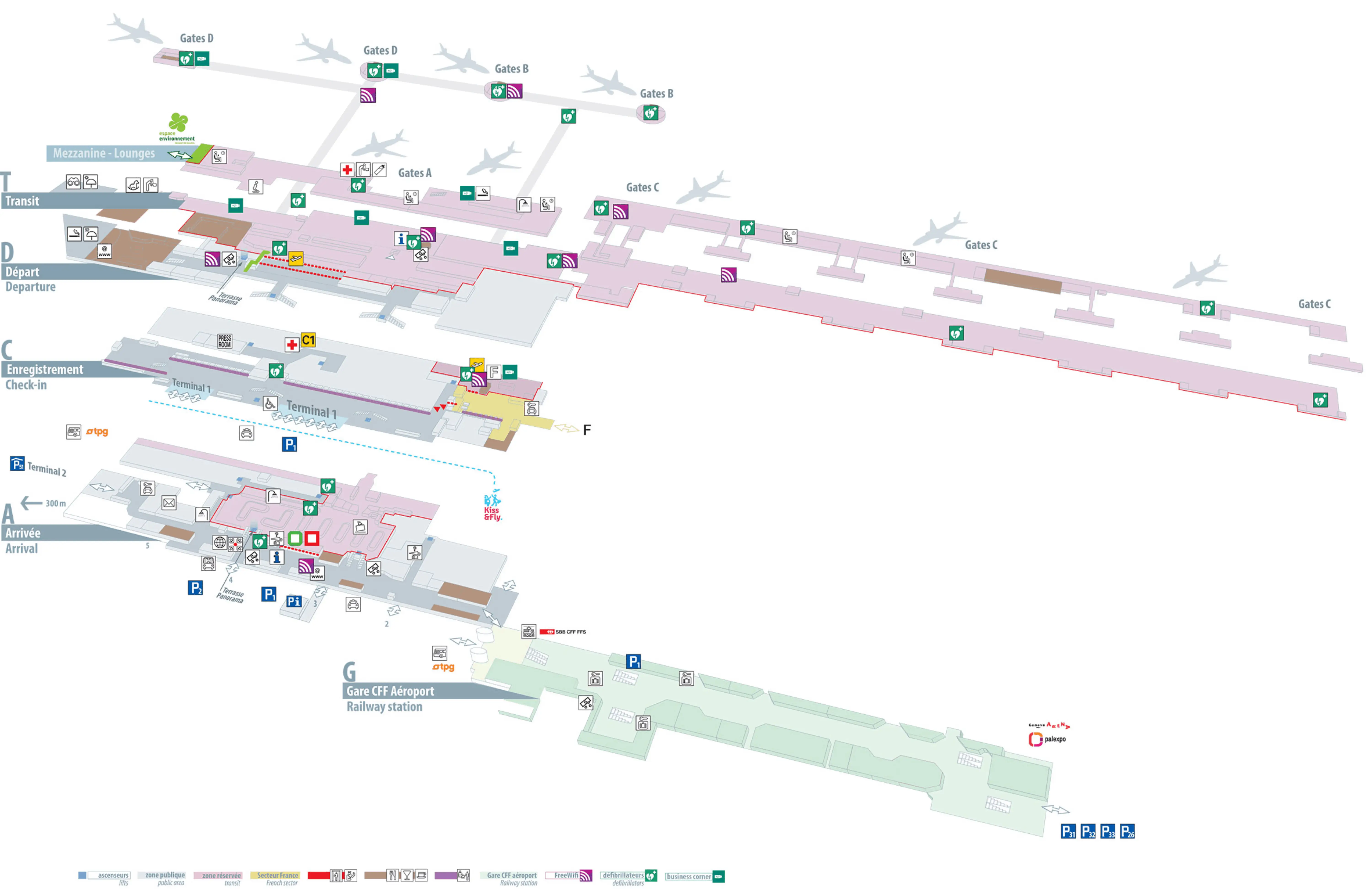
Geneva Airport is a compact, single-terminal footprint with one main processor (Terminal 1) feeding multiple piers, so most walking “fans out” after a centralized choke point. Landside is a long departures hall with check-in desks at one edge; airside funnels through a mezzanine security node into a retail spine, then splits toward A–D and the attached French-sector Pier F. Within Geneva’s main airport complex, the Swiss/French sector divide is the key orientation line.
Map Table
| Terminal | Key Airlines | Primary Function | Transfer Mode |
|---|---|---|---|
| Terminal 1 | easyJet | Main check-in hall | Walk, escalators |
| Pier A | SWISS, Schengen carriers | Schengen gates + retail spine | Walk |
| Piers B/C/D | long-haul + non-Schengen flows | Non-Schengen gates | Walk, underground corridors |
| Pier F | Air France (domestic), French-sector ops | French-sector gates + landside enclave | Walk via internal border door / airside glass corridor |
Geneva Cointrin International Airport Map Strategy
- Treat the Swiss Sector and French Sector as two different terminals: commit early to A–D versus E/F, because the “wrong side” can mean a locked door and a long perimeter detour.
- Use “Destination France” as your landside wayfinding token, then expect a boarding-pass check at the internal border door near the Air France counter area on the check-in level.
- For easyJet, assume the real bag-drop line starts at the self-bag-drop wall (Counters 78–83) and can block lateral movement near Relay/Starbucks; approach from the side that keeps the central security escalators in view.
- During ski-season surges, prioritize correct checkpoint selection over speed: the paid Priority Lane is at the same central security node but can stall if the narrow lane clogs with families and oversized cabin bags.
2026 Geneva Cointrin International Airport Map + Printable PDF
Peak-wave pressure remains the defining operating condition at 2026 GVA: easyJet bag-drop surges can spill across the departures hall, while a single central security point concentrates risk if you choose the wrong entrance. The Swiss-vs-French sector split still functions as a hard border with ticket-gated access, and non-Schengen processing remains vulnerable to passport-control bottlenecks that can spill back into the Pier A retail zone.
2026 Geneva Cointrin International Airport Map Guide
Where is the exact physical corridor split that separates Swiss-side departures (A–D) from the French-sector gates (E/F) inside Terminal 1?
The split point is the airside glass-door corridor at the far end of the post-security Pier A retail zone that leads into Pier F (French Sector). That doorway is the moment you stop being in the Swiss-side A–D airside circulation and start the segregated French-sector path.
After central security, you’re funneled into the main duty-free/retail spine of Pier A; keep walking to the end of that shopping run rather than peeling off early toward A/B/C/D. The French-sector connection is a distinct glass barrier/doorway (often staffed/monitored) where passengers hesitate because it doesn’t feel like a normal open corridor. Once through, you’re committed to the Pier F (E/F) side and its separate customs regime.
At what exact doorway/turnstile point is a boarding pass checked when walking from the Swiss sector into the French sector?
No-ticket access is blocked at the internal landside border door on the check-in level, where entry to the French sector is restricted to passengers with a valid air ticket (typically D ±1). That boarding-pass check happens at the “Destination France” crossing near the Air France counter area on Level 1 (check-in level).
Arriving from the Swiss public side, you do not cross on the arrivals level; you go up to the main check-in level, follow the “Destination France” signage, and reach the controlled doorway/turnstile point where staff verify your boarding pass before the door is opened. If you don’t have a valid ticket, this is the hard stop that forces the perimeter-road workaround via Ferney-Voltaire instead of walking through the terminal.
Where does the easyJet bag-drop queue begin (first choke point) in the departures hall—by which desk numbers/landmarks?
The easyJet bag-drop queue begins at the self-bag-drop wall at Counters 78–83 in the main check-in hall. That counter block is the first true choke point, and the line tail commonly spills back into the main circulation lane that runs past Relay and Starbucks.
During peak ski-season waves, the queue often grows outward from Counters 78–83 rather than forming a neat single-file line, so the “start” can look like a human wall in front of the counters. Use the Relay newsstand and the nearby Starbucks as your landmarks: if either storefront is partially blocked by people with tagged bags, you’re at the queue tail zone for the 78–83 cluster, and lateral movement toward the central security escalators can be constrained.
What is the exact location (level + landmark) of the paid Priority Lane / Fast Track entrance for security at GVA?
The paid Priority Lane is at the single central security checkpoint on the mezzanine level above the main check-in hall. It sits at the same security node reached by the central escalators from departures, marked by dedicated “Priority Lane” scanners where you scan a boarding pass or purchased QR code.
From the check-in level, orient on the central escalators that rise to security; once you reach the top into the screening entry zone, the Priority Lane is the separated, narrower channel immediately within that central checkpoint footprint. The key landmark is the set of Priority Lane terminals/scanners at the security entrance—if you don’t see the scanners, you’re not at the right security intake area (and you’re likely approaching from the wrong side of the mezzanine entry flow).
Where is the primary security-checkpoint entrance relative to the easyJet check-in desk cluster (e.g., desks 1–17 area)?
The primary security-checkpoint entrance is at the top of the central escalators that rise from the main check-in hall to the mezzanine security level, and it is not adjacent to the desks 1–17 end of the hall. The easyJet core cluster is Counters 78–83, and the security access point is the vertical choke directly beyond the main departures circulation lane that those queues can spill into.
In practice, you want to keep the central escalators in sight as your navigation target: from the easyJet 78–83 bag-drop wall, move laterally along the front-of-hall flow toward the escalator bank rather than getting pulled deeper into the queue mass that blocks cross-traffic near Relay and Starbucks. If you find yourself walking toward low-numbered desks (like 1–17) looking for security, you’re drifting away from the main security intake and risking a wrong-approach detour during peak congestion.
Where is the oversize baggage drop located relative to standard easyJet bag drop (distance + landmark reference)?
The oversize baggage drop is in the main check-in hall near the easyJet operational zone, but it is separate from the self-bag-drop wall at Counters 78–83. The practical reference is that you leave the 78–83 bag-drop cluster and walk back into the open circulation lane toward the central hall services area rather than staying pinned to the bag-drop wall.
Use the Counters 78–83 “self-bag drop” wall as your start anchor, then look for the dedicated oversize/odd-size baggage handling point signed for special items (skis, prams, bulky cases) near the same departures-hall processing area. In peak ski-season, the key failure mode is assuming oversize is handled at the same 78–83 wall; it typically requires stepping out of the bag-drop queue mass and locating the separately signed counter/doorway used for special baggage acceptance.
Where is the arrivals-side pedestrian route entrance that leads from Swiss arrivals/baggage reclaim toward the French-sector exit path?
The route starts after you exit Swiss Customs from baggage reclaim into the public Arrivals Hall, then goes up to the check-in level to reach the “Destination France” internal border door. There is no valid lateral pedestrian crossing to the French sector directly on the arrivals level.
Walk out of baggage reclaim through the customs exit into the main Arrivals Hall, then take the nearest escalators/lifts up one level to the main check-in hall. On the check-in level, follow “Destination France” signage toward the Air France counter area on the right side of the hall. The pedestrian “entrance” into the French-side path is the controlled internal doorway/turnstile there, where access can be ticket-checked before you’re allowed through.
Where is the car-rental return “decision point” (the lane split/barrier choice) that causes drivers to enter the wrong parking ramp?
The critical decision point is the turn-off onto Route Douanière for “Secteur français” immediately before the Swiss customs checkpoint at the Ferney-Voltaire border approach. Missing that turn by roughly a car-length commits you to crossing into Switzerland and forces a long loop to get back.
The failure happens in the border-control approach where signage for “Secteur français” / “Aéroport secteur France” competes with customs-lane clutter. You must peel off into the fenced customs-road corridor before you pass the checkpoint line; if you continue straight even about 20 meters, you’ve effectively crossed into the Swiss-sector road system and can’t just flip around. For French-sector rentals, that wrong-lane choice strands you in the Swiss loop and makes the French return park (P21) unreachable without re-approaching via Ferney-Voltaire.
Where is the third-country passport-control queue physically staged on arrivals (which corridor/zone holds the line)?
The third-country arrivals passport-control queue stages in the controlled corridor space feeding into the arrivals immigration area, then can spill backward into the adjacent arrivals circulation corridor when volumes surge. The “hold” zone is the inbound arrivals funnel leading to the border booths, not a dispersed gate-by-gate setup.
At GVA, arrivals processing pushes passengers from the arrival pier into a single immigration sequence; when third-country/UK flows peak, the line backs up into the approach corridor before the control desks rather than forming separate lines in multiple rooms. The practical navigation cue is that the queue occupies the main inbound corridor leading toward the arrivals passport-control booths, and when it’s saturated it can extend into the upstream passageway that would otherwise be a clear walk toward baggage reclaim.
Where is the departures passport-control checkpoint located for non-Schengen/UK flights in the C-gates area (pre-gates vs centralized control point)?
The departures passport-control checkpoint is a centralized control point after Pier A, before you can access the non-Schengen zone for Piers B/C/D, rather than at individual C gates. That means you clear passport control once, then continue onward through the controlled corridor to Pier C.
From central security, you enter the Pier A retail/duty-free spine first, then follow signs for non-Schengen/UK and reach the single passport-control hall that acts like a “border doorway” into the non-Schengen side. The landmark logic is: security → Pier A shops → passport-control checkpoint → onward routes that split to Pier C (direct after control) and to the underground connectors for B/D. If you’re already walking along Pier C looking for passport control, you’ve gone too far—control happens upstream at the Pier A transition.
What is the walking distance (meters) from security exit to Gate E10 (French sector) using the shortest passenger route?
The shortest-route walk from the central security exit to the French-sector gates runs through the Pier A retail spine to the airside glass-door corridor into Pier F, then onward to the E gates, and it is typically a mid-length terminal walk rather than a satellite trek. A practical planning metric is to treat it as a 10–15 minute walk in normal flow, with additional unpredictability at the glass-door control point.
Because the controlling landmarks are fixed, the route is consistent: exit central security onto the airside shopping run (Pier A), keep straight to the far-end glass barrier/door into the French-sector connector, then continue along Pier F signage toward the E-gate numbering. The variable is not distance but latency: if the monitored/manual glass-door interface pauses, your effective “walk time” increases even though the physical path stays the same.
Where is the taxi / rideshare drop-off point that minimizes walking to the French-sector rental pickup garage entrance?
The closest practical drop-off to minimize walking to French-sector rentals is the French Sector landside drop-off lane at the Secteur France terminal frontage by the P21 car park entrance, reached via Route Douanière. That puts you on the French-side curb directly beside the French-sector building and its rental desks/garage access.
If you’re arriving on the Swiss side (standard GVA taxi/Uber drop), the shortest internal walk to the French sector is still inefficient because you must go up to the check-in level and pass the “Destination France” ticket-controlled door near the Air France counters—then continue to the French-side rentals. For pure walking minimization, being dropped at the Secteur France/P21 frontage avoids the ticket-gated interior crossing entirely and eliminates the Swiss-terminal detour that becomes costly during peak-wave congestion and rideshare restrictions.