Copenhagen Airport Terminal 2 Map (Most Up-To-Date)

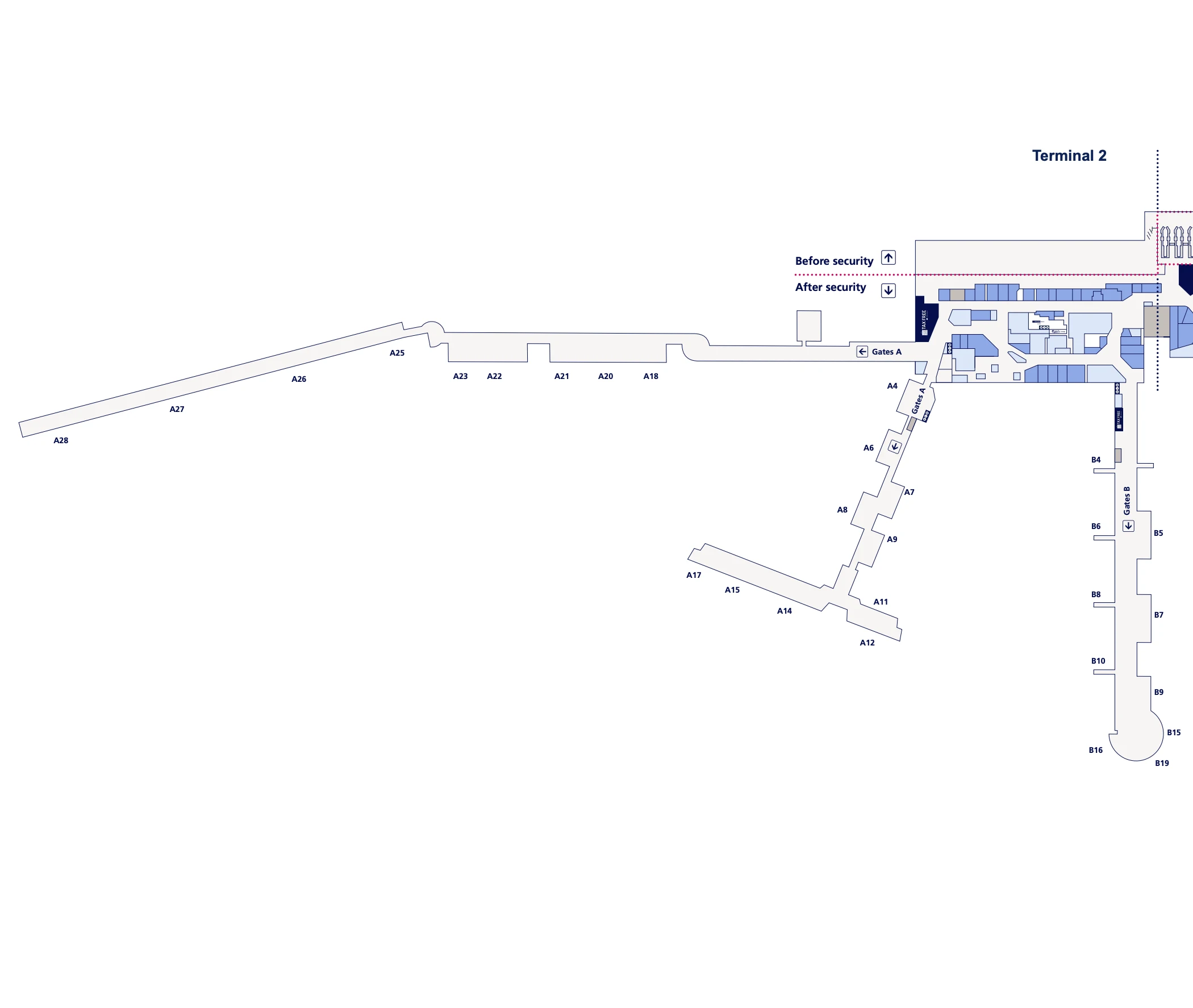
Terminal 2 at Copenhagen Airport is a landside check-in hall within the single “One Roof” building, shaped like a long east–west bar that feeds one centralized security hall and one continuous airside spine. The key scale detail is that “Terminal 2 vs Terminal 3” ends at security—after that, it’s one shared concourse with long pier walks. Plan your route as nodes (Metro/rail at the Copenhagen metro hub, Central Security, Pier C border, Pier E/F corridor), not as separate terminals.
Map Table
| Zone | Connection | Walk Time |
|---|---|---|
| Terminal 2 check-in (west hall) | Central Security hall (west flank) | 2–3 min |
| Terminal 2 ↔ Terminal 3 arcade | Metro/rail side (Terminal 3) | 4–6 min |
| Central Security exit | Pier C border entry | 5–7 min |
| Central Security exit | Pier F corridor entry (CPH Go) | 13–15 min |
Copenhagen Airport Terminal 2 Map Strategy
- Treat “Terminal 2” as a check-in address only; the real navigation model is Central Security → Duty-Free spine → Pier choice (A/B vs C vs E/F).
- Use Schengen vs non-Schengen as the primary divider: commit to passport control only when you’re ready, because it’s a hard boundary with limited backtracking value.
- Build buffer time around chokepoints, then the long walk: Pier F is a “kilometer drag” route where a small security delay becomes a missed-boarding risk.
- From Metro/Terminal 3, prioritize the high-level footbridge-to-security path when possible; it skips the crowded arrivals floor and drops you at the security edge where lane choice matters most.
2026 Copenhagen Airport Terminal 2 Map + Printable PDF
Operationally, Terminal 2 is still “check-in and go” into one shared security hall, with wayfinding that shifts from T2/T3 labels to Schengen vs non-Schengen decisions immediately airside. Automated screening-lane upgrades (CT-style lanes) can change which lanes are open on a given day, and the border process continues evolving with EES-era pre-processing steps near passport control—both of which make choke points (security + border) more important than the terminal label.
2026 Copenhagen Airport Terminal 2 Map Guide
What is the exact walking distance (meters) from the main security exit to the nearest entrance of the F-gates corridor?
850 meters is the walking distance from the central security exit to the nearest entrance of the dedicated F-gates corridor (CPH Go). This is the point where you leave the main airside retail spine and enter the long, utilitarian connector that leads toward Pier F. From the security exit, you’ll be forced through duty-free first, then continue east past the pier junctions until the F-corridor branches off; once you commit to that corridor, amenities thin out and the walk becomes the main risk factor for tight connections.
Where is the passport control boundary point (exact location) that separates Schengen vs non-Schengen airside?
Passport control sits at two airside boundary points: the Pier C entrance checkpoint and the Pier E/F connector checkpoint. The Pier C boundary is at the junction where Pier C branches off the main airside retail spine (east of the post-security duty-free flow). The Pier E/F boundary is further east along the same spine, positioned at the controlled entrance that gates access into the extended non-Schengen area serving Pier E and the non-Schengen section of Pier F (typically F1–F6).
What is the exact walking distance (meters) from the passport control boundary to the first non-Schengen pier junction?
50 meters is the walking distance from the passport control boundary to the first non-Schengen pier junction. After you clear the passport booths/e-gates at the Pier C or Pier E/F boundary, the non-Schengen pier structure begins almost immediately, with the first gate clustering and directional split occurring right after the exit from border control. The practical implication is that there’s no “buffer corridor” where you can reorganize—have documents put away and your direction decided before you step up to the passport control entry area.
Where exactly are the CPH Express (fast track) entrances located relative to the Terminal 2 side of the security hall (lane position / side)?
CPH Express on the Terminal 2 side is on the far-left (west) flank of the central security hall, typically using Lanes 1–4. Entering security from the Terminal 2 check-in hall, you want to keep hard left along the mezzanine approach so you don’t get pulled into the center “economy” lanes. The fast-track lanes are not a separate room or doorway—look for the CPH Express/priority signage at the extreme end of the lane bank nearest Terminal 2, with the mirror set of fast-track lanes at the opposite (Terminal 3) end.
What is the walking distance (meters) from the Terminal 2 Ryanair bag drop area to the security checkpoint entrance?
100–150 meters is the typical walking distance from the Terminal 2 check-in/bag drop area (including Ryanair desks) to the security checkpoint entrance. The route is straightforward: from the Terminal 2 desk zone, head to the escalators up to the security mezzanine, then continue a short, level approach to the west-side entrance of the central security hall. The key landmark cue is that you’re aiming for the security hall’s Terminal 2 (west) flank, where the lane bank begins and where CPH Express is positioned at the far-left end.
What is the walking distance (meters) from the central security hall to the furthest commonly-used F gate (end of the pier)?
1,200 meters is the walking distance from the central security exit to the furthest commonly-used F gate at the end of Pier F (often cited around the F105 end). The route runs through the forced duty-free exit, continues along the main airside spine toward the eastern end, then enters the dedicated F-corridor and keeps going to the pier’s far tip. This is why “F” functions like a separate terminal in practice: even with no stops, it’s a sustained 15–20 minutes of walking for most travelers, especially with luggage and crowds.
From arrivals coming off E/F pier, what is the walking distance (meters) to the passport control queue entry point?
50–200 meters is the typical walking distance from E/F arrivals corridors to the passport control queue entry point. Arriving passengers are funneled through sterile, separated walkways designed to keep flows compliant and prevent mixing with departing passengers, so the path is intentionally short and direct. The exact distance depends on where you dock along Pier E or Pier F and which inbound border channel is operating, but the consistent landmark pattern is “corridor exit → immediate queue entry” with little opportunity to detour.
What is the exact indoor walking distance (meters) from the CPH Metro station exit to the first Terminal 2 check-in/bag drop access point?
250 meters is the indoor walking distance from the Metro station exit area at Terminal 3 to the first Terminal 2 check-in/bag drop access point. The path stays inside the connected “One Roof” building: you move along the Terminal 3 hall, then continue through the indoor connector arcade until the check-in desk numbering and signage shifts into the Terminal 2 zone. If you’re heading to Ryanair/EasyJet desks, this is the same westbound indoor traverse you’ll follow before going up to the central security mezzanine.
What is the exact outdoor “shortcut” route start point (the door/exiting point) used to walk faster from Metro → Terminal 2, and where does it re-enter?
No outdoor shortcut is the operationally reliable faster route; the verified shortcut is the covered Metro footbridge that stays inside the building. The start point is on the upper level at the Metro platform level—do not go down the main escalators into the Terminal 3 arrivals hall. Follow signs toward Security/Transfer to enter the ~100-meter footbridge, and it re-enters at the eastern edge of the central security checkpoint mezzanine, effectively dropping you at the Terminal 3-side end of the security hall rather than on the crowded ground-floor landside.
Where is the airside transfer/assistance center located (exact point on the map) for disrupted connections?
The airside Transfer/Assistance Center is located immediately after the central security checkpoint, before you fully disperse into the main airside retail spine. Exiting the security lanes, you’re pushed into the duty-free flow; the assistance node is positioned right in that post-security transition zone so disrupted passengers can be handled without backtracking landside. The practical navigation cue is to look for “Transfer/Assistance” signage as soon as you clear screening—this is the closest staffed rebooking/help point before the long walks toward Pier C or the E/F corridor.
What is the walking distance (meters) from the Schengen-side duty-free/main retail spine to the passport control entry (the point you must commit to non-Schengen)?
350 meters is the walk from the post-security Schengen retail spine to the Pier C passport control entry, and about 700 meters to the Pier E/F passport control entry. The Pier C boundary sits at the main junction where Pier C branches off the spine, so it’s the first “commit” point you’ll encounter when heading east. The Pier E/F boundary is further along the same spine and is the control point you must pass for the extended non-Schengen area feeding Pier E and non-Schengen Pier F gates (typically F1–F6).
What is the exact walking distance (meters) from the security hall to the first E-gates pier split (the junction where people choose direction)?
600–700 meters is the walking distance from the central security exit to the first Pier E junction/split where passengers begin choosing directions for the E-area flow. After you clear security and pass the duty-free choke, you stay on the main eastbound spine past the earlier pier branches until you reach the Pier E area, which sits toward the far eastern end of the terminal complex. The key operational takeaway is that this decision point is well beyond Pier C, so a late realization about needing E/F is costly because you’ve already committed to a long traverse.
Where is the closest repack / seating area immediately after security, and what is its distance from the exit?
The closest practical repack/seating area is just beyond the large TAX FREE store, in the zone between gates A and B, about 150 meters from the security exit. Security feeds directly into duty-free with minimal space to stop at the belt ends, so most travelers have to carry loose items through the retail flow before they can sit and reorganize. Use the TAX FREE exit as your landmark: once you’re out of the main store, continue a short distance until you hit the first open seating/tables area in the A/B gate direction.
Where are the Entry/Exit System (EES) self-service kiosks positioned within the border control flow (exact location before booths/egates)?
EES self-service kiosks are positioned in the pre-queue buffer zone directly before the passport control booths/e-gates at the border entry points (Pier C and the Pier E/F connector). The kiosks sit in the open floor space ahead of the stanchioned “snake” lines so passengers can complete registration steps before joining the booth/e-gate queues. The landmark cue is that you encounter kiosks after leaving the Schengen retail spine but before you commit into the controlled lane system for border control—effectively acting as a new front layer to the passport control chokepoint.
What is the walking distance (meters) from the EES kiosk area to the passport control booth line entry?
Under 10 meters is the walking distance from the EES kiosk area to the passport control booth line entry. The kiosks are placed as part of the immediate frontage of the border zone, so once you finish at a kiosk you step directly into the stanchioned queue for the manned booths or e-gates. Functionally, there isn’t a meaningful corridor between “kiosk complete” and “queue starts,” which is why kiosk slowdowns can spill back into the same floor space that feeds the passport control entry.
From the Terminal 2 landside entrance, what is the shortest mapped walking route to the exact security lane used for most departures (distance only)?
50–100 meters is the shortest mapped walking distance from the Terminal 2 landside entrance to the nearest primary security-lane bank used for most departures. Terminal 2 sits closest to the west flank of the central security hall, so the shortest route is essentially “enter T2 → take the immediate escalator up to the security mezzanine → merge into the west-end lane frontage,” without needing to traverse the full landside hall toward Terminal 3.