
Cape Town International Airport International Terminal Map (Most Up-To-Date)

Cape Town International Airport’s International Terminal runs along the north side of the Central Terminal Building, with a linear, one-way arrivals spine from Gates A1–A5 down to immigration and baggage reclaim on the Ground Floor. Departures stack above on the 2nd Floor, feeding a single security checkpoint before the international outbound passport-control hall. Within the wider Cape Town air hub, the biggest navigation factor is vertical movement: arrivals stay low; e-hailing requires an “up-over-down” skybridge transfer to Parkade 1.
Map Table
| Zone | Connection | Walk Time |
|---|---|---|
| Gates A1–A5 corridor | Immigration hall entry | 3–5 min |
| Immigration exit doors | First baggage carousel | <1 min |
| Customs exit | Central atrium (toward Parkade 1 routing) | 1–2 min |
| Arrivals hall → Parkade 1 e-hailing | Level 2 skybridge, then down to Ground | 7–10 min |
Cape Town International Airport International Terminal Map Strategy
- Treat immigration as the primary time risk: move with the main corridor flow to the hall, then actively scan for the e-gate bank on the side before committing to the longest manual queue.
- Lock in the one-way thresholds: once you clear immigration into baggage reclaim (and later, once you exit customs), plan as if you cannot backtrack.
- For baggage + services, aim for the rear wall between the carousels and customs where baggage enquiry desks sit, and handle missing-bag reports before crossing the customs channels.
- For Uber/Bolt pickup, follow the “up-over-down” rule: from arrivals exit, go up to the 2nd Floor, cross the Parkade 1 skybridge, then go back down to Ground Floor e-hailing bays—ignore touts and any Parkade 2 mismatch signage.
2026 Cape Town International Airport International Terminal Map + Printable PDF
2026 operations continue to run through the unified Central Terminal Building layout: Ground Floor for international arrivals (immigration → reclaim → customs) and 2nd Floor for all departures (check-in → security → outbound passport control). The practical “map update” is decision-point accuracy—especially around the immigration hall (e-gates vs manual lanes) and the official e-hailing routing, which uses Parkade 1 via the Level 2 skybridge rather than a simple ground-level walk.
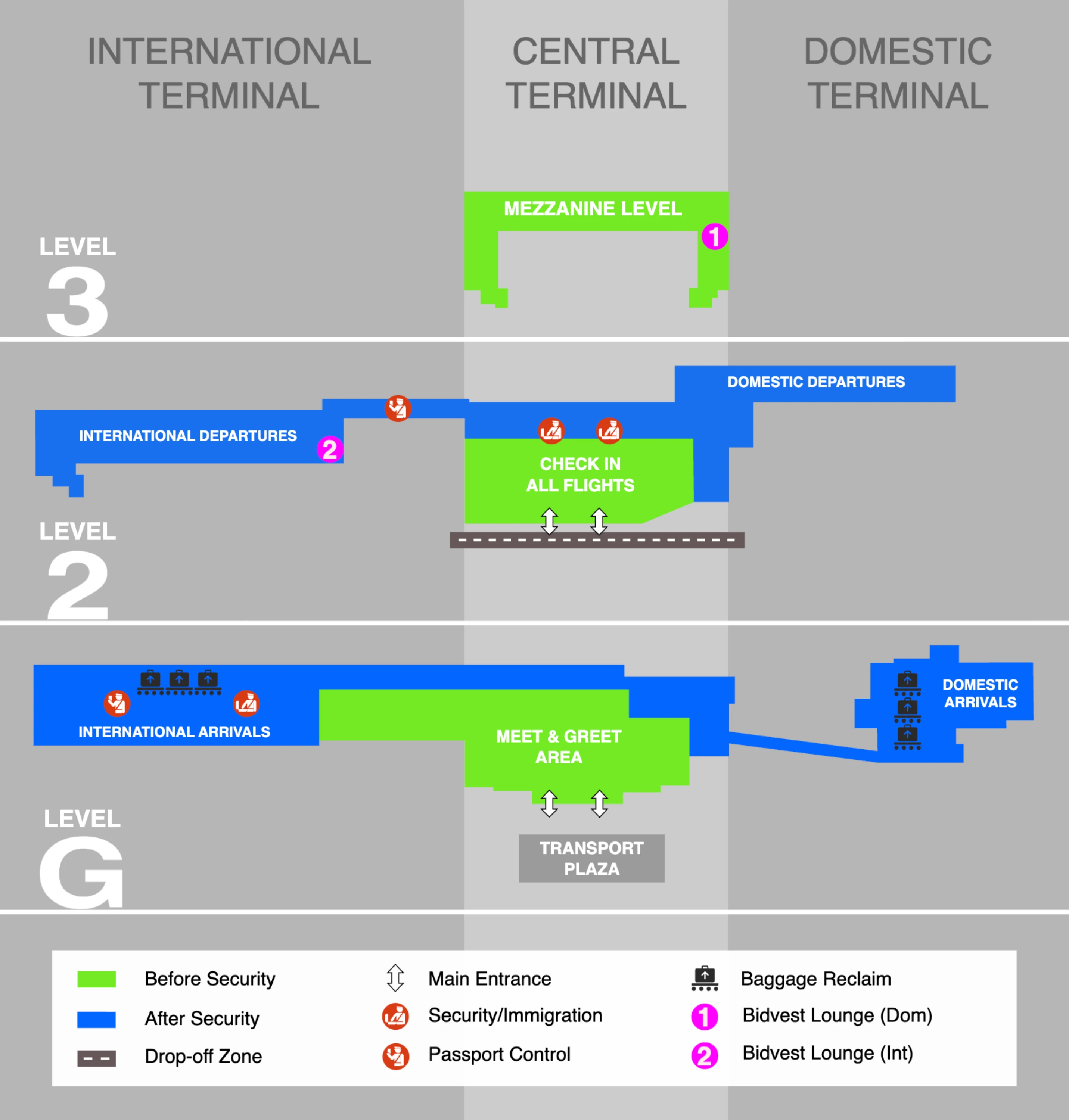
2026 Cape Town International Airport International Terminal Map Guide
What is the exact walking route from international arrival gates to passport control (immigration), including every required corridor/turn?
The route is a one-way, linear corridor walk from Gates A1–A5 into the sterile arrivals spine that funnels directly into the immigration hall entry on the Ground Floor. From the air bridge, follow the only forward corridor (no public cross-corridors) with airfield glass on one side until the passage widens and queueing begins at the passport-control hall threshold.
Stay with the “Arrivals / Immigration” flow from the gate release point into the temperature-controlled corridor network serving the north air-bridge gates. Continue straight through the main sterile passage as it bends with the building edge, keeping the airfield-facing glass to one side as your constant orientation cue. Remain in the single-direction channel until you reach the open hall mouth where lanes split into South African, Foreign Passports, and the side-positioned e-gates.
Where are the arrivals e-gates physically located relative to the manual passport control booths (left/right/adjacent bank)?
The arrivals e-gates sit on the side perimeter of the immigration hall rather than in the central manual-booth banks. Entering the hall from the arrivals corridor, the main manual counters are the central, wide lanes, while the e-gates require peeling off early to the hall’s side bank before you commit to the primary queue lines.
The manual passport control booths form the dominant middle block of lanes that most passengers naturally funnel toward first. The e-gates are positioned along the hall’s perimeter, set apart as a smaller bank that you reach by breaking away from the central queueing channels near the hall entry. If you walk past the initial lane split and fully join the central queues, you typically have to work back out to access the e-gate side bank.
What is the exact exit point from passport control into the baggage claim hall (which doorway/escalator/stair on the map)?
The exit into international baggage claim is through the sliding-door threshold directly behind the passport-control desk banks. After the officer counters, you move forward into the controlled exit line and pass through those doors into the reclaim hall on the same Ground Floor level.
The immigration-to-reclaim transition does not use escalators or stairs and does not involve a level change. The doorway is positioned immediately behind the manual booth area, so the visual cue is simple: finish at the counter, proceed straight ahead with the one-way flow, and go through the sliding doors into the baggage reclaim space. The first carousels are within roughly 20 meters of that threshold.
Which baggage carousel zone is closest to the airport/airline lost baggage or baggage services desk (map location only)?
The closest carousel zone is the back-wall side of the international baggage reclaim hall between the carousel area and the customs exit channels. The baggage enquiry desks sit along that rear wall, so the nearest belts are the higher-numbered carousels typically positioned closest to the customs-side end of the hall.
Baggage services desks are clustered on the far side of reclaim, not at the immigration-entry side, with the key landmark being the customs threshold (Red/Green channels) just beyond. Walk from any carousel toward the customs exit end of the hall and you’ll hit the service desk line on the back wall before you reach the customs channel openings. Handle any missing-bag paperwork there before exiting through customs, since the reclaim area is treated as a sterile zone.
Where is the official e-hailing / rideshare pickup point located on the map (Parkade 1 vs Parkade 2)?
The official e-hailing pickup point is on the Ground Floor of Parkade 1 (P1), not Parkade 2. Parkade 1 is the multi-level structure on the north side of the terminal precinct and is the closest parkade to the international arrivals exit once you follow the designated pedestrian routing.
Parkade references can be misleading because older directions often point to Parkade 2, but current operations route Uber/Bolt pickups to P1. The map landmark to anchor on is the Parkade 1 pedestrian connection reached from the terminal via the 2nd Floor departures level skybridge. Once inside P1, the pickup bays are on the Ground Floor, marked for e-hailing.
What is the exact walking path from international arrivals exit to the official e-hailing pickup point, including the correct level/floor changes?
The path is an “up-over-down” transfer: exit customs into the public arrivals hall on the Ground Floor, go up to the 2nd Floor, cross the Parkade 1 skybridge, then go down inside Parkade 1 to the Ground Floor e-hailing bays. This routing exists because pedestrians are blocked from safely crossing the ring road at ground level.
From the customs exit, enter the public arrivals hall and turn north (right as you face the exterior exit doors) toward the central terminal atrium landmark. Take the main escalators or lifts up one level to the 2nd Floor departures level, then follow overhead signs for “E-Hailing” and “Parkade 1” to the enclosed pedestrian skybridge crossing over the roadway. After crossing into Parkade 1, immediately change levels down via the internal escalators/lifts to the Ground Floor, where the marked Uber/Bolt pickup bays are located.
Where is the designated international departures drop-off curb relative to the e-hailing pickup level (upper vs lower roadway position on the map)?
The international departures drop-off curb is on the upper roadway at the 2nd Floor departures level, while the official e-hailing pickup is down on the Ground Floor level in Parkade 1. In map terms, drop-off aligns with the departures concourse entrances; pickup aligns with the arrivals/ground transport layer.
Departures access is built around the elevated check-in hall on Level 2, so private cars and drivers dropping passengers for international flights should aim for the upper curb that feeds directly into the departures doors. The e-hailing route forces the opposite level change: you cross at Level 2 via the skybridge into Parkade 1, then descend inside the parkade to Ground Floor to meet your rideshare.
What is the exact location of the international check-in row for major long-haul carriers (map position of the check-in island/zone)?
The major long-haul international check-in islands are clustered in the northern section of the 2nd Floor check-in hall, typically concentrated around the first island groups (often described as Rows 1–40). This north-side placement shortens the walk toward the international departures wing after security.
Long-haul carriers like British Airways, Lufthansa, Emirates, and Qatar Airways generally occupy the first three island clusters on the northern side of the unified departures hall, using the same Level 2 entrance zone as all departures. The anchor point is the central check-in concourse on Level 2: move toward the north end of the hall (international side) to find the islands most frequently allocated to long-haul processing and bag drop.
Where is outbound passport control positioned relative to security screening in the international departures flow (which comes first on the mapped route)?
Security screening comes first, and outbound passport control comes after. At Cape Town International, all departing passengers clear the unified central security checkpoint on the 2nd Floor before international travelers peel off to the outbound immigration booths.
After check-in, enter the main consolidated security area in the middle of the departures level and clear the x-ray/metal detector lanes. Immediately after security, the flow splits: domestic passengers turn toward the south side, and international passengers turn toward the north side. The outbound passport-control counters sit on that international path, and the duty-free funnel begins right after you clear those booths.
Where is the main duty-free area located relative to security exit and the primary international gates concourse?
The main duty-free area sits immediately after outbound passport control and before the international gates concourse. From the 2nd Floor security exit, international passengers turn toward the north side to reach outbound immigration, then are funneled directly through duty-free as the first airside commercial zone on the way to Gates A.
The key landmark is the divergence point right after security: domestic turns away, international continues toward passport control. Once you clear the outbound immigration booths, the retail layout forces a pass-through path into the duty-free shop footprint. Exiting duty-free feeds you into the airside circulation that leads to the primary international gate cluster in the A concourse.
Where is the exact location of the primary international lounge(s) relative to the main gate cluster (closest gate number/wing on the map)?
The primary international lounges are on the airside mezzanine level past duty-free, positioned closest to the Gates A cluster around the A3 area. After outbound passport control, follow the leftward international flow and use the lift/escalator up to the mezzanine near the A-wing gates rather than walking deep into the concourse first.
Bidvest Premier Lounge (International) sits airside on the mezzanine level after passport control, accessed near the Gates A circulation, with the nearest landmark being the Gate A3 zone on the leftward path out of immigration. British Airways’ lounge is also in the international wing serving the A concourse, so the practical map cue is: clear passport control → pass through duty-free → stay on the A-wing side → go up to mezzanine access points near the A gates.
Where is the short-stay/free pickup access point into the parkade located (the specific ramp/entry point shown on the airport road layout)?
The short-stay/free pickup access into Parkade 1 is via the first two left-side boom gates as drivers enter the airport precinct, which feed directly into the Parkade 1 ground-floor pickup area. This entry is designed for “Pick-up and Go” use and aligns with the P1 ground level rather than upper parking decks.
On the road layout, the anchor is the initial approach into the terminal ring-road system: stay in the left lanes immediately on entry and take the first access points signed for Parkade 1. Passing those first booms typically forces a longer loop and a different entry sequence, which risks missing the short-stay pickup routing and adding unnecessary circulation time.


