Bucharest Henri Coandă International Airport Map (Most Up-To-Date)

Bucharest Henri Coandă International Airport is a single-terminal, dual-hall layout that behaves like two parallel buildings—Arrivals (north) and Departures (south)—stitched together by a long landside connector. The footprint is deceptively compact, but the “bolt-on” expansions create long, linear walks and sharp decision nodes at exits, levels, and control points. Most confusion happens at Romania’s main Bucharest airport hub at the Arrivals doors (transport split) and post-security (Schengen vs Non-Schengen split).
Map Table
| Terminal | Key Airlines | Primary Function | Transfer Mode |
|---|---|---|---|
| Single terminal | TAROM, Wizz Air, Ryanair | Arrivals Hall (GF), Departures Hall (L1) | Landside connector corridor |
| Schengen airside zone | EU/Schengen carriers | Security → gates | No passport control |
| Non-Schengen airside zone | UK/Turkey/Israel carriers | Security → passport control → gates | Secondary passport barrier |
| Ground interface | Bus/Taxi (L0), Uber/Bolt (P2 L1) | City access | Vertical split |
Bucharest Henri Coandă International Airport Map Strategy
- Treat Arrivals exit doors as the main decision node: Bus 100 and official taxis stay on Level 0; Uber/Bolt requires an immediate pivot up to Parking P2 Level 1.
- Reduce border/security anxiety by planning the Schengen vs Non-Schengen split after the post-security commercial spine, with extra buffer time before the secondary passport barrier.
- Assume baggage reclaim is messy: scan the far end near Belt 6 for oversize/bulky items and locate Lost & Found before crossing customs.
- Use “survival nodes” airside: lock in charging and toilets in the central post-security commercial hub before walking to remote gates or committing to the Non-Schengen zone.
2026 Bucharest Henri Coandă International Airport Map + Printable PDF
Active operations in 2026 still reflect the airport’s high-throughput, add-on design: a crowded Arrivals funnel, a central Departures security filter, and the “Air Schengen” separation that places a second passport barrier deeper airside. Ongoing belt modernization and border-processing changes can shift where queues form, so a printable map is most useful when it highlights levels, doors, and the few “no-mistake” junctions.
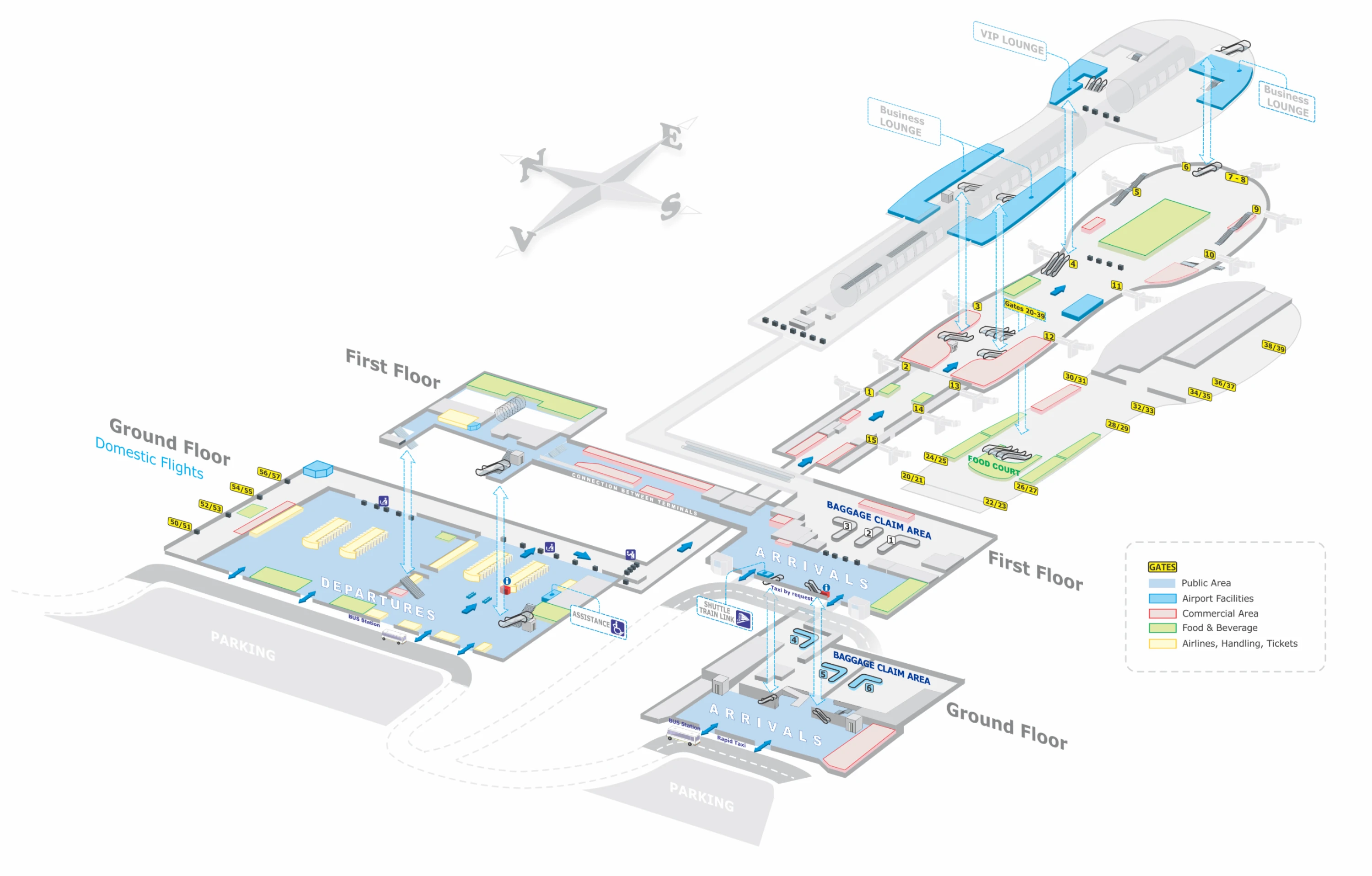
2026 Bucharest Henri Coandă International Airport Map Guide
What is the exact walking distance (meters) from International Arrivals exit doors to the Bus 100 stop (first point where you can physically queue/board)?
Walking distance is about 50–80 meters from the International Arrivals sliding exit doors to the first place you can stand in the Bus 100 queue at the curb. The stop sits on the ground-level arrivals roadway directly in front of the Arrivals hall, so there’s no level change if you’re already exiting from baggage-claim/public arrivals.
Use the terminal’s sliding exit doors as your anchor point, then follow the curbside “Bus to Bucharest” signage to the bus-bay area. The only variation is which exit door you use: doors closer to the bus bay put you near the ~50 m end, while doors farther along the frontage push it toward ~80 m.
From Arrivals exit, what is the exact step-by-step path to the train station entrance, including which car-park level it’s on and the nearest elevator/escalator?
The train station entrance is reached by a straight, ground-level walk of about 200–300 meters from the Arrivals exit, and it is not on a car-park level because the station is a separate building. From the Arrivals sliding exit doors, stay on Level 0 and do not go up into Parking P2.
Exit International Arrivals to the curb, then align yourself with the covered walkway that runs perpendicular away from the terminal across the parking/forecourt. Follow the covered path all the way to the detached station building with the suspended platform roof; the station entrance is at the end of this walkway. After entering the station, use the escalators or elevators inside the station to go up to the elevated platform level (maintenance reliability can vary, so stairs may be the fallback).
Where is the official ride-hail pickup zone for Uber/Bolt (exact curb/door/level), and what is the walking distance from Arrivals exit to that point?
Uber/Bolt pickup is on Level 1 of the Parking P2 multi-storey car park directly in front of the Arrivals hall, not on the Arrivals curb. Walking distance from the Arrivals exit doors to the pickup curb on the parking deck is about 150 meters total, including the vertical climb.
Exit International Arrivals to the ground-level curb, then immediately cross the access roadway toward the Parking P2 structure facing you. Enter the parking building via the nearest access core/rotunda by the front side, then take the elevator or stairs up one level to Level 1. On Level 1, follow the “Ride Sharing / Uber/Bolt” meeting-point signage to the designated curb area where cars can briefly stop; waiting at Level 0 typically causes cancellations because drivers are geofenced to the upper deck.
After inbound arrival, where is the bulky/oversize baggage pickup point relative to the standard baggage carousels (exact corridor/level/landmark)?
Bulky/oversize baggage is typically placed at the far end of the Ground Floor baggage reclaim hall near Belt 6 or at a designated door/static drop point along the end wall rather than on a clearly marked central oversize belt. The most reliable landmark is the end-of-hall area beyond the last standard carousel cluster, where staff will stage strollers, skis, and golf bags.
Start at the standard carousel area in baggage reclaim (Ground Floor), then walk toward the hall’s far end where Belt 6 sits and where the reclaim space narrows toward the customs exit direction. If your flight’s belt assignment is unclear or belts are under maintenance, scan the end-wall/drop-door area near Belt 6 first before looping back, because OTP often places oversize items there with minimal announcement.
What is the walking distance from the center of baggage claim to the terminal exit used to meet drivers (first “public curb” decision point)?
Walking distance is about 50–80 meters from the center of the baggage reclaim carousel area to the first public curb decision point outside the terminal exit doors. The route is short but feels slow because it funnels through customs and into a dense public arrivals corridor.
Use the baggage carousel cluster as your start anchor, then walk toward the Green/Red customs channels and continue straight into the public Arrivals hall. Keep moving to the sliding exit doors—this is the first true “meet drivers / choose transport” node where you can either stay on Level 0 for taxis and buses or pivot toward Parking P2 to go up for Uber/Bolt.
For a self-transfer: what is the exact walking distance from Arrivals (post-immigration) to the airline check-in desks in Departures (landside), using the fastest indoor route?
Walking distance is about 400–600 meters from Arrivals (post-immigration/public side) to the Departures check-in desks via the fastest indoor landside connector. The distance varies mainly by which Arrivals exit point you start from and which check-in row you need once you reach Departures.
From the public Arrivals hall, turn left into the enclosed connector corridor lined with car-rental desks and small retail. Walk the full length of the corridor to the Departures building, then use the main elevator/escalator bank at the corridor’s end to go up to Level 1 (Departures). Once on the Departures concourse, the check-in counter islands are directly ahead in the main hall; the farthest counters push the route toward the ~600 m end.
What is the exact location of passport control that separates Schengen vs non-Schengen flows, and what is the walking distance from that control point to the main security re-entry for departures?
Passport control for Non-Schengen departures sits airside after the main post-security duty-free walkthrough and central food-court/commercial hub, acting as a barrier into the Non-Schengen gate zone. Walking distance between the main security exit and these passport desks is about 150–200 meters, and the route is straight through the central commercial spine.
Use the security exit as your anchor, then proceed forward through the duty-free corridor toward the food-court cluster; the passport-control booths are positioned beyond this hub where the concourse narrows into the segregated Non-Schengen area. For the reverse direction (from that passport barrier back to the main security merge point), walk the same corridor back roughly 150–200 meters to the security exit area where all passengers originally funnel into airside.
Where is the indoor smoking room located (landside/airside), and what is the walking distance from the nearest central gate cluster to that room?
The indoor smoking rooms are airside glass “aquarium” booths along the main departures concourse, and a dedicated smoking room is also inside the TAROM Business Lounge near Gate 3. Walking distance from the central post-security gate cluster to the nearest public smoking booth is typically a short walk within the main concourse, roughly on the order of a few dozen to about 100 meters depending on which booth is open and closest.
After clearing security and reaching the central commercial/gate hub, look along the concourse edge near the major restroom (sanitary) blocks and the food-court area, where the glass smoking booths are usually positioned. If you have lounge access, use the TAROM Business Lounge near Gate 3 as the most consistent landmark-based option; the lounge smoking room is inside, so the final “distance” becomes the lounge entry plus the internal walk to the smoking area.
Where are the nearest guaranteed power outlets airside (exact restaurant/gate cluster), and what is the walking distance from the main post-security merge point to those outlets?
Power outlets are most reliably found inside Starbucks and Brioche Dorée in the central airside commercial hub, about 50–100 meters from the main post-security merge point. Gate seating itself is a poor bet, so the “guaranteed” strategy is to anchor on cafés immediately after the duty-free/security exit corridor.
- Starbucks (airside central hub): outlets typically under banquette seating near the main food-and-retail cluster just past the post-security/duty-free walkthrough; roughly 50–100 meters from the security exit.
- Brioche Dorée (airside, near the connector-side central spine): outlets commonly available at seating in the corridor-like commercial area linking the central hub flow; roughly 50–100 meters from the security exit, depending on which side you emerge into the retail spine.
Where is the closest restroom cluster immediately after security, and what is the walking distance from the security exit to the nearest accessible toilet?
The closest restroom cluster is in the central commercial hub immediately after the duty-free walkthrough, about 100 meters from the security exit, and it includes accessible toilet facilities. This is the highest-density restroom area before you drift toward more distant gates where services thin out.
Exit security, continue forward through the duty-free corridor, and aim for the main food-court/commercial atrium where passenger flows merge and spread. The nearest accessible toilet is typically within the first main sanitary block near that hub; if you keep the food-court seating as your landmark, the restroom entrances are usually adjacent along the concourse edge rather than deep down the gate fingers.
What is the exact walking distance from Arrivals exit to the “safe/official taxi ordering” point (kiosk/desk/posted queue) that avoids curbside solicitation?
Walking distance is about 20 meters from the Arrivals exit-from-baggage/public-arrivals transition to the official taxi-ordering kiosks inside the Arrivals hall. The key dealbreaker is that the “safe” process starts indoors at the yellow touchscreen terminals; curbside solicitation outside is the exact situation this system is meant to prevent.
Use the public Arrivals hall as your anchor: after clearing customs and entering the greeter-filled public area, stay inside and move to the left/south side of the hall where the yellow touchscreen taxi terminals are positioned. Print the ticket with the assigned license plate, then walk out to the taxi curb and match the plate—ignore anyone offering rides without a kiosk ticket.
If you miss the train, where is the nearest indoor waiting area between Arrivals and the train entrance (benches/seating), and what is the walking distance from the train entrance back to that seating zone?
The nearest comfortable indoor waiting area is inside the landside connector corridor between Arrivals and Departures, where cafés and warmer seating clusters are found, and it is about a 200-meter walk back from the train station entrance. This is the most reliable “indoors with seats” fallback compared with the colder, crowded public Arrivals hall.
From the train station entrance, walk back along the covered walkway toward the terminal until you re-enter the Arrivals-side building frontage, then continue inside toward the connector corridor that links Arrivals to Departures. Seating tends to appear near the café nodes in that corridor (City Grill–type areas) roughly another short indoor stretch once you’re back inside, so your practical target is “connector corridor café seating” rather than the sparse metal seats in the Arrivals public hall.
Archive Bucharest Henri Coandă International Airport Map
Below are all historical map versions for Bucharest Henri Coandă International Airport. Each year includes the official map available for that period, presented as both WebP and PDF.
2019-2026 Bucharest Henri Coandă International Airport Map (Official 2019 Edition)