Auckland International Airport Domestic Terminal Map (Most Up-To-Date)

Auckland Airport’s Domestic Terminal is a split-layout building with an Air New Zealand–heavy central/eastern hall and a Jetstar-focused western wing, all fronting a busy landside forecourt. Within Auckland’s main airport hub, the Domestic and International buildings are physically separated, so every transfer is landside (walk or free bus). Most navigation success comes down to choosing the correct door number on the curb and committing early to the right side of the precinct.
Map Table
| Zone | Connection | Walk Time |
|---|---|---|
| Door 2 east end | Green Line start, Bus Stop C | 0–1 min |
| Air New Zealand core | Check-in/bag drop, central curb | 0–2 min |
| Jetstar west wing | Jetstar processing, west curb | 3–6 min |
| Domestic ↔ International | Outdoor Green Line route | 10–15 min |
Auckland International Airport Domestic Terminal Map Strategy
- Treat Domestic ↔ International as a landside transfer only: commit immediately to either the 950 m Green Line walk or the free bus, and don’t hunt for an indoor connector.
- Use Door 2 as the transfer anchor: that’s where the Green Line begins and where Bus Stop C is located, so default there for any inter-terminal move.
- Separate pickup logic by airline before you exit: Jetstar riders go to the far west doors; Air New Zealand riders use the central doors to avoid crossing the forecourt on foot.
- Assume bag drop is the time spike: arrive at the correct door for your airline’s check-in hall so you don’t lose minutes inside the terminal correcting a wrong entrance.
2026 Auckland International Airport Domestic Terminal Map + Printable PDF
Current operations still run as a separated Domestic–International precinct, with the Green Line walk and the free transfer bus remaining the practical link between buildings. Ongoing precinct works and staging can shift curb patterns and parking choices, but the “door-number” logic (Door 2 for transfers, Door 3 for Air NZ, Door 5/7 for Jetstar) remains the fastest way to avoid backtracking and missed pickups.
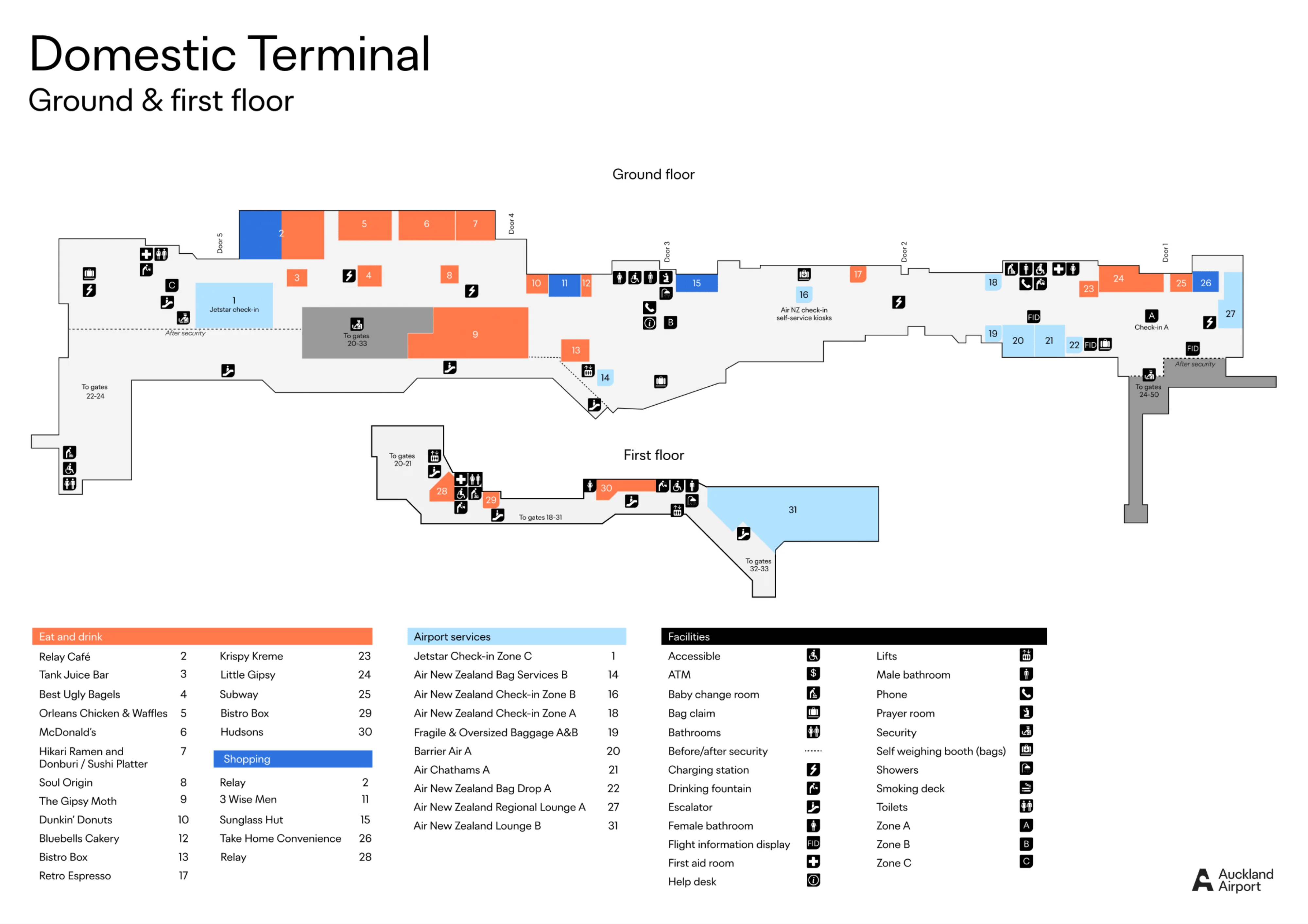
2026 Auckland International Airport Domestic Terminal Map Guide
What is the exact walking distance (meters) along the marked route from AKL Domestic Terminal main exit to the International Terminal departures entry doors?
Walking distance is 950 meters along the marked Green Line route between Auckland Airport’s Domestic Terminal and the International Terminal departures entry doors. The signed path is outdoors and typically takes 10–15 minutes at a normal pace, so luggage, wind, and rain can stretch the timing.
| Segment | Start anchor | End anchor | Distance |
|---|---|---|---|
| Green Line walk | Domestic Terminal Door 2 / Door 3 footpath | International Terminal ground-floor entry doors (Door 1 / Door 2 area) | 950 m |
Where exactly does the painted “green line” route begin outside the Domestic Terminal (which doors/side), so a first-timer can’t accidentally start in the wrong direction?
The painted Green Line begins on the footpath outside the Domestic Terminal’s east end, aligned with Door 2 and Door 3. Starting here keeps you on the correct pedestrian-only path and away from the forecourt vehicle lanes that cause most first-timer wrong turns.
The start point sits immediately outside the eastern doors, where the curb area transitions into a pedestrian footpath with continuous green paint and Green Line signage. After exiting at Door 2/3, take the footpath and commit to the marked green paint rather than drifting right toward the Jetstar (west) end. The first “confirmation cue” is the uninterrupted green paint on the pavement as you pass the transport forecourt edge.
Where is the precise pickup point for the free inter-terminal bus relative to the Domestic Terminal main doors (distance + landmark), including which side to turn after exiting?
The free inter-terminal bus pickup is at Bus Stop C directly outside Domestic Terminal Door 2. Turning left after exiting toward the east end keeps you on the shortest line to the stop, which sits on the forecourt edge beside the Door 2 curb area.
Bus Stop C is positioned immediately adjacent to the Door 2 exit zone, so it’s a near-zero-walk pickup once you’re at the correct door. The key landmark is the stop signage that explicitly indicates the free terminal transfer service—don’t wait at stops labeled for public transport routes. From Door 2, stay on the curbside footpath rather than stepping into the vehicle lanes, and look for the Bus Stop C signpost at the same forecourt frontage.
What is the shortest on-foot route from the Domestic arrivals area to the correct Jetstar pickup zone (not the Air NZ zone), including which exit/curb it sits on?
Jetstar pickup is on the west end curb outside the Domestic Terminal, reached by exiting at Doors 7, 8, or 9. Walking there from domestic arrivals is typically about 150–200 meters, and the main mistake is exiting at the central Air New Zealand doors (Doors 2–4) and then having to traverse the whole forecourt on foot.
| Step | What to do | Anchor point | Distance |
|---|---|---|---|
| 1 | From arrivals, follow the internal flow toward the west wing | move away from the central retail core toward the Jetstar end | — |
| 2 | Keep walking west past seating/retail until the far-west door bank | Jetstar end of the building | — |
| 3 | Exit the terminal at Door 7, Door 8, or Door 9 | doors nearest the control-tower landmark outside | — |
| 4 | Meet your ride on the curb directly outside those west doors | Jetstar pickup curb zone at the west end | 150–200 m (from arrivals)What is the shortest on-foot route from the Domestic arrivals area to the correct Jetstar pickup zone (not the Air NZ zone), including which exit/curb it sits on? Jetstar pickup is on the west end curb outside the Domestic Terminal, reached by exiting at Doors 7, 8, or 9. Walking there from domestic arrivals is typically about 150–200 meters, and the main mistake is exiting at the central Air New Zealand doors (Doors 2–4) and then having to traverse the whole forecourt on foot. Step What to do Anchor point Distance 1 From arrivals, follow the internal flow toward the west wing move away from the central retail core toward the Jetstar end — 2 Keep walking west past seating/retail until the far-west door bank Jetstar end of the building — 3 Exit the terminal at Door 7, Door 8, or Door 9 doors nearest the control-tower landmark outside — 4 Meet your ride on the curb directly outside those west doors Jetstar pickup curb zone at the west end 150–200 m (from arrivals) |
What is the shortest on-foot route from the Domestic arrivals area to the correct Air New Zealand pickup zone (not the Jetstar zone), including which exit/curb it sits on?
Air New Zealand pickup is at the central curb outside the Domestic Terminal, best reached by exiting at Door 3 or Door 4. Walking there from domestic arrivals is typically about 50–100 meters, and it avoids the long cross-terminal walk required to reach the Jetstar west doors.
The fastest line is to stay in the central flow after arrivals and aim for the main Air New Zealand processing area as your orientation cue. Door 3 is the most reliable curb anchor because it aligns with the highest-density Air NZ check-in/bag-drop hall inside, so drivers and walkers converge there naturally. If you exit at Door 3/4, you’re already in the correct central forecourt pickup area; if you mistakenly exit at Door 7–9 (Jetstar end), you’ll burn minutes walking back along the frontage to the Air NZ curb.
What is the exact vehicle approach path into the Domestic “transport hub” pickup/drop-off area (which entry lane/turn-in), to avoid the common bottleneck/queue point?
The cleanest approach is the Domestic Forecourt entry off George Bolt Memorial Drive, staying in the middle/general-public lanes until you’re close to your target door. Early drifting into the far-right commercial lanes is what traps drivers behind bus/taxi queues and the Door 2 pinch point.
| Step | What to do | Anchor point |
|---|---|---|
| 1 | From George Bolt Memorial Drive, follow signs for Domestic Terminal and commit to the Domestic Forecourt approach | Domestic Terminal directional overheads before the forecourt split |
| 2 | Hold the middle/general-public lanes as you enter the forecourt zone | lane group feeding the main curb, not the far-right commercial/bus/taxi lanes |
| 3 | Only near the terminal frontage, merge toward your door number in one move | Door 3 for Air New Zealand; Door 5 or Door 7 for Jetstar; Door 2 for transfers |
| 4 | Avoid stopping behind congestion at the east end | Door 2 curb area where queues commonly form |
Where is the closest “Wait Zone” / short-wait holding area relative to the Domestic Terminal, and what is the fastest driving route back to the correct pickup curb?
Wait Zone 2 on Geoffrey Roberts Road is the closest short-wait holding area for the Domestic Terminal, with a typical 2–3 minute drive back to the curb when traffic is moving. Using it prevents being moved on by security for idling in the Domestic forecourt pickup lanes.
| Route | Start anchor | Key turns | End anchor |
|---|---|---|---|
| Wait Zone 2 → Air NZ pickup | Wait Zone 2 on Geoffrey Roberts Road beside Carpark L | exit Wait Zone 2 → follow the main airport loop signage for Domestic Terminal | central Domestic curb at Door 3 / Door 4 |
| Wait Zone 2 → Jetstar pickup | Wait Zone 2 on Geoffrey Roberts Road beside Carpark L | exit Wait Zone 2 → follow the main airport loop signage for Domestic Terminal → continue along the frontage toward the west end | west Domestic curb at Doors 7–9 |
Which specific Domestic Terminal entrance doors align with the primary bag-drop/check-in hall, so drivers can drop travelers at the correct curb segment without backtracking?
Air New Zealand’s primary bag-drop/check-in hall aligns best with Door 3, while Jetstar’s check-in area aligns with Door 5 or Door 7. Using the correct door number is the fastest way to avoid an internal cross-terminal walk that can add several minutes in peak periods.
A practical curb rule is “Door 3 for Air NZ, Door 5/7 for Jetstar, Door 2 for regional carriers,” because those doors land you closest to the right processing desks the moment you enter. Door 3 puts travelers into the highest-density kiosk/bag-drop zone for Air New Zealand. Door 5 or Door 7 puts Jetstar travelers into the west wing without having to push through the central retail/seating core. For Air Chathams or Barrier Air, Door 2 is the nearest entry to the smaller eastern-sector desks.
Where exactly is the “domestic jet terminal” entry point on the AKL domestic complex (vs other domestic/regional flows), and what’s the shortest pedestrian path between them?
The domestic jet entry zone is the door band from Door 3 through Door 7, while the regional turboprop flow concentrates near Door 2 on the eastern end. Walking between the two is essentially an end-to-end internal traverse of the ground floor frontage, so choosing the right door first is the time-saver.
The jet-oriented doors (3–7) feed the higher-capacity processing and the main security screening flow used by Air New Zealand jet and Jetstar passengers. The regional desks sit closer to Door 2, so a regional traveler entering at Door 5/7 will spend minutes walking back through the central hall, and a jet traveler entering at Door 2 will do the opposite. The shortest path between the jet zone and the regional zone is a straight internal walk along the ground-floor public corridor from Door 2 toward Door 3–7, staying on the main concourse rather than detouring into seating and retail pockets.
From the Domestic Terminal main doors, what is the shortest route to the inter-terminal transfer corridor path (first major landmark), to prevent losing minutes wandering in the transport forecourt?
Door 2 is the fastest route to the inter-terminal transfer corridor because it anchors both the Green Line and Bus Stop C. Reaching Door 2 first prevents the common “forecourt wander” where people drift toward the wrong bus stops or the Jetstar west end and then have to double back.
After exiting, turn left toward the east end and get onto the footpath that carries the continuous green paint. The first major landmark is Bus Stop C signage at the Door 2 curb line—if you can see Bus Stop C, you’re standing in the correct transfer corridor area. From that same Door 2 frontage, continue forward on the marked footpath to stay on the Green Line rather than stepping into vehicle lanes.