Belgrade Nikola Tesla Airport Terminal 1 Map (Most Up-To-Date)

Belgrade Nikola Tesla Airport Terminal 1 is a compact, linear terminal where landside check-in flows straight toward security and passport control, then fans into a short pier-style departures area. The building footprint is smaller than mega-hubs, but pinch points form quickly because key processes stack close together. Use Terminal 1 landmarks within Belgrade’s main airport hub—check-in rows, security entry, passport control barriers, and the main arrivals exit—to keep curb → gate (and plane → curb) predictable.
Map Table
| Zone | Connection | Walk Time |
|---|---|---|
| Departures curb | Terminal 1 entrance doors | 1–3 min |
| Check-in / bag drop hall | Security + passport control direction | 3–8 min |
| Security | Duty-free / airside corridor | 2–6 min |
| Passport control | Schengen/non-Schengen gate area | 2–7 min |
| Arrivals baggage claim | Landside exits, taxi rank | 3–8 min |
Belgrade Nikola Tesla Airport Terminal 1 Map Strategy
- Timing volatility comes from stacked queues, not distance: map-check the exact order of bag drop → security → passport control and treat each as a separate buffer so one slowdown doesn’t cascade into a gate miss.
- Aim for the most direct passport-control entry point instead of drifting with the crowd; verify the correct lane early so you don’t get locked into the wrong barrier line when lines swell.
- For arrivals baggage issues, move with intent from carousel to baggage services first, then only exit landside once you’re done escalating; leaving the hall too early turns a fixable delay into a back-and-forth.
- To avoid taxi intercepts, follow official exit signage to the designated taxi/transport node and ignore anyone offering rides inside; for long waits, pin a “sleep/charge/toilet triangle” near a quiet gate-area seating zone before you settle in.
2026 Belgrade Nikola Tesla Airport Terminal 1 Map + Printable PDF
Terminal 1’s core layout remains a straight-through departures flow—check-in to security to passport control—followed by a compact airside gate corridor where one wrong turn can still cost minutes during peak banks. Arrivals remain simple but can feel “stuck” when baggage carousels slow down or when the landside exit gets crowded by unofficial transport solicitation.
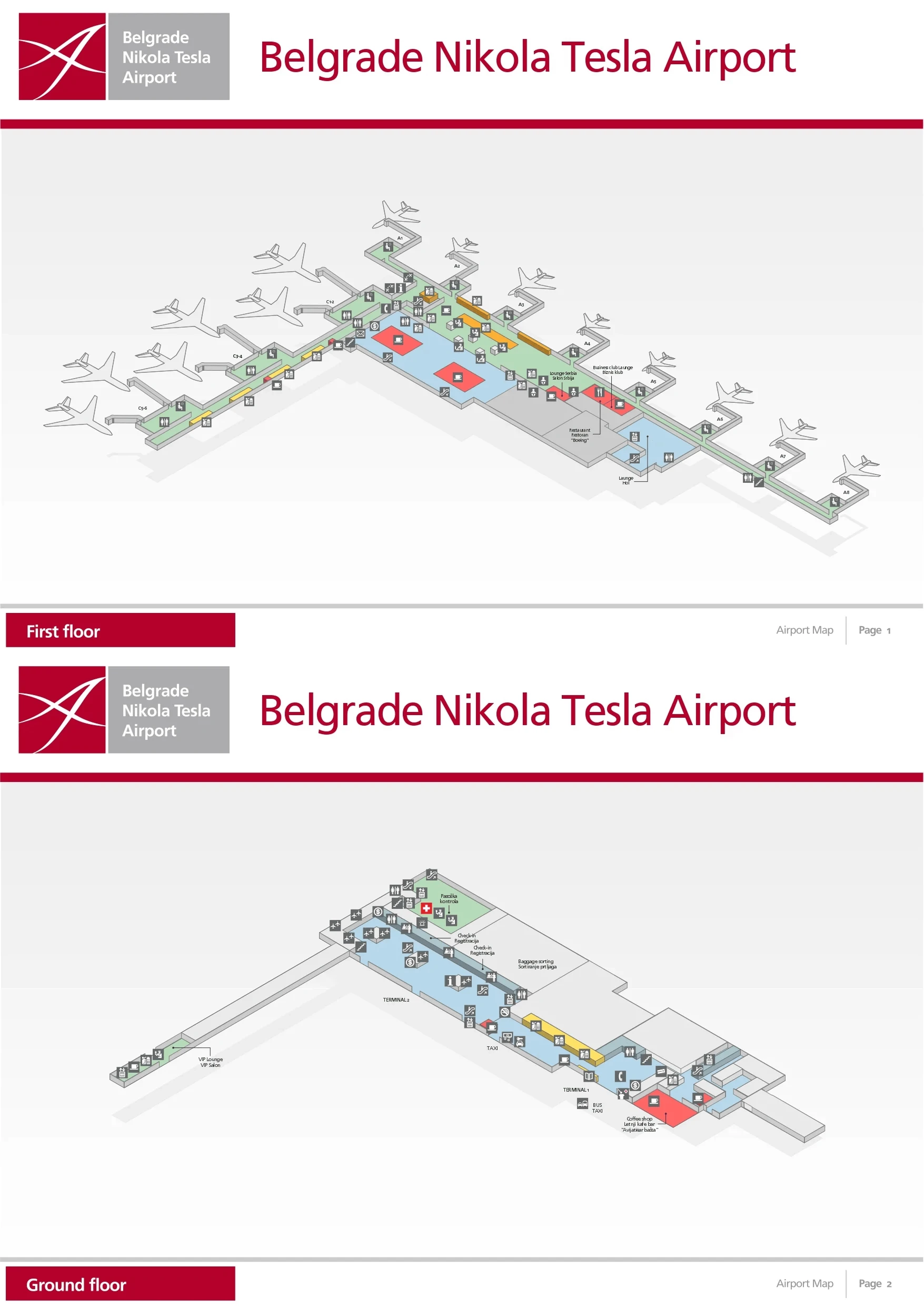
Belgrade Nikola Tesla Airport Terminal 1 First Floor Map 2024-2026
Belgrade Nikola Tesla Airport Terminal 1 Ground Floor Map 2024-2026
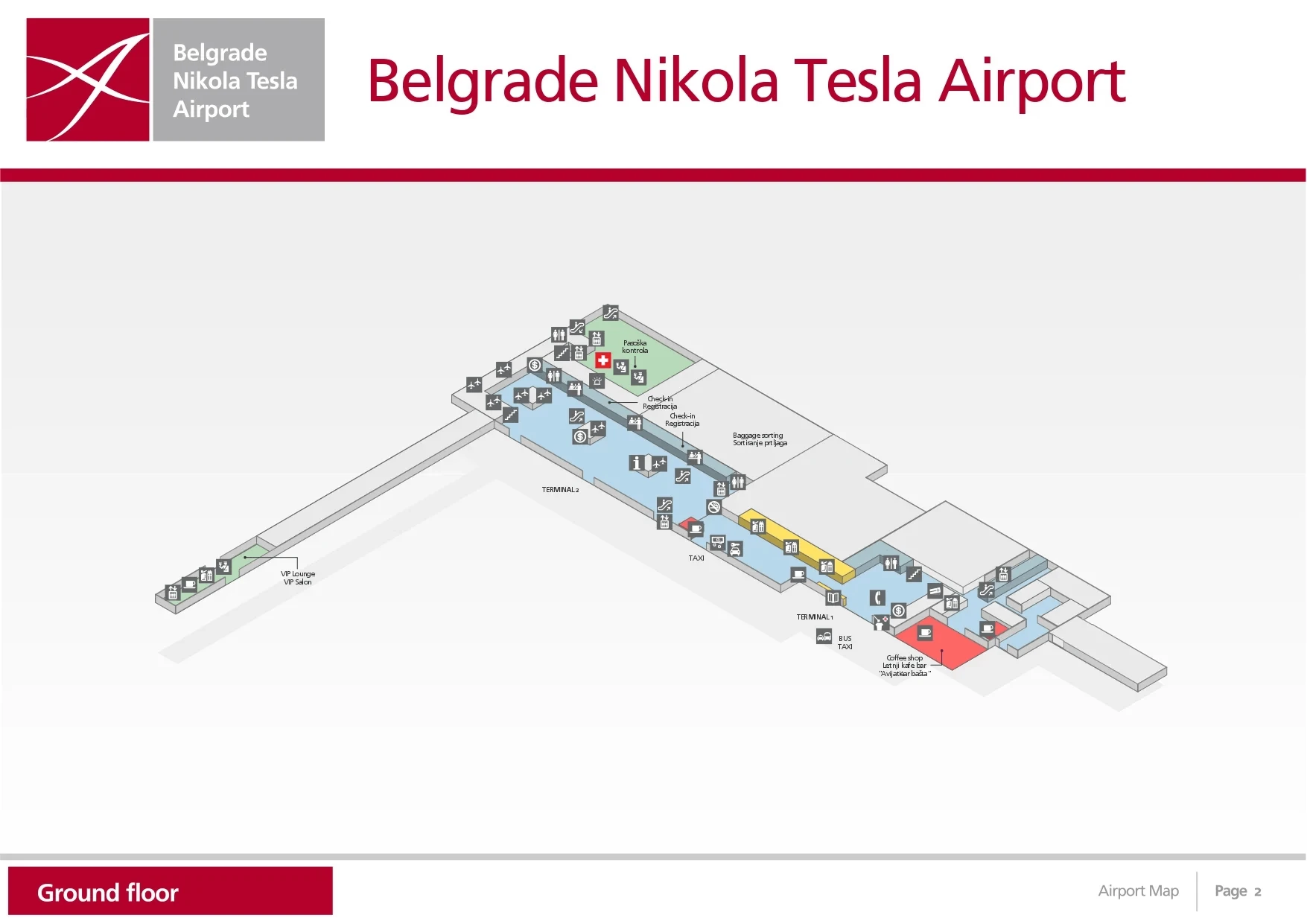
2026 Belgrade Nikola Tesla Airport Terminal 1 Map Guide
What is the exact walking distance (meters) from the main check-in/bag drop zone to passport control in the departures flow?
Walking distance is typically about 120–250 meters in Belgrade Nikola Tesla Airport Terminal 1, depending on which check-in row you start from and which passport-control lane entrance is open. The shortest path usually starts from the central check-in rows and runs straight toward the security entry, then continues to the passport-control barriers just beyond.
| Start point in T1 check-in hall | Map landmark to aim at | Approx. distance to passport control |
|---|---|---|
| Central check-in rows | Main security entry funnel | ~120–170 m |
| Far-end check-in rows | Overhead “Passport Control / Departures” signs | ~180–250 m |
Where is the single most likely choke-point entrance to the passport control queue (the spot passengers should aim for), described by landmarks and nearby gates/shops on the terminal map?
The choke-point entrance is the central Border Police passport-control funnel immediately after the main security exit, right at the mouth of the duty-free entrance corridor. This is the spot where multiple security lanes and travelers from different check-in rows merge into a single set of passport barriers.
After security, keep moving straight toward the first large overhead “Passport Control” sign and aim for the middle set of barrier openings rather than hugging the far left/right edges, where people tend to stall and re-sort documents. You’ll know you’re in the right place when the duty-free entry is just beyond the passport barriers and the airside corridor splits toward the main gate area.
Where is the official taxi voucher desk/booth located (exact position by door number, hall, or counter row) so travelers avoid curbside intercepts?
No voucher workflow is required at Belgrade Nikola Tesla Airport Terminal 1; the official taxi interface is the marked Airport Taxi counter/dispatcher point in the landside Arrivals Hall by the main exit to the taxi rank. That official node is the one to use to avoid curbside intercepts.
From baggage claim, follow “Exit / Arrivals” into the public Arrivals Hall and stay inside until you reach the front-of-hall exit zone facing the curb. The official airport taxi counter/dispatcher is positioned at this exit frontage (adjacent to the main doors out to the taxi line), where passengers queue briefly before being directed outside. Ignore anyone approaching you inside the hall offering “taxi” and only proceed to the curb once you’ve aligned with the airport-marked taxi point.
What is the exact walking distance (meters) from the official taxi voucher desk to the official taxi pickup line outside (curb zone or door)?
Walking distance is typically about 10–40 meters in Belgrade Nikola Tesla Airport Terminal 1, because the official taxi point is positioned right at the Arrivals Hall exit frontage and the taxi rank begins immediately outside. The main variable is whether you start at the counter/dispatcher spot itself or from the nearest interior queue edge during crowding.
| Start point | Landmark to finish at | Approx. distance |
|---|---|---|
| Official airport taxi counter/dispatcher | Threshold of the main Arrivals exit doors | ~5–15 m |
| Main Arrivals exit doors | First position in the official taxi line at the curb | ~5–25 m |
| Taxi counter/dispatcher (worst-case crowd detour) | First taxi in the official rank | ~25–40 m |
Which baggage carousel numbers are physically closest to the Lost & Found or baggage services desk, and what is the walking distance between them?
The closest carousels are the ones directly facing the baggage services desk inside the Terminal 1 baggage reclaim hall, usually the central carousels rather than the far-end belts. Walking distance is typically about 10–40 meters from the nearest carousel edge to the desk’s service counter line.
Carousels shift by flight and the numbering can change by hall configuration, but the practical rule on the map is consistent: aim for the airline baggage service/Lost Baggage counters located along the reclaim hall wall near the main exit toward Arrivals, then identify the carousel directly opposite that counter bank. If your bag doesn’t arrive, stay inside reclaim, walk to that counter line first, and only then proceed out to the public Arrivals Hall.
Where is the entrance to the Lost & Found area (the first door or threshold passengers need), identified by nearby signage and landmarks on the arrivals map?
The Lost & Found / baggage services entrance is the opening into the airline service counter bank inside the Terminal 1 baggage reclaim hall, positioned along the outer wall near the main flow toward the public Arrivals exit. This is the first threshold passengers should aim for before leaving the reclaim zone.
From your carousel, walk toward the “Baggage Services / Lost Baggage” signage and the line of airline service desks that sit between the carousels and the corridor that leads out to the Arrivals Hall. The entrance you want is the front edge of that desk bank (where queues form), with the Arrivals exit corridor visible nearby—once you pass into the public Arrivals Hall, resolving a baggage report usually becomes slower and more back-and-forth.
What is the exact walking distance (meters) from passport control exit to the furthest C-gates (worst-case gate walk) to quantify miss-risk?
Walking distance is typically about 350–650 meters from passport control exit to the furthest Terminal 1 gates, depending on which pier segment is active and how far down the departures corridor your gate sits. The worst-case walk usually happens when your gate is at the far end of the main airside corridor past duty-free and the last seating clusters.
| Segment (T1 airside) | Landmark to use | Approx. distance |
|---|---|---|
| Passport control exit → duty-free edge | First duty-free storefronts / main airside corridor mouth | ~40–120 m |
| Duty-free edge → main gate corridor midpoint | Central seating / main concessions cluster | ~150–250 m |
| Midpoint → furthest gate holding area | Last gate lounge seating / corridor end signage | ~160–280 m |
| Total worst-case | Passport control exit → furthest gate | ~350–650 m |
Where exactly is the Gate C04 rest or lounge-sofa area, and what is the walking distance from the nearest toilet and charging points?
No Gate C04 rest or lounge-sofa area exists in Belgrade Nikola Tesla Airport Terminal 1, because Terminal 1 gate labeling does not use an “C04” gate scheme like mega-hub concourses. The actionable substitute is the quietest seating zone furthest down the main airside departures corridor, away from the duty-free entrance, where power points are typically concentrated near café seating and wall/column outlets.
Use a triangulation approach on the terminal map: pick a seating cluster near the corridor end, then locate the nearest restroom pictogram and the nearest café or workstation-style counter where charging is most likely. In most compact-terminal layouts like BEG T1, toilets are usually within ~30–90 meters of any gate-area seating zone, and charging points tend to be within ~10–60 meters when positioned near concessions or pillar outlets.
Which single corridor or turn decision after security most often sends people the wrong way toward gates (the wrong-branch junction), as shown on the departures map?
The wrong-branch junction is the first airside split immediately after security where passengers drift into the duty-free/shop-lined path instead of continuing into the main gates corridor. This mistake compounds when people follow retail frontage and crowd flow rather than overhead gate lettering.
After you exit security, stop at the first overhead “Gates” direction sign and confirm you’re entering the long departures corridor rather than looping into shop aisles. The fix is to keep the gate-direction signage centered in your sightline and use the first big seating cluster as a checkpoint; if you’re weaving between storefronts with no clear gate-number progression, you’ve taken the wrong branch and should backtrack to the security exit mouth.
Where is the fast-track or priority lane entrance (if present) relative to the standard passport control queue, specified by which side or which barrier line on the map?
Fast-track access, when operating in Belgrade Nikola Tesla Airport Terminal 1, is positioned as a separate, signed entry at the same passport control frontage as the standard queue, reached by staying to the outer edge of the barrier field instead of joining the central mass. The priority entry is typically the side channel marked for eligible passengers rather than a mid-queue “cut-in.”
Approach passport control from the main security exit and scan for “Fast Track / Priority” signage before you enter any roped chute. If you commit into the standard barrier lanes first, switching usually requires exiting back out to the open area and re-entering at the marked priority mouth. Use the first set of stanchions as your decision point: standard lanes feed the central barrier openings, while priority feeds a dedicated side opening under separate signage.
Archive Belgrade Nikola Tesla Airport Terminal 1 Map
Below are all historical map versions for Belgrade Nikola Tesla Airport. Each year includes the official map available for that period, presented as both WebP and PDF.
2024-2026 Belgrade Nikola Tesla Airport Terminal 1 Map (Official 2024 Edition)