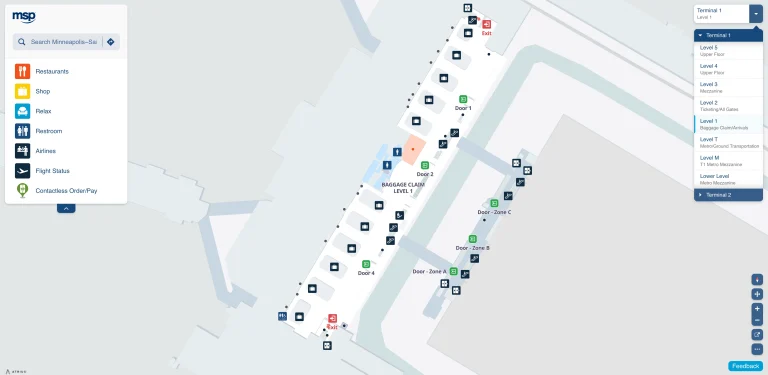
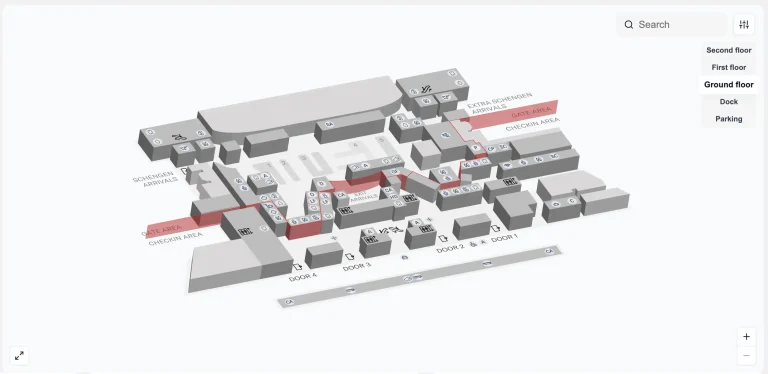
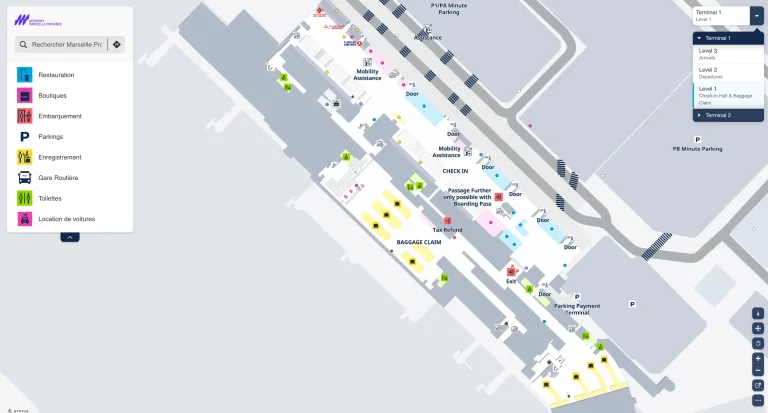
Tan Son Nhat International Airport Terminal 3 Map (most Up-To-Date)

Terminal 3 (T3) at Tan Son Nhat is a large, multi-level domestic terminal set apart from the older T1/T2 cluster by roughly 1.2–2.0 km, so the “shape” of your trip is a vertical stack plus a short landside transfer. Within Ho Chi Minh City’s main airport grounds, arrivals and departures sit on different levels, while most pickups (especially ride-hailing) shift you into the adjacent TCP Garage/PNA building.
Map Table
| Zone | Connection | Walk Time |
|---|---|---|
| L2 Domestic Arrivals | Baggage claim, arrivals exit | 0–3 min |
| L1 Ground Transport | Shuttle Columns 18A–19A, taxi queue | 1–3 min from L2 descent |
| TCP Garage (PNA) L1 | Ride-hailing Lane D1/D2 | 3–5 min from L2 exit |
| L3 Domestic Departures | Check-in 1–109, security | 2–4 min from main atrium vertical bank |
Tan Son Nhat International Airport Terminal 3 Map Strategy
- Confirm “T3 vs T1/T2” before moving: inter-terminal transfers are landside only, and the shuttle pickup is L1 Columns 18A–19A (not the arrivals level).
- Treat TCP Garage (PNA) as your transport hub: ride-hailing pickups route to Lane D1/D2, so plan the arrivals-exit → Pillar D04 → garage connector path before you step outside.
- Use the main atrium’s central escalator/elevator bank as the fail-safe vertical spine: L2 arrivals down to L1 for shuttle/taxi, then up to L3 for check-in and security.
- Avoid curb confusion and parking loops: the “drop-off curb” is aimed at L3 departures, while parking and most waiting/pickups push to the overpass-access garage; if you’re unsure, default to the garage and walk in via the covered connectors.
2026 Tan Son Nhat International Airport Terminal 3 Map + Printable PDF
Terminal 3 remains the key domestic capacity relief node at 2026 SGN, with operations built around a strict vertical split: arrivals on L2, transport on L1, departures on L3. The biggest reliability gain comes from navigating by fixed nodes (Columns 18A/19A, Lane D1/D2, Door D1/D2) instead of “floors,” since most wrong-terminal and wrong-level errors happen at the exits and curb.
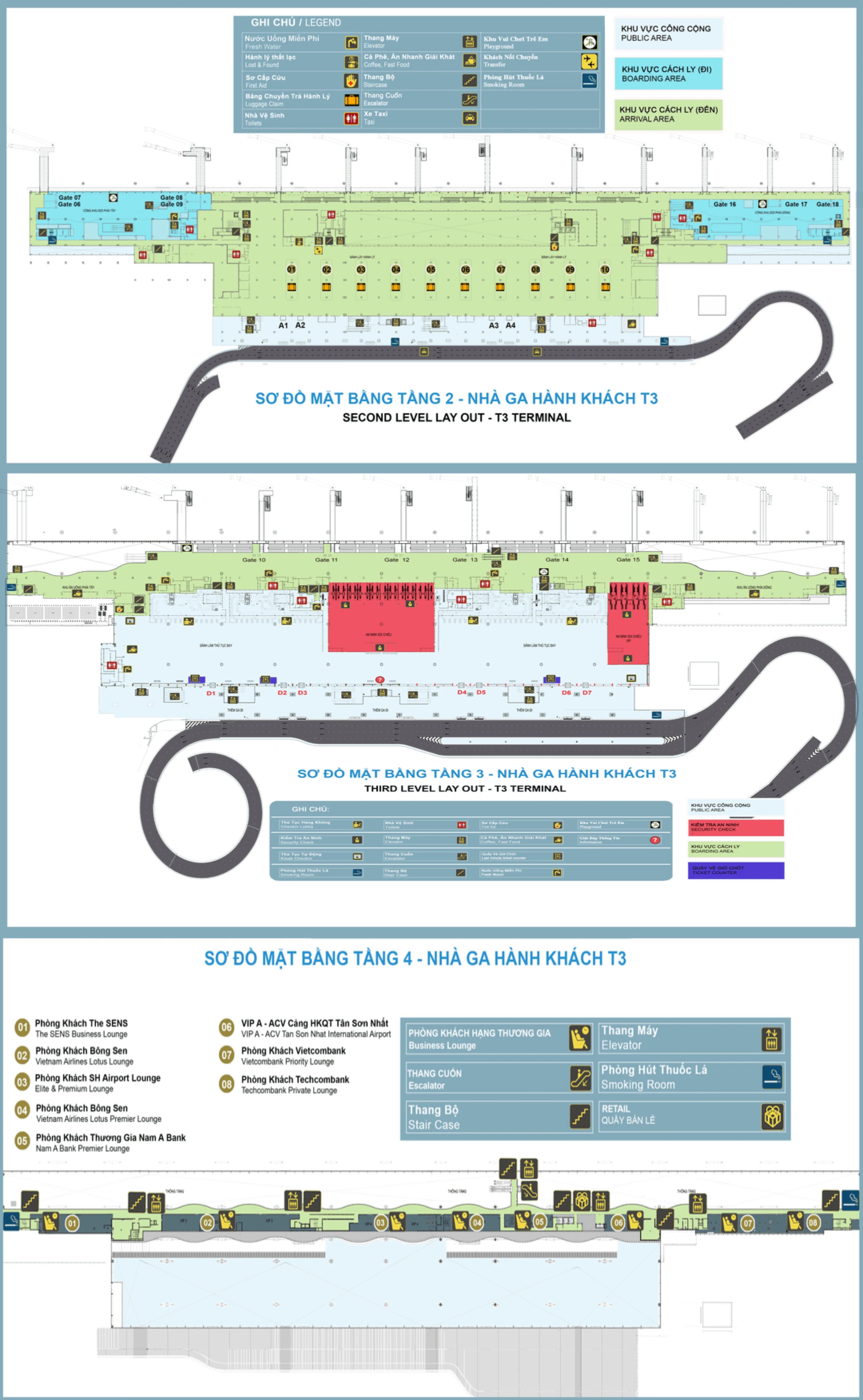
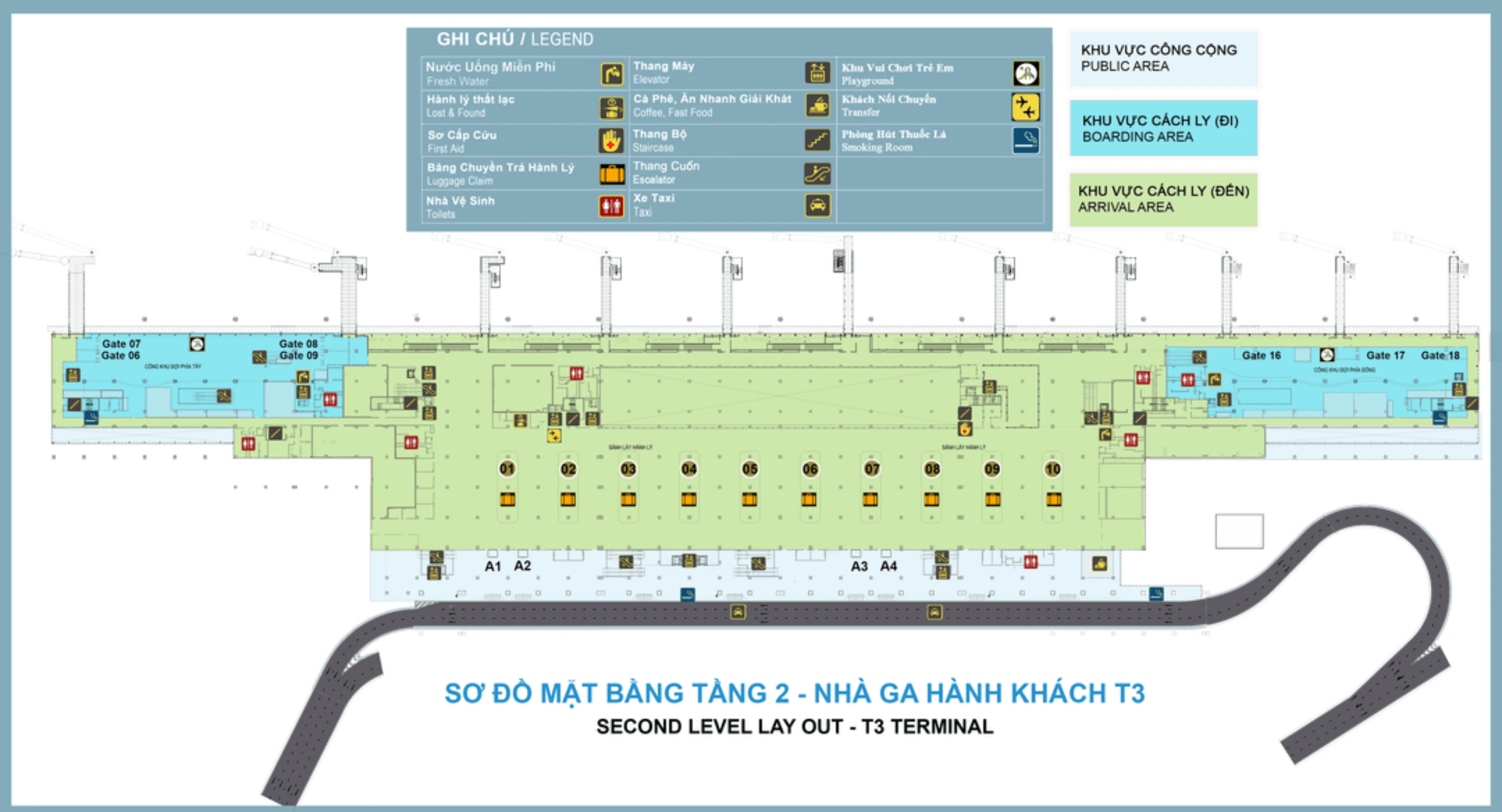
Tan Son Nhat International Airport Terminal 3 Domestic Level 2 Map 2024-2026
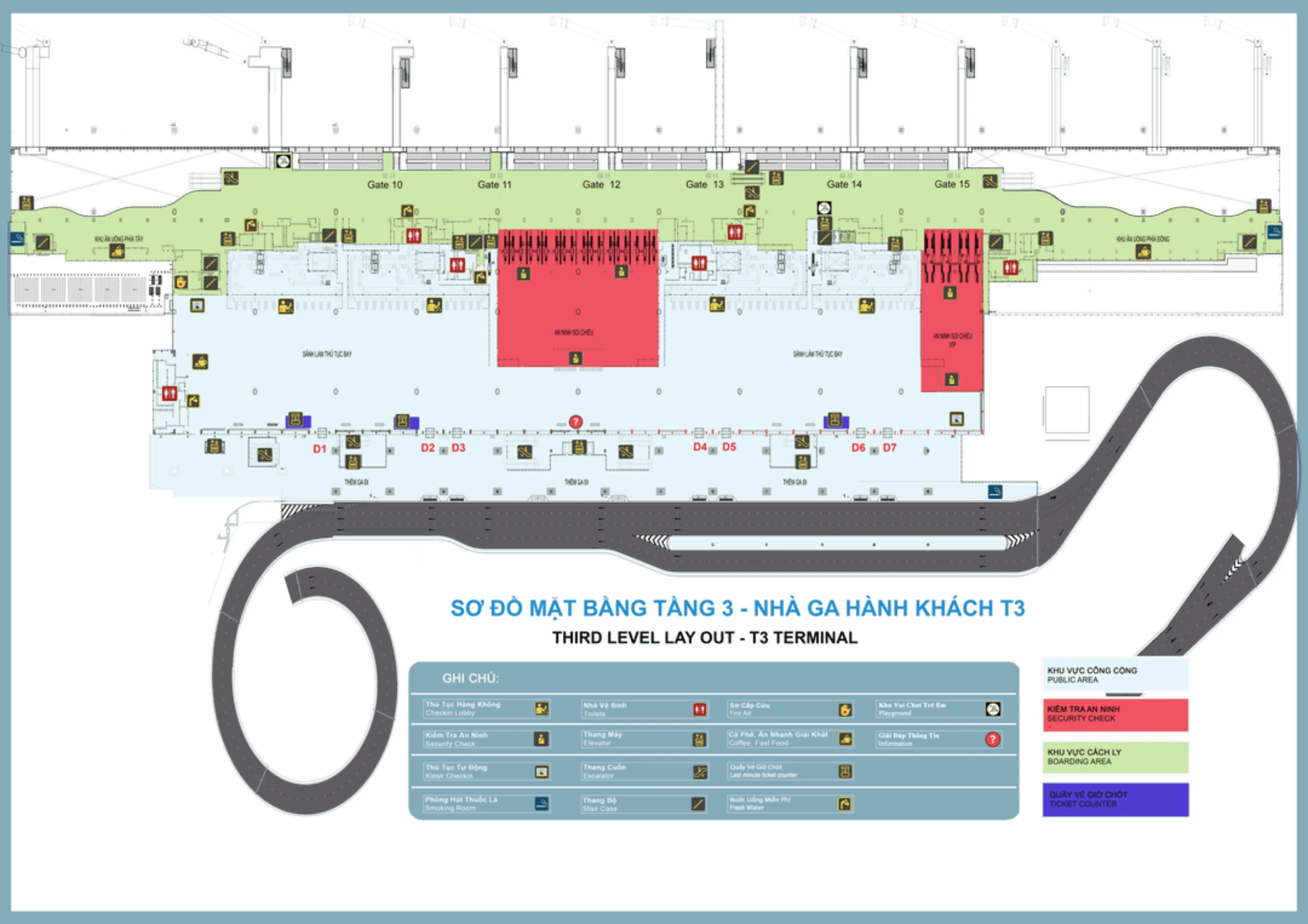
Tan Son Nhat International Airport Terminal 3 Domestic Level 3 Map 2024-2026
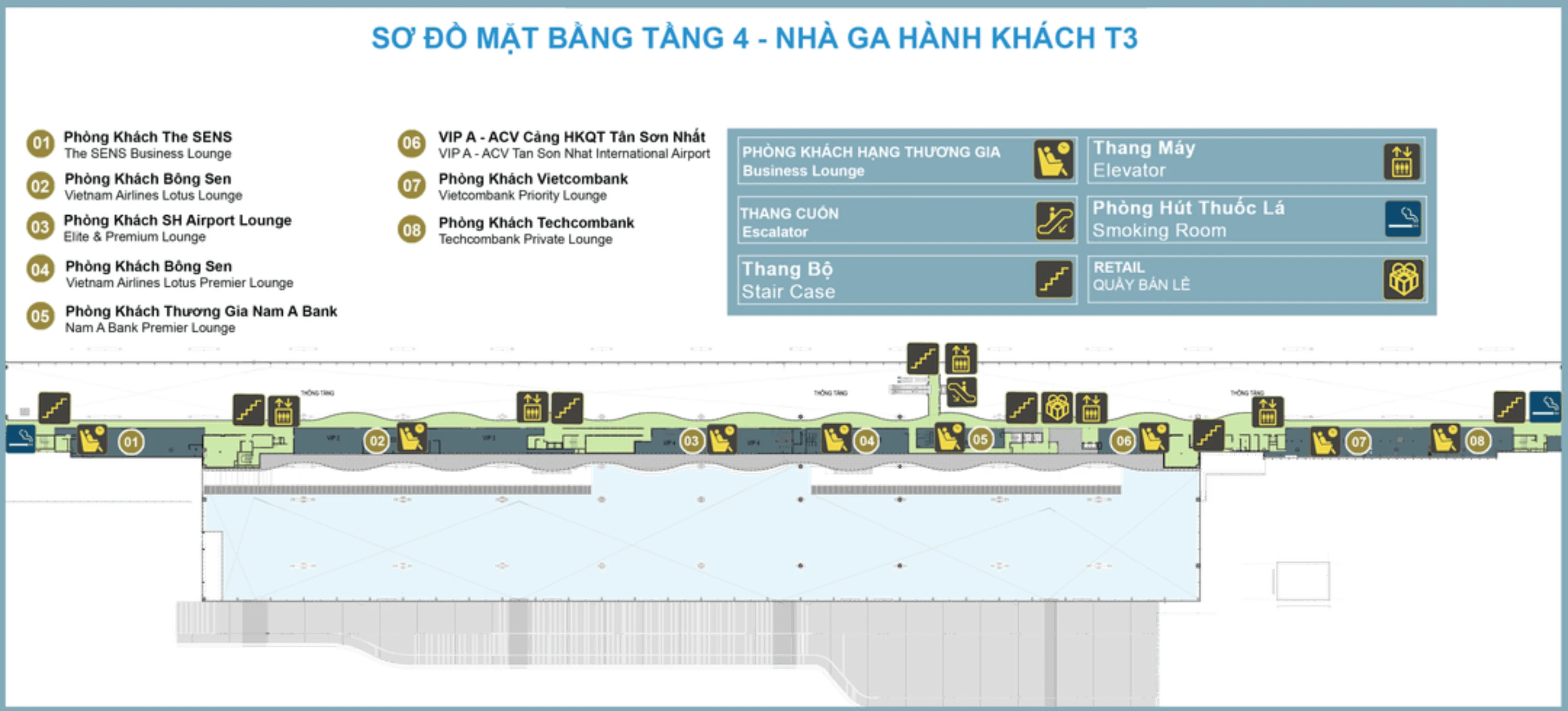
Tan Son Nhat International Airport Terminal 3 Domestic Level 4 Map 2024-2026
2026 Tan Son Nhat International Airport Terminal 3 Map Guide
What is the exact walking distance (meters) from the T3 domestic arrivals exit to the official ride-hailing pickup zone?
Walking distance is approximately 200–250 meters from the T3 Domestic Arrivals exit (L2) to the official ride-hailing pickup zone in the TCP Garage (PNA).
The shortest practical path runs from the L2 arrivals exit past Pillar D04, then turns toward the pedestrian bridge or elevator connector into the TCP Garage. The official ride-hailing lanes are Lane D1 or Lane D2 on the garage’s Ground Floor (L1). Expect the distance to stretch toward the higher end of the range when the connector you reach first forces a small detour inside the garage to Lane D1/D2.
What is the exact curb-to-check-in walking distance (meters) from the primary T3 drop-off curb to the Vietnam Airlines check-in hall entrance?
Walking distance is approximately 60–100 meters from the primary T3 departures drop-off curb (L3) to the Vietnam Airlines check-in hall when you enter through Door D1 or Door D2.
Vietnam Airlines check-in spans Counters 56–109 on Level 3, with the most direct approach coming from the curb straight into Door D1/D2 and forward into the main check-in hall. The walk can jump by 150+ meters if you enter through a mismatched door (for example, arriving at Door D4 and then crossing the hall to the Vietnam Airlines counter zone).
What is the precise location of the free inter-terminal shuttle stop at T3 (door number / side / landmark), and what is the shortest walking path to it from arrivals?
The free inter-terminal shuttle stop at T3 is on the Ground Floor (L1) at Columns 18A and 19A.
From the Domestic Arrivals level (L2), exit the baggage claim/meet-and-greet area and head to the terminal’s central atrium vertical bank (main escalators/elevators). Go down one level to L1, then walk along the ground-transport curbline to Columns 18A–19A; the expected walk from the L2 descent point to the shuttle columns is roughly 50–80 meters, and the total L2-to-shuttle movement commonly lands around 80–100 meters depending on which exit stream you follow.
Which exact gate/column/door at T1 is the shuttle pickup point for going to T3?
The T1 shuttle pickup point for going to T3 is at Lane B, Columns B17 through B20 on the ground-level curb.
Follow the landside flow out of T1 to the curb, then align yourself with the Lane B side and walk until you reach the pillar range marked B17–B20. Staying on the ground curb matters because the inter-terminal shuttle operates from the ground-level pickup lanes, not from upper-level drop-off areas, and waiting at the wrong level is a common cause of missed shuttles.
What is the fastest on-foot route (step-by-step nodes) from T3 arrivals to the car parking payment/exit area?
Walking is typically 100–150 meters from T3 arrivals to the TCP Garage (PNA) car-parking payment/exit nodes using the covered connector.
Exit Domestic Arrivals on L2 and orient toward the western end of the terminal frontage, using the signs for the TCP Garage/PNA. Follow the covered walkway/connector into the garage, then continue to the pedestrian exit node where the automated kiosks and staffed counters are positioned for payment before you descend to your parked level. If you overshoot into the taxi/shuttle curb on L1 first, you usually add a backtrack and a longer indoor loop inside the garage.
Which floor in T3 contains the main domestic departures check-in counters, and what is the shortest vertical path (specific escalator/elevator bank) from the entry level?
Level 3 (the Domestic Departure Hall) contains the main domestic departures check-in counters at T3.
Enter at the ground transport level (L1) and use the central atrium’s main escalator/elevator bank as the shortest vertical route upward, riding directly to L3 rather than wandering to side escalators near curb exits. The check-in zone spans Counters 1–109 on L3, and using the central bank reduces wrong-level errors because it keeps you aligned with the terminal’s primary wayfinding spine from transport to departures.
What is the exact driving access road/turn sequence to reach T3 departures drop-off without entering the T1/T2 approach lanes?
Reaching T3 departures drop-off works best via the Tran Quoc Hoan connecting road into Phan Thuc Duyen, then Road 18E, staying committed to the lower-road split for the Level 3 curb.
The clean, repeatable sequence is Truong Son → Phan Thuc Duyen bypass → Road 18E → follow signs for Terminal 3 Departures, then take the lower-road option (not the overpass) at the final approach split. The overpass sends you into the TCP Garage/PNA parking complex, while the lower road feeds the L3 departures drop-off curb.
Where is the precise ‘wrong-terminal recovery point’ at T3 (information desk / airline service desk) closest to the main entrance?
The closest wrong-terminal recovery point at T3 is the last-minute ticket/airline service desk area positioned near Door D1 at the main entrance on the departures level (L3).
Door D1 is the most reliable “reset” node because it sits beside Vietnam Airlines’ premium check-in lounge access and anchors the start of the main check-in hall flow. If you arrive unsure whether your flight is operating from T3 vs T1/T2, stepping inside at Door D1 and confirming at the adjacent airline service/ticketing area prevents a full hall-crossing and reduces the chance you commit to the wrong curb or the wrong vertical path.
What is the exact distance (meters) between the T3 shuttle drop-off point and the nearest security screening entry for departures?
Distance is approximately 120 meters from the T3 shuttle drop-off at Columns 18A–19A (L1) to the nearest departures security screening entry (L3), including the required vertical move.
From the shuttle columns on L1, walk to the central atrium escalator/elevator bank, go up to Level 3 (Domestic Departures), then follow the shortest straight-line flow into the security entrance nearest the main check-in hall. The number varies mainly with how directly you hit the central bank from Columns 18A/19A, because detouring along the curbline can add tens of meters before you start the vertical climb.
Where is the designated taxi queue at T3 (exact curb/zone), and what is the shortest pedestrian route from arrivals baggage claim to that queue?
The designated taxi queue at T3 is on the Ground Floor (L1) curb on the left side of the terminal lobby exit.
From arrivals baggage claim on L2, exit into the meet-and-greet zone and head to the central atrium escalator/elevator bank. Go down to L1, then turn left along the ground-transport curbline to the taxi queue area; it’s commonly about 50–80 meters from the L2 descent point. This route is shorter than ride-hailing because taxis are allowed at the terminal curb, while ride-hailing is pushed into the TCP Garage lanes.
Which specific doors/exits at T3 lead to motorbike parking, and what is the shortest walking route from arrivals to those exits?
Motorbike parking access is reached via the doors that connect you into the TCP Garage/PNA side connectors, with the most reliable pedestrian approach using the departures-level (L3) bridge into the PNA complex.
From arrivals on L2, exit baggage claim and follow signs toward the TCP Garage/PNA connectors rather than the taxi/shuttle curb. Use the central atrium vertical bank to move up to L3, then take the pedestrian bridge into the PNA building and continue to the dedicated motorbike parking block. This avoids the ground-curb loop where motorbikes are generally not permitted for curbside drop-off and where pedestrians often get pulled toward taxi lanes instead of the parking complex.
What is the exact pedestrian path between T3 and T1 (if walking is possible), including distance and required crossings?
Walking between T3 and T1 is not a safe or reliable option for most travelers because there is no continuous covered sidewalk and the route requires high-traffic crossings.
The straight-line separation is roughly 1.2–2.0 km, and the practical path typically forces you onto Road 18E and the Phan Thuc Duyen/Truong Son road network where pedestrian infrastructure is inconsistent. That means multiple at-grade crossings around fast-moving approach lanes and curb cuts, plus long gaps without protected walk space. For a predictable terminal switch, the fail-safe route is the free inter-terminal shuttle (T3 pickup at L1 Columns 18A–19A; T1 pickup at Lane B Columns B17–B20) rather than attempting to walk.
Archive Tan Son Nhat International Airport Terminal 3 Map
Below are all historical map versions for Tan Son Nhat International Airport. Each year includes the official map available for that period, presented as both WebP and PDF.
2024-2026 Tan Son Nhat International Airport Terminal 3 Domestic Map (Official 2024 Edition)