Juan Santamaría International Airport Main Terminal Map (Most Up-To-Date)

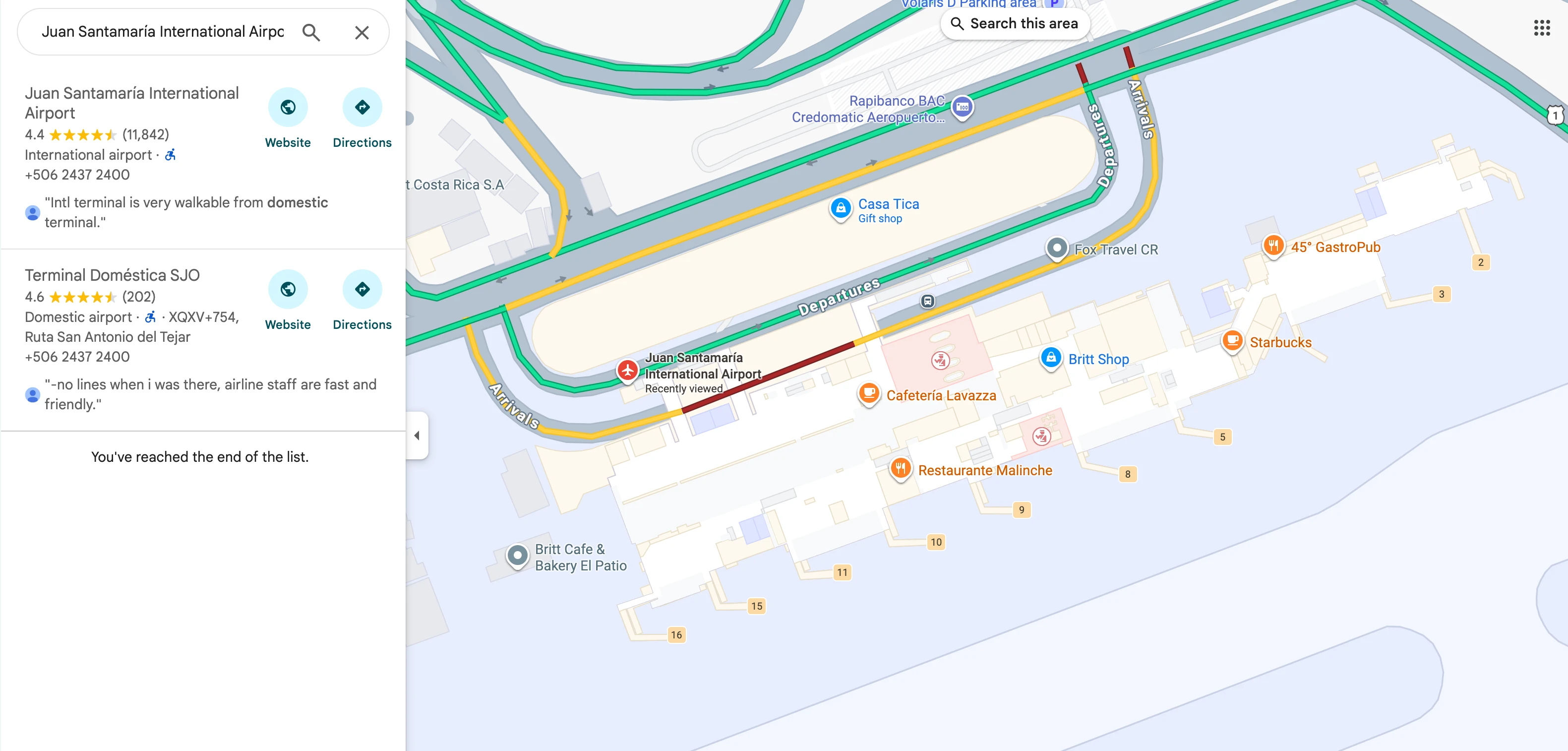
Juan Santamaría International Airport is a compact, linear “dumbbell” terminal with a single Level 2 departures hall feeding one centralized security/immigration checkpoint, then splitting airside into left (Gates 1–7) and right (Gates 10–20) wings. The layout sits within Costa Rica’s main San José-area air gateway, with a separate Sansa domestic building reached by an outdoor sidewalk walk. Expect the biggest timing swings at the landside-to-airside funnel and the post-security retail choke.
Map Table
| Zone | Connection | Walk Time |
|---|---|---|
| Level 2 check-in hall | Security/immigration entrance | 1–3 min |
| Security exit → duty-free | Central atrium decision point | 2–5 min |
| Central atrium | Gates 1–7 (left) | 3–8 min |
| Central atrium | Gates 10–20 (right) | 3–10 min |
Juan Santamaría International Airport Main Terminal Map Strategy
- Time your entry around the single security funnel: if the queue spills into the check-in hall, stay aligned with the stanchions and avoid cutting across the center aisle where the snake blocks through-traffic.
- Treat duty-free as a mandatory corridor, not optional shopping: move straight through the serpentine aisles to regain sightlines at the central atrium before choosing left (Gates 1–7) or right (Gates 10–20).
- Lock route certainty for domestic transfers: Sansa is not connected to the main terminal airside, so any domestic ↔ international move requires a landside exit and an outdoor walk before re-check and re-screening.
- Reduce curbside failure modes: commit to the correct road level early (Departures Level 2 vs Arrivals Level 1) because recovering from a wrong turn can require a full perimeter loop when traffic jams.
2026 Juan Santamaría International Airport Main Terminal Map + Printable PDF
Current operations at 2026 still run through one Level 2 security complex, and when the line surges it can snake into the check-in hall and disrupt circulation right at the entrance doors. After screening, the forced duty-free walkthrough creates a second squeeze point before the concourse split, so “short distances” can still become slow under crowding.
2026 Juan Santamaría International Airport Main Terminal Map Guide
What is the exact walking distance (meters) from the main security entrance to the furthest international gates in the main terminal?
Walking runs about 350 meters from the main departures security exit to the furthest international gates (typically Gate 20 on the right wing or Gate 1/2 on the left wing). That figure assumes you clear the screening lanes and measure from the post-security merge point, because the duty-free walkthrough is mandatory and adds distance even when the gate looks close.
| Reference point | Furthest-gate target | Distance |
|---|---|---|
| Post-security exit rollers | Gate 20 | ~300–350 m |
| Post-security exit rollers | Gate 1 / Gate 2 | ~250–300 m |
| Security zone + forced duty-free path effect | Added displacement | ~50–100 m |
Where is the security queue overflow path routed when lines ‘snake’—which corridor/landmark does it spill into?
The security queue overflow spills back out into the public departures check-in hall, not a separate holding corridor. When the roped queue exceeds the checkpoint’s depth, the “snake” pushes into the main landside circulation lane in front of the counter banks, where it starts to interfere with passengers entering from curbside doors.
It typically extends past the central information desk area and can wrap toward the escalator zone that leads up to the landside food court (the Smashburger / Malinche area), effectively turning the check-in hall’s center aisle into a queue reservoir.
What is the fastest on-foot route from the Sansa domestic terminal exit to the international departures check-in hall (including whether it requires going outside)?
Going outside is required because the Sansa domestic terminal is a separate building with no airside corridor to the main terminal. The fastest route is the straight sidewalk connection along the airport roadway, which is partially covered but still exposed in wind-driven rain.
Exit the Sansa terminal to the curbside frontage, then walk east along the main sidewalk toward the international terminal, staying on the terminal-side walkway. Use the parking garage structure on your right as the continuous landmark; you’ll pass the landside Malinche exterior area along the way, then enter the international terminal at Level 2 departures doors and proceed directly into the linear check-in hall.
What is the exact location of the first ‘point of no return’ after security (the spot where backtracking to check-in is slow or blocked)?
The first true point of no return is the post-security bag reclaim area at the exit rollers of the X-ray scanners. Once you pick up items and step forward into the airside retail zone, you are functionally committed because the return route runs against the controlled flow and typically requires a security or staff escort.
This spot sits immediately before the forced duty-free walkthrough that funnels passengers into the central atrium. Backtracking from inside the duty-free maze to the landside check-in hall is not a simple “turn around” move; it becomes a managed reversal that can take 30+ minutes or be denied depending on staffing and conditions.
From arrivals immigration exit, what is the exact path order to reach baggage claim (which turn/landmark sequence)?
Baggage claim is reached by flowing straight out of the immigration hall into the arrivals duty-free channel, then continuing into the carousel room. The critical detail is that duty-free sits between passport control and the belts, so your “next step” after immigration is not the carousels—it’s the retail corridor.
Leave the passport-control booths and follow the single directed lane into the arrivals duty-free store area. Stay with the main stream past the liquor and perfume shelving until the duty-free exit opens into the baggage claim hall. Once inside the carousel room, the belts sit directly ahead in a compact cluster, with the floor space tightening when two widebody loads overlap.
Where are the largest seating clusters located airside, and what is the walking distance from security to the nearest one?
The largest airside seating clusters sit around Gate 4–5 on the left wing and Gate 10–11 on the right wing near the central food and retail concentration. The nearest major cluster from security is typically the central/near-right seating around Gate 10–11, reached after the duty-free exit into the central atrium.
From the post-security exit point, the closest large seating area is about 80–150 meters depending on congestion through the duty-free gauntlet and where you enter the concourse. The Gate 4–5 cluster is farther at roughly 150–200 meters because it requires committing left after you emerge into the central atrium.
Where are the VIP lounges (e.g., referenced near Gate 5) located relative to gates (upper/lower level, before/after security), and what is the shortest route to reach them?
VIP lounges at Juan Santamaría International Airport are airside and accessed after security, with entrances on upper/mezzanine levels near their gate clusters. VIP Santamaría is the left-wing option near Gate 5, while VIP Lounge Costa Rica and Lounge BAC sit in the far right-wing cluster near Gates 19–20.
Turn left after exiting the post-security duty-free path to reach VIP Santamaría: walk toward Gate 5, then take the local stairs/elevator up to the mezzanine entrance above the gate area. Turn right after duty-free to reach VIP Lounge Costa Rica: continue toward Gate 18–20, then go up one level by the Gate 19/20 area; the lounge is just a few meters from Gate 20, with Lounge BAC directly across nearby.
What is the exact curbside drop-off point that minimizes walking to the primary international airline check-in counters (which door/zone)?
The best curbside drop-off is any Level 2 departures entrance that puts you opposite the center-left counter bank, because the check-in hall is linear and no door is more than about 150 meters from any counter cluster. That makes “correct level + avoid doorway congestion” more important than chasing a numbered door system that doesn’t really exist here.
Aim for a mid-hall departures door where the curbside flow is moving and you can clear the porter cluster quickly, then walk straight into the main circulation lane with counters on the back wall. Avoid the far-right corner unless you specifically need the Departure Tax desk, since that corner pull-in can add a full-length backtrack if your airline is in the left sector.
What is the shortest indoor path from check-in counters to the main security entrance, and what are the named landmarks along that path?
The shortest indoor path runs straight from the counter line into the central “Immigration and Security” entrance area on Level 2, typically a 20–50 meter move depending on where your airline’s counters sit. This is an adjacency layout: counters on the back wall, circulation lane in front, then the security/immigration funnel centered beyond the hall.
From the counter position, step out into the main center aisle of the check-in hall and walk directly toward the central information desk zone. Continue straight to the signed Immigration and Security entry, using the escalator area that leads toward the landside food court (Smashburger / Malinche area) as the nearby landmark reference when the hall is crowded or the queue snake is blocking the most obvious line.
Where is the fastest exit from baggage claim to the official taxi / pickup area, and what is the walking distance from carousel area to curb?
The fastest taxi exit is the main arrivals sliding-glass doors that open directly into the public greeting zone and then out to the orange official taxi rank. Walking distance is roughly 30–50 meters from the carousel edge to the curb once you’re pointed at the correct door.
From the baggage belts, move toward the customs “traffic light” button and bag X-ray area, then continue forward to the final exit doors. After the doors, cut through the “shark tank” greeting area and keep right toward the official taxi desk/queue; the taxi curb is immediately outside, while app-based rideshare pickups are not permitted at that arrivals curb and force a longer off-campus walk.
What is the exact location of the tightest corridor choke point (narrowest passage) between security and the central gate area?
The tightest corridor choke point is the forced post-security duty-free walkthrough immediately after the security exit rollers. This is where the path turns into a serpentine aisle with high shelving that constricts sightlines and compresses foot traffic before you can even see the concourse split.
It sits between the security screening re-pack zone and the central atrium decision point. The effective “narrowest passage” is the mid-aisle bend where passengers slow to shop or re-organize bags, creating a pinch that ripples backward into the security exit area during peaks.
Where are the self-check-in kiosks located relative to the highest-volume airline counters, and what is the walking distance from kiosks to bag drop?
Self-check-in kiosks are positioned in front of the main counter banks in the departures check-in hall, forming an “anterior” layer between the entrance flow and the staffed airline desks. That places them directly in the highest-volume zone rather than off to a side alcove.
The walking distance from kiosks to bag drop is under 10 meters because bag drop is handled at, or immediately adjacent to, the corresponding airline counter positions behind the kiosk cluster. The main operational risk isn’t distance—it’s circulation friction when kiosk users and luggage carts block the through-lane that other passengers need to reach their counter line.