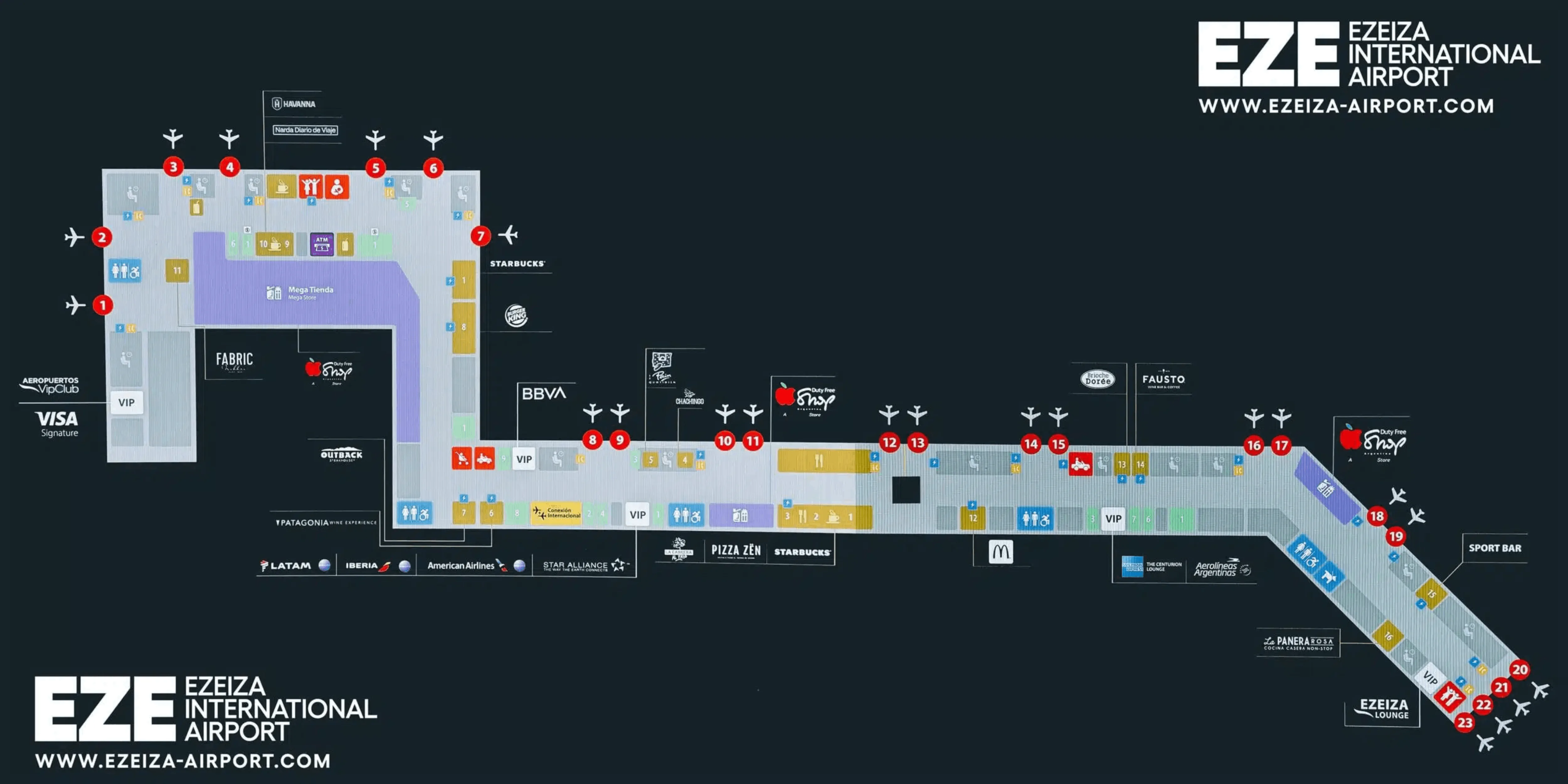
Ministro Pistarini International Airport Terminal C Map (Most Up-To-Date)

Terminal C at the Buenos Aires main airport hub is a long, linear domestic concourse anchored by a single security entrance at the legacy Terminal C building, with gates spreading down one main corridor (roughly Gates 22–27). The critical “map truth” is that processing and boarding are split: check-in and bag drop sit in the New Departures Terminal (the “Zeppelin” NTP), then a covered landside connector feeds you back into Terminal C security.
Map Table
| Zone | Connection | Walk Time |
|---|---|---|
| Terminal C security entrance | Covered connector from NTP (Embarque Cabotaje) | 3–4 min (NTP → C) |
| Gates 22–23 cluster | Straight concourse from security | 1–2 min |
| Gates 24–25 seating core | Mid-corridor, widest waiting area | 2–3 min |
| Gates 26–27 end node | Distal end of concourse | 3–5 min |
Ministro Pistarini International Airport Terminal C Map Strategy
- Treat Terminal C as a boarding concourse only: first decision node is NTP check-in islands (Aerolíneas typically Islands B/C), not the old Terminal C hall.
- Assume landside friction for any international → domestic connection: customs exit doors → public hall → walk to NTP → then connector entry → Terminal C security entrance.
- Use the covered connector as your primary waypoint: follow “Embarque Cabotaje / Terminal C” only after bag drop; avoid drifting upstairs to international security in the NTP.
- Pre-plan “dead ends” in Terminal C: limited airside amenities, no accessible domestic lounge, and Gate 11 listings can be unreachable depending on swing-barrier configuration.
2026 Ministro Pistarini International Airport Terminal C Map + Printable PDF
Terminal C operations in 2026 still run on the split-building model: most domestic passengers start at the NTP “Zeppelin” for check-in/bag drop, then use the covered landside corridor to reach Terminal C security and gates. Plan for a mandatory landside reset after international arrivals (immigration, baggage, customs) before re-entering security for domestic boarding.
2026 Ministro Pistarini International Airport Terminal C Map Guide
What is the exact walking route from the Terminal C arrivals exit to the Terminal C departures security entrance (step-by-step by landmarks)?
A landside walk is required because Terminal C’s domestic arrivals exit is not directly airside-connected to the departures security entry. Exit the Terminal C domestic arrivals hall to the curbside sidewalk, then orient toward the New Departures Terminal (the “Zeppelin” NTP) as the controlling landmark.
Exit Terminal C arrivals to the curb, then turn left and follow the building frontage toward the large glass NTP façade. Enter the NTP through the main “Partidas / Departures” doors and cross the public check-in hall toward the “Embarque Cabotaje / Terminal C” wayfinding. Take the marked “Corredor Cubierto” covered walkway exit on the south/west side of the NTP, then stay on that canopy-covered corridor until it terminates at the legacy Terminal C entrance, which feeds directly into the domestic security queue and screening lanes.
What is the measured walking distance (meters) from the Terminal C ↔ Terminal A/B connector point to the nearest Terminal C security checkpoint?
The walking distance is about 200 meters from the NTP ↔ Terminal C connector entry/exit to the Terminal C security checkpoint. This assumes the “connector point” is the covered-walkway interface where you leave the NTP check-in hall for “Embarque Cabotaje / Terminal C.”
| Reference points | Measured distance |
|---|---|
| NTP covered-walkway exit → Terminal C security queue intake | ~200 m |
| Terminal A arrivals sliding doors → NTP check-in hall (Bay C area) | ~350–400 m |
| Terminal A arrivals sliding doors → Terminal C security (full landside path) | ~600–650 m |
Where is the covered walkway (or indoor connector) between Terminal A/B and Terminal C located, and which doors/entrances does it connect?
The connector is a ground-level covered walkway linking the New Departures Terminal (NTP “Zeppelin”) directly to the legacy Terminal C entrance where domestic security begins. It is not an airside concourse; it functions as a landside bridge used after check-in.
It starts at the NTP departures/check-in level on the side of the hall signed for “Embarque Cabotaje / Terminal C,” where you exit the glass NTP structure onto the canopy-covered corridor. The walkway runs parallel to the curbside roadway (separated from vehicle lanes) and terminates at the north/east entrance of the old Terminal C building, delivering you straight to the domestic security queue intake and screening lanes.
Where exactly are the domestic baggage re-check counters located for passengers arriving international and continuing from Terminal C?
The domestic baggage re-check counters are at the New Departures Terminal (NTP) check-in islands used for domestic flights, not in Terminal A arrivals or in the legacy Terminal C hall. For Aerolíneas Argentinas domestic connections, the practical target is the NTP Bay B/C counter islands (often cited around counters 176–205).
After immigration, baggage claim, and customs in Terminal A, you exit to the public arrivals hall with your bags and walk landside to the NTP departures hall. Re-check happens at the airline’s standard check-in/bag-drop counters in that NTP hall, then you proceed to the covered “Embarque Cabotaje / Terminal C” connector to reach Terminal C security and the gates.
Which specific door/exit should a passenger use after customs/immigration to reach the fastest path to Terminal C (by map location, not instructions)?
The correct exit is the main customs-release sliding glass doors from the Terminal A international arrivals customs area into the public arrivals hall. This is the primary landside “reset” threshold where you re-enter the public side with bags and begin the walk toward the NTP “Zeppelin” before looping back to Terminal C security.
On the map, it’s the ground-floor Terminal A arrivals exit facing the forecourt/curb and parking frontage (the standard public arrivals doors), not a side corridor exit toward parking structures. From that doorway, the fastest path stays along the terminal building frontage toward the NTP glass departures hall, where the “Embarque Cabotaje / Terminal C” connector begins after check-in.
Where are the Terminal C check-in counters located relative to the Terminal C gates used for boarding (i.e., what’s the physical separation on the map)?
Terminal C check-in is physically in the New Departures Terminal (NTP “Zeppelin”), while Terminal C boarding gates are in the separate legacy Terminal C building. The separation is a landside building-to-building transfer rather than a single-hall flow.
Check-in and bag drop are in the NTP departures/check-in hall (commonly the Aerolíneas Argentinas islands in the Bay B/C area), then you follow “Embarque Cabotaje / Terminal C” to the covered connector. That connector runs roughly 200 meters and delivers you to the Terminal C security entrance; after clearing security, the gates (typically 22–27) extend down one linear domestic concourse.
What is the walking time (minutes) from the Terminal C security exit to the furthest domestic gates used by Terminal C departures (based on map distance)?
Walking takes about 3–5 minutes from the Terminal C security exit to the furthest domestic gates at the far end of the concourse (commonly Gate 27). The route is a straight, linear walk with no major turns once you enter the airside corridor.
From the security exit, you merge into the main Terminal C airside spine and continue down the concourse past the central gate cluster (around Gates 22–25) toward the distal end. Gate 22/23 is the closest cluster; the furthest point is the dead-end node near Gate 27 (often anchored by the Tostado Café Club area), which is why it’s also one of the quieter waiting zones.
Where are the post-security food options in Terminal C located (exact corridor/cluster on the map), and how far are they from the main gates?
Post-security food options in Terminal C cluster immediately after the domestic security checkpoint and around the mid-to-far gate nodes rather than being evenly distributed. The most reliable anchors are the central gate corridor (near Gates 22–25) and the terminal dead-end at Gate 27.
- Immediately after security, the highest “commercial density” sits in the first stretch of the airside corridor before the concourse fully opens toward the gates.
- Le Pain Quotidien is positioned near Gate 25, acting as the main sit-down anchor in the middle of the gate line.
- Don Us is near Gate 24, within the same mid-corridor gate cluster.
- Starbucks is typically near the central Gate 22/23 junction area, close to the main boarding flow.
- Tostado Café Club anchors the far end at Hall/Gate 27, at the concourse dead end.
Where is the closest restroom cluster to the Terminal C security queue entrance (precise map position)?
The closest restrooms sit at the Terminal C entrance hall right beside the domestic security intake, with a second reliable cluster back in the NTP atrium before you commit to the covered connector. This matters because restroom access tightens once you’re queued for screening.
Pre-security, the nearest “Terminal C-side” restrooms are immediately inside the legacy Terminal C entrance doors, adjacent to the security queue area (the intake zone before the X-ray lanes). If that area is congested or you are still in the NTP, the next nearest option is the NTP main atrium restrooms near the central public hall circulation—before you exit to the “Corredor Cubierto” covered walkway leading to Terminal C security.
Where is the best long-wait seating zone in Terminal C (largest seating concentration) located airside on the map?
The largest airside seating concentration is the widened waiting area by Gates 24 and 25. This is the concourse “bulge” where the floor plan opens up, creating the densest cluster of tandem seating rows compared with the narrower gate-front areas.
From the Terminal C security exit, walk straight down the main corridor past the early gate cluster (around Gates 22–23) and stop in the mid-corridor zone aligned with Gates 24–25. If you want a quieter alternative rather than maximum capacity, continue to the dead-end near Gate 27 (often adjacent to the Tostado Café Club node), which tends to have less through-traffic but also fewer total seats.
Where is the Terminal C curbside drop-off relative to the correct Terminal C check-in doors (which curb segment maps to which entrance)?
Dropping off at the legacy Terminal C curb is the common mistake because domestic check-in doors are in the New Departures Terminal (NTP), not at old Terminal C. The correct curb-to-door alignment is the NTP departures curb directly in front of the Aerolíneas Argentinas check-in island area used for domestic processing.
Use the NTP “Partidas / Departures” curbside frontage and enter through the main departures doors that open into the central check-in hall; the Aerolíneas domestic counters are typically in the Bay B/C zone inside that hall. If you are dropped at the old Terminal C curb instead, you’re effectively at the boarding building and will need a landside backtrack of roughly 200 meters to reach the NTP check-in doors before you can return to Terminal C via the covered “Embarque Cabotaje” connector.
Where are the information desks/help points closest to Terminal C’s decision nodes (connector arrival point + security entry), by exact map placement?
The closest help point to the connector decision node is the main information desk in the NTP central atrium, and the closest help point to the Terminal C security decision node is a small customer-service podium positioned at the document-check area right before the screening lanes. These are the two places where staff can correct “wrong building” errors fastest.
In the NTP, the information desk sits in the open public atrium of the departures/check-in hall, near the main circulation spine that feeds the “Embarque Cabotaje / Terminal C” wayfinding toward the covered corridor. On the Terminal C side, the secondary help point is immediately inside the legacy Terminal C entrance at the security front end—adjacent to the security queue intake and the ID/boarding-pass check position before passengers enter the X-ray lanes.