O.R. Tambo International Airport Terminal A Map (Most Up-To-Date)

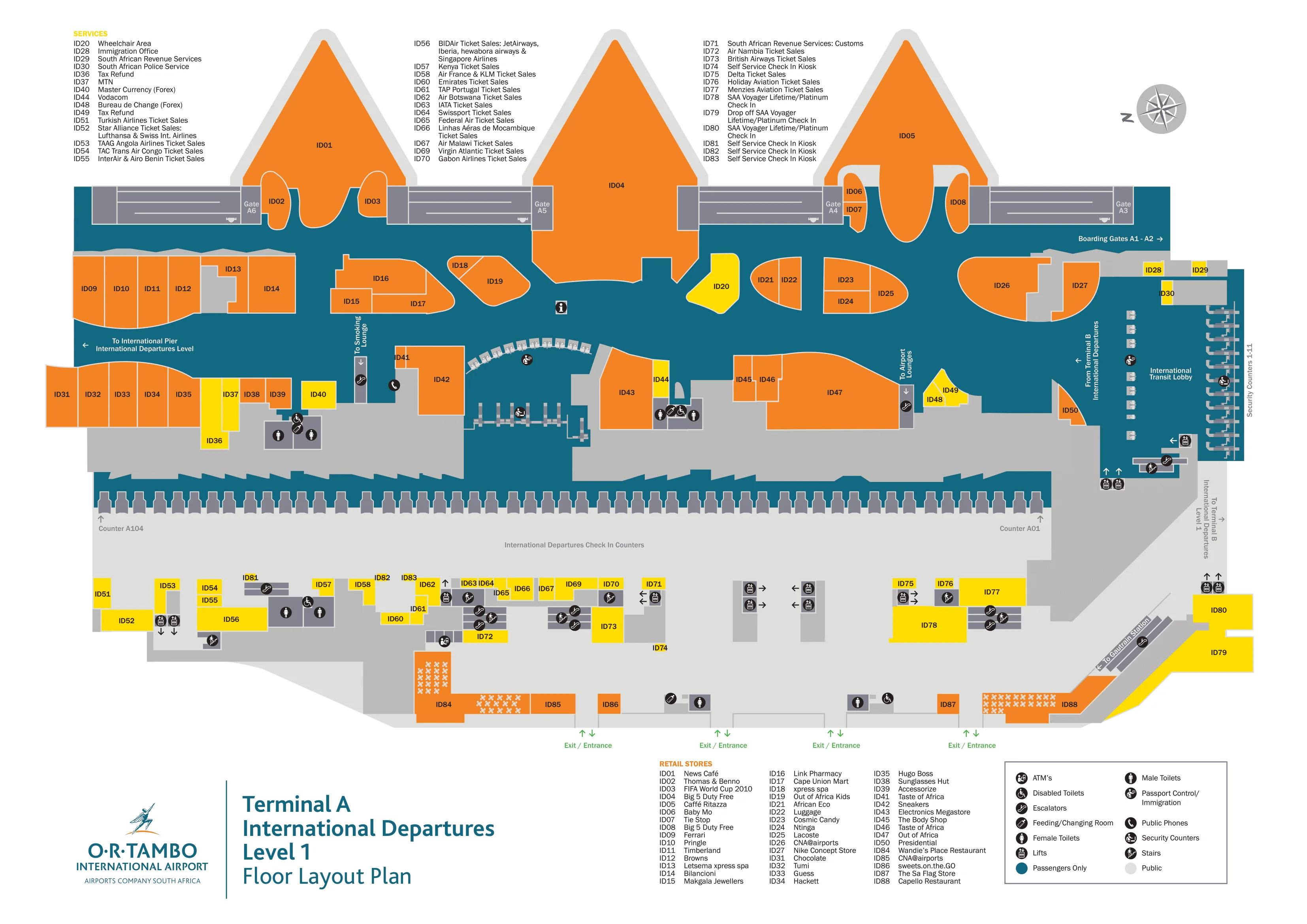
Terminal A is O.R. Tambo’s international-processing side: a multi-level layout that funnels arriving passengers down into a single Immigration Hall, then directly into a compact baggage reclaim zone before Customs releases you into the landside Arrivals Hall. The building stretches laterally into the Central Terminal Building (CTB), which is the indoor hinge for Terminal A ↔ Terminal B transfers within Johannesburg’s primary aviation hub.
Map Table
| Zone | Connection | Walk Time |
|---|---|---|
| Arrivals corridor | Down to Immigration Hall (Level 0) | immediate |
| Immigration Hall | Baggage reclaim (Carousels 1–10) | short |
| Customs exit buffer | CTB indoor link to Terminal B Departures | 10–15 min |
| Departures hall | Security → duty-free spine → Gates A0–A6 | variable |
O.R. Tambo International Airport Terminal A Map Strategy
- Treat Immigration + baggage reclaim as one chained chokepoint: identify the descent landing where queue ropes start, then commit to the correct passport-side lane before you’re trapped in barriers.
- Plan baggage as the connection wildcard: know the first carousel zone and the Customs exit moment where re-check counters appear immediately left/right, before you drift into the public Arrivals crowd.
- Make Terminal A ↔ Terminal B a CTB operation: stay indoors, navigate by the CTB atrium as the single “hinge,” and expect a forced level change before the Terminal B counter banks.
- Use landmark-based decision points to eliminate wrong turns: glass lifts/sloping travelators for level changes, police station/news café for landside anchors, and the main duty-free atrium as the last reliable restroom zone before committing to Gates A0–A6.
2026 O.R. Tambo International Airport Terminal A Map + Printable PDF
Terminal A continues to operate as the international arrivals/departures engine inside the CTB-integrated JNB terminal complex, with passenger flow still dominated by one primary Immigration Hall, a direct baggage reclaim interface, and a landside/airside split that forces clear decision points. A printable 2026 map is most useful when it highlights the exact descent points, re-check counters immediately after Customs, and the CTB level changes that cause wrong turns.
2026 O.R. Tambo International Airport Terminal A Map Guide
Where does the Terminal A arrivals immigration queue physically begin (first landmark/rope-line location) after you leave the arrival corridor?
The immigration queue begins at the base of the main descent into the Immigration Hall on Level 0, where the first rope-line (tens barrier) starts about 10–15 meters from the escalator landing.
After you leave the arrivals corridor, follow the one-way channel until you reach the down escalators or the long sloping ramp; the hall opens up in front of you as you descend, and the queue-control barriers are the first physical “stop” on the flat floor at the bottom. Use the hall layout immediately: “South African Passport Holders” lanes sit far left/center-left, while “Foreign/All Passports” lanes run center-right/right, so pick your side before you enter the rope maze.
What is the shortest walking route from Terminal A baggage claim to the Terminal B domestic check-in hall (first counter bank), without exiting the airport building?
The shortest indoor route runs through the Central Terminal Building atrium and finishes on Terminal B Departures level at the first domestic counter banks. Walking typically takes 10–15 minutes depending on luggage and crowding.
| Route step | Landmark decision point | Level change | Typical distance/time |
|---|---|---|---|
| Exit baggage reclaim | Green/Red Customs doors toward public Arrivals Hall | none | short |
| Stay inside, turn left | Facing the street exit, follow the indoor corridor into the CTB atrium | none | continuous |
| Reach the CTB “hinge” | Large open atrium space with central glass lifts and sloping travelators | up to Departures level | fastest with trolleys via sloping travelators |
| Enter Terminal B Departures | Domestic Departures hall edge, then walk straight to the first counter bank | none | total ~500–800 m / 10–15 min |
From the Terminal A international arrivals exit, what is the exact walking distance (meters) to the first baggage carousel area?
Walking distance is approximately 20–50 meters from the international arrivals immigration exit to the first baggage carousel zone.
After you clear passport control, you pass straight through into the baggage reclaim hall with no intervening corridors or transport links. The first carousel area (Carousels 1–10 hall) begins almost immediately past the final immigration desk line, with the first belt zone visible within a short, direct walk. Use the flight-to-carousel digital screens positioned right after the immigration exit to confirm which belt to approach before you commit deeper into the hall.
Which escalator/elevator bank is the fastest way from Terminal A arrivals level to Terminal A international departures check-in level (name the nearest landmark)?
The fastest vertical route is the Central Terminal Building atrium bank: the central glass elevators for passengers with hand luggage, or the sloping travelators (ramps) for baggage trolleys.
From Terminal A Arrivals (Level 0), walk indoors toward the CTB and use the large open atrium as your landmark—this is where the high-visibility glass lifts sit in the middle of the space. If you have a trolley, skip standard escalators and smaller lifts and take the sloping travelators designed to lock trolley wheels; they move you up compliantly without long elevator waits. The CTB drop-off point lands you at the check-in-level edge that feeds directly back into Terminal A international departures counters.
Where is the passport control / departures immigration entrance located relative to the main Terminal A check-in counters (left/right/behind + nearest shop landmark)?
The departures immigration entrance sits at the central rear of the Terminal A international check-in hall, behind the main counter islands, and it is reached by flowing toward the middle-back of the hall rather than the far left or far right.
From any check-in row, follow the natural crowd movement toward the big “International Departures” signage at the back-center. The sequence is converged and hard to miss: boarding pass scan leads into security screening, and departures immigration (emigration) is positioned immediately after the security checkpoints. Use the central security entry as your anchor point—if you can see the main security lanes and the start of the duty-free retail spine beyond, you’re in the correct place for the passport control entrance immediately after security.
After Terminal A security, where is the nearest restroom before committing toward Gates A0–A6 (exact position on the concourse)?
The nearest restroom is on the perimeter wall of the main duty-free retail atrium immediately after security, tucked into the recesses beside the Big 5 Duty Free zone before the pier walk toward Gates A0–A6.
After you exit security and enter the duty-free mall, do not start down the gate pier yet. Stay in the central retail atrium area and look along the outer wall edges rather than the shopfront centerline; the restroom entrances sit in the cut-back spaces between large retail anchors. Use Big 5 Duty Free (and nearby luxury storefronts in that same atrium block) as your triangulation point—once you pass out of the main retail atrium and commit into the narrower gate corridors, restroom options become smaller and more congested.
What is the walking distance from Terminal A security exit to Gate A1 (meters), using the primary passenger path?
Walking distance is approximately 300–400 meters from the Terminal A security exit to Gate A1 along the primary passenger path.
From the security exit, you enter the duty-free retail spine first, then follow the overhead “A” gate signage toward the start of the international pier. Gate A1 is typically one of the earliest decision points after the main retail block, so you should expect to pass the central duty-free area and then transition into the pier corridor before reaching the gate entrance area. Congestion can add time when boarding queues for early A-gates spill into the main walkway, but the physical distance remains in the 300–400 meter range.
What is the walking distance from Terminal A security exit to Gate A6 (meters), using the primary passenger path?
Walking distance is approximately 600–700 meters from the Terminal A security exit to Gate A6 along the primary passenger path.
After security, the route runs through the main duty-free retail spine and continues down the international pier, often alongside moving walkways (travelators) that can be busy or occasionally out of service. Use mid-pier retail markers as progress checks: The Body Shop and Out of Africa sit along the extended retail corridor on the way toward the higher-numbered A-gates. Gate A6 is far enough that boarding lines for Gates A1–A5 can narrow the corridor and slow the final approach, so budget walking time accordingly even though the measured distance is about two-thirds of a kilometer.
Where is the fast track or priority immigration lane entrance located relative to the main immigration queue (same hall vs separate corridor)?
The fast track entrance is in the same Immigration Hall as the main queues, positioned at the peripheral edge of the immigration desk bank rather than in a separate corridor.
After descending into the hall and reaching the rope-line start area, scan the extreme left and extreme right edges of the queue system. The fast track channel is typically separated by rigid barriers (not the flexible rope maze used for general passengers) and is controlled by staff, often tied to meet-and-assist, crew, or diplomatic processing. If you don’t have a voucher/escort, assume you must enter the standard “Foreign/All Passports” lanes and do not burn time hunting for an off-hall shortcut—the layout is designed to keep all arrivals in the same processing room.
Where is the nearest staffed information desk to the Terminal A arrivals exit (exact placement in the arrivals hall)?
The nearest staffed information desk is centrally positioned in the Terminal A Arrivals Hall directly in the passenger flow line from the Customs exit doors.
After you pass through the Green/Red Customs sliding doors into the public arrivals area, keep moving straight into the main hall rather than drifting toward the outer exit doors. Look for the standard “i” information signage at a central intercept point where arriving passengers naturally fan out toward pickups, car rentals, and transport. If you’re arriving during low-activity hours and the desk is unmanned, the next most reliable anchor nearby is the SAPS police station area, which sits close to the arrivals exit zone.
Where is the Gautrain access point relative to Terminal A (which level and which direction from the Terminal A central atrium)?
The Gautrain access point is on an upper level reached via the Central Terminal Building atrium, above and between Terminals A and B rather than inside Terminal A itself.
From Terminal A, walk indoors toward the CTB central atrium and follow the Gautrain’s gold/yellow branding wayfinding. Use the CTB’s main vertical-transport cluster as your decision point: take the central elevators/escalators up to the station concourse level (the link connects into the parkade superstructure area). From the customs/arrivals side, the walk to the Gautrain access is typically 5–8 minutes depending on crowding, with no need to exit the building to the street to reach it.
On the Terminal A arrivals level, where is the exact meeting-point landmark that drivers/pickups can realistically reach (closest public stand-here spot before restricted areas)?
The best practical meeting point is in front of the SAPS police station and adjacent Firearms Office on the Terminal A arrivals level.
After you exit Customs into the public Arrivals Hall, stay inside and move toward the clearly marked police station frontage rather than the curbside doors. This location is stable, easy to describe, and reachable for pickups without wandering into restricted corridors; it also sits in a higher-surveillance zone that reduces pressure from taxi touts. If you need a secondary landmark in the same arrivals hall line, the News Café or the Vodacom shop work well because they are large branded storefronts visible from a distance.
For an overnight layover, where is the closest 24/7-accessible seating cluster to Terminal A departures security (exact zone/landmark), without leaving the public area?
The closest workable seating cluster is in the Central Terminal Building atrium near the mezzanine food court area around Mug & Bean, one level above the ground arrivals draft zones.
Stay landside and use the CTB atrium as your anchor rather than the Terminal A Arrivals Hall benches, which are colder and more exposed to automatic-door airflow. The most tolerated overnight “survival” zone is typically the seating near the food court edge (Mug & Bean area) where passengers can sit without blocking cleaning routes, and where lighting and foot traffic are steadier than at curb exits. Seating is not sleep-friendly, so prioritize warmth, visibility, and proximity to the main CTB vertical transport.
Where is the first point you can re-check bags for a domestic connection after arriving international (exact counter zone/airline check-in area), and how far is it from Terminal A customs exit?
The first re-check point is immediately after the Green/Red Customs exit doors in the landside transition buffer, at the “Domestic Transfers” / “Baggage Re-check” counter zone positioned just off to the left or right before you merge into the main public Arrivals Hall.
You should treat Customs exit as the trigger: once you pass the sliding glass doors, stop and scan both sides for the transfer desk signage rather than walking forward into the crowd. The distance from the Customs exit to the re-check counters is effectively immediate—typically within a few steps and well under 50 meters—so missing it usually happens from momentum, not from navigation difficulty. If you’re on a separate ticket or an LCC, expect to carry bags onward to Terminal B instead.
If you accidentally walk too far up toward the train level from Terminal A, where is the nearest route back down to Terminal A departures check-in (stairs/elevator location)?
The nearest recovery route is the Central Terminal Building atrium’s main vertical core, using the central glass elevator bank back down to the check-in level edge.
If you find yourself drifting up toward the Gautrain/upper concourse link, stop and backtrack to the CTB’s large open atrium space rather than hunting for side corridors or service lifts. The atrium is the reliable “reset” landmark: it concentrates the public escalators, the sloping travelators, and the most visible glass lifts in one place. Take the glass lifts down to the departures/check-in level and reorient toward the Terminal A international counter islands; avoiding hidden service elevators prevents you from surfacing in staff-only or dead-end zones.