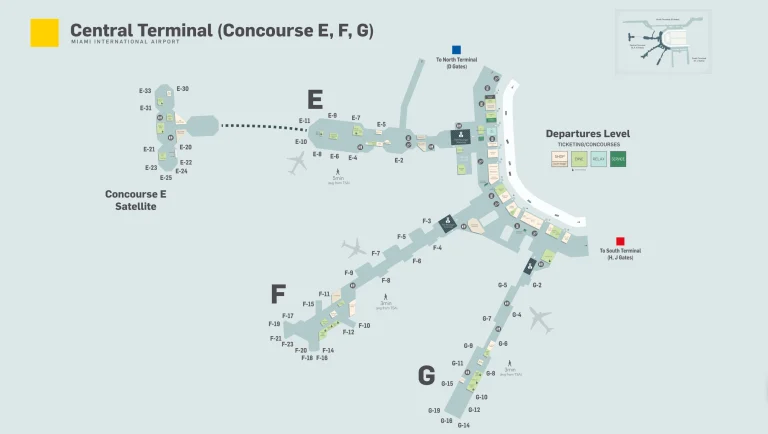
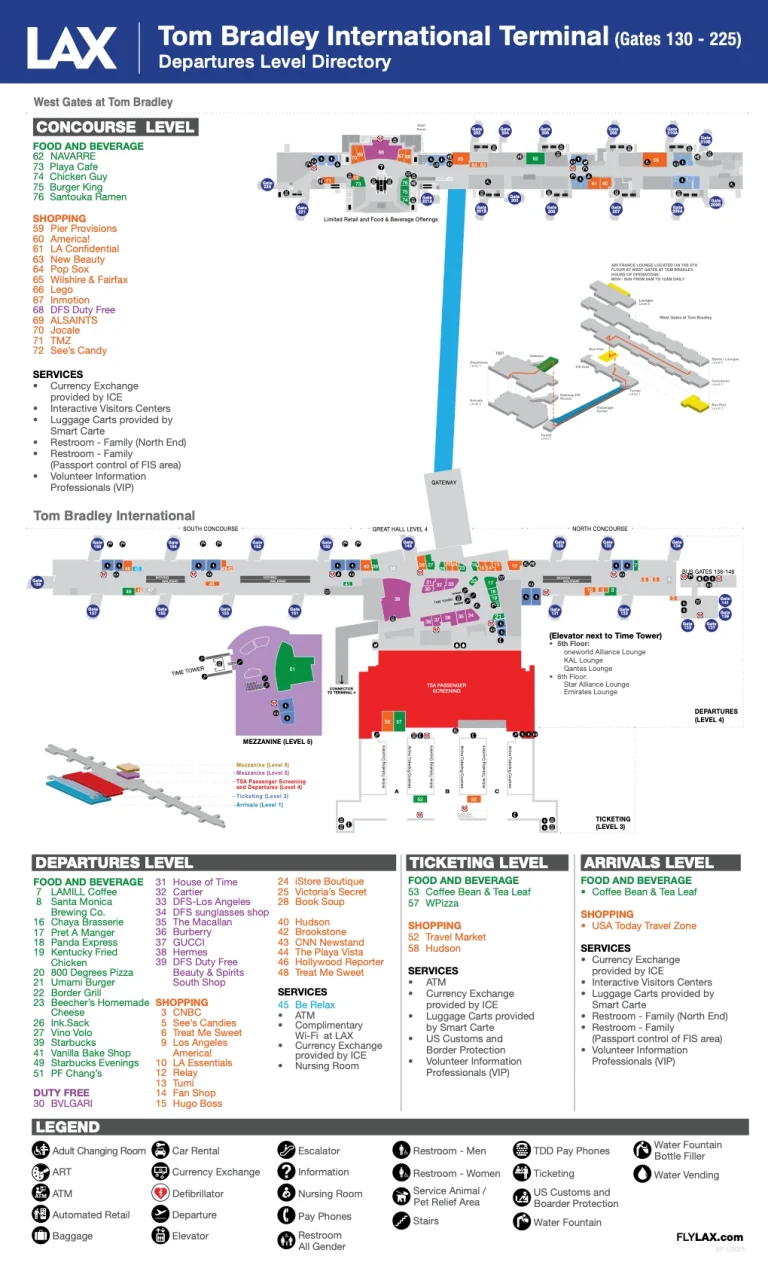
Dubai International Airport Terminal 3 Map (Most Up-To-Date)

Dubai International Airport Terminal 3 is a three-concourse “island chain” within Dubai’s primary airport hub: Concourse B as the central elliptical core, Concourse A as a separate satellite reached by the underground train, and Concourse C as a long linear pier reached on foot (with selective airside bus options). The overall shape is hub-and-spokes at a huge scale, with the Concourse B central pivot determining whether your transfer becomes train, bus, or endurance walk.
Map Table
| Zone | Connection | Walk Time |
|---|---|---|
| Concourse B central hub | transfer security, duty-free atrium, APM access | shortest within Terminal 3 |
| Concourse A satellite | APM train via Concourse B station | fixed train cycle |
| Concourse C linear pier | B–C connector corridors, travelators | longest end-to-end |
| Remote stands | bus intake nodes near key desks | variable dwell time |
Dubai International Airport Terminal 3 Map Strategy
- Treat every connection as a chained transfer: transfer security → concourse decision → train/bus leg → long walk; the map should make that chain predictable at a glance.
- Use Concourse B Central as the pivot: locate the transfer-security exit, then immediately choose APM access versus the B–C connector direction before the duty-free flow pulls you off-line.
- De-risk Concourse A/B/C uncertainty by following modality cues: “Train to Gates A…” for A, continuous gate spines for B, and the right-angle “L” turn into C for the long-pier walk.
- Plan for remote-stand friction: bus arrivals inject passengers into specific intake nodes that can stack queues; the map should highlight those drop points and the fastest path back to screens and help desks.
2026 Dubai International Airport Terminal 3 Map + Printable PDF
Terminal 3 continues to operate as the Emirates-focused complex with three concourses that function like separate buildings. The crucial map truth is modal: the train links only Concourses A and B, while Concourse C is primarily a walking vector unless an airside bus option is available. A printable PDF matters most when it pins the transfer-security exit, the APM access core, and the exact start of the B–C connector.

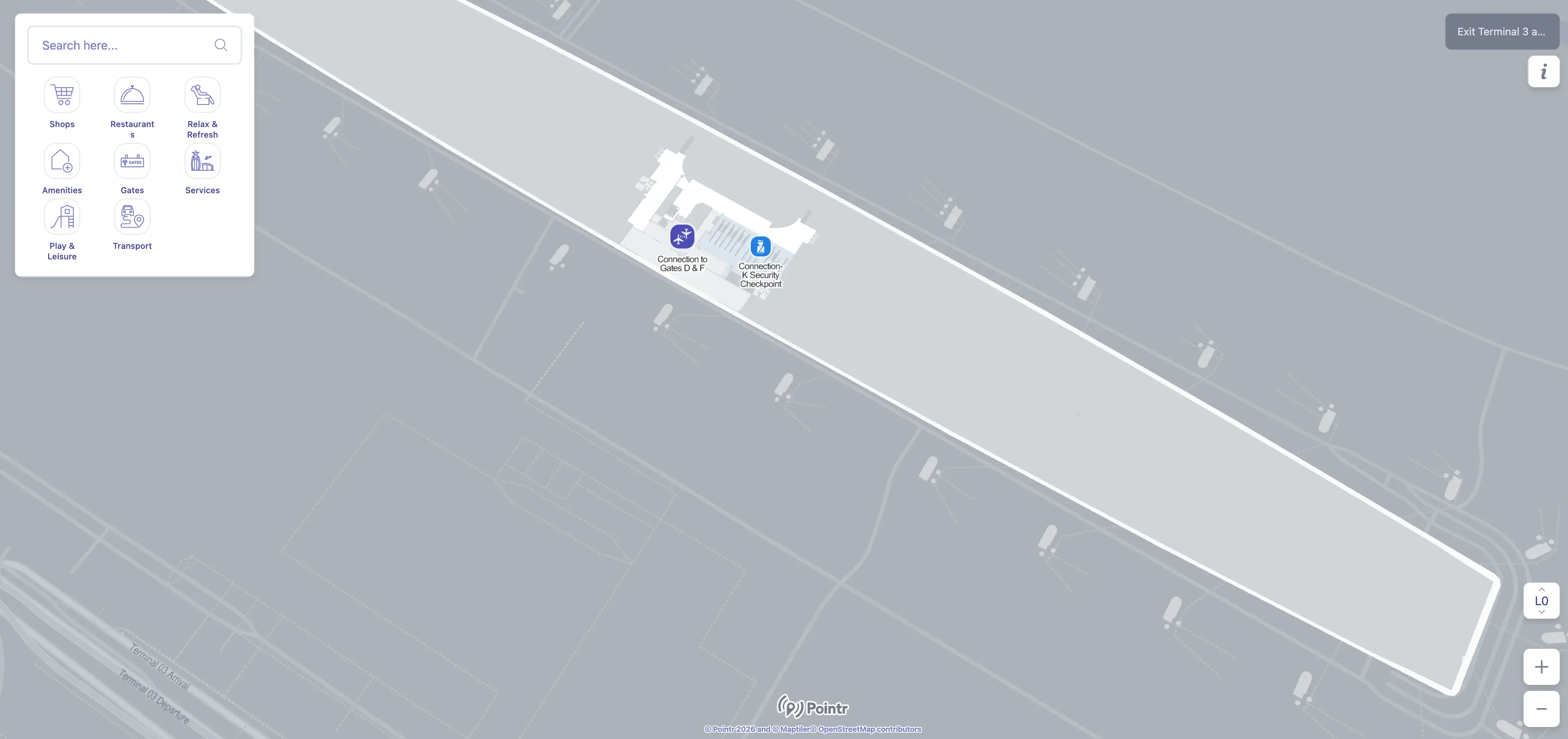
Dubai International Airport Terminal 3 Level 0 Connection Floor Map 2025
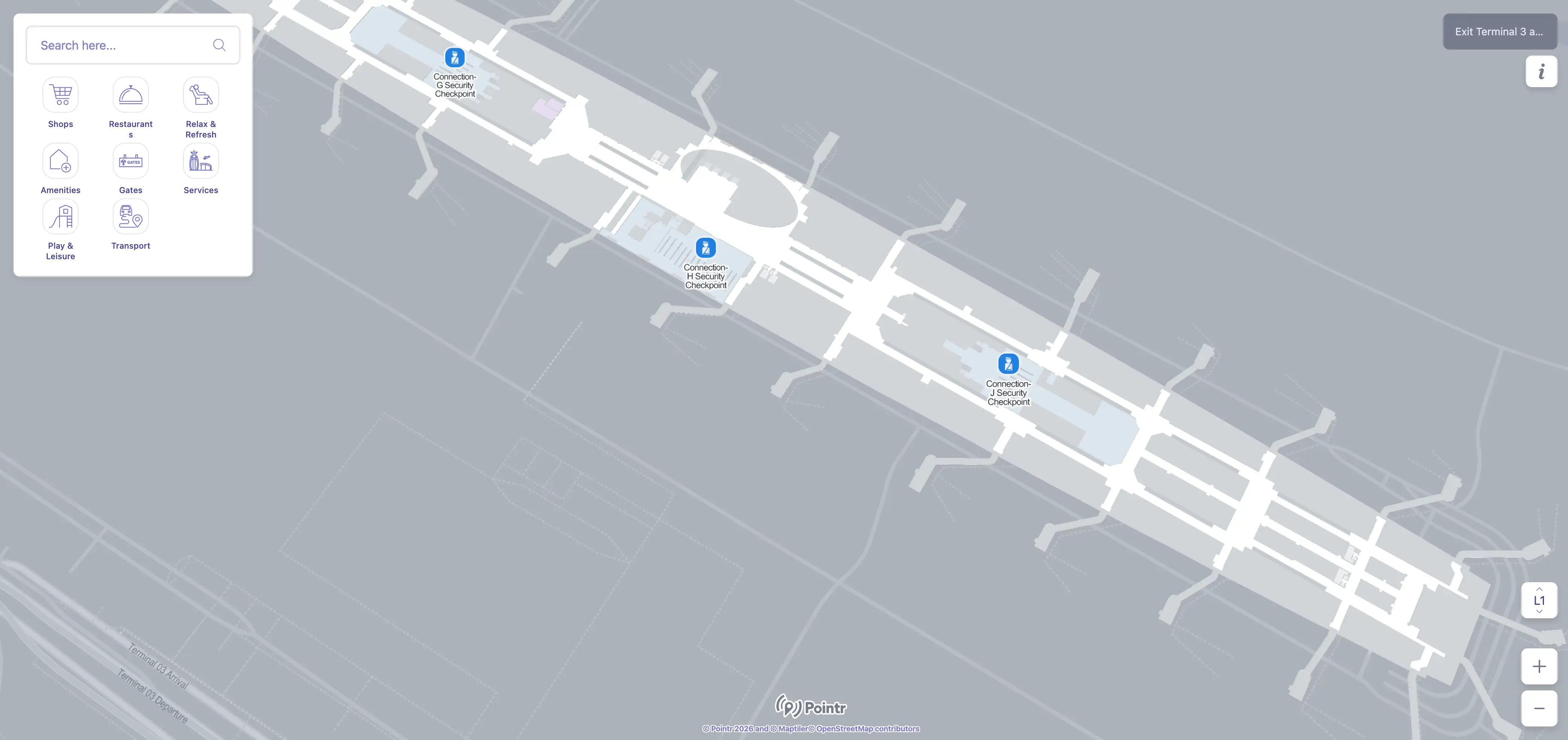
Dubai International Airport Terminal 3 Level 1 Arrivals B Gates Map 2025
Dubai International Airport Terminal 3 Level 2 Departures B Gates Map 2025
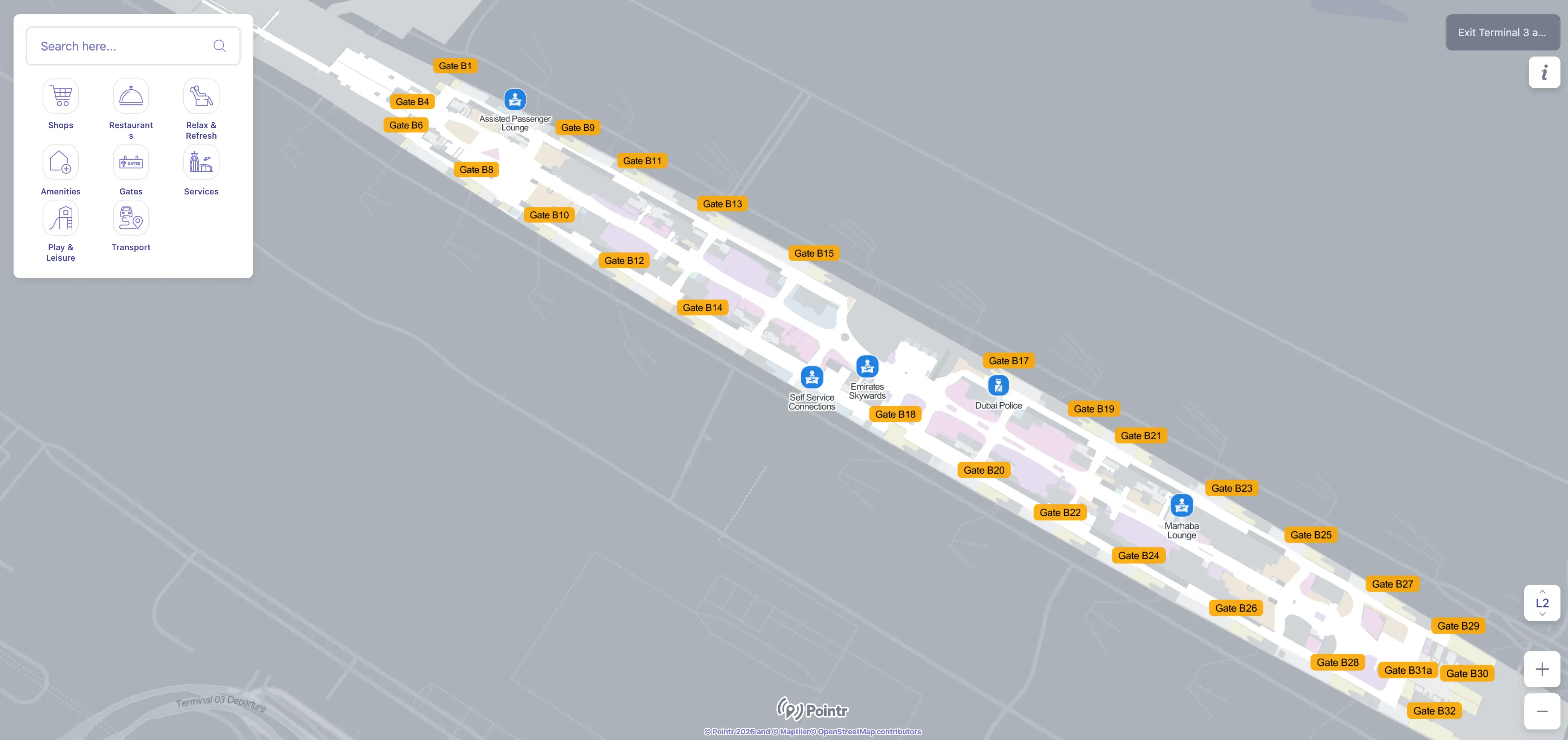
Dubai International Airport Terminal 3 Level 3 EK Lounges B Gates Map 2025
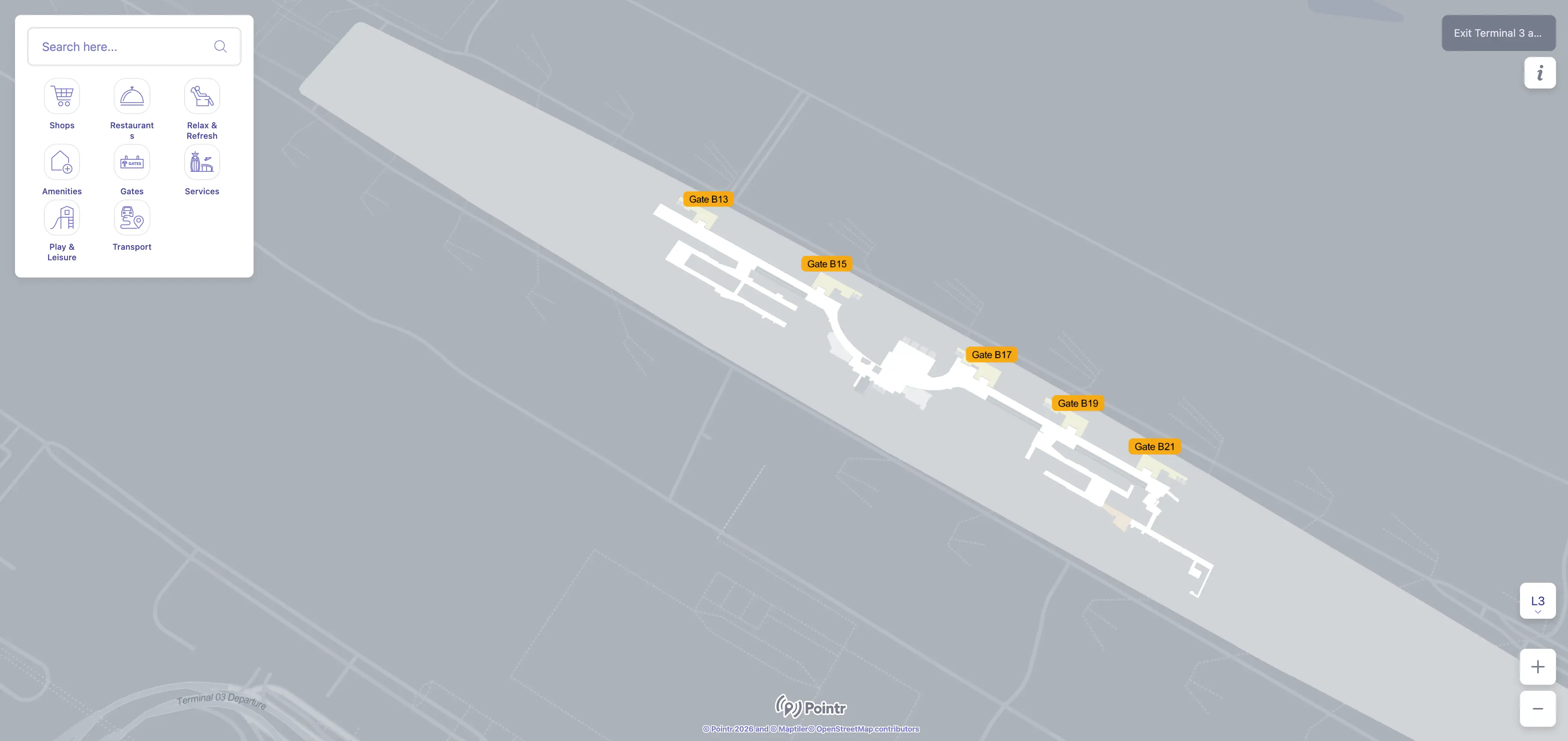
Dubai International Airport Terminal 3 Level B3 Departures Map 2025
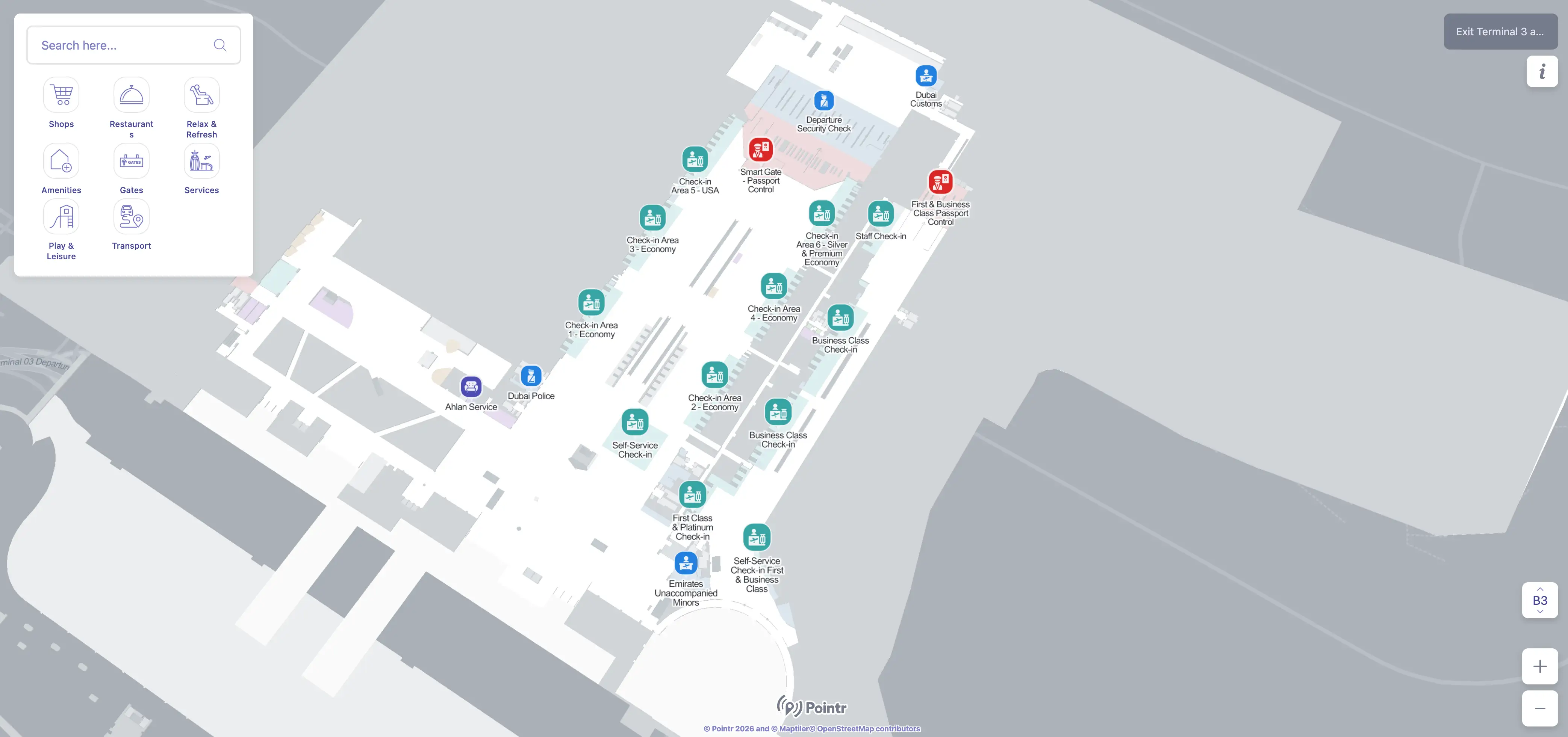
Dubai International Airport Terminal 3 Level B4 Arrivals Map 2025
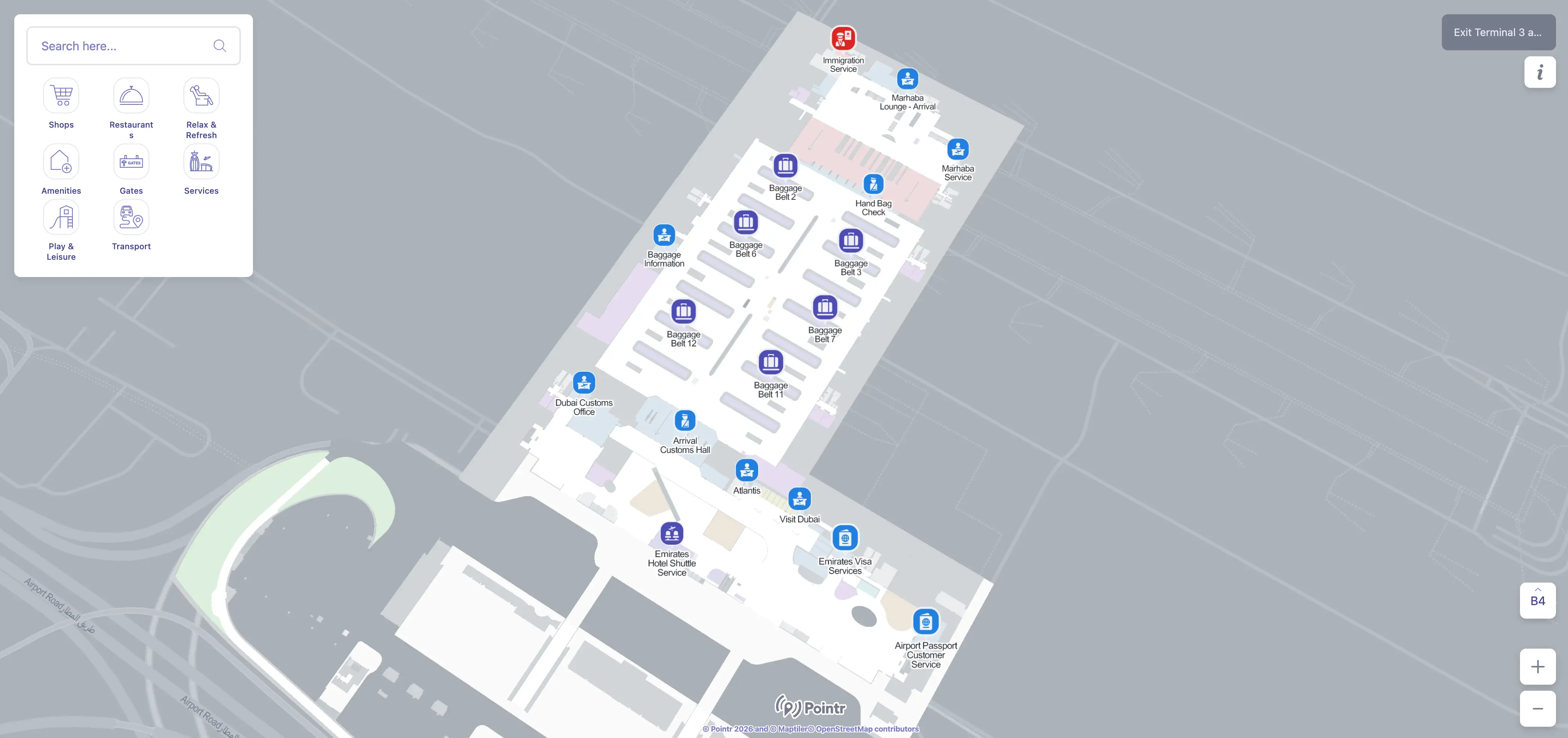
2026 Dubai International Airport Terminal 3 Map Guide
Where is the airside transfer security checkpoint located for Terminal 3 connections (Arrivals → Departures), relative to the main Concourse B arrivals flow?
The airside transfer security checkpoint sits in Concourse B’s central transfer node at the end of the main arrivals corridor, directly under the departures hub around Gates B14–B22 (near the B18 area).
Arriving passengers in Concourse B are funneled along a unidirectional lower-level arrivals flow toward the middle of the concourse, not toward the gate ends. The checkpoint is positioned as the single “release valve” that all connecting passengers reach before re-entering the main airside departures environment. A reliable landmark at this node is the Emirates Connections area (Transfer Desk K), which sits in the same central zone where the security queues form before you go up to the departures/duty-free level.
What is the walking distance (meters) from the transfer security exit to the Concourse A train platform entrance?
The walking distance is approximately 50 to 100 meters from the transfer security exit to the Concourse A train access entrance in Concourse B Central.
After you clear transfer security and surface into the main departures/duty-free atrium (the central Concourse B retail core), the train access is essentially in the same hub zone rather than down a gate spine. The short distance is often slowed by crowd density in the duty-free crossflow, so the path can feel longer than it measures, but the map-relevant geometry is tight: security exit into the central atrium, then a short straight-line displacement to the clearly signed APM/train access point for Gates A1–A24.
Where is the Concourse A train boarding point located (exact level + nearest landmark) when coming from Concourse B?
The Concourse A train boarding point is on the underground automated train level beneath Concourse B Central, reached by the main elevator and escalator banks in the duty-free atrium near the large central landmark features.
From Concourse B’s central departures hub (around the B14–B22 gate cluster), follow signage for “Train to Gates A1–A24” to the vertical circulation core, then descend to the dedicated train platform level (commonly shown as a basement level such as Level -1 or Level -2 on terminal maps). The most consistent landmark is the central Concourse B atrium’s major elevator bank beside the busiest duty-free zone, where the train-wayfinding signs cluster before you drop to the platform.
Where is the airside bus pickup point used for Concourse A ↔ Concourse C transfers located?
The airside bus pickup point is in Concourse A at Bus Connection Area A6, positioned around Gate A6 in the dedicated bus-operation area rather than at the train station.
From the Concourse A gate spine, the pickup is signed as a bus connection node and typically requires moving down into the lower holding area used for bus boarding. A practical triangulation point is Gate A6 itself: the bus area is anchored to that gate cluster, and it’s the same node used when remote-stand arrivals feed into Concourse A by bus. If your map shows “Bus Connection A6,” treat that as the start point for the A ↔ C shuttle.
What is the point-to-point distance from the Concourse C bus drop-off to the midpoint of Concourse C gates?
The point-to-point distance is roughly 300 to 400 meters from the Concourse C bus drop-off at Connections Desk E to the midpoint of the Concourse C gate spine (around the mid-gate cluster).
Connections Desk E is the key airside bus node in Concourse C, and it sits near the concourse’s central control/transfer area rather than at the far ends. From Desk E, the walk to the middle of the pier (often thought of around the central gate band) is a single continuous gate-spine walk with minimal branching, typically taking about 4–6 minutes at a normal pace.
What is the walking distance from the start of Concourse C gates to the furthest end of Concourse C (end-to-end span)?
The walking distance is approximately 800 meters from the start of Concourse C (near Gate C1) to the far end of the concourse.
Concourse C is a long linear pier, so the “start” is effectively the entry near the B–C junction where the gate numbering begins, and the “furthest end” is the tip with the highest gate numbers and remote-stand activity. On the ground, this reads as a straight endurance walk along one main spine with intermittent travelators, typically taking about 10–12 minutes of continuous walking depending on crowd density and whether you catch the moving walkways.
Where do remote-stand shuttle buses most commonly drop passengers into Terminal 3 (specific entry nodes), by concourse?
Remote-stand shuttle buses most commonly drop passengers at Bus Connection Area A6 in Concourse A, at the central transfer intake near Transfer Desk K in Concourse B, and at Connections Desk E in Concourse C.
In Concourse A, remote arrivals feed into the same Gate A6 bus-operations node used for inter-concourse bus transfers, so that area can surge when multiple buses unload. In Concourse B, the most common injection point is the central Concourse B transfer zone aligned with the main transfer-security complex, where Transfer Desk K sits as the recognizable landmark. In Concourse C, bus arrivals concentrate at Connections Desk E, which functions as the primary intake and redistribution point back onto the C gate spine.
What is the shortest mapped route from the Concourse B central junction to a typical Concourse C gate cluster (no train), including all corridor transitions?
The shortest mapped route is a continuous walk from Concourse B Central toward the high-number B-gates, through the B–C connector corridor, then around the right-angle “L” turn into the Concourse C pier to reach the C gate spine.
| Segment | Directional anchor | Typical distance/time |
|---|---|---|
| Concourse B Central → upper B end | from the central hub near Gates B14–B22 toward Gate B32 | ~500–550 m, ~6–9 min |
| B end → B–C connector | enter the connector corridor with travelators | included in above segment flow |
| Connector “L” turn → start of Concourse C | make the right-angle turn into the linear C pier, arriving near Gate C1 | short transition |
| Start of C → typical C gate cluster | continue along the C gate spine toward your gate band | variable along the pier |
Where are the first flight-information screens located immediately after transfer security, and which direction do they face relative to the main flow?
The first flight-information screens are positioned immediately at the top of the vertical ascent from transfer security into Concourse B’s central departures atrium, facing the escalators/elevators where passengers emerge.
After screening, the main flow rises into the central duty-free retail core; the screens are placed so you see them head-on as you step off the escalator (or exit the elevator) before you drift left or right into the Concourse B gate spines. This orientation makes the screens the first “vector decision” point: you read the gate/concourse, then turn toward the A train access, stay in B, or start the walk toward the B–C connector.
Where is the Emirates Connections/Transfer Desk located within Terminal 3 airside, and what is the nearest vertical circulation (escalator/elevator bank)?
The Emirates Connections/Transfer Desk is in Concourse B Central airside at Transfer Desk K, co-located with the main transfer-security complex and the central arrivals-to-departures funnel.
The nearest vertical circulation is the central Concourse B escalator/elevator banksRemote-stand shuttle buses that lift passengers from the transfer-security/arrival levels up into the departures/duty-free atrium. This is the same core used to transition into the main Concourse B retail hub and to access the underground train level for Concourse A, so it’s a reliable landmark: Desk K sits in the high-density central transfer node, and the adjacent escalators/elevators are the first major “upward” move after the queues.
Where is the Dubai International Hotel (airside in Terminal 3) access point located, relative to Concourse B’s central area?
The Dubai International Hotel access point is in Concourse B’s central airside zone, reached via elevators located between Gates B14 and B22.
That placement puts the hotel essentially on the Concourse B “center of gravity,” close to the main duty-free atrium where transfer security releases passengers back into departures flow. From the central Concourse B retail core (often aligned with the B18 area), the hotel access is not down a distant gate corridor; it’s reached by identifying the elevator bank in the mid-concourse gate cluster and going up to the hotel level from that vertical circulation node.
Where is the Marhaba Lounge entrance located in Terminal 3 (airside), relative to the nearest gate spine?
The Marhaba Lounge entrance is in Concourse B airside, accessed from the departures level via a dedicated elevator bank close to Gate B21 on the north side of the Concourse B gate spine.
From the central Concourse B duty-free flow, you don’t reach Marhaba by walking deep toward the gate ends; you reach it by finding the specific lift near the B21 gate cluster and going up from that vertical circulation node. The easiest triangulation is Gate B21 itself: the lounge is not a storefront on the main spine, but a “lift-access” facility that can be missed if you keep moving with the retail traffic. Some older wayfinding references mention the B26 area, but current placement aligns with the B21 node.
Where are the Emirates Business/First lounge entrances in Concourse B vs Concourse C, mapped by nearest gate numbers?
The Emirates lounge access clusters in Concourse B are concentrated near Gates B13–B15 for Business Class and near Gates B17–B21 for First Class, while the Concourse C lounge access is anchored near Gate C13.
In Concourse B, the lounge elevators are distributed across the central gate band rather than at the ends, so the most reliable wayfinding tactic is to head for the nearest listed gate number and then look for the vertical circulation up to the lounge levels. In Concourse C, the lounge access sits near the concourse’s central landmark node, with Gate C13 acting as the simplest triangulation point on the linear gate spine.
What is the minimum walking distance from the Concourse B lounge entrance to the closest B-gate boarding area?
The minimum walking distance is under 50 meters from a Concourse B lounge entrance elevator down to the nearest adjacent B-gate boarding area in the central gate cluster.
When you exit the lounge via the closest elevator banks (in the B13–B21 zone), the nearest gates are immediately on the same central departures spine—examples include the gate band around B16–B20 depending on which lounge access point you used. The distance stays “negligible” only for the gates directly adjacent to that elevator node; once your gate assignment shifts toward an end (like the B32 area), the walk becomes a several-hundred-meter trek down the concourse.
Where are the mobility-assistance friendly routes (elevators / step-free paths) between the transfer security exit and the Concourse A train platform?
The step-free route uses elevators from the transfer-security exit up into Concourse B’s central departures atrium, then the large central elevator bank down to the underground train platform level for the Concourse A APM.
The first elevator node is directly beside the main escalators that lift passengers out of the transfer-security complex into the duty-free atrium, so you can stay in the same vertical core as the main flow without detouring down a gate corridor. From the departures atrium, follow “Train to Gates A1–A24” signage to the central high-capacity elevator bank in the Concourse B hub, then ride down to the dedicated APM platform level where level boarding continues onto the train.