John F Kennedy International Airport Terminal 7 Map (Most Up-To-Date)

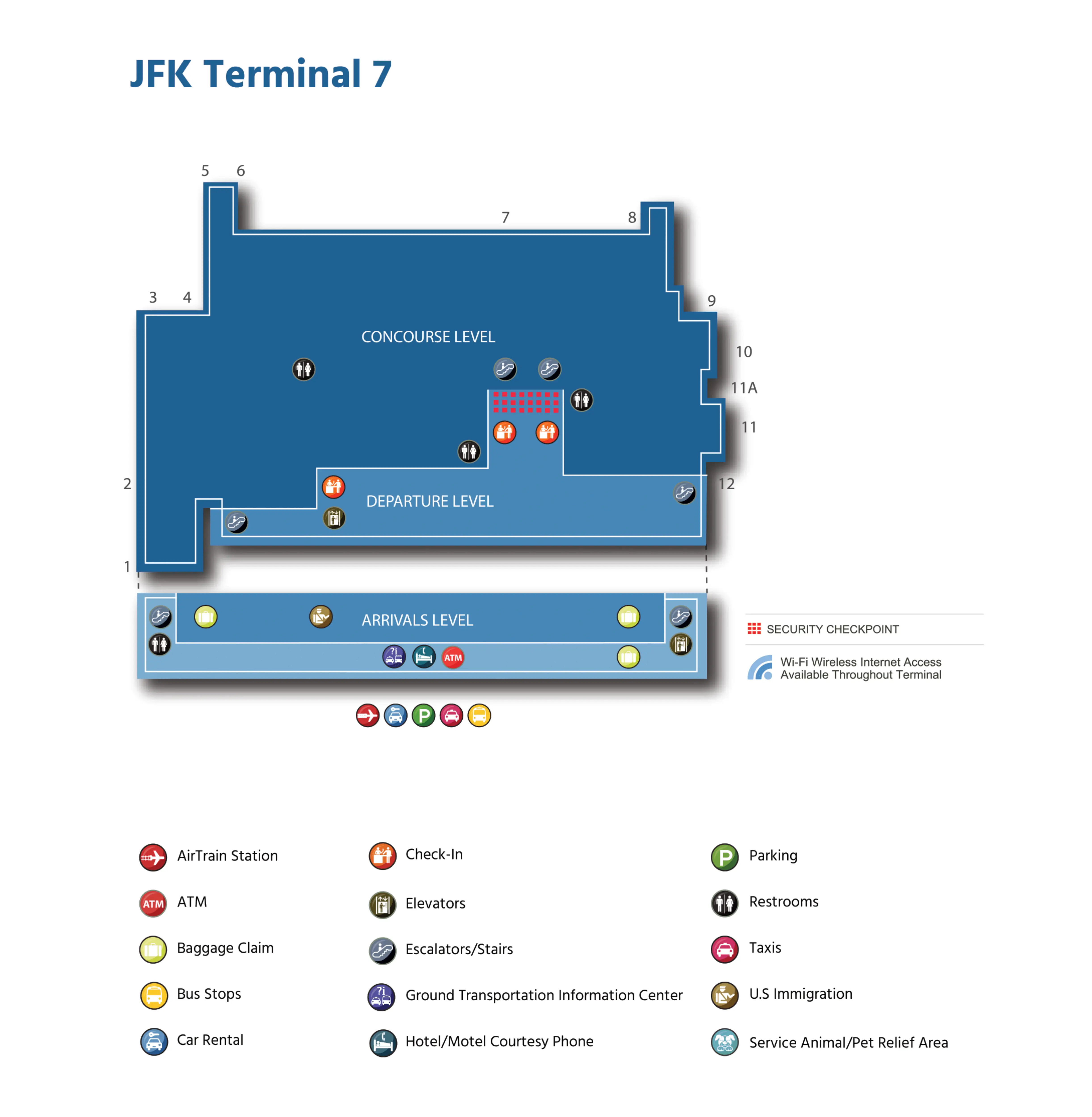
Terminal 7 is a compact, three-level “sandwich” within the broader JFK airport complex, with a narrow Level 2 check-in hall feeding a single, space-constrained TSA frontage, then a post-security central rotunda that fans into three short “finger” concourses for Gates 1–12. Arrivals and baggage claim sit on Level 1, but the AirTrain access is elevated and reached from Level 2 via an enclosed skybridge over the roadway, making “up-then-out” the key movement pattern.
Map Table
| Zone | Connection | Walk Time | Level |
|---|---|---|---|
| Curbside Doors 1–3 | Check-in Zones A–E | 1–4 min | 2 |
| Check-in Zone A | ANA desks, far end frontage | 0–2 min | 2 |
| Check-in Zone E | Alaska desks, TSA frontage nearby | 0–2 min | 2 |
| TSA Checkpoint Frontage | Queue corral, PreCheck lane within bank | 2–6 min | 2 |
| AirTrain Skybridge | “AirTrain” signage, elevated station entrance | 4–8 min | 2 |
| Post-security Rotunda | main concessions cluster, concourse decision point | 1–2 min | 2 |
| Left Pier Gates 1–6 | restroom near Gate 4, sparse amenities deep | 4–8 min | 2 |
| Forward Gates 7–8 | larger holdroom seating | 3–6 min | 2 |
| Right Pier Gates 9–12 | restroom near Gate 10 | 4–8 min | 2 |
| Mezzanine Lounge Level | Alaska Lounge, quieter seating | 2–5 min | 3 |
| Arrivals / Baggage Claim | CBP, carousels, arrivals lobby | 3–7 min | 1 |
John F Kennedy International Airport Terminal 7 Map Strategy
- Treat Terminal 7 as a bottleneck: enter with extra buffer, because the TSA line has limited depth and can spill into the check-in hall fast during departure banks.
- Assume PreCheck can degrade: check the checkpoint frontage for the PreCheck banner before committing, and be ready for a merged/“lite” configuration.
- For rideshare, plan “up-then-out”: from arrivals, go to the central escalators/elevators, up to Level 2, then the AirTrain skybridge—don’t burn time at the curb expecting app pickup.
- At the AirTrain platform, trust the LED “Next Stop” and route names (Howard Beach vs Jamaica vs terminal loop) before boarding; one wrong direction can create a long, high-stress correction.
2025 John F Kennedy International Airport Terminal 7 Map + Printable PDF
In 2025, Terminal 7 remains operational but functions like a “transition” building under heavy JFK redevelopment pressure, with passenger flow repeatedly reshaped by construction-era rules. The biggest practical change is ground-transport logic: app-based rideshare pickup is not a simple curb decision, and the AirTrain skybridge from Level 2 becomes the default “exit route” for many travelers. Expect flexible queue setups and signage-driven detours.
2025 John F Kennedy International Airport Terminal 7 Map Guide
What is the exact physical start point of the Terminal 7 TSA queue (landmark/door/turn), as shown on the terminal layout?
The Terminal 7 TSA queue starts on Level 2 in the departures/check-in hall at the movable stanchion corral beside Check-in Zone E (Alaska Airlines side), where the low glass partitions begin.
Use Door 2 or Door 3 from the departures curb and walk straight into the check-in hall; the first “hard” landmark is the Zone E counter line, then the TSA queue forms immediately adjacent in a reconfigurable lane set (tensabarriers) that often pushes toward the center aisle. If you reach the ANA/Zone A end (Door 1 side), you’ve gone past the closest approach—turn back toward Zone E and look for the glass-and-stanchion queue frontage.
Where is the TSA PreCheck lane entrance located relative to the standard screening entrance (exact position on the checkpoint frontage)?
The TSA PreCheck lane entrance is on the far right side of the Terminal 7 checkpoint frontage when you are facing the screening machines, running parallel to the general/standard entrance in the same checkpoint bank.
Look for the “TSA PreCheck” banner closest to the Alaska Airlines priority/check-in area (Zone E side), with the standard screening lanes immediately to its left along the same stanchioned frontage. The PreCheck and premium/priority queues can sit adjacent, so the dependable differentiator is the overhead PreCheck sign at the lane mouth, not the shorter-looking line.
What is the exact indoor walking route (including level changes) from baggage claim exit to the Terminal 7 AirTrain access?
Reaching Terminal 7’s AirTrain access requires going up to Level 2 first, then using the enclosed skybridge to the elevated station; there is no direct Level 1 (arrivals) AirTrain door.
From the Level 1 arrivals lobby outside baggage claim, stay inside and head to the central escalators/elevators near the Welcome Center/Hudson News area. Go up one level to Level 2 (departures/check-in), then follow the green “AirTrain” signs across the terminal frontage to the enclosed walkway bridge that crosses over the roadway. Continue through the bridge to the AirTrain station entry and platform area. Avoid exiting to the curb on Level 1 expecting a ground-level station—doing so forces a backtrack to reach the elevated bridge access.
At the Terminal 7 AirTrain station, which platform side / direction signage corresponds to trains toward Howard Beach?
Trains toward Howard Beach are the ones signed “Howard Beach” (Green Line) on the platform where the overhead LED shows “Next Stop: Terminal 8,” because that direction continues past Terminal 8 and then exits the terminal loop toward Federal Circle and Howard Beach.
At the Terminal 7 station, stand under the electronic displays and choose the side where the train marquee explicitly reads “Howard Beach Route” (not just “Airline Terminals”). If the next-stop line reads “Terminal 8,” you’re pointed the right way for Howard Beach; if it reads “Terminal 5,” you’re on the terminal-loop direction instead. When in doubt, wait for the next arriving train and match the front/side LED to “Howard Beach.”
At Howard Beach Station, which exit path leads directly into the Ride App / Car Services pickup lot area used for Terminal 7 pickups?
The correct exit path at Howard Beach is the one signed “Ride App Pick Up / Car Services” (often paired with “Long Term Parking”), which takes you out of the AirTrain paid-area without entering the subway turnstiles and down to the ground-level lot.
After you get off the AirTrain at Howard Beach, follow signs for “Ride App Pick Up / Car Services” toward the station exits, staying on the airport-side pathways rather than the A subway entrance. Pass through the AirTrain exit gates (do not tap OMNY/MetroCard for the subway), then take the escalator or elevator down from the elevated station level to the parking-lot surface. You should emerge directly into the designated pickup lot area with numbered stalls/rows used for app-based pickups.
Which Terminal 7 curbside door/entrance minimizes walking distance to the main airline check-in counters (exact nearest entry)?
Door 3 is the closest curbside entry to the central check-in counters and the Zone E (Alaska Airlines) side of the departures hall, minimizing the overall luggage walk for most travelers.
Door 3 drops you into the middle-to-west portion of Level 2 where the counter line thickens and the TSA frontage is nearby, so it’s the best “default” entry if you’re unsure of your airline zone. Door 1 is the shortest walk only if you are specifically heading to ANA’s Zone A desks at the far end of the hall (you’ll see the ANA/Zone A area immediately after entering). Door 2 is the compromise door between those two, but Door 3 most consistently lands you closest to the main processing area.
Post-security, where is the primary food/concessions cluster located (nearest gate numbers/landmarks)?
The primary food and concessions cluster is immediately after the TSA exit in the central post-security rotunda, the “town square” where all gate corridors branch.
It sits at the concourse decision point before you commit to the left pier (toward Gates 1–6), the forward widebody area (Gates 7–8), or the right pier (toward Gates 9–12). The cluster is anchored by the main sit-down and quick-serve lineup (commonly including Wolfgang Puck Express / The Local, plus grab-and-go like Apartment 7B Deli) concentrated in that central hall rather than deep in any gate finger. If you walk past the rotunda and into the narrow gate corridors, you’ve already left the main concessions zone.
Which gate (or gate cluster) is the farthest walking distance from the post-security concessions area?
Gate 6 is typically the farthest walk from Terminal 7’s post-security concessions rotunda because it sits at the tip of the left pier beyond the Gates 1–6 corridor.
From the TSA exit, the concessions rotunda is the center point; the longest “one-way out” walk is down the left finger past the mid-pier area toward the Gate 6 holdroom, where amenities thin out and backtracking is slow during boarding surges. Gate 12 is also an end-of-pier extreme on the right side, but Gate 6 is the most consistently isolated relative to the central food court because the left pier is narrow and service-sparse deep in the corridor.
Where are the largest seating clusters post-security (and their nearest gate references)?
The largest seating cluster is the central post-security rotunda seating around the main concessions area, with the second-largest concentrated in the Gate 7–8 holdroom zone.
The rotunda has the highest density of tables and chairs because it’s built as the terminal’s airside “town square” immediately off the TSA exit, but it fills fast and gets noisy. For a larger, more open holdroom-style seating area, walk toward the forward widebody gates: the Gate 7/8 area was designed for higher-capacity international departures and has noticeably deeper seating banks than the narrow left (Gates 1–6) and right (Gates 9–12) piers. If you need space, the Gate 7–8 zone is the best overflow even when your flight boards elsewhere.
Where are the closest restrooms to each main gate cluster post-security (identify by nearest gate numbers)?
The closest restrooms post-security are grouped in three main spots: the central rotunda immediately after TSA, the left pier near Gate 4 for Gates 1–6, and the right pier near Gate 10 for Gates 9–12, with another set adjacent to Gate 8 for the forward Gate 7–8 area.
- Central hub restrooms: immediately post-security in the rotunda concessions hall (best capacity before walking down a pier).
- Gates 1–6 cluster: restrooms along the left finger around Gate 4 (closest for Gates 1–3 and Gates 5–6).
- Gates 7–8 cluster: restrooms adjacent to Gate 8 (closest for the widebody holdroom area).
- Gates 9–12 cluster: restrooms along the right finger around Gate 10 (closest for Gates 9 and Gates 11–12).
What is the shortest Terminal 7 → Terminal 8 transfer route using AirTrain (origin point, station entry, exit point), as shown on terminal maps?
The shortest Terminal 7 → Terminal 8 transfer is one AirTrain stop from the Terminal 7 station to the Terminal 8 station, using a Howard Beach or Jamaica Route train whose display shows “Next Stop: Terminal 8.”
| Step | Origin point | Connection | Exit point |
|---|---|---|---|
| 1 | Terminal 7 Level 2 departures hall | enclosed AirTrain skybridge | Terminal 7 AirTrain platform |
| 2 | Terminal 7 AirTrain platform | board train signed Howard Beach or Jamaica with “Next Stop: Terminal 8” | Terminal 8 AirTrain station |
| 3 | Terminal 8 AirTrain station | enclosed skybridge into terminal | Terminal 8 departures/check-in hall |
Walking between Terminal 7 and Terminal 8 is often blocked or hostile due to construction and roadways, so the AirTrain is the reliable, sanctioned route even though the buildings are adjacent.
After exiting AirTrain at Terminal 8, what is the exact walking path to reach the Terminal 8 TSA checkpoint entrance (first decision turn included)?
Reaching Terminal 8 TSA is a straight-in walk from the AirTrain skybridge into the departures hall, then forward toward the back-center of the check-in hall where the checkpoint frontage begins.
Exit the AirTrain at Terminal 8 and take the enclosed skybridge into the terminal; when the bridge opens into the departures/check-in hall, do not turn off toward curb exits—continue straight ahead into the main hall toward the large check-in islands. The TSA checkpoint is positioned centrally along the far/back side of that hall, so the first decision is to keep going straight (not left/right toward airline counters at the front edge), then angle toward the central security queue once you see the overhead “Security / TSA” signage and stanchion corral.
Where is the primary lounge in Terminal 7 (exact placement relative to TSA exit and nearest gates)?
The primary lounge in Terminal 7 is the Alaska Lounge on the mezzanine (Level 3), reached by taking the escalator up immediately after you clear TSA into the post-security rotunda.
From the TSA exit, enter the central concessions hall and look for the escalators leading to the upper level above the retail/food area; the lounge sits on that elevated mezzanine overlooking the rotunda rather than down a gate finger. In gate terms, it is closest to the central hub between the left pier (toward Gates 1–6) and the forward/right-side flows (toward Gates 7–8 and Gates 9–12), so you can backtrack to either side with minimal distance compared to walking from a pier-end gate.
From a typical arriving gate corridor, what is the mapped route and distance to reach the ground-transport decision point (AirTrain vs curb exits)?
The ground-transport decision point is the Level 1 arrivals lobby outside baggage claim where you must choose between going straight out to the curb or turning to the central escalators/elevators to go up to Level 2 for the AirTrain bridge.
From an arriving gate corridor, follow the concourse flow back to the central core and descend to Arrivals/Baggage Claim (Level 1), then exit the carousel area into the arrivals lobby near the Welcome Center/Hudson News. That lobby is the decision node: straight ahead is the curb exit (short, roughly 50 feet once you’re in the lobby), while the AirTrain path is a turn to the central escalators/elevators, up to Level 2, then across the enclosed skybridge to the AirTrain station (a longer walk with a vertical change, roughly 300+ feet plus the level transition).