
Hurghada International Airport Terminal Map (2025)

Hurghada International Airport Terminal Map opens the page from the first sentence, framing a simple layout at Hurghada Airport (HRG) because the airport uses two terminals that share broadly similar Arrivals Level 1 and Departures Level 2 patterns.
So traffic spreads between T1 and T2, which sit a short walk apart on the same forecourt. Use this Hurghada International Airport Terminal Map to find gates, security points, and ground transport while following the steady “Exit” arrows through Arrivals.
Hurghada International Airport Terminal Map 2025
In 2025, Hurghada International Airport was designated to transition into a public-private partnership by the end of the year under directives from President Abdel Fattah El-Sisi.
The plan includes airport upgrades as part of a broader effort to modernize Egypt’s civil aviation sector.
The International Finance Corporation is providing advisory support to implement the partnership framework across the country’s airports, including Hurghada.
These measures formalized the move toward private sector involvement in the airport’s operations and development.
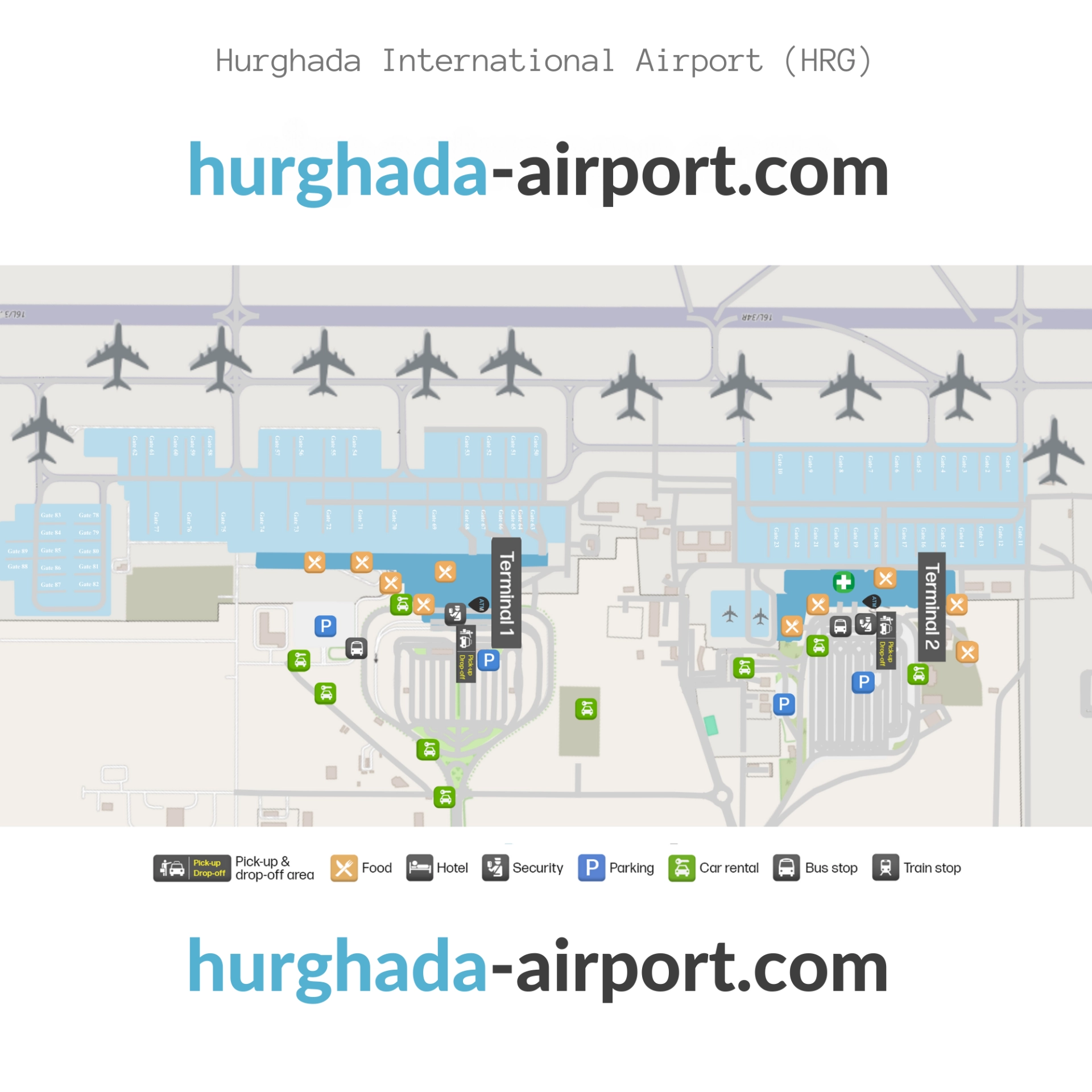
Printable Hurghada International Airport Terminal Map PDF 2025
FAQ
What is Hurghada Airport called?
Hurghada Airport is officially called Hurghada International Airport. Its IATA code is HRG, and it serves as the main airport for the Red Sea resort city of Hurghada, Egypt.
Can I get an Egyptian visa at Hurghada Airport?
Yes, you can get an Egyptian visa on arrival at Hurghada Airport. Most travelers from eligible countries can obtain a 30-day tourist visa upon arrival by paying a fee of $25 USD at the visa counter before passport control.
What airport do you fly to for Hurghada?
To reach Hurghada, you fly to Hurghada International Airport (HRG). It is the city’s only commercial airport and handles both international and domestic flights, serving as the primary gateway for tourists visiting the Red Sea region.
How many terminals are at Hurghada Airport?
Hurghada Airport has two terminals. Terminal 1 handles most international flights and is the newer facility, while Terminal 2 is used for domestic flights and some regional international routes.


